
GBIAC(600004)

Search documents
1月22日起,白云机场T1航站楼所有航司转至T3运营
Xin Lang Cai Jing· 2026-01-10 00:53
Core Points - Starting from January 22, 2026, all airlines operating at Guangzhou Baiyun International Airport's T1 terminal will switch to T3 terminal for operations [1] - Domestic flights will transition to T3 terminal from 02:00 on January 22, 2026, involving 12 domestic airlines including Air China and Hainan Airlines [1] - International flights will also move to T3 terminal, effective from 11:30 on January 22, 2026, impacting 34 domestic and international airlines [1] - Passengers are advised to check flight and terminal information released by the airport and airlines to avoid confusion [1]

1月22日起 白云机场T1航站楼所有航司转至T3运营
Xin Lang Cai Jing· 2026-01-10 00:42
Core Viewpoint - Starting from January 22, all airlines operating at Guangzhou Baiyun International Airport's Terminal 1 will switch to Terminal 3, as Terminal 1 will undergo upgrades and renovations [1] Domestic Flights - From January 22, 2026, at 02:00, domestic flight operations for 12 airlines, including Air China and Hainan Airlines, will be adjusted to Terminal 3 [1] International Flights - From January 22, 2026, at 11:30, all international flight operations for 34 domestic and international airlines will be moved to Terminal 3 [1]
航空机场板块1月9日跌1.19%,中国东航领跌,主力资金净流出4.08亿元
Zheng Xing Xing Ye Ri Bao· 2026-01-09 08:54
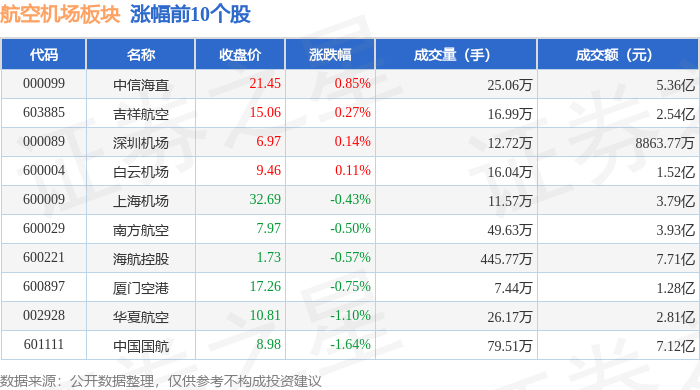
Core Viewpoint - The aviation and airport sector experienced a decline of 1.19% on January 9, with China Eastern Airlines leading the drop, while the overall Shanghai Composite Index rose by 0.92% [1] Group 1: Market Performance - The Shanghai Composite Index closed at 4120.43, up 0.92%, and the Shenzhen Component Index closed at 14120.15, up 1.15% [1] - The aviation and airport sector saw a net outflow of 408 million yuan from major funds, while retail investors contributed a net inflow of 377 million yuan [2] Group 2: Individual Stock Performance - China Eastern Airlines (600115) closed at 5.98, down 3.24%, with a trading volume of 1.3034 million shares and a transaction value of 778 million yuan [2] - Other notable declines included Spring Airlines (601021) down 1.87% and China National Airlines (601111) down 1.64% [2] - The highest trading volume was recorded for Hainan Airlines (600221) with 4.4577 million shares traded, despite a decline of 10.85% in net inflow from major funds [3] Group 3: Fund Flow Analysis - Major funds showed significant outflows in several stocks, including Hainan Airlines with a net outflow of 83.62 million yuan, and Spring Airlines with a net outflow of 28.47 million yuan [3] - Retail investors showed a positive net inflow in several stocks, with Hainan Airlines seeing a retail net inflow of 64.82 million yuan [3]




T1将关闭改造,广州白云机场重要提醒
Huan Qiu Wang· 2026-01-09 03:09
白云机场提醒 1月8日,据白云机场发布:自2026年1月15日零时起,九元航空、浙江长龙航空、成都航空等3家航司出 发/到达广州的航班将变更至广州白云机场T2航站楼运营,值机区域安排在F区。 据航空公司透露,目前在T1运营的其余国内航空公司与全部外航预计将于1月22日零时起转场T3航站楼 运行,T1航站楼自1月22日起关闭。 某购票平台信息显示,目前海航、深航等部分原位于白云机场T1的航司已显示1月22日起乘机航站楼变 更为白云机场T3。 据了解,T3航站楼西侧国内候机区域与国际区域坪也将一同于1月22日启用。 本文转自【广州日报】; 随着广州白云国际机场T3航站楼启用,白云机场T1航站楼计划关闭改造。 有业内人士透露:白云机场T1航站楼预计将于1月22日起关闭,原有航空公司将分批搬迁至T2和T3。其 中,1月15日起,有三家原在T1航站楼运行的航空公司进出港航班调整至T2航站楼。 请旅客关注订票信息及航司提示短信,确认出行日期及所在航站楼,出发旅客请预留充足的时间到达机 场办理乘机手续;到达旅客请结合航班落地时间提前规划出行安排。如不慎走错,白云机场提供24小时 免费穿梭巴士,连接T1、T2、T3航站楼。此 ...
广州白云国际机场股份有限公司 2025年12月生产经营数据快报
Zhong Guo Zheng Quan Bao - Zhong Zheng Wang· 2026-01-08 23:09
Core Viewpoint - The announcement provides a production and operational data report for Guangzhou Baiyun International Airport for December 2025, emphasizing the importance of the data while noting potential discrepancies with actual figures [1]. Group 1 - The data presented is preliminary and may differ from actual figures [1] - The report highlights that the sum of certain sub-items may not equal the total due to other forms of flights [1] - The transportation production data is sourced from internal statistics and is intended for investor reference [1]
机票价格又跳水低价还能卖多久? 春运渐近将迎反弹
Xin Lang Cai Jing· 2026-01-08 23:08
Core Viewpoint - The recent significant drop in domestic flight ticket prices is attributed to a temporary imbalance in supply and demand, with airlines adopting a strategy of lowering prices to increase passenger volume, despite ongoing high operational costs [3][5][8]. Group 1: Price Trends and Market Dynamics - Following the New Year holiday, domestic flight ticket prices have sharply decreased, with some routes offering prices as low as 1.7% of the full fare, such as flights from Guangzhou to Beijing priced at 428 yuan [2][3]. - The current low ticket prices are expected to be a short-term phenomenon, as demand is anticipated to rise again with the upcoming winter break and the Spring Festival, leading to a potential rebound in prices [4][6]. - Airlines are facing a paradox where they report losses while simultaneously offering low prices to fill seats, indicating a struggle between cost management and revenue generation [5][6]. Group 2: Competitive Landscape and Regulatory Environment - The competitive landscape is intensifying, with airlines increasingly adopting a "price for volume" strategy, resulting in a 12.7% year-on-year decline in average economy class ticket prices for 2024 [6]. - The rise of online travel agencies (OTAs) has made price comparisons easier for consumers, further pressuring airlines to maintain competitive pricing [6][7]. - Regulatory bodies are focusing on addressing "involutionary" competition among airlines, aiming to prevent predatory pricing below cost and improve market efficiency through various measures [9][10]. Group 3: Impact of Alternative Transportation - The dominance of rail transport, especially for distances under 800 kilometers, is increasing, with railways capturing a larger share of the market, which is forcing airlines to adapt their strategies towards longer routes [7]. - The trend of self-driving trips during holidays is also contributing to a decline in air travel, as families find it more economical compared to flying [7]. Group 4: Future Outlook - The aviation industry is expected to continue facing challenges in balancing operational costs with competitive pricing strategies, as the market adjusts to changing consumer preferences and regulatory pressures [5][9]. - The upcoming adjustments in airport operations, such as the transition of airlines to new terminals, may also influence operational efficiency and customer experience [11].
白云机场T1航站楼将关闭,部分航空公司航班转至T2
Nan Fang Du Shi Bao· 2026-01-08 15:04
Core Viewpoint - Guangzhou Baiyun Airport is undergoing significant changes with the opening of Terminal 3 (T3) and the planned closure and renovation of Terminal 1 (T1) starting January 22, 2026 [2] Group 1: Terminal Changes - Starting from January 15, 2026, three airlines, including Juneyao Airlines, Zhejiang Changan Airlines, and Chengdu Airlines, will move their operations from T1 to Terminal 2 (T2) [2] - All other domestic airlines and international carriers are expected to transition to T3 starting January 22, 2026, with T1 officially closing on the same date [2] - Some airlines, such as Hainan Airlines and Shenzhen Airlines, have already updated their ticketing platforms to reflect the change to T3 from January 22, 2026 [2] Group 2: Passenger Guidance - Baiyun Airport advises passengers to pay attention to booking information and airline notifications to confirm their travel dates and terminal locations [2] - Travelers are encouraged to allow sufficient time to complete check-in procedures and to plan their travel arrangements based on flight arrival times [2] - A 24-hour free shuttle bus service will be available to connect T1, T2, and T3 for passengers who mistakenly go to the wrong terminal [2]
1月8日晚间重要公告一览
Xi Niu Cai Jing· 2026-01-08 10:30
Group 1 - Jinli Permanent Magnet expects a net profit of 660 million to 760 million yuan for 2025, representing a year-on-year growth of 127% to 161% [1] - Wens Foodstuffs anticipates a net profit of 5 billion to 5.5 billion yuan for 2025, a decrease of 40.73% to 46.12% compared to the previous year [2] - New Open Source plans to repurchase shares worth 40 million to 50 million yuan, with a maximum repurchase price of 25.77 yuan per share [3] Group 2 - Fosun Pharma's subsidiary has had a drug registration application accepted for a new drug targeting ALK-positive non-small cell lung cancer [4] - Leike Film reported a net profit of -86 million yuan for the first three quarters of 2025, indicating a potential annual loss [5] - Crown Stone Technology's application for a specific issuance of A-shares has been accepted by the Shanghai Stock Exchange [6] Group 3 - Dongxin Technology has completed the business registration change for its subsidiary, Lishuan Technology, and has invested 211 million yuan in it [7] - Tianci Materials has increased its commodity futures hedging business limit from 150 million to 300 million yuan [8] - Gaode Infrared's actual controller has reduced his shareholding by 0.54%, bringing his stake down to 62.95% [9] Group 4 - Tianyong Intelligent expects a net profit of 10 million to 15 million yuan for 2025, marking a turnaround from losses [10][11] - China Merchants Energy anticipates a net profit of 6 billion to 6.6 billion yuan for 2025, an increase of 17% to 29% year-on-year [18] - Guangdong Electric Power A's Huizhou Power Plant's Unit 5 has been put into commercial operation, with an investment of 8.05 billion yuan [19] Group 5 - Jianghuai Automobile reported a 42.24% year-on-year increase in sales volume for December 2025 [25] - China Pharmaceutical's subsidiary has received a drug registration certificate for a new medication [26] - TianNeng Co. plans to use up to 12 billion yuan of its own funds for entrusted wealth management [27] Group 6 - Luoyang Huizhong reported a 10.55% month-on-month decrease in sales revenue from live pigs for December 2025 [28] - Baolidi expects a net profit of 145 million to 152 million yuan for 2025, a year-on-year increase of 27.17% to 33.30% [30] - Changchun High-tech's subsidiary has had a melatonin granule registration application accepted [31] Group 7 - Zhongmin Energy reported a 4.46% year-on-year decrease in cumulative on-grid electricity for 2025 [32] - Huaxin Electronics reported a 7.79% year-on-year decrease in consolidated operating revenue for December 2025 [35] - Xiamen Airport reported a 2.79% year-on-year increase in passenger throughput for December 2025 [36] Group 8 - Baiyun Airport reported a 12.27% year-on-year increase in passenger throughput for December 2025 [37] - Pulaike has received a new veterinary drug registration certificate for a chewable tablet [38] - Yunnan Energy Holdings' subsidiary has reduced its stake to 84% after a capital increase [39] Group 9 - Gansu Energy Chemical's new thermal power project has successfully completed trial operation [41] - Zhenghong Technology reported a significant decrease in sales revenue from live pigs for December 2025 [42] - Huasheng Lithium Battery is planning to issue H-shares for listing on the Hong Kong Stock Exchange [43] Group 10 - Jincheng Mining has signed a mining production contract with an estimated total price of approximately 510 million yuan [44] - Microchip Biotech has received approval for clinical trials of a new drug for pancreatic cancer [45] - Yahon Pharmaceutical has completed the first patient enrollment for a Phase I clinical trial of its drug [46]





航空机场板块1月8日跌0.33%,厦门空港领跌,主力资金净流出2.22亿元
Zheng Xing Xing Ye Ri Bao· 2026-01-08 08:56
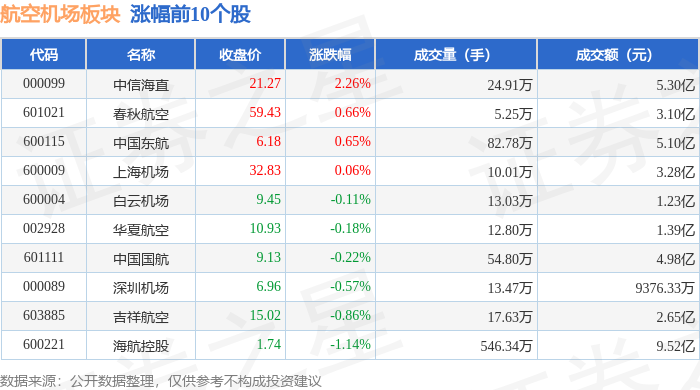
Market Overview - The aviation and airport sector experienced a decline of 0.33% on January 8, with Xiamen Airport leading the drop [1] - The Shanghai Composite Index closed at 4082.98, down 0.07%, while the Shenzhen Component Index closed at 13959.48, down 0.51% [1] Stock Performance - Notable stock performances include: - CITIC Hainan Airlines (Code: 6600000) rose by 2.26% to close at 21.27 with a trading volume of 249,100 shares and a turnover of 530 million yuan [1] - Spring Airlines (Code: 601021) increased by 0.66% to 59.43 with a turnover of 310 million yuan [1] - China Eastern Airlines (Code: 600115) saw a rise of 0.65% to 6.18 with a trading volume of 827,800 shares [1] - Xiamen Airport (Code: 600897) fell by 1.86% to 17.39 with a turnover of 162 million yuan [2] Capital Flow - The aviation and airport sector saw a net outflow of 222 million yuan from major funds, while retail investors contributed a net inflow of 243 million yuan [2] - The capital flow for individual stocks indicates: - CITIC Hainan Airlines had a net outflow of 33.83 million yuan from major funds [3] - Shanghai Airport experienced a net inflow of 11.45 million yuan from major funds [3] - Xiamen Airport had a net outflow of 15.54 million yuan from major funds but a net inflow of 16.07 million yuan from retail investors [3]





广州白云机场口岸2025年实现国际客货运量双增长
Nan Fang Ri Bao Wang Luo Ban· 2026-01-08 08:06
Core Insights - In 2025, Guangzhou Baiyun Airport's international passenger and cargo operations experienced significant growth due to optimized visa policies, expanded international route networks, and improved customs facilitation [1][2] - The airport handled over 18.6 million inbound and outbound passengers, a year-on-year increase of approximately 19% [1] - The number of inbound and outbound flights reached 122,000, marking a 13% year-on-year growth [1] - The import and export cargo volume exceeded 1.53 million tons, reflecting an 8.3% increase year-on-year, maintaining a leading position among national air ports [1] Route Expansion - In 2025, the airport added, enhanced, and restored 29 passenger and cargo routes, including 13 connecting to countries and regions involved in the Belt and Road Initiative [1] - New intercontinental destinations such as Madrid and Darwin were introduced, establishing air links between the Greater Bay Area and Europe, Asia, Africa, and Oceania [1] - The airport has developed a route network covering 105 major cities globally, with over 146 international routes and nearly 30 intercontinental destinations, of which around 70 are major cities in Belt and Road countries [1] Customs Facilitation - The growth in cargo is attributed to the continuous deepening of customs facilitation reforms [2] - In 2025, Guangzhou Customs implemented 20 practical measures to enhance customs facilitation at the airport, including 24-hour customs clearance and support for cross-border business exchanges [2] - The introduction of the first "pre-flight security check + pre-customs inspection" cargo station in the country has enabled a one-stop process for export goods in the comprehensive bonded zone, significantly reducing cargo waiting times by over 50% and lowering logistics costs [2] - Currently, the airport handles an average of over 4,000 tons of import and export cargo daily [2]