HUA XIA BANK(600015)

Search documents
银行积存金投资门槛大摸底
Bei Jing Shang Bao· 2026-01-08 06:43
Core Viewpoint - The recent announcement by Industrial and Commercial Bank of China (ICBC) to raise the risk acceptance level for personal gold accumulation business to C3 (balanced) and above has triggered significant changes in the precious metals investment market, reflecting a broader industry trend towards stricter risk management in response to increased market volatility and rising gold prices [1][6]. Group 1: Industry Trends - Major banks have collectively raised the entry-level risk tolerance for gold accumulation products to at least a balanced level (C3), with some banks even setting it to aggressive levels, indicating a comprehensive industry-wide upgrade in risk control measures [1][3][4]. - The international gold price has surpassed $4,400 per ounce, prompting banks to filter out investors with lower risk tolerance to prevent significant losses due to market volatility [6][7]. Group 2: Bank-Specific Requirements - ICBC requires personal clients to achieve a C3 (balanced) risk assessment result to engage in gold accumulation business, a shift from the previous requirement of C1 (conservative) [3][4]. - Other banks, such as Postal Savings Bank and Shanghai Rural Commercial Bank, have also raised their risk assessment standards, with some requiring a minimum of C3 or higher for participation in gold accumulation products [4][6]. - Banks like China CITIC Bank and Ningbo Bank have announced future adjustments to their risk assessment requirements, aligning with the trend of increasing risk thresholds for gold investment [6][7]. Group 3: Investor Behavior and Risks - There is a growing concern about investors attempting to misrepresent their risk tolerance in order to qualify for gold accumulation products, which undermines the integrity of the risk assessment process [8][9]. - The industry is urged to enhance investor education and awareness regarding the risks associated with gold investments, especially in a volatile market environment [8][9].








2025年金融机构被罚没31亿元,反洗钱和数据相关罚单大增
2 1 Shi Ji Jing Ji Bao Dao· 2026-01-07 10:47
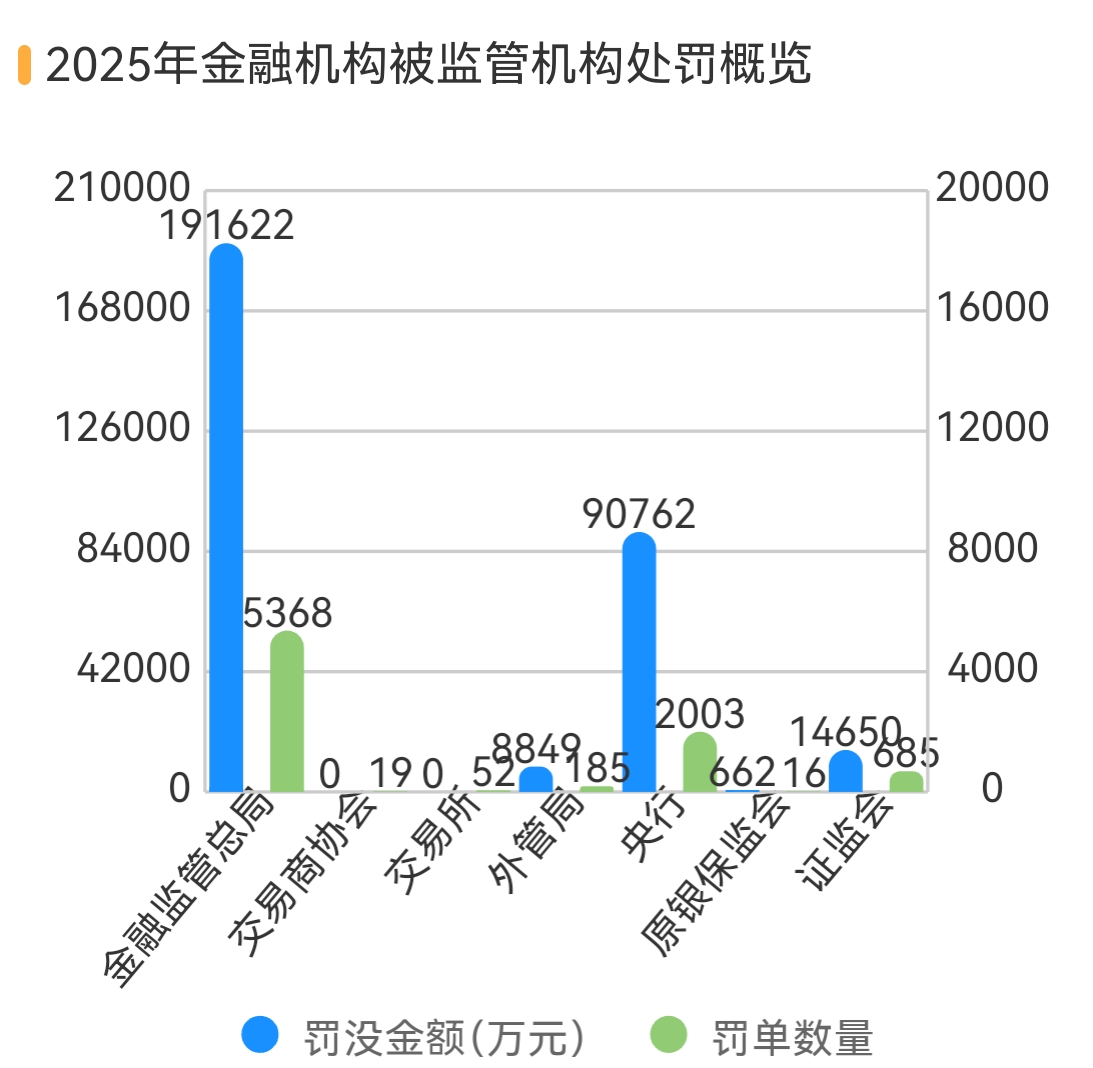
Core Insights - In 2025, financial institutions received a total of 8,328 fines, a year-on-year decrease of 8.41%, while the total amount of fines reached 3.065 billion yuan, an increase of 27.55% [1][2] Group 1: Penalty Overview - The National Financial Supervision Administration issued 5,368 fines totaling 1.916 billion yuan, the central bank issued 2,003 fines totaling 908 million yuan, the Securities Regulatory Commission issued 685 fines totaling 146 million yuan, and the State Administration of Foreign Exchange issued 185 fines totaling 88.49 million yuan [2] - Monthly distribution shows peaks in December, January, and July for the number of fines, with September and December having higher total fine amounts [4] Group 2: Institution-Specific Penalties - Banks received 5,313 fines in 2025, a decrease of 8.88% year-on-year, with total fines amounting to 2.461 billion yuan, an increase of 40.63% [7] - Insurance institutions received 2,166 fines, a decrease of 5.5%, with total fines of 325 million yuan, a decrease of 3.56% [7] - Securities firms received 195 fines, a significant decrease of 42.98%, but the total fines increased by 56.69% [7] Group 3: Major Penalty Cases - In 2025, there were 8 fines exceeding 50 million yuan, with the largest fine of 97.9 million yuan issued for issues related to company governance, loans, and asset quality management [13] - A village bank in Dalian had its financial license revoked due to multiple severe violations, marking a significant regulatory action [14] - A bank president was sentenced to death with a two-year reprieve for illegal lending and bribery, highlighting severe consequences for financial misconduct [15][16] Group 4: Compliance Characteristics - The main areas of violations for banks in 2025 were in credit business, anti-money laundering, and inadequate internal controls [22] - Insurance companies faced penalties primarily for untrue financial/business data and misleading sales practices [23] - Securities firms' violations were concentrated in personnel misconduct, investment banking, and internal control issues [24][25] Group 5: Anti-Money Laundering Violations - There was a significant increase of 188.25% in penalties related to anti-money laundering violations, with 1,349 fines issued [26] - Common violations included failure to identify customer identities and improper transaction reporting [26] Group 6: Data-Related Violations - Penalties related to data violations increased by 44.65%, with 554 fines issued, primarily affecting banks and insurance companies [27] Group 7: Penalty Rankings - Among non-banking institutions, Donghai Securities faced the highest fines at 60 million yuan, followed by China People's Property Insurance and China Pacific Property Insurance [30]


2025年银行CIO盘点:建行、中行CIO离任,多家中小银行行外引进CIO
Xin Lang Cai Jing· 2026-01-07 03:33
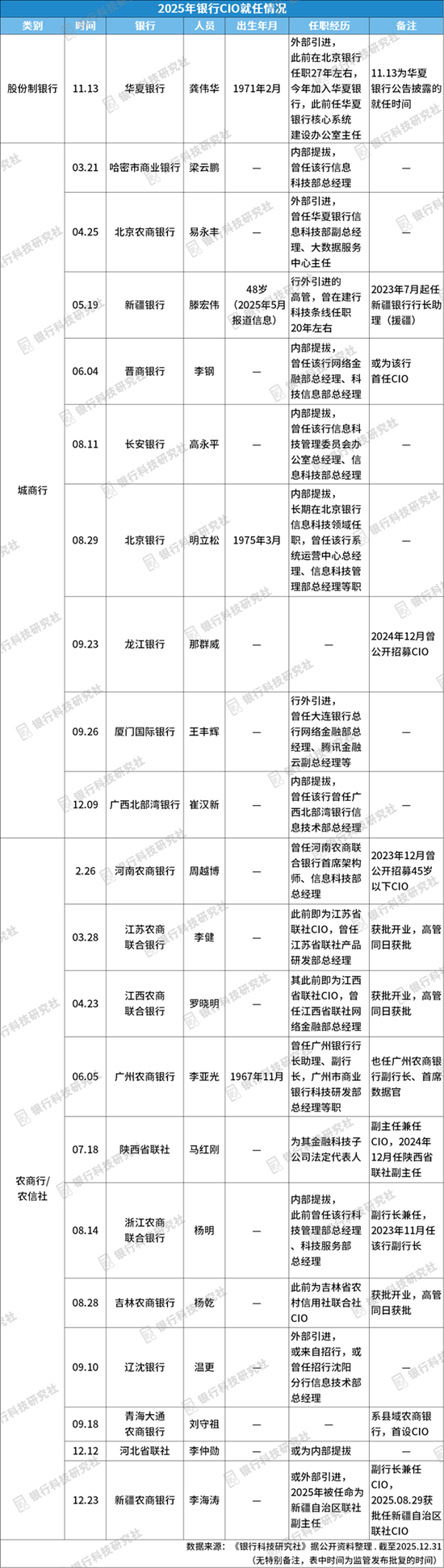
Core Insights - The digital transformation is crucial for the banking industry, with a significant focus on the restructuring of digital talent, particularly the Chief Information Officers (CIOs) [1][2] Group 1: Changes in CIO Positions - In 2025, several major banks experienced changes in their technology leadership, with the CIOs of China Construction Bank (CCB) and Bank of China (BOC) resigning [2][4] - CCB's former CIO, Jin Panshi, resigned due to age reasons after serving for four years [2][3] - BOC's former CIO, Meng Qian, also resigned for age reasons after a 38-year tenure, during which she held multiple senior positions [4][6] - The Industrial and Commercial Bank of China (ICBC) also saw its technology leader, CTO Lv Zhongtao, leave at the end of 2025 [7][8] Group 2: New Appointments and Trends - In 2025, 21 new CIOs were appointed, primarily in small and medium-sized banks, with many being external hires [10][11] - Notable new CIOs include Gong Weihua at Huaxia Bank and Wang Fenghui at Xiamen International Bank, both of whom were brought in from outside the banking sector [11][12] - The trend indicates a shift towards external recruitment for CIO positions, with 48% of the new appointments being external hires [16] Group 3: Recruitment Trends in Smaller Banks - Many small and medium-sized banks have publicly announced CIO recruitment in 2025, including Xiamen International Bank and Zhengzhou Bank [18][19] - Recruitment criteria often include age limits and specific experience requirements, such as a minimum of six years in information technology and four years in senior management roles [18][20] - The trend reflects a growing emphasis on digital leadership within smaller banks, as they seek to enhance their technological capabilities [18][19]
已有十余家银行聘任首席合规官
Jin Rong Shi Bao· 2026-01-07 02:52
Core Viewpoint - The appointment of Chief Compliance Officers (CCOs) in banks is a response to increasing regulatory demands, aiming to enhance compliance management and integrate it into business processes [1][2]. Group 1: Appointment of Chief Compliance Officers - Zhangjiagang Rural Commercial Bank appointed Wu Kai as its Chief Compliance Officer, marking a trend where over ten banks have made similar appointments [1]. - In December 2025 alone, several banks, including Ping An Bank and Industrial Bank, approved the hiring of CCOs [1]. - The rapid appointment of CCOs aligns with the implementation of the "Financial Institutions Compliance Management Measures," which mandates the establishment of CCO positions at the headquarters of financial institutions [2]. Group 2: Responsibilities and Challenges - CCOs are expected to take on more responsibilities, including the formulation and supervision of compliance policies, ensuring that all business activities adhere to regulatory frameworks [5]. - There is a concern that an increase in executive positions may burden banks, particularly smaller financial institutions [2]. - Many currently appointed CCOs are existing senior executives, which helps mitigate potential operational burdens [3]. Group 3: Recruitment Trends - Some banks, such as Jiangxi Bank and Shangrao Bank, have publicly announced recruitment for CCO positions, indicating a proactive approach to compliance management [4].



2025年A股银行板块涨幅放缓 个股分化显著 机构看好2026年上市银行营收利润增速改善
Xin Lang Cai Jing· 2026-01-06 23:23
Core Viewpoint - The A-share banking sector is expected to achieve a market value breakthrough in 2025, but the overall growth rate is slowing and underperforming compared to the broader market, with significant individual stock differentiation [1][7]. Market Performance - As of December 31, 2025, the Wind Banking Index reached 7180.68 points, with an annual growth of 12.04%, lower than the previous year's 43.56%. The total market value of the sector at year-end was 15.71 trillion yuan, an increase of over 15% from the beginning of the year, having briefly surpassed 16 trillion yuan [1][7]. - The banking sector exhibited a clear phase differentiation throughout the year, with a mild increase in Q1, a significant rise in Q2, a deep correction in Q3, and a recovery in Q4 [2][8]. Individual Stock Performance - In 2025, 35 out of 42 A-share listed banks saw their stock prices rise, accounting for over 83%. Among the six banks with over 20% growth, Agricultural Bank led with a 52.66% increase, followed by Xiamen Bank, Shanghai Pudong Development Bank, Chongqing Bank, Industrial and Commercial Bank, and Ningbo Bank with growth rates ranging from 20.68% to 35.78% [3][9]. - Conversely, seven banks experienced declines, with Huaxia Bank at the bottom with a 9.82% drop, and Zhengzhou Bank, Beijing Bank, and China Everbright Bank all declining by over 5% [3][9]. Future Outlook - Multiple brokerage firms predict an improvement in revenue and profit growth for listed banks in 2026, with expected revenue growth rates of +2.5% and +3.6% for 2026 and 2027, respectively, and net profit growth rates of +1.9% and +2.6% [4][10]. - The improvement in revenue and profit growth is attributed to several factors, including a reduction in net interest margin pressure, a shift towards quality in credit issuance, and a stabilization in fee income growth [4][10]. Investment Strategy - In light of the different characteristics of new inflows, the equity market in 2025 is characterized by increased stable return strategy products, enhanced structural trends, and greater individual stock volatility. For 2026, it is recommended to prioritize stable stocks and adopt a bottom-fishing strategy, while also considering elastic stocks for rotation trading [6][12].

股份制银行板块1月6日涨0.88%,兴业银行领涨,主力资金净流入6.46亿元
Zheng Xing Xing Ye Ri Bao· 2026-01-06 09:00
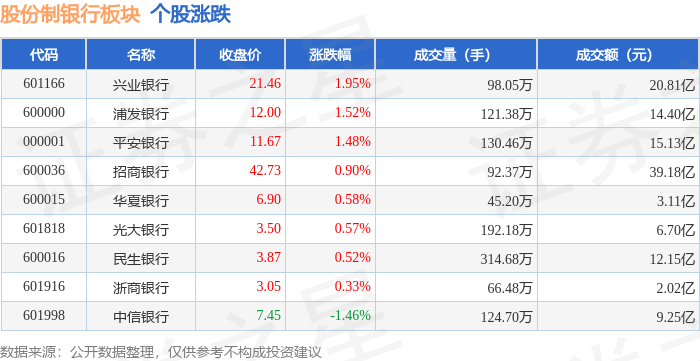
Group 1 - The banking sector saw an increase of 0.88% on January 6, with Industrial Bank leading the gains [1] - The Shanghai Composite Index closed at 4083.67, up 1.5%, while the Shenzhen Component Index closed at 14022.55, up 1.4% [1] - Key stocks in the banking sector and their performance included Industrial Bank (up 1.95% to 21.46), Pudong Development Bank (up 1.52% to 12.00), and Ping An Bank (up 1.48% to 11.67) [1] Group 2 - The net inflow of main funds in the banking sector was 646 million yuan, while retail investors saw a net outflow of 357 million yuan [1] - The main fund inflow for Industrial Bank was 222 million yuan, accounting for 10.65% of its total, while retail investors had a net outflow of 137 million yuan [2] - Ping An Bank experienced a main fund inflow of 209 million yuan (13.79%) but a retail outflow of 65 million yuan [2]


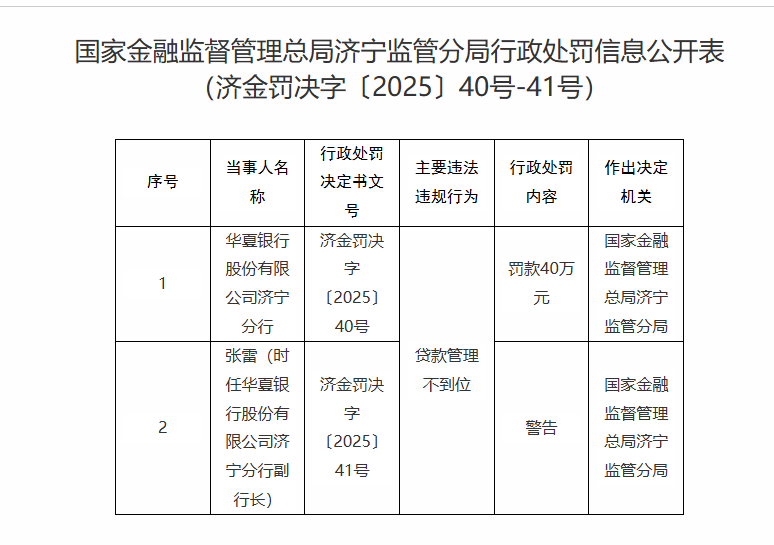
因贷款管理不到位,华夏银行济宁分行被罚40万元
Qi Lu Wan Bao· 2026-01-06 02:27
Group 1 - The core issue for Huaxia Bank is the repeated violations related to loan management, which has been identified as a persistent problem in its compliance governance [3] - On December 31, 2025, Huaxia Bank's Jining branch was fined 400,000 yuan due to "inadequate loan management," with the vice president receiving a warning [1] - The term "inadequate loan management" points to critical vulnerabilities in the banking sector, often indicating failures in pre-loan investigations, during-loan reviews, and post-loan monitoring, which can lead to misappropriation of credit funds and concealment of real non-performing assets [2] Group 2 - On September 5, 2025, Huaxia Bank's headquarters was fined 87.25 million yuan for multiple serious violations, including improper management of loans and regulatory data reporting [3] - Other branches of Huaxia Bank, such as Nanchang, Langfang, and Shijiazhuang, also faced penalties in 2025 for similar loan management issues, indicating a systemic problem within the bank [3]
疯狂的银行企微考核:“一天要加十几个,完不成会通报”
Mei Ri Jing Ji Xin Wen· 2026-01-05 13:51
Core Viewpoint - The banking industry is increasingly focusing on the use of corporate WeChat (企微) as a tool for customer relationship management, driven by performance metrics that require employees to add a specific number of clients to their corporate WeChat accounts. This shift reflects the industry's struggle with retail business performance and the need for innovative customer engagement strategies [1][12]. Group 1: Performance Metrics and Employee Pressure - Many banks have implemented strict KPIs for corporate WeChat additions, with requirements such as adding 50 clients per month, leading to financial penalties for underperformance [2][5]. - Employees are sharing their corporate WeChat QR codes on social media to meet these targets, often incentivized by rewards like cash bonuses for high performance [1][2]. - The pressure to meet these metrics has led to a culture of "mutual assistance" among bank employees, where they help each other add clients to fulfill their quotas [1][2]. Group 2: Challenges and Limitations - There are significant challenges in achieving these targets, including restrictions on the types of clients that can be added and the requirement for clients to complete real-name authentication [3][4]. - Some employees have resorted to purchasing client contacts from online platforms, indicating a potential loophole in the system [3][4]. - The effectiveness of corporate WeChat in enhancing customer engagement is questioned, as many employees focus on merely completing tasks rather than fostering genuine client relationships [10][11]. Group 3: Strategic Importance of Corporate WeChat - The push for corporate WeChat is partly to prevent "client privatization," ensuring that customer relationships remain with the bank rather than individual employees [5][6]. - Corporate WeChat is seen as a vital tool for managing customer interactions and data, allowing banks to analyze client behavior and preferences more effectively [5][6]. - The banking sector views corporate WeChat as essential for addressing the challenges of declining retail business performance, with the potential to enhance customer insights and operational efficiency [12][14]. Group 4: Success Stories and Outcomes - Some banks have reported positive outcomes from their corporate WeChat initiatives, such as increased customer engagement and higher transaction volumes [15]. - For instance, a bank in Dongying achieved over 234,900 corporate WeChat friend additions, with a significant portion completing authentication, leading to improved customer activity [15]. - Another bank has successfully provided financial services to nearly a million clients through corporate WeChat, demonstrating its potential as a customer engagement platform [15].

华夏银行杨书剑上任首年即拿罚款第一!2025年度被罚超亿元,位居全国性股份银行之首,深陷合规泥潭
Xin Lang Cai Jing· 2026-01-05 10:44
Core Insights - Huaxia Bank received the highest fines among national joint-stock commercial banks in 2025, totaling 120 million yuan, significantly surpassing other banks [1][21] - The bank's compliance issues are systemic, affecting various operational areas, including credit management, data governance, and anti-money laundering [8][30][38] Major Penalties Overview - In 2025, Huaxia Bank faced three major penalties totaling over 113 million yuan, accounting for the majority of its annual fines [3][25] - The largest single penalty of 87.25 million yuan was issued by the National Financial Regulatory Administration on September 5, 2025, for imprudent management of loans, bills, and interbank business, as well as data reporting issues [6][27] - The second penalty of 13.81 million yuan was imposed by the People's Bank of China on November 26, 2025, for violations across ten operational areas, including account management and anti-money laundering [6][27] - Huaxia Wealth, a subsidiary, received a penalty of 12 million yuan, marking its first administrative punishment since its establishment in 2020, which accounted for 38% of the total penalties in the wealth management sector for 2024 [6][35] Branch Penalty Analysis - In 2025, Huaxia Bank's branches collectively received penalties amounting to approximately 17.99 million yuan, primarily related to credit management issues [3][25] - The Shenzhen branch was fined 5.6 million yuan for multiple violations, including improper asset transfer and inadequate internal controls [28] - Other branches, such as Wenzhou and Ningbo, faced fines for various compliance failures, including inadequate loan management and internal controls [28][29] Systemic Issues Identified - The bank's credit management violations are characterized by their prevalence, severity, and recurrence, indicating a systemic issue rather than isolated incidents [10][31] - Data governance problems were highlighted, with 18 specific violations related to the EAST system, reflecting a significant deficiency in data management capabilities [12][34] - Anti-money laundering compliance was found to be severely lacking, with multiple violations noted, including failure to identify customers and report suspicious transactions [14][37] Governance and Compliance Failures - The penalties reveal deep-rooted governance issues within Huaxia Bank, including failures at the board and executive levels in risk management [38] - Institutional and procedural weaknesses were evident, with inadequate execution of critical policies such as the "three checks" in credit management and anti-money laundering protocols [38] - The lack of effective internal oversight mechanisms contributed to the failure to detect and rectify compliance issues in a timely manner [38][39] Market Impact and Future Outlook - Following the imposition of substantial fines, market reactions included negative impacts on Huaxia Bank's credit ratings and stock performance, potentially leading to a reevaluation of the entire joint-stock banking sector [40] - To meet regulatory requirements, the bank may need to increase compliance investments, tighten credit standards, and slow business expansion, which could sacrifice short-term profits [21][40]
徐彤:AI在To B领域仍存应用瓶颈 本地化部署“AI助手”成现阶段关键策略
Xin Lang Cai Jing· 2026-01-05 09:19
Core Viewpoint - The China Wealth Management 50 Forum 2025 Annual Meeting emphasizes the theme of "Building a Financial Power during the 14th Five-Year Plan" and discusses the role of AI in the financial industry infrastructure [1][3] Group 1: AI in Financial Sector - The Chief Information Officer of Hengfeng Bank, Xu Tong, highlighted that AI still faces application bottlenecks in the B2B sector but remains a development trend [1][3] - Four application models of AI were identified: fine-tuning models based on high-quality data, optimizing business processes with AI, leveraging expert capabilities for "AI inclusiveness," and creating new business models based on digital infrastructure [1][3] - Hengfeng Bank's current strategy involves using AI as an assistant to employees, with localized deployment of mainframe systems to assist in completing work tasks [1][3]