HUA XIA BANK(600015)

Search documents
华夏银行成功牵头欧元并购银团贷款 赋能中国企业“走出去”战略收购 德国巨头资产
Zhong Jin Zai Xian· 2025-12-09 02:33
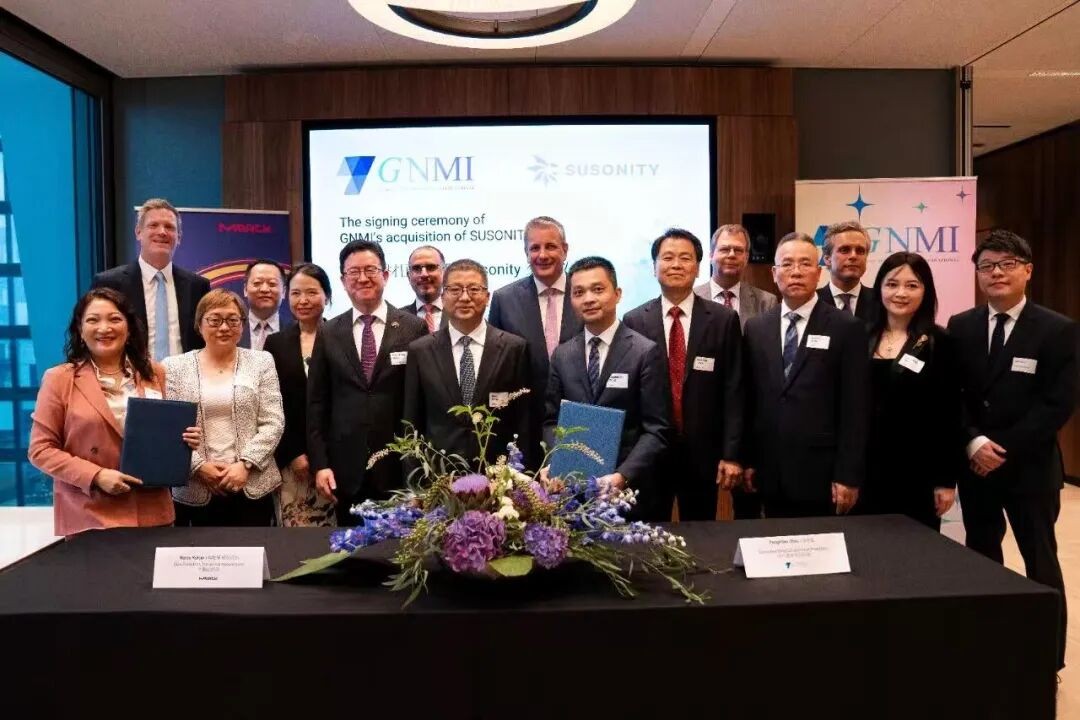
Group 1 - The core viewpoint of the news is that Huaxia Bank successfully issued a Euro-denominated syndicated loan to support the acquisition of Merck Group's global pearlescent pigment assets by Global New Materials, marking a significant cross-border merger in the pearlescent materials industry [1][2]. - This acquisition is not only the largest in the pearlescent materials sector but also represents a breakthrough for Huaxia Bank in the field of cross-border merger financing [2]. - The acquisition allows Chinese enterprises to gain access to Merck's core surface solutions technology, established sales networks, and high-quality customer resources, thereby enhancing their competitive position in the global new materials sector [4]. Group 2 - The deal, valued at approximately 6 billion RMB, involves complex challenges, including assets spanning 25 countries and 40 legal entities, with varying asset divestiture requirements and strict delivery timelines [6]. - Huaxia Bank implemented an innovative "regional disassembly + coordinated advancement" model to address the complexities of the transaction, ensuring compliance while maintaining overall progress [9]. - The entire process from submission to delivery was completed in just 21 working days, significantly faster than the typical approval speed for cross-border merger loans [10]. Group 3 - This transaction marks Huaxia Bank's first Euro-denominated cross-border merger loan, filling a service gap in Eurozone merger financing and providing new options for Chinese enterprises looking to invest in high-end manufacturing in Europe [12]. - The successful merger showcases Huaxia Bank's robust capabilities in cross-border finance, emphasizing its commitment to supporting the real economy and facilitating Chinese enterprises' global expansion [15].

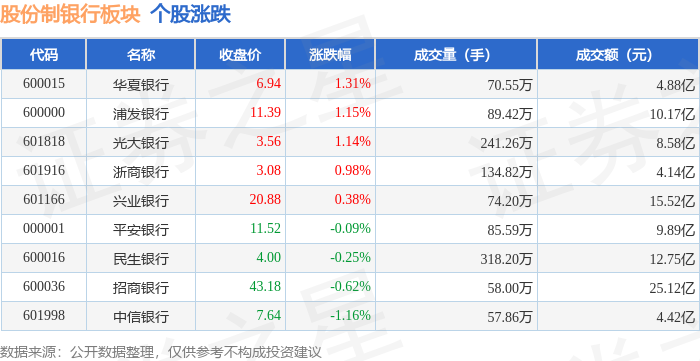
股份制银行板块12月8日涨0%,华夏银行领涨,主力资金净流入1.71亿元
Zheng Xing Xing Ye Ri Bao· 2025-12-08 09:09
Core Viewpoint - The banking sector showed a slight increase on December 8, with the Shanghai Composite Index rising by 0.54% and the Shenzhen Component Index increasing by 1.39% [1] Group 1: Stock Performance - The banking sector rose by 0.0% compared to the previous trading day, with Huaxia Bank leading the gains [1] - Key stock performances include: - Huaxia Bank: Closed at 6.94, up 1.31% with a trading volume of 705,500 shares and a turnover of 488 million [1] - Pudong Development Bank: Closed at 11.39, up 1.15% with a trading volume of 894,200 shares and a turnover of 1.017 billion [1] - Everbright Bank: Closed at 3.56, up 1.14% with a trading volume of 2.4126 million shares and a turnover of 858 million [1] - Other banks showed mixed results, with some experiencing slight declines [1] Group 2: Capital Flow - The banking sector experienced a net inflow of 171 million in main funds, while retail investors saw a net outflow of 1.44 billion [1] - Detailed capital flow for selected banks includes: - China Merchants Bank: Net inflow of 114 million, with a 4.53% share of main funds [2] - Huaxia Bank: Net inflow of 69.04 million, with a 14.13% share of main funds [2] - Minsheng Bank: Net inflow of 65.87 million, with a 5.17% share of main funds [2] - Other banks like Ping An Bank and CITIC Bank experienced net outflows [2]





华夏银行股份有限公司关于2025年无固定期限资本债券(第一期)发行 完毕的公告
Zhong Guo Zheng Quan Bao - Zhong Zheng Wang· 2025-12-04 08:43
A股代码:600015 A股简称:华夏银行 编号:2025一58 经中国人民银行《准予行政许可决定书》(银许准予决字〔2025〕第5号)和《国家金融监督管理总局 关于华夏银行发行资本工具的批复》(金复〔2024〕334号)批准,华夏银行股份有限公司(以下简 称"本行")近日在全国银行间债券市场发行了"华夏银行股份有限公司2025年无固定期限资本债券(第 一期)"(以下简称"本期债券"),并在银行间市场清算所股份有限公司完成债券的登记、托管。 本期债券于2025年11月28日簿记建档,并于12月2日发行完毕。本期债券发行规模为人民币200亿元,前 5年票面利率为2.32%,每5年调整一次,在第5年及之后的每个付息日附发行人有条件赎回权。本期债 券募集资金将依据适用法律和主管部门的批准用于补充本行其他一级资本。 特此公告。 华夏银行股份有限公司董事会 华夏银行股份有限公司关于2025年无固定期限资本债券(第一期)发行 完毕的公告 本行董事会及全体董事保证本公告内容不存在任何虚假记载、误导性陈述或者重大遗漏,并对其内容的 真实性、准确性和完整性承担法律责任。 2025年12月4日 ...
华夏银行200亿元无固定期限资本债券发行完毕
Bei Jing Shang Bao· 2025-12-03 13:36
本期债券于2025年11月28日簿记建档,并于12月2日发行完毕。本期债券发行规模为人民币200亿元,前 5年票面利率为2.32%,每5年调整一次,在第5年及之后的每个付息日附发行人有条件赎回权。本期债 券募集资金将依据适用法律和主管部门的批准用于补充该行其他一级资本。 北京商报讯(记者 孟凡霞 周义力)12月3日,华夏银行发布公告,经中国人民银行《准予行政许可决定 书》和《国家金融监督管理总局关于华夏银行发行资本工具的批复》批准,该行近日在全国银行间债券 市场发行了"华夏银行股份有限公司2025年无固定期限资本债券(第一期)"(以下简称"本期债券"), 并在银行间市场清算所股份有限公司完成债券的登记、托管。 ...
华夏银行(600015) - 华夏银行关于2025年无固定期限资本债券(第一期)发行完毕的公告
2025-12-03 09:45
A 股代码:600015 A 股简称:华夏银行 编号:2025—58 特此公告。 华夏银行股份有限公司董事会 华夏银行股份有限公司关于 2025 年无固定期限 资本债券(第一期)发行完毕的公告 2025 年 12 月 4 日 本行董事会及全体董事保证本公告内容不存在任何虚假记载、误导性陈述 或者重大遗漏,并对其内容的真实性、准确性和完整性承担法律责任。 经中国人民银行《准予行政许可决定书》(银许准予决字〔2025〕第 5 号) 和《国家金融监督管理总局关于华夏银行发行资本工具的批复》(金复〔2024〕 334 号)批准,华夏银行股份有限公司(以下简称"本行")近日在全国银行间债 券市场发行了"华夏银行股份有限公司 2025 年无固定期限资本债券(第一期)" (以下简称"本期债券"),并在银行间市场清算所股份有限公司完成债券的登 记、托管。 本期债券于 2025 年 11 月 28 日簿记建档,并于 12 月 2 日发行完毕。本期 债券发行规模为人民币 200 亿元,前 5 年票面利率为 2.32%,每 5 年调整一 次,在第 5 年及之后的每个付息日附发行人有条件赎回权。本期债券募集资金 将依据适用法律和主管 ...
华夏银行牵头簿记发行“区块链+数字人民币”债券
Xin Lang Cai Jing· 2025-12-03 09:25
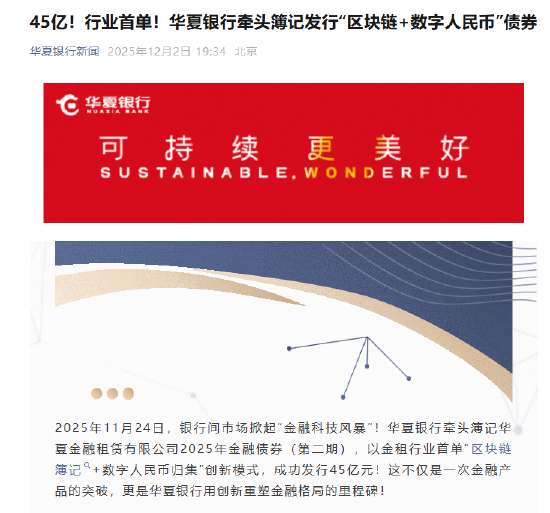
12月3日金融一线消息,据"华夏银行新闻"微信公众号,近日,华夏银行牵头簿记,以行业首创"区块链 簿记+数字人民币归集"创新模式,成功发行45亿元金融债券。发行全流程信息实时上链、不可篡改, 投资者随时能查。募集资金直接通过数字人民币归集,省去中间多重清算环节。本次债券发行人为华夏 银行控股子公司华夏金融租赁有限公司。本期债券初始计划发行30亿元,同步设置15亿元超额发行权, 最终全额触发超额配售,以45亿元满额收官,3年期票面利率锁定1.84%。 责任编辑:秦艺 责任编辑:秦艺 12月3日金融一线消息,据"华夏银行新闻"微信公众号,近日,华夏银行牵头簿记,以行业首创"区块链 簿记+数字人民币归集"创新模式,成功发行45亿元金融债券。发行全流程信息实时上链、不可篡改, 投资者随时能查。募集资金直接通过数字人民币归集,省去中间多重清算环节。本次债券发行人为华夏 银行控股子公司华夏金融租赁有限公司。本期债券初始计划发行30亿元,同步设置15亿元超额发行权, 最终全额触发超额配售,以45亿元满额收官,3年期票面利率锁定1.84%。 ...

ST云动:为全资子公司昆明云内动力智能装备有限公司提供不超过2800.00万元担保

2 1 Shi Ji Jing Ji Bao Dao· 2025-12-03 08:57
南财智讯12月3日电,ST云动公告,公司为满足全资子公司昆明云内动力智能装备有限公司日常经营需 要,于2025年12月3日与华夏银行股份有限公司昆明大观支行签署《最高额保证合同》,为其在该行办 理的授信业务提供连带责任保证担保,担保总额不超过2800.00万元人民币,担保期限自保证合同签署 之日始至主合同项下主债务履行期届满之日起满三年。本次担保事项已经公司第七届董事会第十六次会 议审议通过,无需提交股东大会审议。截至目前,公司及控股子公司累计担保额度为2800.00万元,占 公司最近一期经审计净资产的1.70%,均为对全资子公司的担保,无逾期担保情况。 ...
华夏银行:重绘科技金融“作战图”
Shang Hai Zheng Quan Bao· 2025-12-02 23:45
Core Viewpoint - The article discusses how Huaxia Bank is innovating its credit offerings to support technology-driven enterprises, addressing the mismatch between traditional banking practices and the unique needs of high-risk, long-cycle tech innovations [2][5]. Group 1: Innovative Credit Solutions - Huaxia Bank is implementing a range of innovative financial products such as R&D loans, acquisition loans, and technology innovation bonds to better serve technology companies [2][4]. - A notable case includes a biotechnology company receiving a R&D loan of 13 million yuan to support its clinical trial funding needs, demonstrating the bank's commitment to matching financial products with the long-term investment nature of tech firms [3]. - Another example is a smart technology company that secured a 300 million yuan credit loan to expand its production scale, which facilitated a significant order with a laboratory, showcasing the bank's tailored financial solutions [3]. Group 2: Market Opportunities and Challenges - The launch of the "technology board" in the bond market has opened new financing channels for banks to support tech innovation, with Huaxia Bank successfully underwriting a 8 billion yuan technology innovation bond for Geely Holding Group [4]. - The bank faces challenges in assessing tech companies due to their unique characteristics and the inadequacy of traditional financial metrics, necessitating a shift in evaluation models [6]. Group 3: Building a Supportive Ecosystem - Huaxia Bank is enhancing its service mechanisms and risk control capabilities to align with the needs of technology innovation, as outlined in the regulatory framework for high-quality development in the banking sector [7]. - The bank is establishing specialized technology financial centers across its branches to improve its research capabilities and better serve tech enterprises [7]. - As of the end of October, Huaxia Bank's loans to tech enterprises reached nearly 240 billion yuan, with a growth rate of nearly 50%, indicating the effectiveness of its new strategies [8].

活水润科创——金融支持实体经济一线调研
Shang Hai Zheng Quan Bao· 2025-12-02 18:09
Core Insights - The financial industry is facing a transformative opportunity to support technological innovation and local economic development, moving beyond traditional credit models to embrace a more integrated approach to financing [1][2][3] Group 1: 华夏银行 (Huaxia Bank) - Huaxia Bank is implementing a comprehensive initiative to address the inherent conflict between high-risk, long-cycle technology innovation and traditional banking's focus on safety and profitability, utilizing innovative financial tools and internal reforms [3][4] - The bank has successfully launched various financial products, such as "研发贷" (R&D loans) and "并购贷" (merger loans), to meet the specific needs of technology companies, including a notable 13 million yuan R&D loan for a biotechnology firm [4][6] - As of October, Huaxia Bank's loans to technology enterprises reached nearly 240 billion yuan, with a growth rate of approximately 50%, indicating a strong commitment to supporting the tech sector [9] Group 2: 北京农商银行 (Beijing Rural Commercial Bank) - Beijing Rural Commercial Bank has evolved from a local credit cooperative to a major financial institution, with assets growing to 1.3 trillion yuan and maintaining a non-performing loan rate of around 1% [11][12] - The bank focuses on rural revitalization and small and micro enterprises, offering tailored financial products like "优农快贷" (Fast Agricultural Loans) to support local agricultural initiatives [12][14] - As of October, the bank's inclusive small and micro loans reached 20.048 billion yuan, reflecting its commitment to serving diverse customer needs [14] Group 3: 郑州银行 (Zhengzhou Bank) - Zhengzhou Bank is strategically aligned with the national goals of high-quality development and efficient governance, focusing on providing financial support to key industries and local economies [21][23] - The bank has established a "产业链金融" (industry chain finance) model to support local industries, particularly in manufacturing and agriculture, and has signed strategic agreements to provide targeted credit support [24][25] - As of June, the bank's agricultural loan balance was 48.094 billion yuan, demonstrating its commitment to rural financial services [25] Group 4: 中关村银行 (Zhongguancun Bank) - Zhongguancun Bank, as the first private bank focused on technology innovation, aims to build a comprehensive ecosystem for tech enterprises, shifting from merely providing financial services to becoming a key player in the tech finance ecosystem [32][33] - The bank emphasizes early-stage support for startups, particularly in hard technology sectors, and has developed customized financial solutions to meet the unique needs of these companies [34][35] - By collaborating with over 400 venture capital and industry partners, Zhongguancun Bank is creating a robust network to support tech companies throughout their lifecycle [36][37]
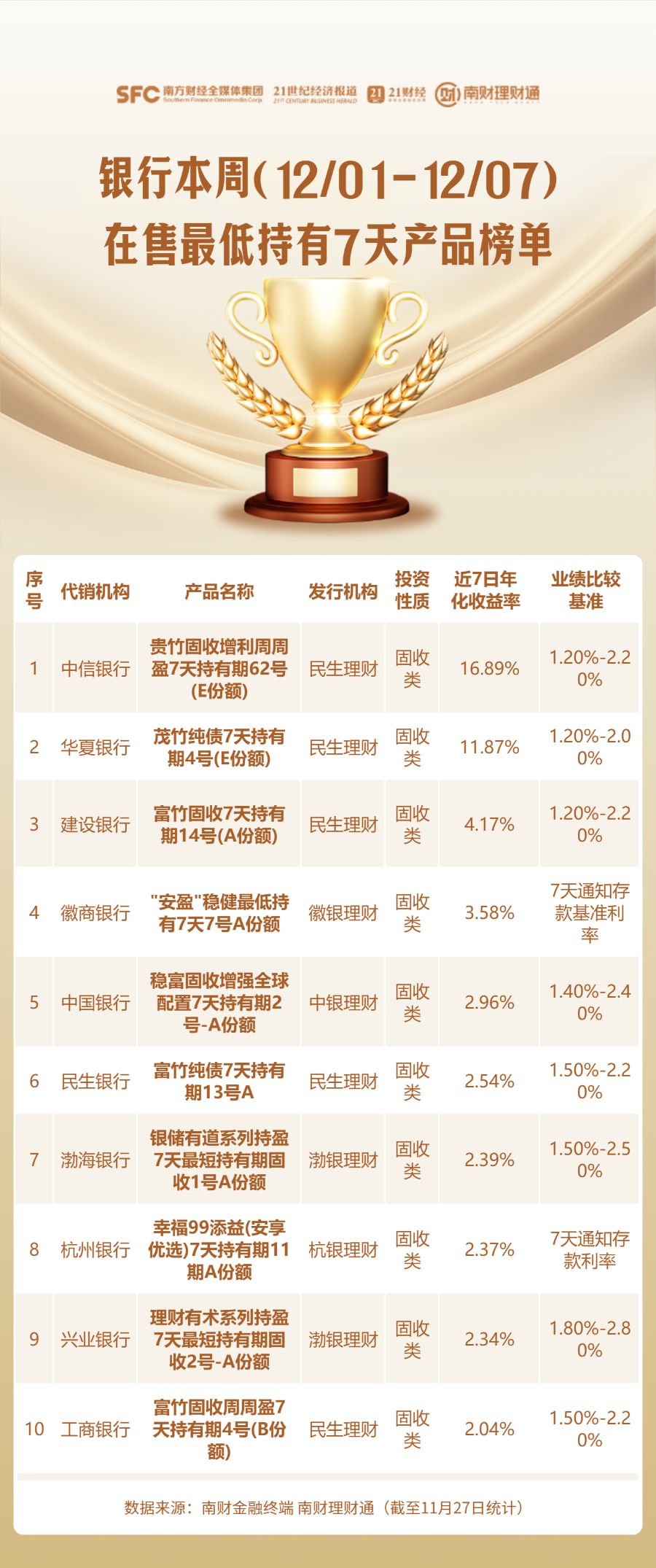
哪家商业银行最低持有期理财产品收益更高?
2 1 Shi Ji Jing Ji Bao Dao· 2025-12-02 10:37
Core Insights - The article focuses on the performance of minimum holding period RMB public offering products, ranking them based on annualized returns for holding periods of 7, 14, 30, and 60 days [1][4][12] Group 1: 7-Day Holding Period Products - The top-performing product is from Minsheng Bank with an annualized return of 4.17% [3] - Other notable products include: - Huishang Bank with 3.58% [3] - Bank of China with 2.96% [3] - Minsheng Bank's Fuzhu Pure Bond with 2.54% [3] - Bohai Bank with 2.39% [3] Group 2: 14-Day Holding Period Products - Minsheng Bank's product "Jingxiang Fixed Income Incremental Dual-Week" leads with a return of 34.68% [5] - Other significant products include: - Minsheng Bank's Fuzhu Pure Bond with 5.66% [5] - WeBank's "Anying" Stable Income with 4.47% [5] - SPDB's "Wealth Management Series" with 2.33% [5] Group 3: 30-Day Holding Period Products - Minsheng Bank's "Guizhu Fixed Income Incremental Monthly" tops the list with a return of 21.23% [9] - Other key products include: - Minsheng Bank's Fuzhu Fixed Income with 13.53% [9] - Bank of China with 7.64% [9] - Huishang Bank's "Happiness 99" with 6.07% [9] Group 4: 60-Day Holding Period Products - The leading product is from Minsheng Bank with a return of 15.12% [13] - Other notable products include: - CITIC Bank's Fuzhu Pure Bond with 8.94% [14] - Bank of China with 4.57% [14] - Huishang Bank's product with 3.46% [14]