
HUA XIA BANK(600015)

Search documents
中国人民银行:就华夏银行违法行为对其罚款1365.5万元
Xin Lang Cai Jing· 2025-11-28 10:54
中国人民银行 :就 华夏银行 违法行为对其罚款1365.5万元。 ...

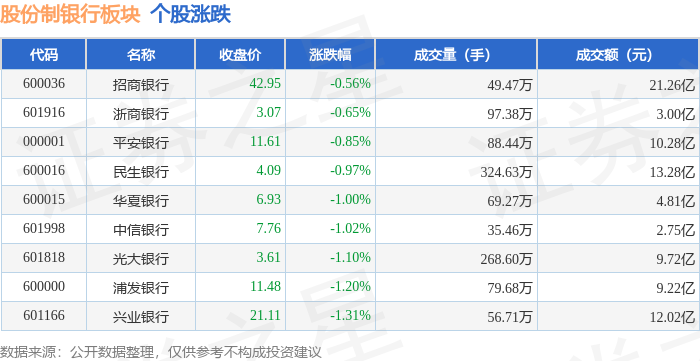
股份制银行板块11月28日跌0.92%,兴业银行领跌,主力资金净流入2.64亿元
Zheng Xing Xing Ye Ri Bao· 2025-11-28 09:05
Market Overview - The banking sector saw a decline of 0.92% on November 28, with Industrial Bank leading the drop [1] - The Shanghai Composite Index closed at 3888.6, up 0.34%, while the Shenzhen Component Index closed at 12984.08, up 0.85% [1] Individual Bank Performance - The closing prices and changes for major banks are as follows: - China Merchants Bank: 42.95, -0.56% - Zheshang Bank: 3.07, -0.65% - Ping An Bank: 11.61, -0.85% - Minsheng Bank: 4.09, -0.97% - Huaxia Bank: 6.93, -1.00% - Citic Bank: 7.76, -1.02% - Everbright Bank: 3.61, -1.10% - Pudong Development Bank: 11.48, -1.20% - Industrial Bank: 21.11, -1.31% [1] Capital Flow Analysis - The banking sector experienced a net inflow of 264 million yuan from institutional investors, while retail investors saw a net outflow of approximately 969,840 yuan [1] - Detailed capital flow for individual banks shows: - China Merchants Bank: 32.5 million net inflow from institutions, 36.1 million net outflow from retail - Industrial Bank: 47.9 million net inflow from institutions, 45.1 million net outflow from retail [2] - Ping An Bank: 30.6 million net inflow from institutions, 31.7 million net outflow from retail [2] - Huaxia Bank: 16.3 million net inflow from institutions, 30.9 million net outflow from retail [2] - Pudong Development Bank: 60.9 million net outflow from institutions, 69.1 million net inflow from retail [2] - Everbright Bank: 87.1 million net outflow from institutions, 20.3 million net inflow from retail [2]






华夏银行股份有限公司关于董事任职资格获国家金融监督管理总局核准的公告
Shang Hai Zheng Quan Bao· 2025-11-27 19:25
Core Points - The National Financial Regulatory Administration has approved the qualifications of Mr. Lü Chen and Mr. Ma Jinzhao as directors of Huaxia Bank, effective from November 25, 2025 [1][2] - The term for Mr. Lü Chen and Mr. Ma Jinzhao as directors will last until the completion of the ninth board of directors of Huaxia Bank [1] Summary of Directors' Background - Mr. Lü Chen, a non-executive director, was born in October 1971 and holds a master's degree. He has held various senior positions in the China People's Insurance Company and is currently a vice president and audit responsible person at China People's Property Insurance Co., Ltd. [2] - Mr. Ma Jinzhao, also a non-executive director, was born in October 1985 and has a master's degree. He has worked in various financial management roles within Shougang Group and is currently the deputy director of the operating finance department [2]
华夏银行中层调整涉及多家一级分行
Xin Lang Cai Jing· 2025-11-27 10:32
Group 1 - Huaxia Bank announced the appointment of Gong Weihua as Chief Information Officer starting November 13, 2025, following approval from the financial regulatory authority [1] - The bank has seen significant changes in its middle management, including the appointment of several vice presidents across various branches [1] - Li Hao, former vice president of Huaxia Bank's Beijing branch, has been reassigned to the Harbin branch, while Li Xiyu from Zheshang Bank will serve as deputy leader of the Beijing urban sub-center branch [2] Group 2 - As of June 30, 2025, Huaxia Bank operates in 120 cities across China, with a total workforce of 36,775 employees, reflecting a reduction of 1,531 employees or nearly 4% from the previous year [3] - The bank's business and management expenses for the first half of the year amounted to 12.828 billion yuan, a decrease of 209 million yuan or 1.60% year-on-year, attributed to cost management efforts [3] - Huaxia Bank has completed the absorption and merger of its village banks, with the Sichuan financial regulatory authority approving the dissolution of Sichuan Jiangyou Huaxia Village Bank [4] Group 3 - The Jiangyou Village Bank, established in September 2011 with a registered capital of 75 million yuan, had total assets of approximately 188.12 million yuan and net assets of 17.66 million yuan as of June 30, 2025 [4] - The restructuring of village banks aligns with regulatory efforts to mitigate financial risks, as emphasized by the financial regulatory authority's focus on the reform of small financial institutions [5]
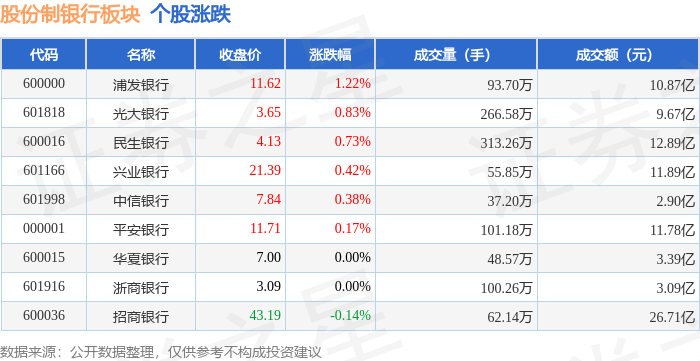
股份制银行板块11月27日涨0.34%,浦发银行领涨,主力资金净流出3360.95万元
Zheng Xing Xing Ye Ri Bao· 2025-11-27 09:07
Group 1 - The banking sector saw a slight increase of 0.34% on November 27, with Shanghai Pudong Development Bank leading the gains [1] - The Shanghai Composite Index closed at 3875.26, up 0.29%, while the Shenzhen Component Index closed at 12875.19, down 0.25% [1] - Major banks' stock performance included Shanghai Pudong Development Bank at 11.62 with a rise of 1.22%, and China Merchants Bank at 43.19 with a decline of 0.14% [1] Group 2 - The net outflow of main funds in the banking sector was 33.61 million yuan, while retail funds saw a net inflow of 47.02 million yuan [1] - Specific banks like China Merchants Bank had a net inflow of 88.82 million yuan from main funds, but also experienced a net outflow of 48.14 million yuan from retail investors [1] - The overall trend showed that while some banks attracted main fund inflows, others faced significant outflows, indicating mixed investor sentiment [1]


华夏银行(600015) - 华夏银行关于董事任职资格获国家金融监督管理总局核准的公告
2025-11-27 08:00
马金钊,非执行董事,男,1985 年 10 月出生,硕士研究生。曾任首钢京 唐钢铁联合有限责任公司计财部综合成本管理员、计财部成本处处长助理、计财 部成本管理室副主任(主持工作);首钢贵阳特殊钢有限责任公司经营财务部副 部长、部长;首钢集团有限公司经营财务部部长助理。现任首钢集团有限公司经 营财务部副部长。 华夏银行股份有限公司关于董事任职资格 获国家金融监督管理总局核准的公告 特此公告。 本行董事会及全体董事保证本公告内容不存在任何虚假记载、误导性陈述或 者重大遗漏,并对其内容的真实性、准确性和完整性承担法律责任。 华夏银行股份有限公司(以下简称"本行")于近日收到《国家金融监督管 理总局关于吕晨华夏银行董事任职资格的批复》(金复〔2025〕674 号)和《国 家金融监督管理总局关于马金钊华夏银行董事任职资格的批复》(金复〔2025〕 677 号)。国家金融监督管理总局已核准吕晨先生、马金钊先生担任本行董事的 任职资格。 吕晨先生、马金钊先生担任本行董事的任期自核准日 2025 年 11 月 25 日起 生效,至本行第九届董事会届满之日止。 A 股代码:600015 A 股简称:华夏银行 编号:2025—5 ...
华夏银行首席信息官龚伟华:把握人工智能发展机遇 打造金融新质生产力
Cai Jing Wang· 2025-11-27 03:42
Core Viewpoint - Artificial intelligence (AI) is a key driver of technological revolution and industrial transformation, facilitating the financial industry's transition from digitalization to intelligent development. Huaxia Bank is actively promoting the integration of AI and big data to enhance its operational capabilities and support high-quality business development [1]. Group 1: AI Technology Application Development - Huaxia Bank is building an open collaborative AI innovation ecosystem through partnerships with universities, research institutions, and technology companies, enhancing its AI computing power and data readiness [2]. - The bank is developing various AI algorithms, including discriminative, generative, strategic, and behavioral models, to support applications in intelligent marketing, risk control, and operational efficiency [3][4]. - The introduction of quantum technology aims to balance the advancement of AI models with cost control, significantly improving training speed and resource efficiency [5]. Group 2: AI Data Preparation - High-quality data is recognized as crucial for enhancing AI model performance, leading to the establishment of a robust AI-ready data system that supports model training and intelligent decision-making [6][7]. - The bank implements comprehensive data management processes, including collection, annotation, cleaning, and desensitization, to ensure data quality and relevance [8]. Group 3: AI Computing Power Support - The demand for intelligent computing power is rapidly increasing, prompting the bank to adopt a dynamic resource allocation mechanism to optimize GPU utilization and manage computing resources effectively [9]. Group 4: AI Talent Support - Huaxia Bank has formed an integrated AI team across its technology and fintech divisions, facilitating collaboration and reducing barriers to AI application across the organization [10]. Group 5: AI Technology Application Achievements - The bank has identified 240 AI model application scenarios, with 24 officially launched, demonstrating significant improvements in efficiency across various functions, including marketing, risk control, and operational processes [11]. Group 6: Future Directions - The bank plans to deepen the integration of AI with big data and quantum technology, aiming to enhance its AI capabilities and promote large-scale application across all business lines [12].
华夏银行广州分行:廿六载奋楫湾区 勇立潮头开新局
Cai Fu Zai Xian· 2025-11-26 03:36
Core Viewpoint - Huaxia Bank's Guangzhou Branch has evolved over 26 years, focusing on sustainable development and supporting high-quality economic growth in Guangdong through various financial initiatives [1] Group 1: Technology Finance - The bank has established a special team for technology finance, creating a whitelist and green approval channels for innovative enterprises [2] - Innovative products like intellectual property pledge loans and investment-loan linkage have been introduced to support asset-light tech companies [4] - As of mid-November, the loan balance for technology enterprises has increased by 44.59% compared to the beginning of the year [4] Group 2: Green Finance - Green finance has been elevated to a strategic level, with a comprehensive service system covering green credit, green bonds, and ESG investment [5] - The bank launched its first "Sui Carbon" platform inclusive financing business, providing a credit loan of 1.5 million yuan to specialized tech enterprises [5] - Collaborations with international organizations like the World Bank and Asian Development Bank have involved over 3 billion yuan in funding for green projects [7] Group 3: Inclusive Finance - The bank supports the private economy, small and micro enterprises, and rural areas through tailored financial products like "Motorcycle Parts Loan" [8] - The "Assist Farmers Loan" product has been customized for agricultural services, with agricultural loans growing at a rate of 33.4% as of September [8] Group 4: Pension Finance - The bank has developed a three-in-one model for pension finance, including personal pension accounts and elder service financial products [9] - Initiatives like the "Silver Economy Breakfast Meeting" have reached over 6,000 elderly individuals, enhancing financial services for seniors [9] Group 5: Digital Finance - A dedicated digital finance department has been established, with over 2.4 billion yuan allocated to various industries through digital financial products [10] - The bank has introduced innovative digital products like "Carbon Quota Pledge Financing" and "Railway Freight Loan" to support enterprises [11] - As of mid-November, the bank has added nearly 3 billion yuan in corporate loans, supporting cross-border operations for companies [11]
华夏银行深圳罗湖支行将在2026年1月31日起正式停办保管箱业务
Jin Tou Wang· 2025-11-26 03:27
Core Points - Huaxia Bank's Shenzhen Luohu Branch will officially cease safe deposit box services starting January 31, 2026 [1] - Customers with existing safe deposit box agreements must complete termination procedures by March 31, 2026, to avoid overdue rent [1] - The bank will charge fees for overdue safe deposit boxes that are not terminated on time [1] Summary by Sections Announcement Details - The bank expresses gratitude for customer support and announces the discontinuation of safe deposit box services due to business adjustments [1] - New rental agreements and renewals will not be accepted after January 31, 2026 [1] Customer Instructions - Customers with ongoing agreements must bring valid ID, keys, and rental contracts to terminate their agreements [1] - Full waiver of overdue rent will be provided for terminations completed by March 31, 2026 [1] Consequences for Non-compliance - The bank reserves the right to seal and store overdue safe deposit boxes under notarization, charging related fees [1] - Customers can still apply for termination during the sealing period at the branch [1]