
HUA XIA BANK(600015)

Search documents
银行零售信贷“缩表”,调整期持续?
券商中国· 2025-10-08 08:10
Core Viewpoint - Recent adjustments by some joint-stock banks to reduce credit card overdraft rates to "0" aim to increase volume by lowering costs [1] Group 1: Credit Card Loan Trends - Credit card loan balances are a key indicator of retail banking customer activity, with recent adjustments reflecting banks' efforts to compete for existing customers during a retail "cold season" [2] - Many listed banks have seen a further expansion of negative growth in credit card loan balances this year, alongside a decline in other retail loan categories such as consumer loans and mortgages [2][4] - Major state-owned banks like Bank of China and Postal Savings Bank reported declines in credit card loan balances of 13.88% and 5.67% respectively, while some joint-stock banks also experienced negative growth [3] Group 2: Overall Retail Lending Environment - The retail lending sector is undergoing an "adjustment period," with 17 out of 42 listed banks reporting a contraction in personal loan balances as of mid-2023 [4] - The contraction in personal housing mortgage loans has been a significant factor, with a reported negative growth of 1.6% in personal housing loan balances at the end of 2023, marking the first decline since 1997 [5][6] Group 3: Retail Loan Risk Assessment - Retail loan risks are on the rise, with the non-performing loan (NPL) ratio for retail loans increasing to 1.23% as of mid-2023, compared to a decrease in corporate loan NPL ratios [9] - Specific segments such as mortgage loans, consumer loans, and credit cards have seen their NPL ratios rise, indicating a challenging environment for retail lending [9][10] - The overall retail loan risk trend remains upward, with banks acknowledging the need for improved risk management practices in response to these challenges [10]






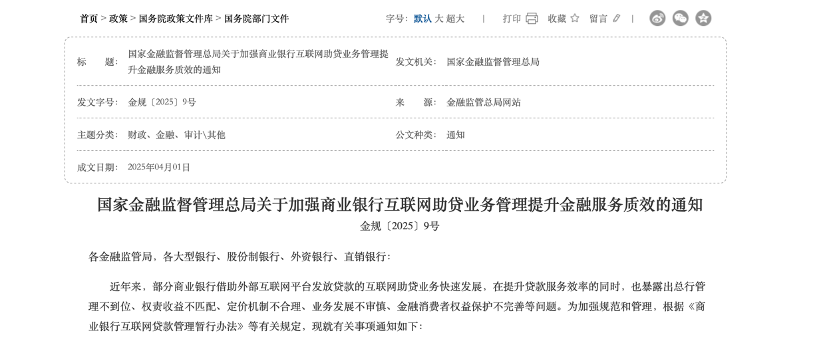
助贷新规10月1日落地,银行不得与名单外机构合作
2 1 Shi Ji Jing Ji Bao Dao· 2025-09-30 10:51
Core Viewpoint - The implementation of the new regulatory policy, referred to as the "Assisted Loan New Regulations," will significantly reshape the landscape of the assisted loan industry by establishing clear compliance boundaries for commercial banks' internet-assisted loan businesses [1][3]. Group 1: Regulatory Changes - The new regulation, effective from October 1, 2025, mandates commercial banks to adopt a "list management" system for assisted loan cooperation institutions, which has led to a lack of transparency regarding the cooperation lists of major banks [4][5]. - The regulation imposes strict controls on "comprehensive financing costs," particularly targeting products with annualized comprehensive costs exceeding 24%, which poses a challenge to existing business models in the assisted loan sector [1][9]. Group 2: Market Dynamics - The disclosed cooperation lists indicate a trend where major internet giants are preferred partners for banks, leading to a concentration of funds and resources in the hands of a few leading institutions [5][6]. - Various banks have begun to reveal their cooperation lists, with significant participation from both state-owned and private banks, although the six major state-owned banks have yet to disclose their lists [4][6]. Group 3: Business Models and Strategies - Banks like Ping An Bank have developed platforms such as the "Smart Loan Platform" to enhance compliance and safety while expanding their internet credit ecosystem, reflecting a shift towards more regulated and secure lending practices [7]. - Some banks are reconsidering their involvement in assisted loan businesses due to high default rates and rising customer acquisition costs, which are compressing profit margins [7]. Group 4: Financial Implications - The new regulations are expected to create a significant stratification in funding sources, with high-interest assets losing bank support while assets with annualized rates below 24% become highly competitive [9][10]. - Trust funds have seen a temporary increase in demand as an alternative funding source, but their higher costs and regulatory constraints limit their sustainability [10]. Group 5: Regulatory Focus Post-Implementation - Post-implementation, regulatory scrutiny will focus on pricing transparency and comprehensive cost control, particularly regarding the inclusion of service fees in the overall financing costs [11]. - The regulatory authorities will also evaluate banks' risk management capabilities and their adherence to core responsibilities in the assisted loan sector [11].





华夏银行“刀刃向内”改革再落子,股份行第8家资金运营中心可期
2 1 Shi Ji Jing Ji Bao Dao· 2025-09-30 10:20
Core Viewpoint - Huaxia Bank is advancing its internal reform by establishing a dedicated Fund Operations Center and optimizing the organizational structure of its headquarters [1][3][4]. Group 1: Establishment of Fund Operations Center - The establishment of the Fund Operations Center is part of Huaxia Bank's internal organizational reform, aimed at enhancing specialized and refined fund management capabilities [3][4]. - The Fund Operations Center will focus on various financial activities, including bond investments, foreign exchange trading, and asset custody services [3][4]. - If approved, Huaxia Bank will become the eighth joint-stock bank to establish such a center, joining other banks like Industrial Bank and Ping An Bank [3][6]. Group 2: Organizational Changes and Leadership - The internal restructuring involves splitting and integrating departmental responsibilities to better align with new development strategies [4][10]. - Recent leadership changes at Huaxia Bank include several executives from Beijing Bank, indicating a shift in management approach towards reform and innovation [4][11]. - The new leadership emphasizes a proactive approach to reform, urging the bank to move out of its comfort zone and tackle challenges head-on [4][11]. Group 3: Industry Context and Trends - As of now, 27 banks in China have received approval to operate independent Fund Operations Centers, with a significant number being city commercial banks [6][9]. - The trend of establishing Fund Operations Centers is driven by regulatory compliance needs, particularly for banks operating in multiple regions [8][9]. - Shanghai has emerged as the preferred location for these centers due to its advantages in policy, talent, and market access [9][10]. Group 4: Benefits of Fund Operations Centers - Establishing a Fund Operations Center allows banks to enhance their financial market business capabilities and improve risk management [10][11]. - These centers serve as crucial hubs for liquidity management, financial market investments, and risk control, directly impacting the bank's profitability and risk management quality [10][11]. - The specialized teams within these centers can effectively manage complex financial operations, optimize investment strategies, and respond to market fluctuations [11].
华夏银行“刀刃向内”改革再落子 股份行第8家资金运营中心可期
2 1 Shi Ji Jing Ji Bao Dao· 2025-09-30 09:05
Core Viewpoint - Huaxia Bank is advancing its internal reform by establishing a dedicated fund operation center and optimizing the organizational structure of certain departments [1][3]. Group 1: Establishment of Fund Operation Center - The establishment of the fund operation center is part of Huaxia Bank's internal organizational reform, aimed at enhancing specialized and refined fund management capabilities [3][4]. - If approved, Huaxia Bank will become the eighth joint-stock bank to set up a fund operation center, joining the ranks of other banks like Industrial Bank and Ping An Bank [3][4]. - The fund operation center will focus on various financial activities, including bond investment, foreign exchange trading, and asset custody, which are crucial for improving asset-liability management efficiency [3][8]. Group 2: Organizational Changes and Leadership - The recent leadership changes at Huaxia Bank, with several executives from Beijing Bank taking key positions, indicate a strategic shift towards a more reform-oriented approach [4][6]. - The new management has emphasized the need for structural adjustments within the bank to align with its development plans and strategies [4][6]. - The call for a "breakthrough mindset" reflects the bank's commitment to addressing challenges in innovation and transformation [4][6]. Group 3: Regulatory Compliance and Market Positioning - The establishment of fund operation centers by banks, particularly city commercial banks, is largely driven by the need to comply with regulatory requirements for cross-regional operations [6][7]. - Shanghai has emerged as the preferred location for these centers due to its advantages in policy, talent, and market access, with a significant number of banks choosing to set up operations there [7][8]. - The fund operation center serves as a critical hub for liquidity management and risk control, directly impacting the bank's profitability and risk management quality [8][9]. Group 4: Industry Trends and Implications - The trend of establishing independent fund operation centers reflects a broader industry shift towards specialization and risk isolation in response to increasing complexity in financial markets [9]. - Banks with larger business scales and active trading are more likely to establish these centers to enhance their operational efficiency and market competitiveness [9]. - The establishment of these centers is expected to improve investment decision-making and execution capabilities, ultimately supporting the banks' strategic development goals [9].
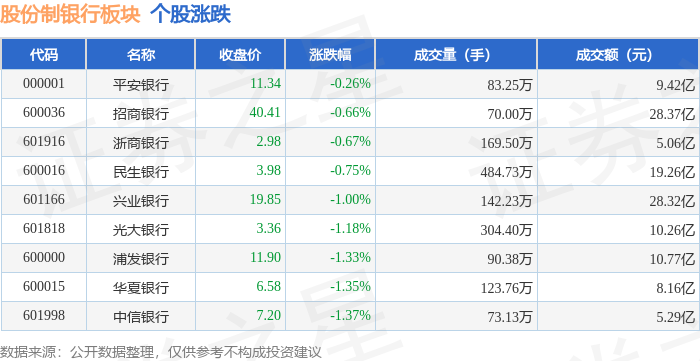
股份制银行板块9月30日跌0.92%,中信银行领跌,主力资金净流出22.07亿元
Zheng Xing Xing Ye Ri Bao· 2025-09-30 08:51
Core Insights - The banking sector experienced a decline of 0.92% on September 30, with CITIC Bank leading the drop [1] - The Shanghai Composite Index closed at 3882.78, up 0.52%, while the Shenzhen Component Index closed at 13526.51, up 0.35% [1] Banking Sector Performance - Ping An Bank closed at 11.34, down 0.26% with a trading volume of 832,500 shares and a transaction value of 942 million [1] - China Merchants Bank closed at 40.41, down 0.66% with a trading volume of 700,000 shares and a transaction value of 2.837 billion [1] - Zhejiang Commercial Bank closed at 2.98, down 0.67% with a trading volume of 1.695 million shares and a transaction value of 506 million [1] - Minsheng Bank closed at 3.98, down 0.75% with a trading volume of 4.847 million shares and a transaction value of 1.926 billion [1] - Industrial Bank closed at 19.85, down 1.00% with a trading volume of 1.422 million shares and a transaction value of 2.832 billion [1] - Everbright Bank closed at 3.36, down 1.18% with a trading volume of 3.044 million shares and a transaction value of 1.026 billion [1] - Shanghai Pudong Development Bank closed at 11.90, down 1.33% with a trading volume of 903,800 shares and a transaction value of 1.077 billion [1] - Huaxia Bank closed at 6.58, down 1.35% with a trading volume of 1.237 million shares and a transaction value of 816 million [1] - CITIC Bank closed at 7.20, down 1.37% with a trading volume of 731,300 shares and a transaction value of 529 million [1] Capital Flow Analysis - The banking sector saw a net outflow of 2.207 billion from institutional investors, while retail investors had a net inflow of 1.312 billion [1] - The table shows detailed capital flows for individual banks, indicating varying levels of net inflow and outflow among institutional, speculative, and retail investors [2]


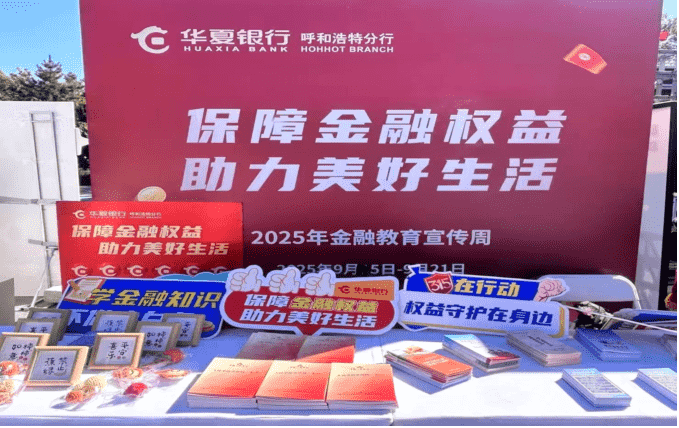
华夏银行呼和浩特分行开展反假币宣传活动
Zhong Guo Jin Rong Xin Xi Wang· 2025-09-30 06:06
Core Viewpoint - The Huaxia Bank Hohhot Branch is actively promoting anti-counterfeiting currency education through engaging and practical activities, aiming to enhance public awareness and skills in identifying counterfeit money [1][2][3] Group 1: Anti-Counterfeiting Activities - The bank has set up "anti-counterfeiting experience stations" in public areas, featuring enlarged models of currency security features to provide hands-on learning experiences for the public [1] - Staff members are teaching citizens practical skills to identify counterfeit money using a three-step method: "turn, touch, and see through" [1][2] - The activities have attracted over 200 participants, with more than 500 individuals reached through various events, and 800 promotional materials distributed [2] Group 2: Targeted Education - The bank has tailored its educational materials to address specific concerns of different demographic groups, such as creating large-print guides for elderly customers and focusing on new types of scams for younger audiences [2] - Real-life case studies are used to illustrate common scams faced by merchants, along with guidance on using cash verification machines [2] Group 3: Future Plans - The bank plans to integrate anti-counterfeiting education into daily services at branches, establishing "anti-counterfeiting experience corners" and organizing community outreach programs [3] - The goal is to transition from concentrated promotional efforts to ongoing education and protection against counterfeit currency [3]
银行股回调背后:谁在抛售 谁在加仓
Zhong Guo Zheng Quan Bao· 2025-09-29 20:45
Core Viewpoint - The recent fluctuations in the banking sector are primarily driven by short-term arbitrage fund withdrawals and an increase in market risk appetite, rather than the fundamental performance of banks [1][2][3] Group 1: Market Trends - Since July 11, the banking sector index has shown a downward trend, with an overall decline exceeding 14% after a brief rebound in early August [1] - The current market environment has led active funds to favor technology and growth sectors, resulting in a shift away from banking stocks [1][2] - The recent adjustments in the banking sector are compounded by high dividend payouts in July, leading to profit-taking by investors [2][3] Group 2: Investment Sentiment - Despite recent underperformance, banking stocks remain attractive to long-term investors such as insurance funds and social security funds, supported by favorable policies encouraging institutional investment [3][4] - Data shows that insurance funds are significant shareholders in over 700 stocks, with several banking stocks among their top holdings [3] Group 3: Long-term Outlook - Analysts believe that the long-term valuation recovery of banking stocks is not a short-term phenomenon but will be supported by ongoing transformations in the banking sector's operating models [6][7] - The banking sector is transitioning towards a more quality-focused approach, enhancing capital efficiency and increasing non-interest income, which is expected to bolster the attractiveness of banking stocks [6][7] - The potential for increased investment from insurance funds is significant, as regulatory changes may lead to a higher allocation of new premiums into the A-share market [7]



反诈拒诈守初心 平安护驾暖青城——华夏银行呼和浩特分行创新开展多维度反诈宣传活动
Zhong Guo Jin Rong Xin Xi Wang· 2025-09-29 10:12
Core Viewpoint - The Huaxia Bank Hohhot Branch is actively promoting financial consumer rights protection and anti-fraud awareness through innovative and engaging methods during the 2025 Financial Education Promotion Week [1] Group 1: Anti-Fraud Campaign Initiatives - The bank has established an "anti-fraud publicity station" at Dazhao Square, utilizing interactive methods such as quizzes to educate the public on common fraud scenarios [3] - Over 300 participants engaged in the activities, which transformed serious financial education into an enjoyable learning experience [3] Group 2: Targeted Outreach for Special Groups - Customized anti-fraud strategies were developed for specific demographics, including bilingual warning cards for the Mongolian community and specialized sessions for elderly clients [3][5] - The elderly were taught to recognize fraud tactics and were guided on how to use the National Anti-Fraud Center app [3] Group 3: Focus on Small Business Owners - The bank formed an "anti-fraud lecture team" to address the high incidence of fraud among individual business owners, covering scams related to payment codes and false orders [5] - The initiative included hands-on training for over 80 merchants, emphasizing the importance of verifying payment information and using secure transaction methods [5] Group 4: Future Plans - The bank aims to integrate anti-fraud education into daily financial services, shifting from concentrated campaigns to ongoing community engagement [5] - The goal is to strengthen the financial safety net for the public and contribute to local financial stability [5]
湖南一华夏银行员工诱导他人套现私吞华夏银行:合同工,已开除
Xin Lang Cai Jing· 2025-09-29 09:04
Core Viewpoint - The article highlights a case of a teacher who fell victim to a fraudulent scheme involving credit card activation and cash withdrawal, leading to significant debt and financial distress [1] Group 1: Incident Overview - A teacher in Hunan Province was lured into applying for a credit card under the pretense of receiving gifts, despite having no prior experience with credit cards [1] - After activating the card, the teacher was misled by a bank staff member into believing they could withdraw cash without repayment obligations, resulting in a debt of 150,000 yuan and nearly 20,000 yuan in interest [1] Group 2: Fraud Mechanism - The teacher was instructed to provide verification codes to the staff member, which allowed the fraudulent transfer of funds from the credit card to the staff member's account [1] - The teacher's attempts to recover the funds were met with excuses and delays from the staff member, who eventually failed to repay the debt [1] Group 3: Legal and Institutional Response - Local police did not file a case, and the involved bank staff member claimed to be unable to repay due to personal financial issues, leading to a written promise to repay by the end of 2024 [1] - The bank distanced itself from the incident, stating that the involved staff member was a contract worker and that the issue was a personal financial dispute [1] Group 4: Regulatory Context - The article references regulations from the China Banking and Insurance Regulatory Commission and the People's Bank of China, emphasizing the need for banks to supervise credit card marketing activities and ensure that only qualified personnel engage in such activities [2] - The bank acknowledged that guiding others to withdraw cash and failing to return the funds constitutes a violation, indicating a need for police investigation and potential internal review [2]
华夏银行股份有限公司第九届董事会第十一次会议决议公告
Shang Hai Zheng Quan Bao· 2025-09-28 17:37
Core Points - The board of directors of Huaxia Bank held its 11th meeting of the 9th session, which was conducted via written consent, ensuring compliance with relevant laws and regulations [1][3] - The meeting approved the establishment of a fund operation center for Huaxia Bank with unanimous support from all directors [1] - The board also approved an organizational restructuring and optimization of certain departments within the bank, again with unanimous support [2][3] - The meeting reviewed reports on significant operational risk events and regulatory updates for the first half of 2025 [3]