HUA XIA BANK(600015)

Search documents
股份制银行板块10月10日跌0.01%,招商银行领跌,主力资金净流出14.22亿元
Zheng Xing Xing Ye Ri Bao· 2025-10-10 08:46
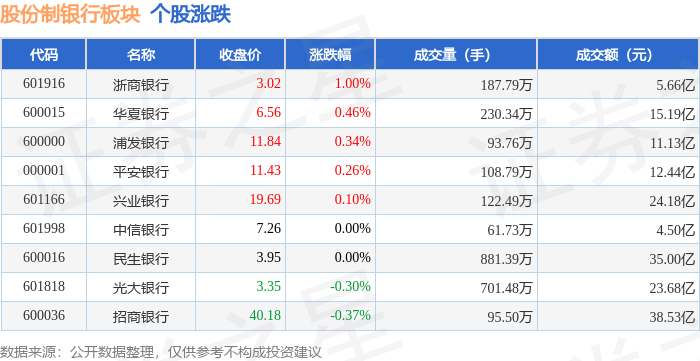
证券之星消息,10月10日股份制银行板块较上一交易日下跌0.01%,招商银行领跌。当日上证指数报收于3897.03,下跌0.94%。深证成指报收于 13355.42,下跌2.7%。股份制银行板块个股涨跌见下表: | 代码 | 名称 | 收盘价 | 涨跌幅 | 成交量(手) | 成交额(元) | | --- | --- | --- | --- | --- | --- | | 601916 | 浙商银行 | 3.02 | 1.00% | 187.79万 | 5.66亿 | | 600015 | 半夏银行 | 6.56 | 0.46% | 230.34万 | 15.19亿 | | 600000 | 浦发银行 | 11.84 | 0.34% | - 93.76万 | 11.13亿 | | 000001 | 平安银行 | 11.43 | 0.26% | 108.79万 | 12.44亿 | | 601166 | 兴业银行 | 19.69 | 0.10% | 122.49万 | 24.18亿 | | 666109 | 中信银行 | 7.26 | 0.00% | 61.73万 | 4.50亿 | | 600016 | 民生 ...





华夏银行、亚洲开发银行“促进产业园区绿色低碳发展项目”首笔贷款落地江苏
Zhong Jin Zai Xian· 2025-10-10 01:59
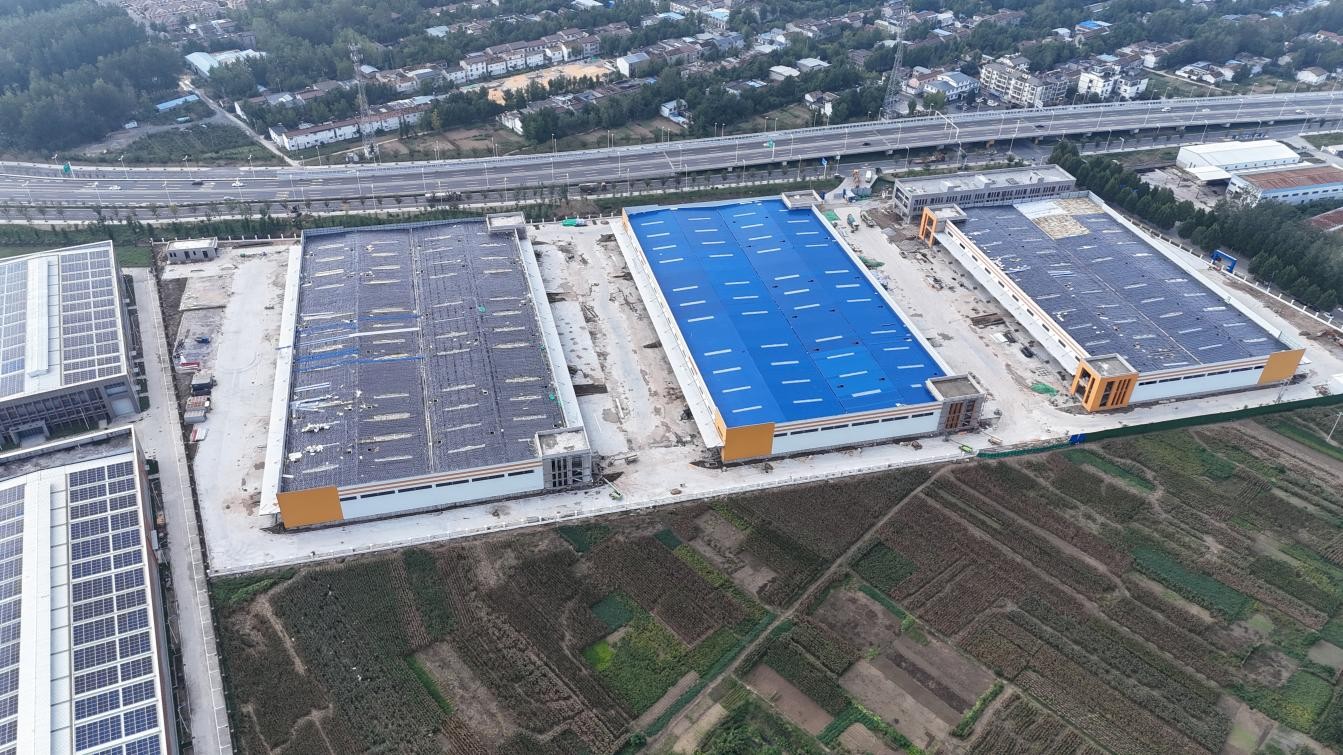
Core Viewpoint - The article highlights the development of the Suqian Port Smart Logistics Park in Jiangsu as a significant project supporting the green and low-carbon transformation of industrial parks in China, aligning with national strategies for sustainable development and the Belt and Road Initiative [3][7][13]. Group 1: Project Overview - The Suqian Port Smart Logistics Park is a key component of Suqian's logistics network, aiming to create a "gateway to the sea" and enhance the region's economic position in the Yangtze River Delta [3][4]. - The construction of the logistics park is progressing rapidly, with three energy-efficient logistics warehouses being built, set to be operational by the end of this year [6][9]. Group 2: Financial Support and Green Initiatives - Huaxia Bank and the Asian Development Bank (ADB) have jointly provided 220 million yuan in financing for the logistics park, marking the first loan issued under their collaboration to promote green and low-carbon development in industrial parks [6][7]. - The project aims to meet "zero carbon park" standards, with energy savings projected to reach 72% compared to traditional construction methods [9][11]. Group 3: Policy and Strategic Alignment - The initiative aligns with national policies aimed at establishing zero-carbon parks and promoting green transformation in industrial zones, contributing to China's dual carbon goals [7][8]. - The project utilizes an innovative financing model where ADB loans are matched by Huaxia Bank, providing long-term, efficient funding in local currency to mitigate exchange rate risks [8][12]. Group 4: Service and Implementation - Huaxia Bank's proactive approach included on-site assessments and tailored financial solutions to address the park's funding challenges, demonstrating effective collaboration between financial institutions and local governments [11][12]. - The bank has established a comprehensive service system that includes carbon management consulting, enhancing the project's international impact and supporting its green objectives [8][13].
银行股逆势上涨,上海银行等涨超2%
Ge Long Hui· 2025-10-10 01:58
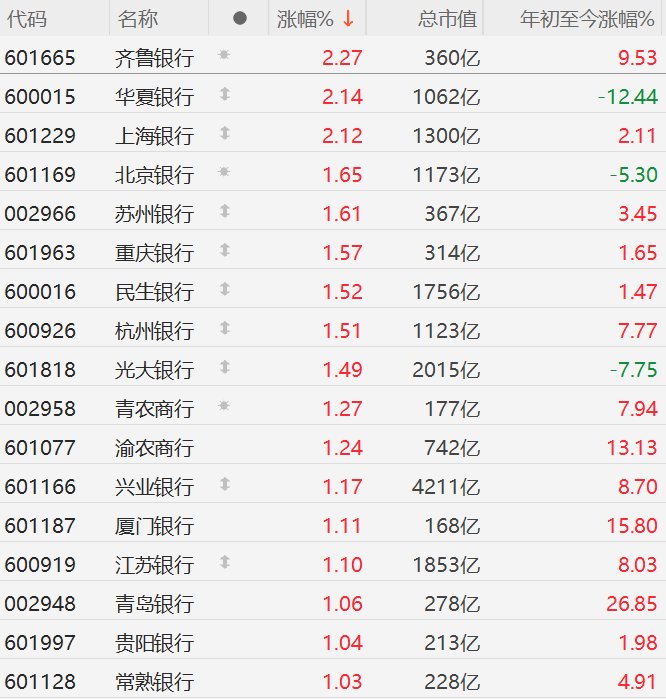
Core Insights - The A-share market has seen a rise in bank stocks, with notable increases in Qilu Bank, Huaxia Bank, and Shanghai Bank, all exceeding 2% [1] Group 1: Stock Performance - Qilu Bank's stock increased by 2.27%, with a total market capitalization of 36 billion and a year-to-date increase of 9.53% [2] - Huaxia Bank's stock rose by 2.14%, with a market cap of 106.2 billion and a year-to-date decline of 12.44% [2] - Shanghai Bank's stock saw a 2.12% increase, with a market cap of 130 billion and a year-to-date increase of 2.11% [2] - Beijing Bank's stock increased by 1.65%, with a market cap of 117.3 billion and a year-to-date decline of 5.30% [2] - Suzhou Bank's stock rose by 1.61%, with a market cap of 36.7 billion and a year-to-date increase of 3.45% [2] - Chongqing Bank's stock increased by 1.57%, with a market cap of 31.4 billion and a year-to-date increase of 1.65% [2] - Minsheng Bank's stock rose by 1.52%, with a market cap of 175.6 billion and a year-to-date increase of 1.47% [2] - Hangzhou Bank's stock increased by 1.51%, with a market cap of 112.3 billion and a year-to-date increase of 7.77% [2]




华夏银行、亚洲开发银行“促进产业园区绿色低碳发展项目” 首笔贷款落地江苏
Jin Rong Shi Bao· 2025-10-10 01:23
以运河宿迁港智慧物流园为例,该项目是宿迁市打造集城市配送、中转分拨、区域仓储、信息平台、综 合服务等功能为一体的现代物流融合的先行区,也是宿迁市大力建设的零碳园区之一。华夏银行南京分 行紧跟该园区低碳发展需求,总分支协同联动,与亚开行环境、社会、土地等多领域专家高效沟通,加 快审批流程,实现项目快速落地。 据了解,华夏银行致力成为产业园区绿色低碳发展专业服务银行,围绕园区孤立、散点、多元化绿色低 碳发展的金融和碳管理需求,提供"商行+投行+撮合"的综合金融服务以及碳管理和ESG管理服务,推动 园区绿色高质量发展。责任编辑:韩胜杰 本报讯 记者张冰洁报道 华夏银行、亚洲开发银行(以下简称"亚开行")"促进产业园区绿色低碳发展项 目"首笔贷款近日在江苏落地,为运河宿迁港智慧物流园项目提供2.2亿元贷款支持,期限15年。 为促进我国工业园区绿色低碳转型,助力国家"双碳"目标实现,日前,华夏银行与亚开行共同启动 了"促进产业园区绿色低碳发展项目"。该项目是经国务院批准的主权贷款项目,也是专项支持产业园区 绿色低碳发展的金融产品,总金额近50亿元人民币,亚开行贷款和华夏银行配套贷款1∶1,为全国范围 内的产业园区运营管 ...
信贷高频违规 银行业前三季被罚9.81亿元
Bei Jing Shang Bao· 2025-10-09 16:14
Core Insights - The regulatory environment for the banking industry in 2025 remains stringent, with a "zero tolerance" approach leading to a significant number of penalties issued [1][3] - In the first three quarters of 2025, a total of 997 penalties were imposed on various banking institutions, amounting to approximately 981 million yuan [3][4] - The focus of regulatory scrutiny is primarily on credit business violations, which account for nearly 60% of total penalties, highlighting the need for improved internal controls and compliance mechanisms within banks [6][9] Regulatory Overview - The National Financial Supervision Administration and its branches issued 997 penalties in the first nine months of 2025, with a total fine amounting to 981 million yuan [3][4] - The regulatory body itself issued 14 penalties totaling approximately 314.67 million yuan, indicating a high average penalty per case [3] - The first quarter saw the highest number of penalties at 394, while the third quarter experienced a surge in penalties to 372, reflecting an intensified regulatory environment [4] Credit Business Violations - Credit business remains a significant area of concern, with various violations leading to substantial penalties, including cases of improper loan management and misuse of funds [6][7] - Notable penalties include 16.8 million yuan for Zhejiang Merchants Bank and 8.725 million yuan for Huaxia Bank, both related to credit business violations [7][8] - The prevalence of violations in the credit sector is attributed to the high stakes involved, as it directly impacts financial security and order [9][10] Compliance Challenges - Other areas of compliance, such as wealth management and credit card operations, also exhibit significant vulnerabilities, necessitating a comprehensive upgrade in internal control systems [11][12] - Banks are encouraged to shift their focus from aggressive business expansion to robust risk management and compliance practices [13] - The need for a cultural shift within banks to prioritize compliance as a core aspect of operations is emphasized, aiming to build a more resilient financial environment [13]


罚没9.81亿元!前三季度银行收近千张罚单 信贷违规高频踩“雷”
Bei Jing Shang Bao· 2025-10-09 14:56
Core Insights - The regulatory environment for the banking sector in 2025 remains stringent, with a "zero tolerance" approach leading to a significant number of penalties issued [1][2] - In the first three quarters of 2025, a total of 997 penalties were imposed on various banking institutions, amounting to approximately 981 million yuan [2][3] - The majority of penalties are related to credit business violations, highlighting the need for banks to enhance internal control mechanisms and compliance [1][5] Regulatory Overview - The National Financial Supervision Administration and its branches issued 997 penalties, with a total fine of 981 million yuan in the first nine months of 2025 [2] - The central administration issued 14 penalties totaling approximately 314.67 million yuan, while local regulatory bodies issued 306 and 677 penalties, respectively, with fines of 294.39 million yuan and 371.52 million yuan [2] - The first quarter saw the highest number of penalties, with 394 issued, while the second quarter experienced a decline, followed by a surge in the third quarter with 372 penalties and fines reaching 538 million yuan [3] Credit Business Violations - Credit business violations account for nearly 60% of total penalties, with diverse violations leading to substantial fines [5][6] - Notable cases include Zhejiang Merchants Bank and Shanghai Huari Bank, which faced significant penalties for various credit-related violations [5][6] - The trend of high penalties in the credit sector is attributed to the core nature of credit business in banking and the associated risks of fund mismanagement and regulatory non-compliance [7][8] Compliance Challenges - Compliance issues are not limited to credit business; other areas such as wealth management and credit card operations also exhibit significant regulatory gaps [9][10] - Banks often prioritize business expansion over compliance, leading to inadequate risk management practices [8][10] - The need for banks to upgrade their internal control governance is emphasized, focusing on a comprehensive approach to compliance and risk management [9][10]


股份制银行板块10月9日跌0.25%,兴业银行领跌,主力资金净流出16.96亿元
Zheng Xing Xing Ye Ri Bao· 2025-10-09 09:03
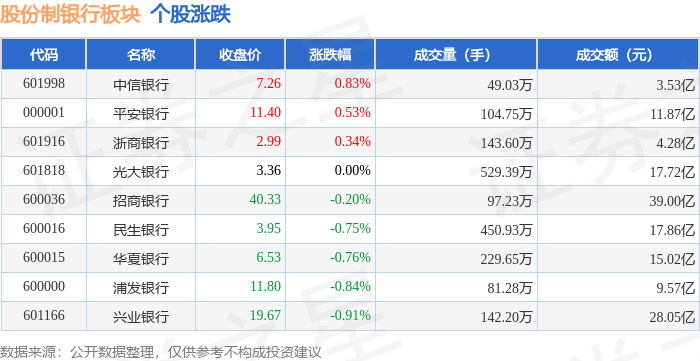
Core Viewpoint - The banking sector experienced a decline, with the share prices of major banks falling, particularly led by Industrial Bank, while the overall stock market showed positive growth [1] Group 1: Market Performance - On October 9, the share price of the banking sector fell by 0.25%, with Industrial Bank leading the decline [1] - The Shanghai Composite Index closed at 3933.97, up by 1.32%, and the Shenzhen Component Index closed at 13725.56, up by 1.47% [1] Group 2: Individual Bank Performance - The closing prices and performance of key banks are as follows: - CITIC Bank: 7.26, up by 0.83% - Ping An Bank: 11.40, up by 0.53% - Zheshang Bank: 2.99, up by 0.34% - Everbright Bank: 3.36, unchanged - China Merchants Bank: 40.33, down by 0.20% - Minsheng Bank: 3.95, down by 0.75% - Huaxia Bank: 6.53, down by 0.76% - Pudong Development Bank: 11.80, down by 0.84% - Industrial Bank: 19.67, down by 0.91% [1] Group 3: Capital Flow Analysis - The banking sector saw a net outflow of 1.696 billion yuan from major funds, while retail investors contributed a net inflow of 963 million yuan [1] - The capital flow for individual banks indicates: - Pudong Development Bank: Major net inflow of 20.68 million yuan, retail net outflow of 47.41 million yuan - CITIC Bank: Major net inflow of 8.90 million yuan, retail net inflow of 1.20 million yuan - Ping An Bank: Major net inflow of 1.22 million yuan, retail net outflow of 6.27 million yuan - Zheshang Bank: Major net outflow of 8.04 million yuan, retail net inflow of 15.78 million yuan - China Merchants Bank: Major net outflow of 1.79 billion yuan, retail net inflow of 2.16 million yuan - Minsheng Bank: Major net outflow of 28.60 million yuan, retail net inflow of 114 million yuan - Industrial Bank: Major net outflow of 40 million yuan, retail net inflow of 254 million yuan - Huaxia Bank: Major net outflow of 41.80 million yuan, retail net inflow of 18 million yuan - Everbright Bank: Major net outflow of 43.70 million yuan, retail net inflow of 23.60 million yuan [2]


银行零售信贷“缩表”,调整期持续?
券商中国· 2025-10-08 08:10
Core Viewpoint - Recent adjustments by some joint-stock banks to reduce credit card overdraft rates to "0" aim to increase volume by lowering costs [1] Group 1: Credit Card Loan Trends - Credit card loan balances are a key indicator of retail banking customer activity, with recent adjustments reflecting banks' efforts to compete for existing customers during a retail "cold season" [2] - Many listed banks have seen a further expansion of negative growth in credit card loan balances this year, alongside a decline in other retail loan categories such as consumer loans and mortgages [2][4] - Major state-owned banks like Bank of China and Postal Savings Bank reported declines in credit card loan balances of 13.88% and 5.67% respectively, while some joint-stock banks also experienced negative growth [3] Group 2: Overall Retail Lending Environment - The retail lending sector is undergoing an "adjustment period," with 17 out of 42 listed banks reporting a contraction in personal loan balances as of mid-2023 [4] - The contraction in personal housing mortgage loans has been a significant factor, with a reported negative growth of 1.6% in personal housing loan balances at the end of 2023, marking the first decline since 1997 [5][6] Group 3: Retail Loan Risk Assessment - Retail loan risks are on the rise, with the non-performing loan (NPL) ratio for retail loans increasing to 1.23% as of mid-2023, compared to a decrease in corporate loan NPL ratios [9] - Specific segments such as mortgage loans, consumer loans, and credit cards have seen their NPL ratios rise, indicating a challenging environment for retail lending [9][10] - The overall retail loan risk trend remains upward, with banks acknowledging the need for improved risk management practices in response to these challenges [10]

助贷新规10月1日落地,银行不得与名单外机构合作
2 1 Shi Ji Jing Ji Bao Dao· 2025-09-30 10:51
Core Viewpoint - The implementation of the new regulatory policy, referred to as the "Assisted Loan New Regulations," will significantly reshape the landscape of the assisted loan industry by establishing clear compliance boundaries for commercial banks' internet-assisted loan businesses [1][3]. Group 1: Regulatory Changes - The new regulation, effective from October 1, 2025, mandates commercial banks to adopt a "list management" system for assisted loan cooperation institutions, which has led to a lack of transparency regarding the cooperation lists of major banks [4][5]. - The regulation imposes strict controls on "comprehensive financing costs," particularly targeting products with annualized comprehensive costs exceeding 24%, which poses a challenge to existing business models in the assisted loan sector [1][9]. Group 2: Market Dynamics - The disclosed cooperation lists indicate a trend where major internet giants are preferred partners for banks, leading to a concentration of funds and resources in the hands of a few leading institutions [5][6]. - Various banks have begun to reveal their cooperation lists, with significant participation from both state-owned and private banks, although the six major state-owned banks have yet to disclose their lists [4][6]. Group 3: Business Models and Strategies - Banks like Ping An Bank have developed platforms such as the "Smart Loan Platform" to enhance compliance and safety while expanding their internet credit ecosystem, reflecting a shift towards more regulated and secure lending practices [7]. - Some banks are reconsidering their involvement in assisted loan businesses due to high default rates and rising customer acquisition costs, which are compressing profit margins [7]. Group 4: Financial Implications - The new regulations are expected to create a significant stratification in funding sources, with high-interest assets losing bank support while assets with annualized rates below 24% become highly competitive [9][10]. - Trust funds have seen a temporary increase in demand as an alternative funding source, but their higher costs and regulatory constraints limit their sustainability [10]. Group 5: Regulatory Focus Post-Implementation - Post-implementation, regulatory scrutiny will focus on pricing transparency and comprehensive cost control, particularly regarding the inclusion of service fees in the overall financing costs [11]. - The regulatory authorities will also evaluate banks' risk management capabilities and their adherence to core responsibilities in the assisted loan sector [11].



华夏银行“刀刃向内”改革再落子,股份行第8家资金运营中心可期
2 1 Shi Ji Jing Ji Bao Dao· 2025-09-30 10:20
Core Viewpoint - Huaxia Bank is advancing its internal reform by establishing a dedicated Fund Operations Center and optimizing the organizational structure of its headquarters [1][3][4]. Group 1: Establishment of Fund Operations Center - The establishment of the Fund Operations Center is part of Huaxia Bank's internal organizational reform, aimed at enhancing specialized and refined fund management capabilities [3][4]. - The Fund Operations Center will focus on various financial activities, including bond investments, foreign exchange trading, and asset custody services [3][4]. - If approved, Huaxia Bank will become the eighth joint-stock bank to establish such a center, joining other banks like Industrial Bank and Ping An Bank [3][6]. Group 2: Organizational Changes and Leadership - The internal restructuring involves splitting and integrating departmental responsibilities to better align with new development strategies [4][10]. - Recent leadership changes at Huaxia Bank include several executives from Beijing Bank, indicating a shift in management approach towards reform and innovation [4][11]. - The new leadership emphasizes a proactive approach to reform, urging the bank to move out of its comfort zone and tackle challenges head-on [4][11]. Group 3: Industry Context and Trends - As of now, 27 banks in China have received approval to operate independent Fund Operations Centers, with a significant number being city commercial banks [6][9]. - The trend of establishing Fund Operations Centers is driven by regulatory compliance needs, particularly for banks operating in multiple regions [8][9]. - Shanghai has emerged as the preferred location for these centers due to its advantages in policy, talent, and market access [9][10]. Group 4: Benefits of Fund Operations Centers - Establishing a Fund Operations Center allows banks to enhance their financial market business capabilities and improve risk management [10][11]. - These centers serve as crucial hubs for liquidity management, financial market investments, and risk control, directly impacting the bank's profitability and risk management quality [10][11]. - The specialized teams within these centers can effectively manage complex financial operations, optimize investment strategies, and respond to market fluctuations [11].