BGCTV(600037)

Search documents
歌华有线:公司未直接投资商用航空航天领域
Zheng Quan Ri Bao Wang· 2025-12-18 12:41
证券日报网讯12月18日,歌华有线(600037)在互动平台回答投资者提问时表示,公司未直接投资商用 航空航天领域,仅通过歌华丝路金桥基金间接投资了凌空天行项目。 ...

歌华有线(600037.SH):公司通过参与的丝路金桥基金间接投资了凌空天行项目
Ge Long Hui· 2025-12-18 08:38
格隆汇12月18日丨歌华有线(600037.SH)在投资者互动平台表示,公司通过参与的丝路金桥基金间接投 资了凌空天行项目。 ...
歌华有线:通过歌华丝路金桥基金间接投资凌空天行项目
Zheng Quan Shi Bao Wang· 2025-12-18 08:27
人民财讯12月18日电,歌华有线(600037)在互动平台表示,公司未直接投资商用航空航天领域,仅通过 歌华丝路金桥基金间接投资了凌空天行项目。 ...
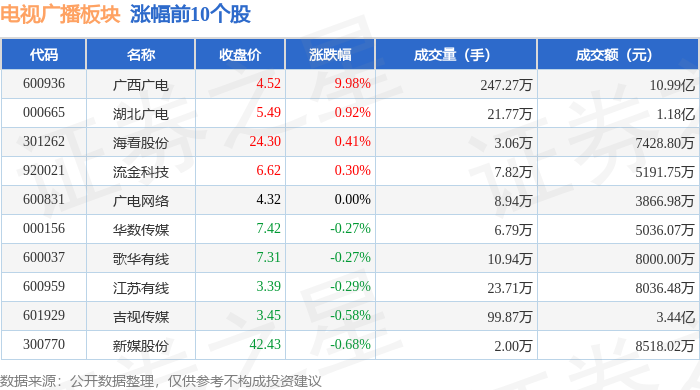
电视广播板块12月15日跌0.95%,电广传媒领跌,主力资金净流出3.39亿元
Zheng Xing Xing Ye Ri Bao· 2025-12-15 09:06
Market Overview - The television broadcasting sector experienced a decline of 0.95% on the previous trading day, with the leading stock, Dianguang Media, falling significantly [1] - The Shanghai Composite Index closed at 3867.92, down 0.55%, while the Shenzhen Component Index closed at 13112.09, down 1.1% [1] Stock Performance - Guangxi Radio and Television (600936) saw a notable increase of 9.98%, closing at 4.52, with a trading volume of 2.4727 million shares and a transaction value of approximately 1.099 billion [1] - Other stocks in the sector showed mixed performance, with Hubei Radio and Television (000665) up by 0.92% and Jiangsu Cable (600959) down by 0.29% [1] Capital Flow - The television broadcasting sector experienced a net outflow of 339 million in main funds, while retail investors contributed a net inflow of 201 million [2] - The data indicates that speculative funds had a net inflow of 139 million, suggesting a divergence in investment strategies among different investor types [2] Individual Stock Capital Flow - Tianwei Video (002238) had a main fund net inflow of 6.3305 million, while retail investors showed a net outflow of 819.72 thousand [3] - Other stocks like Guohua Cable (600037) and Huasu Media (000156) also displayed varied capital flows, with significant retail inflows and outflows [3]





央国企的传媒标的,为何值得被重视?
2025-12-10 01:57
Summary of Key Points from the Conference Call Industry Overview - The media industry has undergone 8 years of clearing and 6 years of bottoming out, with some central state-owned enterprises (SOEs) nearing their license value, indicating potential for revaluation [1] - Since 2023, transaction volumes have increased, yet the allocation ratio of active equity funds remains at historical lows, suggesting investment opportunities [1] Core Insights and Arguments - Central SOEs in the media sector are expected to lead in the application of new technologies due to policy support and resource advantages [1][5] - Historical data shows that these enterprises have stable dividends, with 38 companies maintaining a dividend payout ratio exceeding 30% over the past six years [3] - The commercialization paths for AI differ significantly between domestic and international markets, with the former needing to explore copyright protection and tax audits to find suitable development paths [1][6] - The AR/VR technology is anticipated to undergo a process from mass entrepreneurship to resource integration and asset securitization, with central SOEs playing a crucial role in resource allocation and policy guidance [1][7] - The value of print media and cable networks may return in the AI era, with leading companies like Mango TV and China Film already having plans for resource assetization and securitization [1][8] - New content forms are expected to emerge post-2027, potentially merging film and gaming into large-scale interactive content [1][9] Investment Recommendations - Recommended central SOE media stocks include Xinhua News Agency, China Central Television, Gehua Cable, Cultural Investment Holdings, Guigang Network, Guomai Culture, Zhejiang Digital Culture, and China Film, suggesting a diversified investment approach [2][19] Additional Important Insights - The increasing attention on central SOEs in the media sector is attributed to their significant presence in the industry, with 56 central SOEs accounting for 43% of all listed media companies [3] - The unique development environment and market positioning of these enterprises make them suitable for investment, especially in the context of emerging business models driven by government-backed entities [5] - The differences in commercialization paths for AI highlight the need for domestic companies to adapt to local market demands and regulatory environments [6] - The future of AR/VR technology is expected to enhance the position of professional creators and integrate key resources from major tech companies [7] - The potential for value recovery in traditional media sectors is supported by the current market conditions and the ability of central SOEs to mobilize resources effectively [8][10] - The evolution of content forms will likely focus on the integration of film, music, and gaming, enhancing user engagement and retention [18]


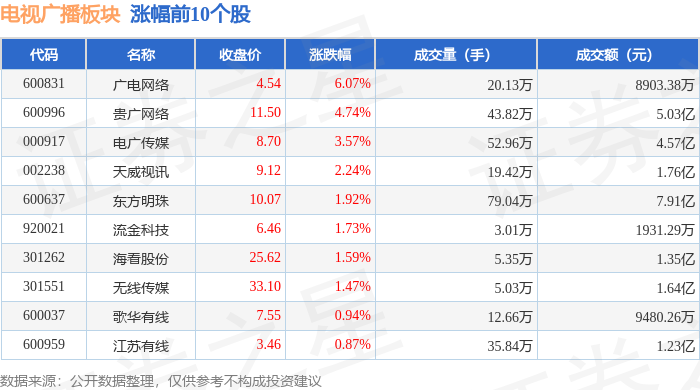
电视广播板块12月5日跌0.68%,湖北广电领跌,主力资金净流入9434.89万元
Zheng Xing Xing Ye Ri Bao· 2025-12-05 09:13
Market Overview - The television broadcasting sector experienced a decline of 0.68% on the previous trading day, with Hubei Broadcasting leading the losses [1] - The Shanghai Composite Index closed at 3902.81, up by 0.7%, while the Shenzhen Component Index closed at 13147.68, up by 1.08% [1] Individual Stock Performance - Guangdian Network (600831) saw a closing price of 4.54, with an increase of 6.07% and a trading volume of 201,300 shares, amounting to approximately 89.03 million yuan [1] - Guiguang Network (600996) closed at 11.50, up by 4.74%, with a trading volume of 438,200 shares, totaling around 503 million yuan [1] - Dianguang Media (000917) closed at 8.70, up by 3.57%, with a trading volume of 529,600 shares, amounting to about 457 million yuan [1] - Other notable performers include Tianwei Video (002238) at 9.12 (+2.24%), Dongfang Mingzhu (600637) at 10.07 (+1.92%), and Liujin Technology (920021) at 6.46 (+1.73%) [1] Fund Flow Analysis - The television broadcasting sector saw a net inflow of 94.35 million yuan from institutional investors, while retail investors experienced a net outflow of 19.53 million yuan [2] - Major stocks like Dongfang Mingzhu (600637) had a net inflow of 63.62 million yuan from institutional investors, while retail investors showed a net outflow of 49.96 million yuan [3] - Dianguang Media (000917) reported a net inflow of 37.94 million yuan from institutional investors, with retail investors experiencing a net outflow of 20.29 million yuan [3]



2025年前三季度有线电视行业运行分析
Lian He Zi Xin· 2025-12-04 11:08
Investment Rating - The report does not explicitly provide an investment rating for the cable television industry Core Insights - The cable television industry is a crucial information infrastructure for the country and is under pressure from new media and internet competition, despite some user recovery due to policy interventions [2][14] - As of Q3 2025, the actual number of cable television users reached 207 million, showing a slight decline of 0.96% compared to the end of 2024, but a quarter-on-quarter increase of 0.49% [4][35] - The total revenue of the broadcasting and television service industry in the first three quarters of 2025 was 1,048.919 billion yuan, representing a year-on-year growth of 4.59% [4] Industry Operation Status - The broadcasting and television service industry saw total revenue of 1,048.919 billion yuan in the first three quarters of 2025, with actual revenue of 193.4598 billion yuan, up 4.31% year-on-year [4] - The revenue from broadcasting institutions was 446.904 billion yuan, up 6.73%, while revenue from online audio-visual service institutions was 602.015 billion yuan, up 3.05% [4][7] - The cable television network revenue has shown limited fluctuation, indicating a stable but pressured revenue stream [5] Competitive Landscape - The cable television industry faces significant user diversion due to the growth of new media, broadband networks, and mobile communications [11] - As of Q3 2025, the number of mobile internet users reached 1.269 billion, with video app monthly active users at 799 million, accounting for 62.96% of total internet users [11] - The short video sector has also seen explosive growth, with 1.129 billion monthly active users as of September 2025 [11] Policy Developments - In 2025, significant progress was made in hotel television governance and simplification of remote controls, which helped facilitate user recovery [16] - New standards for residential projects were implemented to ensure the inclusion of cable television systems, enhancing the infrastructure for broadcasting services [17] Company Performance - Among the eight sample companies, only three reported revenue growth: Jishi Media, Jiangsu Cable, and Huashu Media, with growth rates of 3.00%, 2.79%, and 0.92% respectively [18] - The remaining five companies experienced revenue declines, with Guizhou Network and Shaanxi Broadcasting facing the most significant drops of -27.63% and -22.16% [19] - Profitability varied, with Jiangsu Cable's profit increasing by 6.08%, while Huashu Media's profit decreased by 11.36% [24] Financial Health - The average debt-to-asset ratio for sample companies was 56.19%, with some companies exceeding 80%, indicating high leverage [28] - Cash flow from investment activities was generally negative, with several companies relying on external financing to meet their needs [32] Summary - The cable television industry is experiencing user recovery due to policy support, but it continues to face intense competition from new media and the internet [35] - Revenue growth is uneven among companies, with many facing losses and increasing debt levels, while the impact of 5G services on performance remains limited [35]
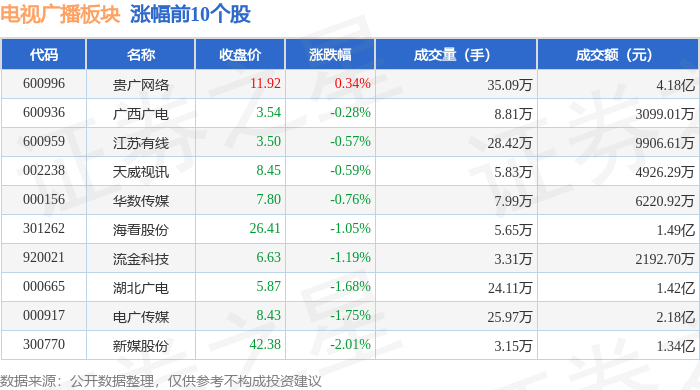
电视广播板块12月2日跌1.48%,广电网络领跌,主力资金净流出2.42亿元
Zheng Xing Xing Ye Ri Bao· 2025-12-02 09:09
Core Viewpoint - The television broadcasting sector experienced a decline of 1.48% on the trading day, with significant losses in key stocks such as Guangdian Network, which fell by 2.73% [1][2]. Market Performance - The Shanghai Composite Index closed at 3897.71, down 0.42%, while the Shenzhen Component Index closed at 13056.7, down 0.68% [1]. - The television broadcasting sector saw a net outflow of 242 million yuan from major funds, while retail investors contributed a net inflow of 187 million yuan [2][3]. Stock Performance - Key stocks in the television broadcasting sector showed varied performance: - Guangdian Network (600831) closed at 4.63, down 2.73% with a trading volume of 158,800 shares and a turnover of 73.83 million yuan [2]. - Wireless Media (301551) closed at 35.47, down 2.34% with a trading volume of 34,800 shares and a turnover of 124 million yuan [2]. - Other notable declines included: - Jishi Media (601929) down 2.31% to 3.80 [2]. - Gehua Cable (600037) down 2.30% to 7.63 [2]. - Dongfang Mingzhu (600637) down 2.28% to 9.84 [2]. Fund Flow Analysis - The fund flow analysis indicates: - Major funds showed a significant outflow from Guangdian Network, with a net outflow of 13.46 million yuan, representing an 18.23% decrease [3]. - Retail investors showed a positive net inflow into Guangdian Network, amounting to 13.03 million yuan, or 17.65% of the total [3]. - Other stocks like Jiangsu Cable (600959) and Hubei Broadcasting (000665) also experienced notable outflows from major funds [3].

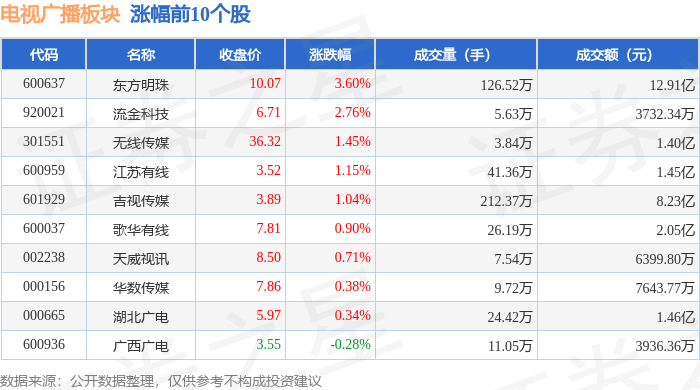
电视广播板块12月1日涨0.8%,东方明珠领涨,主力资金净流出1.94亿元
Zheng Xing Xing Ye Ri Bao· 2025-12-01 09:16
Market Overview - The television broadcasting sector increased by 0.8% compared to the previous trading day, with Dongfang Mingzhu leading the gains [1] - The Shanghai Composite Index closed at 3914.01, up 0.65%, while the Shenzhen Component Index closed at 13146.72, up 1.25% [1] Stock Performance - Key stocks in the television broadcasting sector showed varied performance, with Dongfang Mingzhu (600637) closing at 10.07, up 3.60% with a trading volume of 1.2652 million shares and a turnover of 1.291 billion [1] - Other notable performers included Liujin Technology (920021) at 6.71, up 2.76%, and Wuxian Media (301551) at 36.32, up 1.45% [1] - Conversely, Guiguang Network (600996) saw a decline of 1.90%, closing at 11.88, with a trading volume of 515,500 shares and a turnover of 623 million [2] Capital Flow - The television broadcasting sector experienced a net outflow of 194 million from institutional investors, while retail investors saw a net inflow of 199 million [2] - The capital flow data indicates that retail investors were more active in the market, contrasting with the outflows from institutional and speculative funds [2] Individual Stock Capital Flow - Liujin Technology (920021) had a net inflow of 7.1519 million from institutional investors, while it faced a net outflow of 192.67 thousand from speculative funds [3] - Other stocks like Hubei Broadcasting (000665) and Jiangsu Cable (600959) also showed mixed capital flows, with Hubei Broadcasting experiencing a net outflow of 465.82 thousand from speculative funds [3]

歌华有线北京地区超高清机顶盒突破10万端
Bei Jing Ri Bao Ke Hu Duan· 2025-11-30 12:53
Core Viewpoint - The company has made significant progress in promoting ultra-high-definition (UHD) set-top boxes, exceeding its annual targets and achieving a penetration rate of over 60% by the end of November 2025 [1][3]. Group 1: Promotion and Achievements - The company plans to promote over 450,000 UHD set-top boxes within the year, with a cumulative total of over 2.8 million units [1]. - The penetration rate of UHD set-top boxes has surpassed 60%, indicating strong market acceptance and demand [1]. - The ultra-high-definition insertable micro set-top box, developed under the guidance of the National Radio and Television Administration, has achieved a breakthrough of over 100,000 units in the Beijing cable television network [1]. Group 2: Product Features and User Experience - The ultra-high-definition insertable micro set-top box is characterized by its lightweight, intelligent design, and high compatibility, leading to innovation in industry terminals [1][3]. - Users have reported that the compact design and plug-and-play features of the micro set-top box, along with a universal remote control, have simplified the viewing experience and significantly enhanced user satisfaction [3]. Group 3: Strategic Initiatives and Future Plans - The company is enhancing its "Gohua mini" brand image and increasing the integration and supply of UHD content [3]. - The company aims to expand the coverage of UHD insertable micro set-top boxes and respond to the "2+5+N" vertical business strategy of China Broadcasting, promoting UHD services in various settings such as homes, hotels, and senior communities [3].