
Rnm(600259)

Search documents
央国企动态系列报告之57:顶层设计确定高质量发展蓝图,系统化布局夯实安全基础
CMS· 2026-02-09 03:08
Group 1: Development Goals and Framework - The State-owned Assets Supervision and Administration Commission (SASAC) has set the annual development goals centered on "two guarantees and two strives" for 2026, marking a shift towards quality and efficiency in state-owned enterprises (SOEs) [4] - The total assets of central enterprises have surpassed 95 trillion yuan, with R&D investment exceeding 1 trillion yuan for four consecutive years, indicating a focus on quality-driven growth [8] - The framework aims to guide state capital towards strategic security, public welfare, and emerging industries, providing a clear action plan for reform and development [4] Group 2: Industry Integration and Collaboration - In 2025, the restructuring of central enterprises will follow a dual-track approach, focusing on strategic formation of new central enterprises and multi-field professional integration [13] - The establishment of new central enterprises, such as China Yajiang Group and China Chang'an Automobile Group, aims to serve national macro strategies and enhance industry collaboration [14] - A total of 17 units signed agreements in key areas like artificial intelligence and new materials, creating a multi-party collaborative model involving central enterprises, private enterprises, and local governments [16] Group 3: Capital Investment and Fund Management - The total scale of the China Chengtong fund system reached 710 billion yuan, with 97.99% allocated to strategic emerging industries, demonstrating a strong focus on high-tech sectors [18] - The National Investment Group manages 61 funds with a total scale of 345.1 billion yuan, having invested in 1,249 projects and facilitated 293 companies going public [20] - The investment strategy emphasizes long-term support for innovative enterprises, with over two-thirds of funds directed towards private enterprises [20] Group 4: Resource Integration and Security - Central enterprises are undergoing intensive integration in key mineral sectors, such as iron ore and rare earths, to enhance resource control and pricing power [24] - The integration aims to create a closed-loop industry chain, improving domestic supply security and reducing reliance on imports [25] - This strategic move is seen as a vital step in ensuring national resource security and enhancing the global influence of China's mineral resources [24]




有色金属周报:节前市场波动加剧,坚定看好有色牛市
SINOLINK SECURITIES· 2026-02-08 10:24
Investment Rating - The report does not explicitly provide an investment rating for the industry Core Insights - The copper price on LME decreased by 1.65% to $12,855.0 per ton, while the Shanghai copper price fell by 3.45% to ¥100,100 per ton. The copper inventory in major regions increased by 4.03% week-on-week, and total inventory rose by 6,270 tons year-on-year [1][14] - The aluminum price on LME dropped by 3.49% to $3,026.00 per ton, and the Shanghai aluminum price decreased by 5.07% to ¥23,300 per ton. The aluminum processing industry showed a comprehensive operating rate of 57.9%, down by 1.5% week-on-week [2][15] - The gold price on COMEX increased by 6.57% to $4,988.6 per ounce, influenced by geopolitical risks and rising expectations of interest rate cuts [3][16] - The rare earth sector saw a price increase for praseodymium and neodymium oxide by 1.20%, with expectations of improved demand due to relaxed export policies [4][35] - Tungsten prices rose by 11.98% due to tight supply conditions, while tin prices fell by 15.81% amid inventory depletion [4][38] Summary by Sections Copper - LME copper price decreased by 1.65% to $12,855.0 per ton, and Shanghai copper price fell by 3.45% to ¥100,100 per ton. The processing fee index dropped to -$52.37 per ton. Copper inventory increased by 4.03% week-on-week [1][14] - The operating rate of copper cable enterprises was 60.15%, with an increase of 0.69% week-on-week. The industry maintained stable production due to new orders from State Grid [1][14] Aluminum - LME aluminum price decreased by 3.49% to $3,026.00 per ton, and Shanghai aluminum price fell by 5.07% to ¥23,300 per ton. The aluminum processing industry showed a comprehensive operating rate of 57.9%, down by 1.5% week-on-week [2][15] - The operating rate for primary aluminum alloy dropped to 57.9% due to holiday impacts and high aluminum prices [2][15] Precious Metals - COMEX gold price increased by 6.57% to $4,988.6 per ounce, driven by geopolitical risks and expectations of interest rate cuts [3][16] - SPDR gold holdings decreased by 10.87 tons to 1,076.23 tons [3][16] Rare Earths - Praseodymium and neodymium oxide prices increased by 1.20%. December exports of rare earth permanent magnets showed a year-on-year increase of 7% [4][35] - The sector is expected to benefit from relaxed export policies and increased demand [4][36] Tungsten and Tin - Tungsten prices rose by 11.98% due to tight supply conditions, while tin prices fell by 15.81% amid inventory depletion [4][38] - The supply of tin is expected to remain tight due to lower-than-expected production from Indonesia and Myanmar [4][38] Lithium and Cobalt - Lithium carbonate price decreased by 13.3% to ¥148,000 per ton, while lithium hydroxide price fell by 11.6% to ¥150,000 per ton. The total lithium production was 20,700 tons, down slightly [4][53] - Cobalt price decreased by 5.6% to ¥420,000 per ton, with stable prices for cobalt intermediates [5][54]


海南自贸港新春强势出圈!金融跨境结算实现突破 文旅消费持续火爆,物流增速亮眼,海南成万众向往宜居家园
Xin Lang Cai Jing· 2026-02-04 12:20
Group 1 - Intercontinental Oil and Gas focuses on oil exploration and development, with significant operations in Kazakhstan and the Malacca Strait, benefiting from the Hainan Free Trade Port's zero-tariff policy which will reduce equipment import costs and enhance cross-border energy trade efficiency, with a projected 30% increase in trade scale over the next three years [1][34] - Jinpan Technology, a leading manufacturer of high-end power distribution equipment, will benefit from reduced raw material costs and a 15% corporate income tax reduction, enhancing profitability and enabling expansion into the ASEAN power equipment market [2][35] - Hainan Airlines, a major player in the aviation sector, expects a significant increase in passenger traffic due to the visa-free policy for 86 countries and duty-free upgrades, with projected passenger volume exceeding 80 million by 2026 [3][36] Group 2 - Junda Co., a top photovoltaic cell manufacturer, anticipates growth in its solar business due to reduced equipment costs and tax incentives, with plans to participate in Hainan's integrated wind and solar storage projects [4][37] - Caesar Travel, a comprehensive tourism service provider, expects a doubling of cross-border tourism business and a significant increase in tourist arrivals, with projections of 180 million visitors by 2026 [5][38] - Xinda A, a diversified company focusing on motorcycle manufacturing and coal mining, aims to leverage the zero-tariff policy to enhance profitability and expand into the electric vehicle market [6][39] Group 3 - ST Huluwawa, a leading pediatric pharmaceutical company, will benefit from reduced raw material costs and tax incentives, with plans to expand into the ASEAN pharmaceutical market [8][40] - Hainan Ruize, a construction industry leader, anticipates a surge in infrastructure demand with projected investments exceeding 100 billion by 2026, benefiting from the Hainan Free Trade Port's policies [9][42] - Hainan Airport, a key player in airport operations, expects a doubling of cargo business and significant passenger growth due to the visa-free policy and duty-free upgrades [10][43] Group 4 - Hainan Development, an investment platform, anticipates a substantial increase in duty-free sales, projected to exceed 100 billion by 2026, benefiting from the Hainan Free Trade Port's policies [11][45] - Hainan Highway, a major highway operator, expects a significant increase in traffic volume, projected to exceed 200 million vehicles by 2026, benefiting from the integration of tourism and real estate [20][56] - Hainan Rubber, the world's largest natural rubber producer, aims to expand its market presence in ASEAN due to favorable trade policies and tax incentives [21][57]


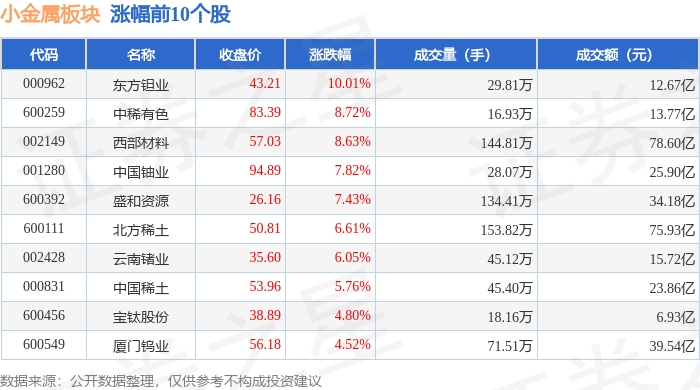
小金属板块2月3日涨4.94%,东方钽业领涨,主力资金净流入6.25亿元
Zheng Xing Xing Ye Ri Bao· 2026-02-03 09:03
Group 1 - The small metals sector increased by 4.94% on February 3, with Dongfang Tantalum leading the gains [1] - The Shanghai Composite Index closed at 4067.74, up 1.29%, while the Shenzhen Component Index closed at 14127.1, up 2.19% [1] - Notable performers in the small metals sector included Dongfang Silver Industry, which rose by 10.01% to a closing price of 43.21, and Zhong Rare Metals, which increased by 8.72% to 83.39 [1] Group 2 - The small metals sector saw a net inflow of 625 million yuan from main funds, while retail funds had a net inflow of 364 million yuan, and speculative funds experienced a net outflow of 989 million yuan [2] - The top stocks by main fund inflow included Beifang Rare Earth with a net inflow of 347 million yuan, and Dongfang Aluminum with 286 million yuan [3] - The overall trading volume for the small metals sector was significant, with stocks like Xiamen Tungsten Industry achieving a trading volume of 715,100 shares and a transaction value of 3.954 billion yuan [1][2]


矿产央企罕见大整合
经济观察报· 2026-02-02 11:47
Core Viewpoint - The recent actions of three central enterprises in China, focusing on iron ore, copper, zinc, and rare earths, represent a significant and rare strategic move in the mineral sector, driven by national policy and aimed at enhancing resource control and pricing power [2][4][20]. Group 1: Recent Acquisitions and Restructuring - China Nonferrous Metal Mining Group acquired 55% of Kazakhstan's SMMinerals for $89 million, securing 158,000 tons of copper resources [2][8]. - China Nonferrous Metal Group's subsidiary purchased Peru's Raura zinc mine for $106.85 million, gaining 106,850 tons of zinc [2][8]. - Minmetals Development announced a restructuring plan to acquire 100% of Minmetals Mining and Luzhong Mining, controlling over 4 billion tons of iron ore resources, transforming into "China's first iron ore stock" [2][6]. Group 2: Strategic Importance and Policy Support - The restructuring actions are not isolated but are part of a systematic reorganization under national strategic guidance, addressing long-standing issues of resource fragmentation and efficiency [4][14]. - The State-owned Assets Supervision and Administration Commission emphasized optimizing the layout of state-owned capital, focusing on strategic security and key industries [4][14]. - The recent legal interpretations have simplified transaction processes and reduced risks associated with mineral rights transfers, facilitating smoother mergers and acquisitions [16][20]. Group 3: Market Conditions and Timing - The current market conditions, including low iron ore prices and improving steel industry profits, provide a favorable environment for asset injections, allowing for lower acquisition costs [17][19]. - The rare earth market is experiencing a supply shortage, with prices for praseodymium and neodymium oxides rising by 27.4% in 2025, creating an opportune moment for consolidation [18][19]. Group 4: Industry Impact and Future Outlook - The consolidation efforts aim to reshape pricing power in key mineral resources, addressing China's historical reliance on foreign pricing mechanisms [22][24]. - The integration of resources is expected to enhance domestic supply chain security and create a dual-circulation system for critical minerals [24][25]. - The restructuring is anticipated to lead to a fundamental shift in valuation logic for central enterprises, with potential for significant market capitalization recovery [25].

矿产央企罕见大整合
Jing Ji Guan Cha Wang· 2026-02-02 09:04
Core Viewpoint - The Chinese mineral market is experiencing significant activity driven by three central enterprises, focusing on strategic acquisitions in key mineral sectors such as iron ore, copper, zinc, and rare earths [2][3][21]. Group 1: Recent Acquisitions and Restructuring - China Nonferrous Metal Mining Group acquired a 55% stake in Kazakhstan's SMMinerals for $89 million, securing 1.58 million tons of copper resources [2][7]. - China Nonferrous Metal Group's subsidiary, China Nonferrous Metal Industry Co., purchased a 99.9% stake in Peru's Raura zinc mine for $106.85 million, obtaining 106,850 tons of zinc [2][7]. - Minmetals Development announced a restructuring plan to divest low-margin trading assets and acquire 100% stakes in Minmetals Mining and Luzhong Mining, gaining control of over 4 billion tons of iron ore resources [2][4]. Group 2: Strategic Importance and Policy Support - The recent actions of these central enterprises are not typical annual operations but are seen as landmark industry events driven by policy support and a focus on optimizing state-owned capital [3][13]. - The State-owned Assets Supervision and Administration Commission (SASAC) emphasized the need for restructuring and integration of state-owned enterprises to enhance strategic security and resource control [3][13][20]. Group 3: Market Dynamics and Timing - The timing of these acquisitions aligns with favorable market conditions, such as low iron ore prices and rising demand for rare earths, providing a strategic window for these enterprises [17][18]. - The integration of high-quality assets is expected to enhance profitability, with projected gross margins for iron ore assets reaching around 40% [18]. Group 4: Industry Impact and Future Outlook - The consolidation of these enterprises is anticipated to reshape the industry landscape, enhancing China's pricing power in key mineral resources and reducing reliance on foreign suppliers [21][24]. - The integration efforts are expected to create a more secure supply chain for critical minerals, supporting domestic industries and mitigating risks from international market fluctuations [25][26].
中稀有色金属股份有限公司 2025年度业绩预告
Zhong Guo Zheng Quan Bao - Zhong Zheng Wang· 2026-01-27 23:45
Core Viewpoint - The company expects to achieve a turnaround in profitability for the fiscal year 2025, projecting a net profit attributable to shareholders of the parent company between 100 million and 130 million yuan, compared to a loss in the previous year [2][4]. Group 1: Performance Forecast - The performance forecast period is from January 1, 2025, to December 31, 2025 [3]. - The expected net profit attributable to shareholders of the parent company is projected to be between 100 million and 130 million yuan, indicating a turnaround from the previous year's loss [4]. - The expected net profit, after deducting non-recurring gains and losses, is estimated to be between 130 million and 160 million yuan [5]. Group 2: Previous Year’s Financial Performance - In the previous year, the total profit was -355.2282 million yuan, with a net profit attributable to shareholders of the parent company at -298.5037 million yuan [6]. - The net profit attributable to shareholders of the parent company, after deducting non-recurring gains and losses, was -311.7215 million yuan [6]. - The earnings per share for the previous year were -0.89 yuan [7]. Group 3: Reasons for Profit Turnaround - The overall market for rare earths is expected to rise in 2025, and the company plans to capitalize on this by enhancing market analysis, improving management, and innovating marketing strategies, leading to increased production and sales of rare earth smelting separation and permanent magnet materials [7]. - The company will focus on its core business, intensifying efforts to eliminate inefficient assets and exit loss-making enterprises, thereby optimizing its asset structure and fundamentally reducing sources of loss [7]. - The company’s equity investment in the Baoshan company is expected to yield increased profits due to rising copper, sulfur, and tungsten prices during the reporting period [7].
中稀有色:预计2025年盈利1亿元-1.3亿元 同比扭亏
Zhong Guo Zheng Quan Bao· 2026-01-27 12:04
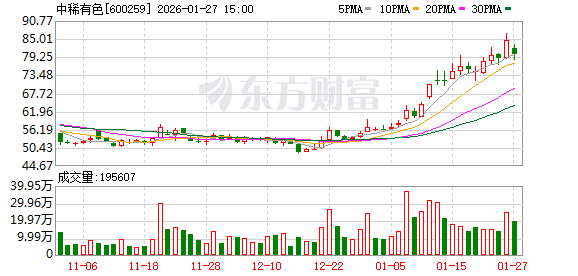
Group 1 - The company, Zhongxi Rare Earth (600259), forecasts a net profit attributable to shareholders of 100 million to 130 million yuan for 2025, compared to a loss of 299 million yuan in the same period last year [4] - The expected net profit excluding non-recurring items is projected to be between 130 million and 160 million yuan, also an improvement from a loss of 312 million yuan in the previous year [4] - As of January 27, the company's price-to-earnings ratio (TTM) is approximately 207.68 to 269.99 times, with a price-to-book ratio (LF) of about 7.73 times and a price-to-sales ratio (TTM) of around 3.18 times [4] Group 2 - The company primarily engages in rare earth mining, smelting separation, deep processing, and non-ferrous metal trading [15] - The performance change is attributed to the overall rising trend in the rare earth market in 2025, with the company actively seizing opportunities through enhanced market analysis and management, leading to increased sales of rare earth smelting separation and permanent magnet materials [15] - The company is focusing on its core business, increasing efforts to eliminate inefficient assets and exit loss-making enterprises, which has impacted current profits due to associated reform costs [15]
中稀有色(600259.SH)发预盈,预计2025年度归母净利润1亿元至1.3亿元
智通财经网· 2026-01-27 11:53
Core Viewpoint - The company, Zhong Rare Earth (600259.SH), forecasts a net profit attributable to shareholders of the parent company for 2025 to be between 100 million and 130 million yuan, indicating a turnaround from losses in the previous year [1] Group 1: Financial Performance - The expected net profit for 2025 represents a significant improvement compared to the previous year's statutory disclosure data, marking a return to profitability [1] - The company attributes this positive outlook to the overall rising trend in the rare earth market for 2025 [1] Group 2: Strategic Initiatives - The company is actively seizing market opportunities by enhancing market analysis, coordinating enterprise management, and strengthening upstream and downstream marketing collaboration [1] - Innovations in marketing strategies have contributed to the growth in the production and sales of rare earth smelting separation and permanent magnet materials [1] Group 3: Challenges - The company's performance in the fourth quarter has been impacted by a decline in prices of medium and heavy rare earth products, ongoing reforms, and the recognition of investment impairments in associated enterprises [1]
中稀有色:2025年全年净利润预计同比扭亏
2 1 Shi Ji Jing Ji Bao Dao· 2026-01-27 10:06
Core Viewpoint - The company expects to achieve a net profit attributable to shareholders of 100 million to 130 million yuan for the year 2025, indicating a turnaround from previous losses, driven by favorable market conditions in the rare earth sector [1] Group 1: Financial Performance - The projected net profit for 2025 is between 100 million and 130 million yuan, with a non-GAAP net profit (excluding non-recurring gains and losses) expected to be between 130 million and 160 million yuan [1] - The company experienced a decline in performance in the fourth quarter due to falling prices of medium and heavy rare earth products, reform-related costs, and impairment losses from equity investments [1] Group 2: Market Strategy - The company has actively seized market opportunities by enhancing market analysis, managing operations effectively, and improving collaboration in marketing across the supply chain, leading to increased production and sales of rare earth smelting separation and permanent magnet materials [1] - Continuous focus on core business development and efforts to eliminate inefficient assets and exit loss-making enterprises are part of the strategy to optimize the asset structure and fundamentally reduce sources of loss [1] Group 3: Investment Performance - The company’s equity investment in Da Baoshan Company has yielded increased profits due to sustained high production levels and rising prices of copper, sulfur, and calcium during the reporting period, resulting in higher investment income recognized under the equity method [1]