
ELION(600277)

Search documents
亿利洁能索赔案已有获赔
Xin Lang Cai Jing· 2026-02-25 03:57
2026年2月24日,上海久诚律师事务所股票索赔律师许峰代理的亿利洁能(600277)虚假陈述索赔案再 向呼和浩特市中级人民法院提交一次立案。(许峰律师专栏) 许峰律师代理的亿利洁能(600277)投资者索赔案已多次向法院提交立案,目前正在等待法院的下一步 安排。律师团队目前还在继续推进后续案件的立案工作,还在继续接受其他投资者的索赔委托。 2025年9月12日,亿利洁能公告收到证监会内蒙古监管局行政处罚事先告知书,经查明,亿利洁能、亿 利集团涉嫌存在以下违法事实: 一、亿利洁能在股票和债券市场披露的信息存在虚假记载、重大遗漏 1、2016年至2022年,亿利洁能及其子公司通过虚增利润、资产、收入等进行财务造假。 2、2017年至2022年,亿利洁能及其子公司为控股股东及其关联方提供担保。 许峰律师认为,在2017年4月18日到2024年4月24日之间买入亿利洁能股票,并在2024年4月24日之后卖 出或持有股票的投资者,目前还可发起索赔。(ST亿利维权入口) 除了亿利洁能投资者索赔案再次提交法院立案,许峰律师代理的部分保利联合(维权)(002037)投资 者索赔案已经获赔到位,律师团队也还在继续接受其他投资 ...


亿利洁能索赔递交立案,律师提示符合区间即可加入
Xin Lang Cai Jing· 2026-01-05 07:56
Core Viewpoint - The article discusses the legal actions being taken against Yili Clean Energy for securities fraud, highlighting the importance of investor rights and the ongoing litigation process [1][2][3]. Group 1: Legal Proceedings - The Liu Peng lawyer team from Shanghai Huzhi Law Firm is representing investors in a lawsuit against Yili Clean Energy for false statements, with cases already submitted to the court [1][2]. - Yili Clean Energy has been delisted as of July 18, 2024, and will face administrative penalties from the Inner Mongolia Securities Regulatory Bureau due to eight years of financial fraud [1][2]. Group 2: Financial Fraud Details - The fraudulent activities of Yili Clean Energy spanned from 2016 to 2022, involving methods such as fictitious futures trading, inflated investment income, and fabricated trade operations to artificially boost profit totals [4]. - To conceal the financial misconduct of its controlling shareholder, Yili Group, the company also inflated cash reserves and fabricated financial asset transactions [4]. Group 3: Investor Rights and Compensation - Investors who purchased shares between April 18, 2017, and April 23, 2024, and sold or still hold shares after April 24, 2024, are eligible to participate in the legal claims [3][4]. - The actual losses that investors can claim include the difference in investment losses, as well as associated commissions and stamp duties [4].
上市公司财务造假,财务总监和实控人都干了什么?
Sou Hu Cai Jing· 2025-12-24 16:08
Core Viewpoint - Financial fraud has severely undermined the principles of fairness and transparency in the A-share market, harming the legitimate rights and interests of investors, with over 10 listed companies facing penalties and forced delisting since 2025, including five companies receiving fines exceeding 100 million RMB [1][3]. Group 1: Financial Fraud Cases - Numerous typical cases of financial fraud in listed companies over the past three to five years have been identified, including companies like Zijing Storage, Kangde Xin, Guizhou Bailing, and Yili Clean Energy, revealing complex relationships between actual controllers and financial directors, as well as chaotic corporate governance [3][4]. - In the case of Kangde Xin, the actual controller and financial director conspired to implement systematic financial fraud for seven years, while Zijing Storage's actual controller organized high-level executives to inflate revenue through fake contracts and falsified documents [4][5]. - The financial fraud methods commonly employed include inflating profits, manipulating costs, and creating fictitious assets, often involving collusion among key personnel [6][8]. Group 2: Penalties and Consequences - The penalties for financial fraud have been severe, with individuals facing both administrative and criminal consequences. For instance, Kangde Xin's actual controller received a 15-year prison sentence and a fine of 202 million RMB, while the financial director received a 13-year sentence and a fine of 10.15 million RMB [5][9]. - Companies involved in financial fraud face significant repercussions, such as ST Gaohong, which reported a cumulative litigation amount of 3.511 billion RMB, representing 427.64% of its latest audited net assets [9][10]. - The ongoing issues of financial fraud and deceptive practices are seen as major threats to the healthy development of China's capital market, undermining investor confidence and market fairness [9][10]. Group 3: Systemic Issues and Recommendations - The prevalence of financial fraud highlights systemic issues within corporate governance, including failures in internal controls and potential negligence by auditing firms, with some cases involving extensive collusion with third parties [10]. - Experts suggest that regulatory oversight of listed companies should be strengthened, with increased penalties for fraudulent activities and accountability for auditing firms and colluding third parties to maintain the integrity of the capital market [10].


8年造假欺诈 亿利洁能案暴露资本市场多重顽疾
Zhong Guo Jing Ji Wang· 2025-12-18 01:27
Core Viewpoint - The case of Yili Clean Energy Co., Ltd. (referred to as "Linen 5") highlights the regulatory stance of "delisting does not exempt from liability" and emphasizes the need for stronger oversight of listed companies and their auditors [1][3]. Group 1: Regulatory Actions and Penalties - Yili Clean Energy was fined 375 million yuan for long-term financial fraud and fraudulent bond issuance, potentially setting a record for penalties against a delisted company in China [1][2]. - The penalties include 210 million yuan for Yili Clean Energy, with the controlling shareholder and 29 responsible individuals facing severe fines and market bans [3]. Group 2: Financial Misconduct Details - From 2016 to 2023, Yili Clean Energy engaged in financial fraud, including inflating profits by over 125 million yuan, assets by over 11 billion yuan, and revenues by over 13 billion yuan [2]. - The company also failed to disclose non-operational fund usage by its controlling shareholder, which amounted to 3.906 billion yuan [2]. Group 3: Governance and Audit Failures - The internal governance of Yili Clean Energy was ineffective, allowing the controlling shareholder to manipulate the company for personal gain, indicating a failure in the board and audit committee's oversight [4]. - The auditing firm, Crowe Horwath, issued unqualified audit reports for seven consecutive years despite the ongoing fraud, raising concerns about their diligence [5]. Group 4: Systemic Issues and Recommendations - The case reveals systemic issues in corporate governance, audit practices, and the existence of a fraudulent industry chain involving third parties [4][5]. - Experts recommend strengthening regulatory frameworks, enhancing investor protection mechanisms, and improving the accountability of auditing firms and third-party collaborators [6][8].
亿利洁能索赔持续征集,退市仍可加入
Xin Lang Cai Jing· 2025-12-09 07:58
受损股民可至新浪股民维权平台登记该公司维权:http://wq.finance.sina.com.cn/ 关注@新浪证券、微信关注新浪券商基金、百度搜索新浪股民维权、访问新浪财经客户端、 新浪财经首页都能找到我们! 一、部分案件已递交立案 上海沪紫律师事务所刘鹏律师团队代理的投资者诉亿利洁能证券虚假陈述案,已陆续递交法院立案审 理。值得注意的是该公司已于2024年7月18日终止上市。(刘鹏律师专栏) 受损股民可至新浪股民维权平台登记该公司维权:http://wq.finance.sina.com.cn/ 关注@新浪证券、微信关注新浪券商基金、百度搜索新浪股民维权、访问新浪财经客户端、 新浪财经首页都能找到我们! 一、部分案件已递交立案 在退市一年后,2025年9月,内蒙古证监局公布了对亿利洁能的行政处罚决定,因长达8年的财务造假行 为被处以巨额罚款。 依据相关法律法规,符合于2017年4月18日-2024年4月23日期间买入,并在2024年4月24日之后卖出或仍 持有而亏损的即可参与维权。对于权益受损的投资者而言,唯有通过法律途径主动维权,才能弥补部分 损失,维护自身合法权益。(ST亿利维权入口) 二、连续八 ...
亿利洁能索赔案已有胜诉
Xin Lang Cai Jing· 2025-10-22 09:16
Group 1 - The core issue involves investor claims against Yili Clean Energy (亿利洁能) due to false statements leading to financial losses [1] - Yili Clean Energy has been accused of financial fraud, including inflating profits, assets, and revenues from 2016 to 2022 [1] - The company allegedly provided guarantees to its controlling shareholders and related parties from 2017 to 2022 [1] Group 2 - Investors who purchased Yili Clean Energy stock between April 18, 2017, and April 24, 2024, may initiate claims if they sold or held the stock after April 24, 2024 [2] - There is a precedent for successful claims against Simai Media (思美传媒) for false statements, indicating a potential for similar outcomes in Yili Clean Energy's case [2] - Simai Media was found to have misrepresented its relationship with Douyin, leading to stock price manipulation [3]

亿利洁能索赔案已有获赔先例
Xin Lang Cai Jing· 2025-10-14 02:33
Core Points - The lawsuit for investor compensation against Yili Clean Energy (600277) due to false statements has been resubmitted to the court, with ongoing efforts to accept more claims from investors [1][2] - The company has been found to have committed financial fraud from 2016 to 2022, including inflating profits, assets, and revenues through various deceptive practices [1][2] - The company provided guarantees to its controlling shareholder and related parties, and facilitated fund transfers through various financial agreements [2] Financial Misconduct - From 2016 to 2022, Yili Clean Energy inflated profits by amounts ranging from 1,928.89 thousand to 8,268.53 thousand, which represented 3.76% to 9.37% of the reported profit totals for those years [1] - The company also inflated assets by amounts ranging from 70,010.00 thousand to 311,519.33 thousand, accounting for 2.06% to 8.49% of the reported total assets [1] - Revenue was inflated by amounts ranging from 70,879.63 thousand to 354,577.68 thousand, representing 5.70% to 22.62% of the reported revenue [1] Legal Context - Investors who purchased Yili Clean Energy stock between April 18, 2017, and April 24, 2024, may still initiate claims based on the identified violations [2] - The statute of limitations for claims against Poly Union (002037) is running out, with some cases already reaching settlement agreements [2][3] - Poly Union was found to have understated bad debt provisions, leading to inflated net profits in 2019, 2020, and 2021, with the latter year showing a 124.47% overstatement of net profit [2]
光伏治沙,中国鄂尔多斯还需克服哪些"坎"
Zhong Guo Xin Wen Wang· 2025-09-28 06:05
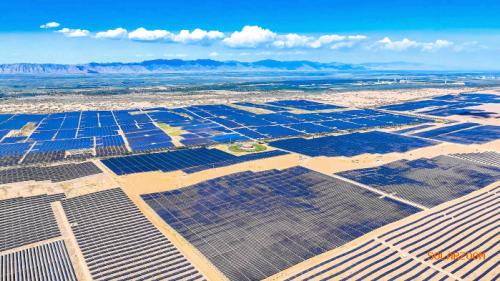
Core Viewpoint - Ordos, known as "China's coal capital," has been a leader in photovoltaic (PV) desertification control, benefiting from reduced sandstorms and increased agricultural productivity through innovative PV projects [1][3][6] Group 1: Photovoltaic Projects and Economic Impact - The 2 million kW PV desertification project in the Kubuqi Desert began construction in June 2022 and is expected to generate 4.1 billion kWh annually, saving 1.23 million tons of standard coal and reducing CO2 emissions by 3.198 million tons [3][4] - Local farmers have reported significant income from crops grown under PV panels, with one farmer earning 50,000 yuan from 12 acres of tomatoes sold to major cities [3][4] Group 2: Environmental Benefits and Sustainability - The dual function of PV panels in desert areas helps stabilize sand, conserve water, and create microclimates for plant growth, contributing to sustainable desert management [4][5] - The integration of PV and desertification control is seen as a way to enhance ecological restoration and carbon sequestration, with the potential for improved vegetation and soil quality [7][9] Group 3: Future Development and Challenges - Ordos has approved a total of 39.79 million kW of PV capacity, with plans to achieve over 30 million acres of PV desertification control, creating a "PV Great Wall" to protect the Yellow River [6][7] - Experts highlight the need for standardized construction and recognition criteria for PV desertification projects to facilitate broader implementation and success [8][9]

亿利洁能索赔案持续推进
Xin Lang Cai Jing· 2025-09-24 07:38
Core Viewpoint - The article discusses ongoing legal actions against Yili Clean Energy (亿利洁能) and Guangyuyuan (广誉远) for alleged financial misconduct and false statements, with investors seeking compensation for losses incurred due to these actions [1][2][3]. Group 1: Yili Clean Energy (亿利洁能) - Yili Clean Energy is facing multiple investor compensation claims due to false statements and financial misconduct, with cases submitted to the Hohhot Intermediate People's Court [1]. - The company has been accused of financial fraud from 2016 to 2022, including inflating profits, assets, and revenues, as well as providing guarantees to controlling shareholders and related parties [1]. - The company allegedly engaged in fraudulent bond issuance and misled investors regarding its financial health [1]. Group 2: Guangyuyuan (广誉远) - Guangyuyuan is also under scrutiny for false disclosures related to its sales practices from 2016 to 2021, including improper revenue recognition and mismanagement of sales expenses [2]. - Investors who purchased Guangyuyuan stock between March 21, 2017, and December 29, 2023, may still initiate compensation claims [3]. - The company has been found to have misrepresented its "buyout sales" model, leading to significant inaccuracies in its annual reports [2].

多家公司同日披露收到监管“罚单”说明了什么
Zheng Quan Ri Bao· 2025-09-21 15:24
Group 1 - Regulatory bodies have intensified scrutiny on financial fraud, fund misappropriation, and information disclosure violations, with 20 companies receiving penalties since September, including one under investigation and five receiving advance notice of administrative penalties [1][2] - Over half of the penalties issued in September are related to financial fraud, with two penalties exceeding 100 million yuan, highlighting a zero-tolerance approach from regulators [2] - The principle of "delisting does not exempt from liability" is being enforced, with three delisted companies receiving penalties for financial fraud and failure to disclose reports on time, emphasizing that all market participants must adhere to compliance [3] Group 2 - Regulatory efforts aim to create a "survival of the fittest" market ecosystem, protecting investors' rights by punishing fraudulent companies and reallocating resources to well-governed firms [4] - The current administrative penalties serve as a basis for civil and criminal accountability, with a comprehensive accountability system expected to increase the cost of violations and uphold fairness in the capital market [4] - There is a need for improved preemptive regulation to prevent issues before they arise, with calls for better institutional design and enhanced responsibilities for intermediary organizations [4] Group 3 - The recent surge in penalties sends a clear message that regulatory bodies are committed to creating a more standardized, transparent, and vibrant capital market, thereby boosting investor confidence and enhancing the market's role in supporting the real economy [5]


