
CNOOC EnerTech(600968)

Search documents
油服工程板块12月1日涨1.78%,科力股份领涨,主力资金净流出1.13亿元
Zheng Xing Xing Ye Ri Bao· 2025-12-01 09:16
Core Insights - The oil service engineering sector experienced a rise of 1.78% on December 1, with Keli Co., Ltd. leading the gains [1] - The Shanghai Composite Index closed at 3914.01, up 0.65%, while the Shenzhen Component Index closed at 13146.72, up 1.25% [1] Stock Performance - Keli Co., Ltd. (code: 920088) closed at 32.01, with a gain of 6.17% and a trading volume of 39,200 shares, amounting to a transaction value of 123 million yuan [1] - Tongyuan Petroleum (code: 300164) closed at 6.13, up 5.69%, with a trading volume of 1,137,300 shares and a transaction value of 687 million yuan [1] - Zhun Oil Co., Ltd. (code: 002207) closed at 8.68, increasing by 4.20%, with a trading volume of 320,300 shares and a transaction value of 277 million yuan [1] - Other notable performers include Shihua Oil Service (code: 600871) with a 3.07% increase and a closing price of 2.35, and Tian Sihua (code: 601808) with a 2.29% increase, closing at 14.29 [1] Fund Flow Analysis - The oil service engineering sector saw a net outflow of 113 million yuan from institutional investors, while retail investors contributed a net inflow of 168 million yuan [2] - Keli Co., Ltd. had a net inflow of 11.38 million yuan from institutional investors, representing 9.25% of its total trading volume [3] - Other companies like Haiyou Development (code: 600968) and Tongyuan Petroleum experienced mixed fund flows, with Haiyou Development seeing a net inflow of 10.62 million yuan from institutional investors [3]







一项发明专利获授权
Qi Lu Wan Bao· 2025-11-27 21:51
Core Viewpoint - The invention of a method for dynamic deformation and sound insulation analysis of door seals has been granted a national invention patent, which enhances noise control in well repair operations [1] Group 1 - The patented method is designed for noise control analysis in well repair operations, specifically for the evaluation of dynamic deformation and sound insulation of door seals [1] - It enables rapid assessment of different cross-sections of sealing strips and calculates sound insulation, establishing a database for dynamic deformation and sound insulation of various cross-sections [1] - The method supports better optimization of door sound insulation, features a simple processing model, and allows for efficient calculations [1]

海油发展:天津院水质检测预制试剂是专为水质快速分析而设计的粉状化学试剂
Zheng Quan Ri Bao· 2025-11-27 13:41
Core Viewpoint - The company Haiyou Development has introduced a new powdered chemical reagent designed for rapid water quality analysis, addressing key technical challenges in the field [2] Group 1: Product Features - The reagent is specifically designed for quick and accurate detection of water quality [2] - It utilizes a precise formulation and solid reaction component encapsulation technology [2] - The product allows for a simple procedure where users can add water samples to complete the color reaction [2] Group 2: Technical Advantages - The reagent overcomes significant technical bottlenecks such as poor stability of key reagents in complex water bodies and high color interference [2] - This innovation enhances the reliability of water quality testing [2] Group 3: Company Communication - The company has engaged with investors through an interactive platform to provide insights on this new product [2] - Further significant matters related to the company will be disclosed through designated information disclosure media [2]
油服工程板块11月27日涨0.07%,仁智股份领涨,主力资金净流出309.35万元
Zheng Xing Xing Ye Ri Bao· 2025-11-27 09:13
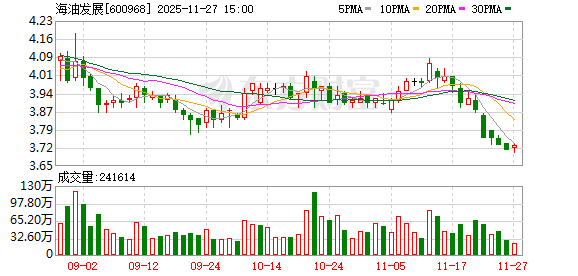
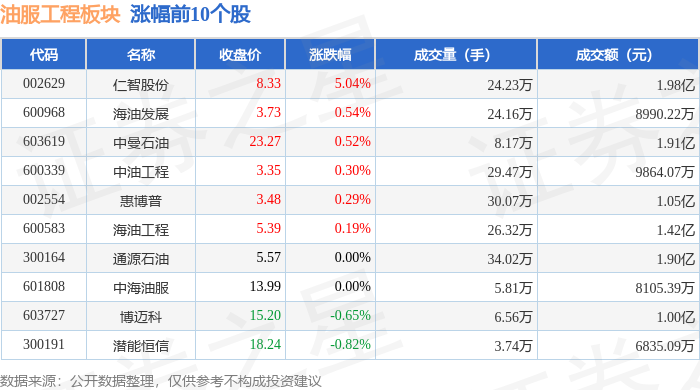
Market Overview - The oil service engineering sector saw a slight increase of 0.07% on November 27, with Renji Co., Ltd. leading the gains [1] - The Shanghai Composite Index closed at 3875.26, up 0.29%, while the Shenzhen Component Index closed at 12875.19, down 0.25% [1] Stock Performance - Renji Co., Ltd. (002629) closed at 8.33, up 5.04% with a trading volume of 242,300 shares [1] - Other notable stocks included: - CNOOC Development (600968) at 3.73, up 0.54% [1] - Zhongman Petroleum (603609) at 23.27, up 0.52% [1] - China Oil Engineering (600339) at 3.35, up 0.30% [1] - The overall trading volume and turnover for the oil service engineering sector were significant, with various stocks showing mixed performance [1][2] Capital Flow - The oil service engineering sector experienced a net outflow of 3.09 million yuan from institutional investors, while retail investors saw a net inflow of 30.19 million yuan [2] - The detailed capital flow for specific stocks indicated varying trends, with some stocks experiencing significant outflows from institutional and speculative investors [3] Individual Stock Capital Flow - Major stocks and their capital flow included: - CNOOC Engineering (600583) with a net inflow of 21.34 million yuan from institutional investors [3] - Zhongman Petroleum (603619) with a net inflow of 18.28 million yuan [3] - However, stocks like Huibo Energy (002554) and PetroChina Oilfield Services (600871) faced notable net outflows [3]


油服工程板块11月18日跌1.87%,石化油服领跌,主力资金净流出1.36亿元
Zheng Xing Xing Ye Ri Bao· 2025-11-18 08:11
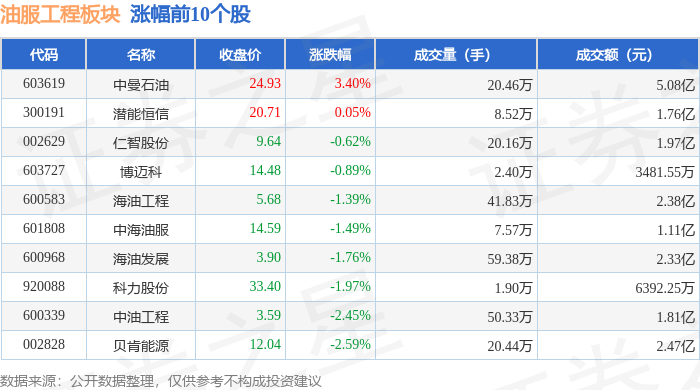
Core Insights - The oil service engineering sector experienced a decline of 1.87% on November 18, with PetroChina Oilfield Services leading the drop [1] - The Shanghai Composite Index closed at 3939.81, down 0.81%, while the Shenzhen Component Index closed at 13080.49, down 0.92% [1] Stock Performance - Zhongman Petroleum (603619) closed at 24.93, up 3.40% with a trading volume of 204,600 shares and a transaction value of 508 million yuan [1] - Potential Energy (300191) closed at 20.71, up 0.05% with a trading volume of 85,200 shares and a transaction value of 176 million yuan [1] - Other notable declines include PetroChina Oilfield Services (600871) down 4.26% and Tongyuan Petroleum (300164) down 3.73% [2] Capital Flow - The oil service engineering sector saw a net outflow of 136 million yuan from institutional investors, while retail investors had a net inflow of 184 million yuan [2] - Major stocks like Zhongman Petroleum and Renji Co. experienced mixed capital flows, with Zhongman Petroleum seeing a net inflow of 33.83 million yuan from institutional investors [3]


海油发展跌2.02%,成交额1.66亿元,主力资金净流出2455.45万元
Xin Lang Cai Jing· 2025-11-18 06:00
Core Viewpoint - CNOOC Development's stock price has experienced a decline, with a current trading price of 3.89 CNY per share and a market capitalization of 39.542 billion CNY, reflecting a year-to-date drop of 5.93% [1] Financial Performance - For the period from January to September 2025, CNOOC Development reported a revenue of 33.947 billion CNY, representing a year-on-year growth of 0.81%, and a net profit attributable to shareholders of 2.853 billion CNY, which is a 6.11% increase compared to the previous year [2] Shareholder Information - As of September 30, 2025, the number of shareholders for CNOOC Development increased by 10.86% to 74,000, while the average circulating shares per person decreased by 9.79% to 137,449 shares [2] - CNOOC Development has distributed a total of 4.747 billion CNY in dividends since its A-share listing, with 3.354 billion CNY distributed over the past three years [3] Institutional Holdings - As of September 30, 2025, Hong Kong Central Clearing Limited is the second-largest circulating shareholder with 100 million shares, a decrease of 5.92672 million shares from the previous period [3] - The Southern CSI 500 ETF ranks as the fifth-largest circulating shareholder with 29.432 million shares, down by 685,100 shares compared to the last period [3]
油服工程板块11月17日跌0.21%,科力股份领跌,主力资金净流出6579.46万元
Zheng Xing Xing Ye Ri Bao· 2025-11-17 09:00
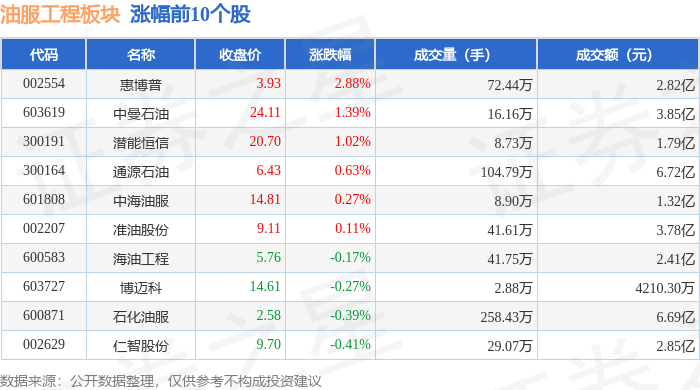
Core Viewpoint - The oil service engineering sector experienced a slight decline of 0.21% on November 17, with Keli Co., Ltd. leading the losses. The Shanghai Composite Index closed at 3972.03, down 0.46%, while the Shenzhen Component Index closed at 13202.0, down 0.11% [1]. Group 1: Market Performance - The oil service engineering sector's performance was mixed, with individual stocks showing varied results. For instance, Huibo Yin increased by 2.88% to close at 3.93, while Keli Co., Ltd. fell by 2.41% to 34.07 [1][2]. - The trading volume for Huibo Yin was 724,400 shares, with a transaction value of 282 million yuan, while Keli Co., Ltd. had a trading volume of 21,000 shares and a transaction value of 71.71 million yuan [1][2]. Group 2: Capital Flow - The oil service engineering sector saw a net outflow of 65.79 million yuan from institutional investors, while retail investors contributed a net inflow of 4.12 million yuan [2]. - Among individual stocks, Tongyuan Petroleum had a net inflow of 17.68 million yuan from institutional investors, while Keli Co., Ltd. experienced a net outflow of 8.81 million yuan [3].

油服工程板块11月14日涨0.22%,仁智股份领涨,主力资金净流出1.41亿元
Zheng Xing Xing Ye Ri Bao· 2025-11-14 08:58
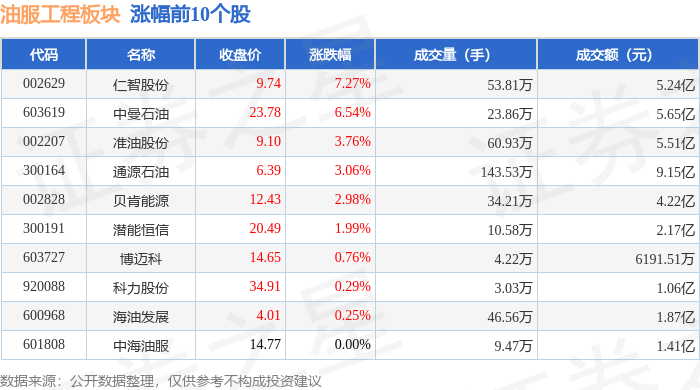
Market Overview - The oil service engineering sector increased by 0.22% on November 14, with Renji Co., Ltd. leading the gains [1] - The Shanghai Composite Index closed at 3990.49, down 0.97%, while the Shenzhen Component Index closed at 13216.03, down 1.93% [1] Stock Performance - Renji Co., Ltd. (002629) closed at 9.74, up 7.27% with a trading volume of 538,100 shares and a transaction value of 524 million yuan [1] - Zhongman Petroleum (603619) closed at 23.78, up 6.54% with a trading volume of 238,600 shares and a transaction value of 565 million yuan [1] - Other notable performers include: - Zhun Oil Co. (002207) up 3.76% to 9.10 [1] - Tongyuan Petroleum (300164) up 3.06% to 6.39 [1] - Beiken Energy (002828) up 2.98% to 12.43 [1] Fund Flow Analysis - The oil service engineering sector experienced a net outflow of 141 million yuan from institutional investors, while retail investors saw a net inflow of 182 million yuan [2] - The detailed fund flow for selected stocks includes: - Zhun Oil Co. (002207) with a net inflow of 39.78 million yuan from institutional investors [3] - Tongyuan Petroleum (300164) with a net inflow of 16.10 million yuan from institutional investors [3] - Renji Co., Ltd. (002629) with a net inflow of 13.17 million yuan from institutional investors [3] Individual Stock Fund Flow - Notable net outflows from institutional investors include: - Zhong Oil Engineering (600339) with a net outflow of 26.02 million yuan [3] - Huibo Yin (002554) with a net outflow of 11.94 million yuan [3] - Retail investors showed significant inflows in several stocks, including: - Zhong Oil Engineering (600339) with a net inflow of 28.63 million yuan [3] - Huibo Yin (002554) with a net inflow of 18.89 million yuan [3]
5.79亿元资金今日流出石油石化股
Zheng Quan Shi Bao Wang· 2025-11-13 08:51
Market Overview - The Shanghai Composite Index rose by 0.73% on November 13, with 27 out of 28 sectors experiencing gains, led by the power equipment and non-ferrous metals sectors, which increased by 4.31% and 4.01% respectively [1] - The oil and petrochemical sector saw a slight decline of 0.12%, with a net outflow of 579 million yuan in capital [1] Oil and Petrochemical Sector Analysis - Within the oil and petrochemical sector, there are 47 stocks, with 28 rising and 18 falling on the day [1] - The top three stocks with the highest net capital inflow were: - Sinopec Oilfield Service (369.595 million yuan) - Tongkun Co. (337.274 million yuan) - CNOOC Development (153.185 million yuan) [1] - The stocks with the highest net capital outflow included: - CNOOC (1.93 billion yuan) - PetroChina (1.01 billion yuan) - Unification Holdings (629.724 million yuan) [1] Capital Flow Summary - The following table summarizes the capital flow and performance of key stocks in the oil and petrochemical sector: | Code | Name | Daily Change (%) | Turnover Rate (%) | Main Capital Flow (10,000 yuan) | |--------|----------------|------------------|-------------------|----------------------------------| | 600938 | CNOOC | -2.10 | 1.87 | -1932.034 | | 601857 | PetroChina | -0.20 | 0.10 | -1014.741 | | 600506 | Unification | -0.10 | 28.24 | -629.724 | | 600346 | Hengli Petro | -0.15 | 0.33 | -507.347 | | 600583 | CNOOC Engineering | -0.34 | 1.40 | -343.601 | | 300164 | Tongyuan Oil | -2.21 | 22.93 | -276.618 | | 600256 | Guanghui Energy | 0.18 | 1.22 | -232.265 | | 000554 | Taishan Oil | -0.56 | 6.72 | -229.610 | | 002493 | Rongsheng Petro | -0.18 | 0.35 | -221.928 | | 300055 | Wanbangda | 0.12 | 4.43 | -215.356 | | 300191 | Qianeng Hengxin | -1.52 | 4.86 | -211.016 | | 000059 | Huajin Co. | 2.04 | 2.01 | -209.412 | | 002554 | Huibo Co. | -0.26 | 7.61 | -184.245 | | 600759 | Intercontinental Oil | 1.50 | 7.76 | -132.599 | | 603619 | Zhongman Oil | -0.93 | 2.59 | -130.928 | | 600688 | Shanghai Petro | 0.35 | 0.63 | -120.380 | | 002221 | Donghua Energy | 0.24 | 0.67 | -83.914 | | 601808 | CNOOC Service | -1.20 | 0.49 | -83.727 | | 000096 | Guangju Energy | 0.08 | 1.29 | -72.291 | | 600339 | Sinopec Engineering | 0.00 | 1.07 | -72.291 | | 002828 | Beiken Energy | -0.90 | 17.99 | -68.515 | | 002408 | Qixiang Tenda | 1.19 | 0.84 | -60.924 | | 002986 | Yuxin Co. | 0.62 | 0.84 | -46.701 | | 603798 | Compton | -0.23 | 2.13 | -43.220 | | 000968 | Blue Flame Holdings | 0.13 | 1.85 | -38.858 | | 300839 | Bohui Co. | 0.86 | 0.92 | -28.037 | | 000698 | ST Shenhua | 0.77 | 1.19 | -23.339 | | 603353 | Heshun Oil | 4.21 | 3.98 | -17.913 | | 600800 | Bohai Chemical | 2.21 | 2.17 | -8.393 [1]




海油发展跌2.22%,成交额1.11亿元,主力资金净流出761.44万元
Xin Lang Cai Jing· 2025-11-13 02:14
Group 1 - The stock price of CNOOC Development fell by 2.22% on November 13, trading at 3.97 yuan per share with a total market capitalization of 40.355 billion yuan [1] - The company has seen a year-to-date stock price decline of 3.99%, with a slight increase of 0.51% over the last five trading days [1] - CNOOC Development's main business segments include energy logistics services (51.51% of revenue), energy technology services (35.37%), and low-carbon environmental and digital services (17.13%) [1] Group 2 - As of September 30, the number of shareholders for CNOOC Development increased by 10.86% to 74,000, while the average circulating shares per person decreased by 9.79% to 137,449 shares [2] - For the period from January to September 2025, CNOOC Development reported a revenue of 33.947 billion yuan, reflecting a year-on-year growth of 0.81%, and a net profit attributable to shareholders of 2.853 billion yuan, up 6.11% year-on-year [2] Group 3 - Since its A-share listing, CNOOC Development has distributed a total of 4.747 billion yuan in dividends, with 3.354 billion yuan distributed over the past three years [3] - As of September 30, 2025, the second-largest circulating shareholder is Hong Kong Central Clearing Limited, holding 100 million shares, a decrease of 5.92672 million shares from the previous period [3]