CNOOC EnerTech(600968)

Search documents
油服工程板块2月2日跌7.68%,科力股份领跌,主力资金净流出7.52亿元
Zheng Xing Xing Ye Ri Bao· 2026-02-02 09:22
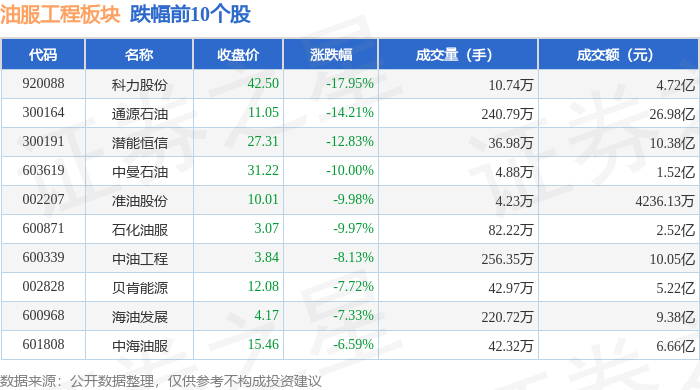
Market Overview - The oil service engineering sector experienced a significant decline of 7.68% on February 2, with Keli Co., Ltd. leading the drop [1] - The Shanghai Composite Index closed at 4015.75, down 2.48%, while the Shenzhen Component Index closed at 13824.35, down 2.69% [1] Individual Stock Performance - Keli Co., Ltd. (stock code: 920088) saw a closing price of 42.50, down 17.95% with a trading volume of 107,400 shares and a transaction value of 472 million [1] - Tongyuan Petroleum (stock code: 300164) closed at 11.05, down 14.21%, with a trading volume of 2,407,900 shares and a transaction value of 2.698 billion [1] - Potential Energy Holdings (stock code: 300191) closed at 27.31, down 12.83%, with a trading volume of 369,800 shares and a transaction value of 1.038 billion [1] - Other notable declines include Zhongman Petroleum (down 10.00%), Zhun Oil Co., Ltd. (down 9.98%), and PetroChina Oilfield Services (down 9.97%) [1] Capital Flow Analysis - The oil service engineering sector experienced a net outflow of 752 million from institutional investors and 157 million from speculative funds, while retail investors saw a net inflow of 909 million [1] - Specific stocks such as Keli Co., Ltd. had a net outflow of 543.96 million from institutional investors, indicating significant selling pressure [2] - Other stocks like PetroChina Oilfield Services and Beiken Energy also faced substantial net outflows from institutional and speculative investors, while retail investors showed interest in these stocks [2]



海油发展股价跌5.33%,大成基金旗下1只基金重仓,持有2.6万股浮亏损失6240元
Xin Lang Cai Jing· 2026-02-02 01:59
Group 1 - CNOOC Development Co., Ltd. experienced a decline of 5.33% in stock price, trading at 4.26 CNY per share with a total market capitalization of 43.303 billion CNY as of the report date [1] - The company, established on February 22, 2005, and listed on June 26, 2019, specializes in energy technology services, FPSO production technology services, energy logistics services, and safety, environmental protection, and energy-saving products and services [1] - The revenue composition of the company includes energy logistics services at 51.51%, energy technology services at 35.37%, and low-carbon environmental and digitalization services at 17.13% [1] Group 2 - Dazhong Fund has a significant holding in CNOOC Development, with the Dazhong Zhihui Quantitative Multi-Strategy Mixed A Fund (004209) holding 26,000 shares, representing 0.81% of the fund's net value, ranking as the fifth largest holding [2] - The fund has reported a floating loss of approximately 6,240 CNY for the day [2] - The Dazhong Zhihui Quantitative Multi-Strategy Mixed A Fund was established on March 21, 2017, with a current size of 8.1705 million CNY, yielding a return of 6.65% year-to-date and 33.73% over the past year [2]

石油化工行业周报:伊朗推动地缘溢价进一步上升
SINOLINK SECURITIES· 2026-02-01 10:50
Investment Rating - The report indicates a positive outlook for the oil and petrochemical sector, with the sector outperforming the Shanghai Composite Index by +8.40% this week [10]. Core Insights - Geopolitical factors remain the primary driver in the current oil market, with significant attention on the potential for conflict between the US and Iran. The market is pricing in a geopolitical risk premium of approximately $8-10 per barrel related to Iran [15][17]. - The report anticipates that if the situation with Iran does not escalate into a full-blown conflict, oil prices may revert to supply-demand fundamentals, potentially leading to a price decline [15][17]. - The report highlights that the recent cold wave and reduced production in Kazakhstan have slowed the accumulation of global inventories, with expectations of a return to a higher accumulation rate in the coming weeks [17][18]. Summary by Sections Market Review - The oil and petrochemical sector has shown a weekly increase of +7.95%, with specific indices such as the oil and gas resources index rising by +7.79% and the oil and gas extraction services index by +7.96% [10][11]. Oil Sector - As of January 29, WTI crude oil was priced at $65.42, up by $6.06, while Brent crude was at $72.57, up by $6.60. The EIA reported a decrease in commercial crude oil inventories by 2.295 million barrels [16][17]. - The report notes that US crude oil production stands at 13.696 million barrels per day, with a decrease in net imports by 61.8% [16]. Refining Sector - The average operating rate of domestic refineries was reported at 80.02%, with a slight increase of 1.24 percentage points from the previous week. The average refining margin for major refineries was 659.83 yuan per ton, down by 101.65 yuan per ton [16]. Polyester Sector - The PX-Naphtha spread has increased to approximately $340 per ton, with PTA processing fees at 374.32 yuan per ton. The report indicates a decline in profitability for polyester products, with average profit levels for various types of polyester showing negative margins [16]. Olefins Sector - The average price for ethylene in the domestic market was reported at 5769 yuan per ton, a slight decrease of 0.33%. The propylene market saw an increase in average transaction prices to 6400 yuan per ton, up by 3.64% [16].




石油化工行业周报:伊朗推动地缘溢价进一步上升-20260201
SINOLINK SECURITIES· 2026-02-01 09:30
Investment Rating - The report indicates a positive outlook for the oil and petrochemical sector, with the sector outperforming the Shanghai Composite Index by +8.40% this week [10]. Core Insights - The oil market is experiencing a rapid increase in prices due to geopolitical risks, particularly concerning Iran's potential actions in the Strait of Hormuz, with a risk premium estimated at $8-10 per barrel [15][16]. - The overall supply remains in excess, with previous supportive factors like cold weather and reduced production in Kazakhstan starting to stabilize [15]. - The report highlights a mixed performance across various segments of the petrochemical industry, with oil and gas resources showing a +7.79% increase, while the polyester index decreased by -1.82% [10]. Summary by Sections Market Review - The petrochemical sector has outperformed the Shanghai Composite Index, with various indices showing significant weekly changes, including the oil and gas extraction service index at +7.96% and the refining and chemical index at +6.75% [10][11]. Oil Market - As of January 29, WTI crude oil closed at $65.42, up $6.06 from the previous week, while Brent crude closed at $72.57, up $6.60 [16]. - The EIA reported a decrease in commercial crude oil inventories by 2.295 million barrels, with a notable drop in gasoline inventories as well [16]. Refining Sector - The average operating rate of domestic refineries increased to 80.02%, with a slight rise in gasoline demand due to seasonal travel [16]. - The average refining margin for major refineries was reported at 659.83 yuan per ton, down 101.65 yuan from the previous period [16]. Polyester Sector - The PX-Naphtha spread has risen to approximately $340 per ton, with PTA processing fees reported at 374.32 yuan per ton [15]. - The report notes a decline in profitability for various polyester products, with average profit levels for POY150D at -21.03 yuan per ton [15]. Olefins Market - The average price for ethylene in the domestic market was reported at 5769 yuan per ton, a slight decrease of 0.33% from the previous week [15]. - Propylene prices in Shandong increased by 225 yuan per ton, reflecting a 3.64% rise [15].
海油发展招标结果:海油发展-物流公司伊拉克集装箱物资国际运输代理服务专有协议中标候选人公示
Sou Hu Cai Jing· 2026-01-31 04:12
Group 1 - The core point of the article is the announcement of the candidate for the exclusive agreement for international transportation agency services for container materials in Iraq by CNOOC Energy Development Co., Ltd. [1] - CNOOC Energy Development Co., Ltd. has made investments in 61 companies and participated in 50,758 bidding projects [1] - The company holds 103 trademark registrations, 4,307 patents, and 392 copyrights, along with 61 administrative licenses [1] Group 2 - The procurement party is CNOOC Energy Development Co., Ltd. [2] - The supplier awarded the contract is Yantai Anxin International Logistics Co., Ltd. [2] - The bid amounts for the contract are 6,831,600, 7,014,605, and 7,435,420 [2]
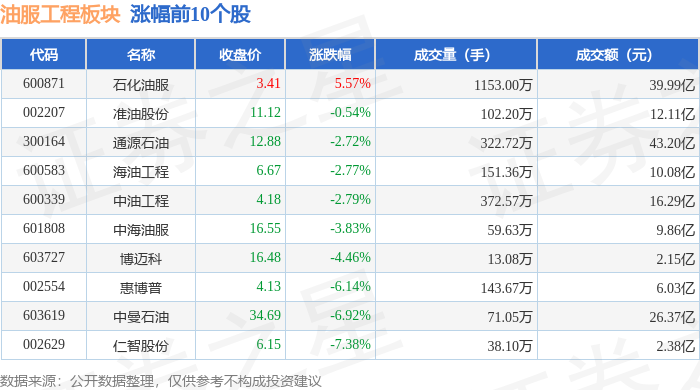
油服工程板块1月30日跌3.38%,科力股份领跌,主力资金净流出10.05亿元
Zheng Xing Xing Ye Ri Bao· 2026-01-30 09:00
Core Viewpoint - The oil service engineering sector experienced a decline of 3.38% on January 30, with Keli Co., Ltd. leading the losses. The Shanghai Composite Index closed at 4117.95, down 0.96%, while the Shenzhen Component Index closed at 14205.89, down 0.66% [1]. Group 1: Market Performance - The oil service engineering sector saw significant individual stock movements, with notable declines in Keli Co., Ltd. by 14.39% and Qianeng Hengxin by 12.83% [2]. - The trading volume for Keli Co., Ltd. was 138,000 shares, with a transaction value of 773 million yuan [2]. - The overall sector had a net outflow of 1 billion yuan from major funds, while retail investors contributed a net inflow of 656 million yuan [2][3]. Group 2: Individual Stock Analysis - Keli Co., Ltd. closed at 51.80 yuan, experiencing a drop of 14.39% with a trading volume of 138,000 shares [2]. - Qianeng Hengxin closed at 31.33 yuan, down 12.83%, with a trading volume of 457,200 shares [2]. - The stock of Huibo Yin fell by 6.14%, closing at 4.13 yuan, with a trading volume of 143,670 shares [2]. Group 3: Fund Flow Analysis - Major funds showed a net outflow from several stocks, including Keli Co., Ltd. with a net outflow of 75.27 million yuan [3]. - Retail investors showed a positive net inflow in stocks like Huibo Yin, with a net inflow of 58.99 million yuan [3]. - The stock of Haiyou Development had a net inflow of 18.4 million yuan from retail investors, despite a major fund outflow [3].

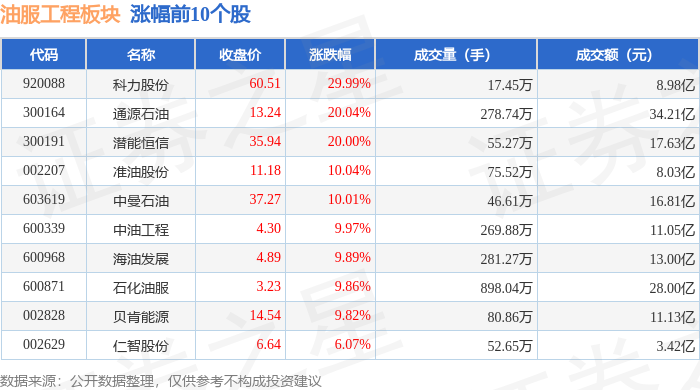
油服工程板块1月29日涨7.69%,科力股份领涨,主力资金净流入7416.32万元
Zheng Xing Xing Ye Ri Bao· 2026-01-29 09:00
Core Viewpoint - The oil service engineering sector experienced a significant increase of 7.69% on January 29, with Keli Co., Ltd. leading the gains [1] Group 1: Market Performance - The Shanghai Composite Index closed at 4157.98, up 0.16%, while the Shenzhen Component Index closed at 14300.08, down 0.3% [1] - Keli Co., Ltd. saw a remarkable rise of 29.99%, closing at 60.51, with a trading volume of 174,500 shares and a transaction value of 898 million [1] - Tongyuan Petroleum and Qianeng Hengxin both increased by 20.04% and 20.00%, respectively, with closing prices of 13.24 and 35.94 [1] Group 2: Capital Flow - The oil service engineering sector had a net inflow of 74.16 million from main funds, while retail investors saw a net outflow of 302 million [1] - Major stocks like Haiyou Development and Zhongyou Engineering attracted significant main fund inflows of 131 million and 114 million, respectively [2] - Retail investors showed a negative trend in several stocks, with notable outflows from Zhongyou Engineering and Keli Co., Ltd. at 86.91 million and 1.73 million, respectively [2]

海油发展股价涨5.17%,南方基金旗下1只基金位居十大流通股东,持有2943.2万股浮盈赚取676.93万元
Xin Lang Cai Jing· 2026-01-29 06:14
Group 1 - The stock of CNOOC Development increased by 5.17%, reaching 4.68 CNY per share, with a trading volume of 739 million CNY and a turnover rate of 1.60%, resulting in a total market capitalization of 47.573 billion CNY [1] - CNOOC Development Co., Ltd. was established on February 22, 2005, and listed on June 26, 2019. The company specializes in energy technology services, FPSO production technology services, energy logistics services, and safety, environmental protection, and energy-saving products and services [1] - The revenue composition of CNOOC Development includes energy logistics services at 51.51%, energy technology services at 35.37%, and low-carbon environmental protection and digitalization at 17.13% [1] Group 2 - Southern Fund's Southern CSI 500 ETF (510500) reduced its holdings in CNOOC Development by 685,100 shares in the third quarter, now holding 29.432 million shares, which accounts for 0.29% of the circulating shares, with an estimated floating profit of approximately 6.7693 million CNY [2] - The Southern CSI 500 ETF (510500) was established on February 6, 2013, with a latest scale of 144.69 billion CNY. Year-to-date return is 15.26%, ranking 552 out of 5,551 in its category; the one-year return is 56.56%, ranking 1,089 out of 4,285; and since inception, the return is 190.06% [2] Group 3 - The Southern Pension Target Date 2035 Three-Year Holding Mixed Fund (FOF) A (006290) holds 560,100 shares of CNOOC Development, representing 0.3% of the fund's net value, making it the fifth-largest holding, with an estimated floating profit of about 128,800 CNY [4] - The Southern Pension Target Date 2035 Three-Year Holding Mixed Fund (FOF) A (006290) was established on November 6, 2018, with a latest scale of 437 million CNY. Year-to-date return is 3.81%, ranking 640 out of 1,319 in its category; the one-year return is 16.61%, ranking 611 out of 1,051; and since inception, the return is 72.67% [4] Group 4 - The fund managers of the Southern Pension Target Date 2035 Three-Year Holding Mixed Fund (FOF) A (006290) are Lu Bingliang and Huang Jun. Lu has a tenure of 7 years and 42 days, with a total fund size of 3.103 billion CNY, achieving a best return of 71.48% and a worst return of 3.1% during his tenure [5] - Huang Jun has a tenure of 10 years and 92 days, managing a total fund size of 1.817 billion CNY, with a best return of 72.25% and a worst return of 11.57% during his tenure [5]
油气资源股午后持续冲高,准油股份2连板
Jin Rong Jie· 2026-01-29 05:13
油气资源股午后持续冲高, 准油股份2连板, 石化油服、 中曼石油涨停, 通源石油涨超15%,科力股 份涨超10%, 潜能恒信、 洲际油气、 中油工程、 贝肯能源、 海油发展跟涨。 ...
油服工程板块1月28日涨6.38%,通源石油领涨,主力资金净流入9.4亿元
Zheng Xing Xing Ye Ri Bao· 2026-01-28 09:04
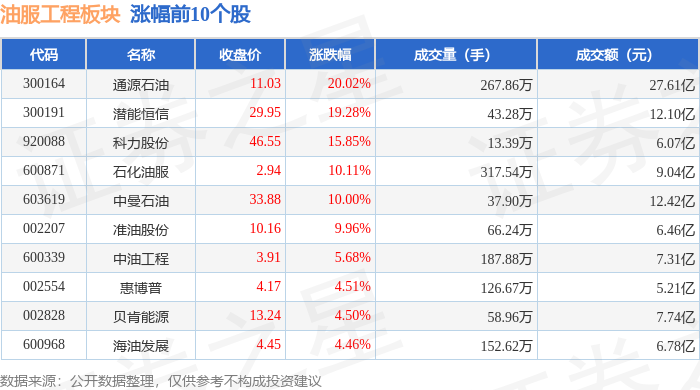
Core Viewpoint - The oil service engineering sector experienced a significant increase of 6.38% on January 28, with Tongyuan Petroleum leading the gains [1] Market Performance - The Shanghai Composite Index closed at 4151.24, up 0.27% - The Shenzhen Component Index closed at 14342.9, up 0.09% [1] Individual Stock Performance - Tongyuan Petroleum (300164) closed at 11.03, up 20.02% with a trading volume of 2.6786 million shares and a transaction value of 2.761 billion - Qianeng Hengxin (300191) closed at 29.95, up 19.28% with a trading volume of 432,800 shares and a transaction value of 1.21 billion - Keli Co., Ltd. (920088) closed at 46.55, up 15.85% with a trading volume of 133,900 shares and a transaction value of 607 million - PetroChina Oilfield Services (600871) closed at 2.94, up 10.11% with a trading volume of 3.1754 million shares and a transaction value of 904 million - Zhongman Petroleum (603619) closed at 33.88, up 10.00% with a trading volume of 379,000 shares and a transaction value of 1.242 billion [1] Capital Flow Analysis - The oil service engineering sector saw a net inflow of 940 million from main funds, while retail investors experienced a net outflow of 624 million [1] - The main fund inflow and outflow for key stocks include: - PetroChina Oilfield Services: net inflow of 237 million, net outflow from retail of 137 million - Zhongman Petroleum: net inflow of 109 million, net outflow from retail of 43 million - Tongyuan Petroleum: net inflow of 84 million, net outflow from retail of 1.15 million [2]