CNOOC EnerTech(600968)

Search documents
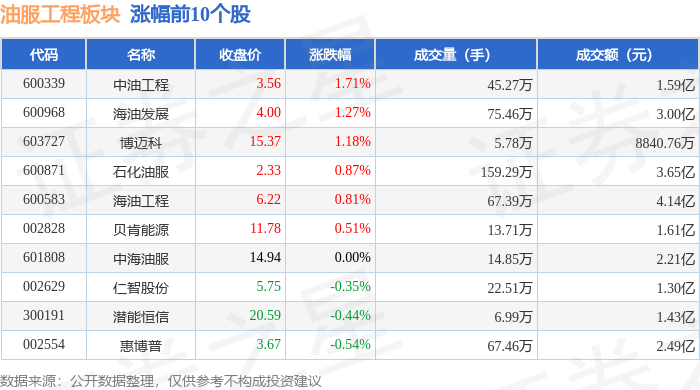
油服工程板块1月20日涨0.56%,中油工程领涨,主力资金净流出1.64亿元
Zheng Xing Xing Ye Ri Bao· 2026-01-20 09:00
Group 1 - The oil service engineering sector increased by 0.56% on January 20, with China Oil Engineering leading the gains [1] - The Shanghai Composite Index closed at 4113.65, down 0.01%, while the Shenzhen Component Index closed at 14155.63, down 0.97% [1] - Key stocks in the oil service engineering sector showed varied performance, with China Offshore Engineering closing at 3.56, up 1.71%, and PetroChina Oilfield Services at 2.33, up 0.87% [1] Group 2 - The oil service engineering sector experienced a net outflow of 164 million yuan from institutional investors, while retail investors saw a net inflow of 222 million yuan [2] - The trading volume and turnover for key stocks in the sector varied, with China Offshore Engineering having a turnover of 159 million yuan and China Oilfield Services at 365 million yuan [2] - The net inflow and outflow of funds for individual stocks showed significant differences, with China Oil Engineering having a net inflow of 5.71 million yuan from institutional investors [3]



海油发展(600968) - 关于公司董事辞任暨选举职工代表董事的公告
2026-01-20 08:45
中海油能源发展股份有限公司 关于公司董事辞任暨选举职工代表董事的公告 本公司董事会及全体董事保证本公告内容不存在任何虚假记载、误导性陈述 或者重大遗漏,并对其内容的真实性、准确性和完整性承担法律责任。 一、董事辞任情况 证券代码:600968 证券简称:海油发展 公告编号:2026-001 公司于 2025 年 6 月 9 日召开 2024 年年度股东大会,审议通过了《关于修订 <公司章程>的议案》。根据修订后的《公司章程》规定,公司董事会中设置一名 职工代表董事,董事会中的职工代表由公司职工通过职工代表大会、职工大会或 1 | 姓名 | 离任职务 | 离任时间 | 原定任期 | | 是否继续在上 | 具体职务 | 是否存在 未履行完 | | --- | --- | --- | --- | --- | --- | --- | --- | | | | | 到期日 | 离任原因 | 市公司及其控 股子公司任职 | (如适 用) | 毕的公开 承诺 | | 杜向东 | 董事、薪 酬与考核 | 2026 年 1 | 第五届董事 | 公司治理 | | 党委副书 记、工会 | | | | | | 会任期届满 | | 是 ...
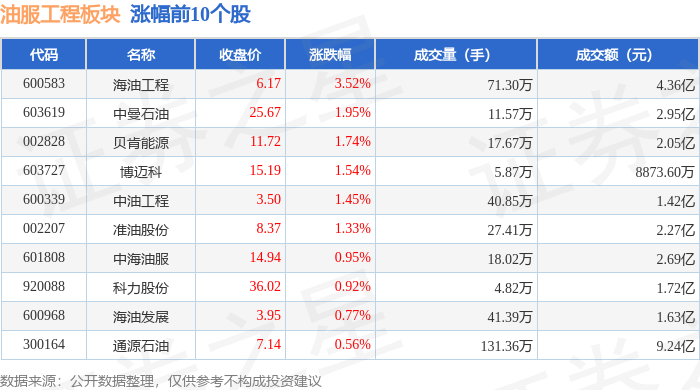
油服工程板块1月19日涨1.06%,海油工程领涨,主力资金净流出9853.08万元
Zheng Xing Xing Ye Ri Bao· 2026-01-19 08:58
Group 1 - The oil service engineering sector increased by 1.06% on January 19, with Haiyou Engineering leading the gains [1] - The Shanghai Composite Index closed at 4114.0, up 0.29%, while the Shenzhen Component Index closed at 14294.05, up 0.09% [1] - Key stocks in the oil service engineering sector showed various performance metrics, with notable increases in closing prices and trading volumes [1] Group 2 - The oil service engineering sector experienced a net outflow of 98.53 million yuan from institutional investors, while retail investors saw a net inflow of 164 million yuan [2] - Detailed fund flow data indicates that major stocks like Haiyou Engineering and Beiken Energy had mixed net inflows and outflows from different investor categories [3] - The overall market sentiment reflected a divergence in fund flows, with retail investors showing a positive trend despite institutional outflows [2][3]


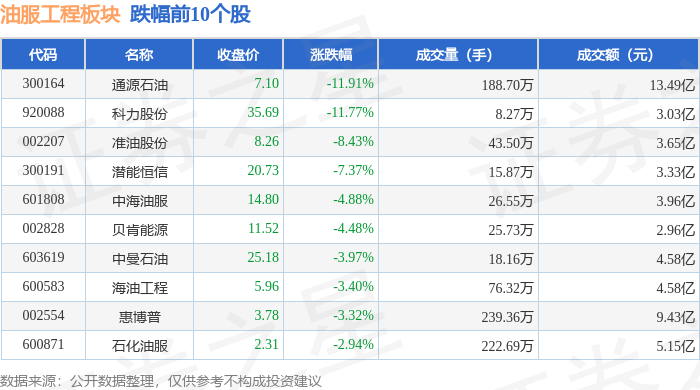
油服工程板块1月16日跌3.44%,通源石油领跌,主力资金净流出4.6亿元
Zheng Xing Xing Ye Ri Bao· 2026-01-16 09:00
Market Overview - The oil service engineering sector experienced a decline of 3.44% on January 16, with Tongyuan Petroleum leading the drop [1] - The Shanghai Composite Index closed at 4101.91, down 0.26%, while the Shenzhen Component Index closed at 14281.08, down 0.18% [1] Stock Performance - Notable declines in individual stocks include: - Daoyuan Petroleum (300164) at 7.10, down 11.91% with a trading volume of 1.887 million shares and a transaction value of 13.49 billion [1] - Keli Co., Ltd. (920088) at 35.69, down 11.77% with a trading volume of 82,700 shares and a transaction value of 303 million [1] - Zhunyou Co., Ltd. (002207) at 8.26, down 8.43% with a trading volume of 435,000 shares and a transaction value of 365 million [1] Capital Flow - The oil service engineering sector saw a net outflow of 460 million from main funds, while retail investors contributed a net inflow of 391 million [1] - The table of capital flow indicates that: - Zhongyou Engineering (600339) had a main fund net inflow of 5.4486 million, while retail investors had a net inflow of 3.3170 million [2] - Haiyou Engineering (600583) experienced a main fund net outflow of 20.4936 million, but retail investors had a net inflow of 2.5745 million [2] - Beiken Energy (002828) faced a main fund net outflow of 23.0657 million, with a significant retail net inflow of 39.8684 million [2]


2025中国企业ESG“金责奖”优秀奖评选结果揭晓

Xin Lang Cai Jing· 2026-01-15 03:45
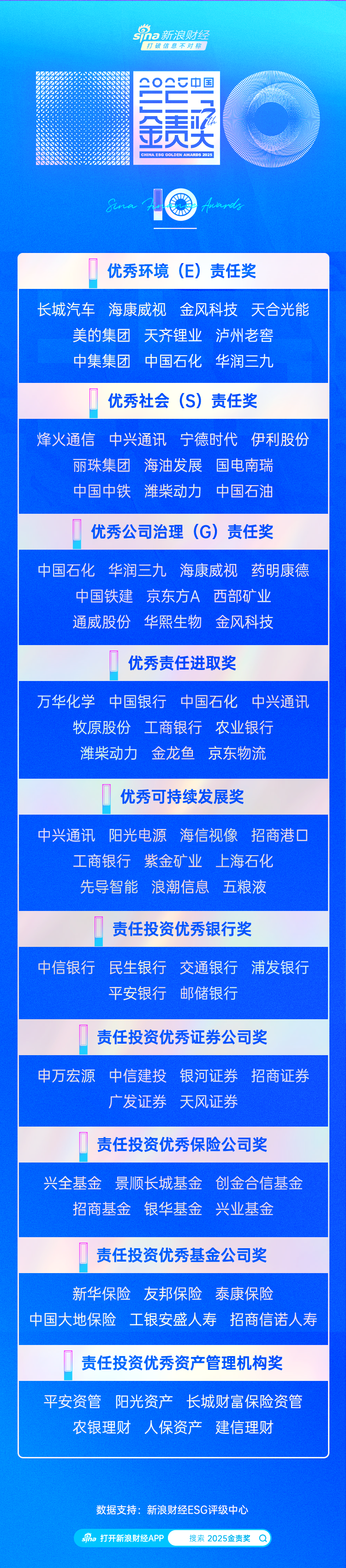
Core Viewpoint - The 2025 China Enterprise ESG "Golden Responsibility Award" aims to recognize companies and institutions that have made significant contributions to ESG initiatives in China, reflecting a shift from voluntary practices to compliance requirements in ESG performance [1][12]. Group 1: ESG Development and Awards Overview - By 2025, China's ESG development has transitioned from "setting standards" to "strengthening regulations," with a comprehensive disclosure standard system being established [1][12]. - The award selection attracted over 5,000 companies, with results based on ESG performance, online voting, and professional evaluations [2][12]. Group 2: Award Categories and Winners - The award categories include Excellent Environmental Responsibility Award, Excellent Social Responsibility Award, Excellent Corporate Governance Responsibility Award, Excellent Responsibility Initiative Award, Excellent Sustainable Development Award, and various responsibility investment awards [1][12]. - Notable winners of the Excellent Environmental Responsibility Award include Great Wall Motors, Hikvision, and China Petroleum [7][24]. - The Excellent Social Responsibility Award was awarded to companies such as YF Communication, ZTE, and Ningde Times [7][24]. - Winners of the Excellent Corporate Governance Responsibility Award include China Petroleum, Hikvision, and WuXi AppTec [7][24]. - The Excellent Responsibility Initiative Award was given to companies like ZTE, Sunlight Power, and Industrial and Commercial Bank of China [7][24]. - The Excellent Sustainable Development Award included companies such as WanHua Chemical, China Bank, and China Petroleum [7][24]. Group 3: Responsibility Investment Awards - The Responsibility Investment Excellent Bank Award was given to institutions like CITIC Bank and Minsheng Bank [5][21]. - The Responsibility Investment Excellent Securities Company Award included firms such as Shenwan Hongyuan and CITIC Securities [5][22]. - The Responsibility Investment Excellent Insurance Company Award recognized companies like New China Life and AIA [5][26]. - The Responsibility Investment Excellent Fund Company Award included firms such as Xinhua Fund and Harvest Fund [5][27]. - The Responsibility Investment Excellent Asset Management Institution Award recognized institutions like Ping An Asset Management and Sunshine Asset Management [5][28]. Group 4: Call to Action and Future Directions - The award committee encourages more Chinese enterprises to integrate ESG principles into their operations and strategic planning, emphasizing the importance of balancing commercial and social values [10][29].
海油发展:目前公司所开展的海外业务主要集中在中东区域、非洲区域、北美区域和亚太区域
Zheng Quan Ri Bao Wang· 2026-01-14 13:12
Core Viewpoint - The company, CNOOC Development (600968), is focusing on its overseas business in four main regions: the Middle East, Africa, North America, and Asia-Pacific, while actively implementing the "Belt and Road" initiative [1] Group 1: Overseas Business Focus - The company's overseas operations are concentrated in four key regions: Middle East, Africa, North America, and Asia-Pacific [1] - CNOOC has made significant breakthroughs in the core areas of the "Belt and Road" initiative, particularly in the Middle East, Africa, and Asia-Pacific [1] Group 2: Strategic Optimization - The company is continuously optimizing its overseas strategic layout by focusing on mature regions, new regions, mature industries, and new industries [1] - CNOOC aims to establish a competitive advantage in key areas of international oil and gas technology services and important markets [1]

海油发展:海外业务主要集中中东、非洲、北美、亚太四个区域
Sou Hu Cai Jing· 2026-01-14 10:01
Group 1 - The company primarily focuses its overseas business in four regions: the Middle East, Africa, North America, and the Asia-Pacific region [1] - The company is actively implementing the national "Belt and Road" initiative, achieving breakthroughs in core areas of the initiative [1] - The company aims to optimize its overseas strategic layout by focusing on mature areas, new regions, mature industries, and new industries, establishing competitive advantages in key international oil and gas technology service markets [1]
特朗普搅动地缘风险升级!美控委油+伊朗制裁引爆油价,油气服务开采板块风口全面降临
Xin Lang Cai Jing· 2026-01-13 11:27
Group 1 - Tongyuan Petroleum, based in Chengdu, is a leading company in perforation technology, providing a full range of oil and gas engineering services, and is well-positioned to benefit from rising oil prices through increased orders and revenue [1][36] - Huai Oil Co., located in Jiangsu, has a stable oil and gas production base and benefits from regional cooperation, allowing for dual revenue growth during rising oil prices [2][37] - CNOOC Services, the largest marine oil and gas engineering service provider in China, is set to see significant increases in drilling platform utilization and service orders due to rising oil prices [3][38] Group 2 - Sinopec Oilfield Services, a leading player in oil and gas engineering services, is expected to benefit from increased internal orders and global oil development opportunities as oil prices rise [4][39] - Beiken Energy, based in Xinjiang, focuses on oilfield technical services and is well-positioned to expand its business in response to rising oil prices and increased exploration activities in the western oil and gas regions [5][41] - Zhongman Petroleum, with integrated oil and gas exploration and service capabilities, is likely to see increased orders and revenue from both domestic and international projects as oil prices rise [6][42] Group 3 - Potential Energy, specializing in oil and gas exploration technology services, is expected to benefit from increased demand for high-precision exploration services as oil prices rise [8][43] - China National Offshore Oil Corporation, the largest offshore oil producer in China, is positioned to benefit from rising oil prices through increased revenue from oil sales and a focus on deepwater development [9][44] - Bomeike, focusing on marine oil and gas engineering equipment, is set to see increased demand for its products as marine oil and gas projects accelerate due to rising oil prices [10][45] Group 4 - Blue Flame Holdings, a leader in coalbed methane development, is expected to benefit from rising demand for clean energy and increased coalbed methane sales prices as oil prices rise [11][47] - Shouhua Gas, with a comprehensive natural gas business model, is likely to see revenue growth from both upstream exploration and downstream distribution as oil prices and natural gas prices rise [12][48] - CNOOC Engineering, a leading marine oil and gas engineering construction company, is expected to gain stable orders and enhance profitability through deep cooperation with CNOOC as oil prices rise [13][49] Group 5 - Intercontinental Oil and Gas, focusing on overseas oil resource development, is well-positioned to benefit from rising oil prices through increased sales revenue from its overseas oil fields [14][50] - Guanghui Energy, a comprehensive energy service provider, is expected to see significant revenue growth from its oil and gas extraction and LNG production businesses as oil prices rise [15][51] - CNOOC Development, providing comprehensive marine oil and gas services, is likely to see increased demand for its services as oil production rises due to higher oil prices [16][52] Group 6 - China Petroleum Engineering, a leading oil and gas engineering construction company, is set to benefit from increased orders due to rising oil prices and expanded overseas market opportunities [18][54] - New Natural Gas, focusing on natural gas exploration and distribution, is expected to see revenue growth from both upstream and downstream operations as oil and natural gas prices rise [19][55] - ST Xinchao, despite its current ST status, is expected to see improved performance from its oil and gas business as oil prices rise, benefiting from the synergy between its oil and chemical operations [20][56]

油服工程板块1月13日涨2.94%,通源石油领涨,主力资金净流入2.87亿元
Zheng Xing Xing Ye Ri Bao· 2026-01-13 09:06
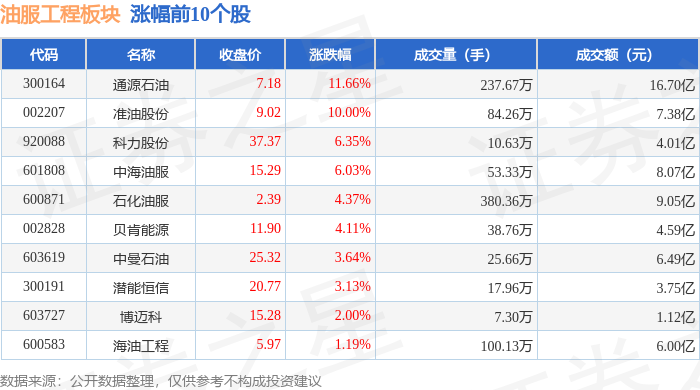
Core Viewpoint - The oil service engineering sector experienced a significant increase of 2.94% on January 13, with Tongyuan Petroleum leading the gains, while the overall Shanghai Composite Index fell by 0.64% [1] Group 1: Market Performance - The Shanghai Composite Index closed at 4138.76, down 0.64% [1] - The Shenzhen Component Index closed at 14169.4, down 1.37% [1] - Key stocks in the oil service engineering sector showed notable increases, with Tongyuan Petroleum rising by 11.66% to a closing price of 7.18 [1] Group 2: Stock Performance - Tongyuan Petroleum (300164) led the sector with a closing price of 7.18 and a trading volume of 2.3767 million shares, resulting in a transaction value of 1.67 billion [1] - Zhun Oil Co. (002207) increased by 10.00% to 9.02, with a transaction value of 738 million [1] - Other notable performers included Keli Co. (920088) up 6.35% to 37.37, and Sinopec Oilfield Service (600871) up 4.37% to 2.39 [1] Group 3: Capital Flow - The oil service engineering sector saw a net inflow of 287 million from main funds, while retail investors experienced a net outflow of 185 million [1] - Main funds showed significant net inflows in Zhun Oil Co. (002207) at 114 million, while retail investors had a net outflow of 5317.78 million [2] - The overall capital flow indicates a mixed sentiment, with main funds favoring certain stocks while retail investors withdrew [2]
油气ETF(159697)收涨超1.1%,今日净申购1500万份
Sou Hu Cai Jing· 2026-01-13 08:03
Group 1: Industry Overview - According to Raytad Energy, global upstream exploration and development spending is expected to be around $600 billion in 2025, a decrease of 4% year-on-year, with deepwater investments projected to decline by 6% [1] - China's crude oil production has rebounded since 2019 due to a long-term strategy for increasing reserves and production, with a CAGR of 2.2% from 2019 to 2024, while natural gas production has a CAGR of 7.3% during the same period [1] - The "Big Three" oil companies in China have significantly increased capital expenditures from 2020 to 2023 and are expected to maintain high levels in 2024 and 2025, which will support upstream reserve growth and benefit their oil service subsidiaries [1] Group 2: Company Performance - In the first half of 2025, major oil service companies benefited from the ongoing domestic "increase reserves and production" initiative and the gradual release of overseas business performance, leading to improved operational quality despite falling oil prices [2] - CNOOC's oil service subsidiary reported a 23.3% year-on-year increase in net profit attributable to shareholders, while other companies like Haiyou Development and Haiyou Engineering saw net profit changes of +13.1% and -8.2% respectively, with the latter experiencing a 27% increase in gross profit [2] - The annualized ROE for CNOOC's oil service companies in the first half of 2025 showed resilience, with CNOOC at +1.5 percentage points compared to the full year of 2024, indicating a potential improvement in international competitiveness [2] Group 3: Market Performance - As of January 13, 2026, the National Petroleum and Natural Gas Index (399439) rose by 0.81%, with significant increases in stocks such as CNOOC's oil service (+6.03%) and China National Petroleum (+3.57%) [3] - The oil and gas ETF (159697) increased by 1.15%, reflecting a four-day consecutive rise, with the latest price reported at 1.23 yuan and a net subscription of 15 million units [3] - The top ten weighted stocks in the National Petroleum and Natural Gas Index account for 67.11% of the index, including major players like China National Petroleum, Sinopec, and CNOOC [3]