
Chongqing Rural Commercial Bank(601077)

Search documents
成都农商银行晋级万亿元:农商行头部阵营扩容至五家 金融资源“极化”趋势凸显
Mei Ri Jing Ji Xin Wen· 2026-01-04 15:24
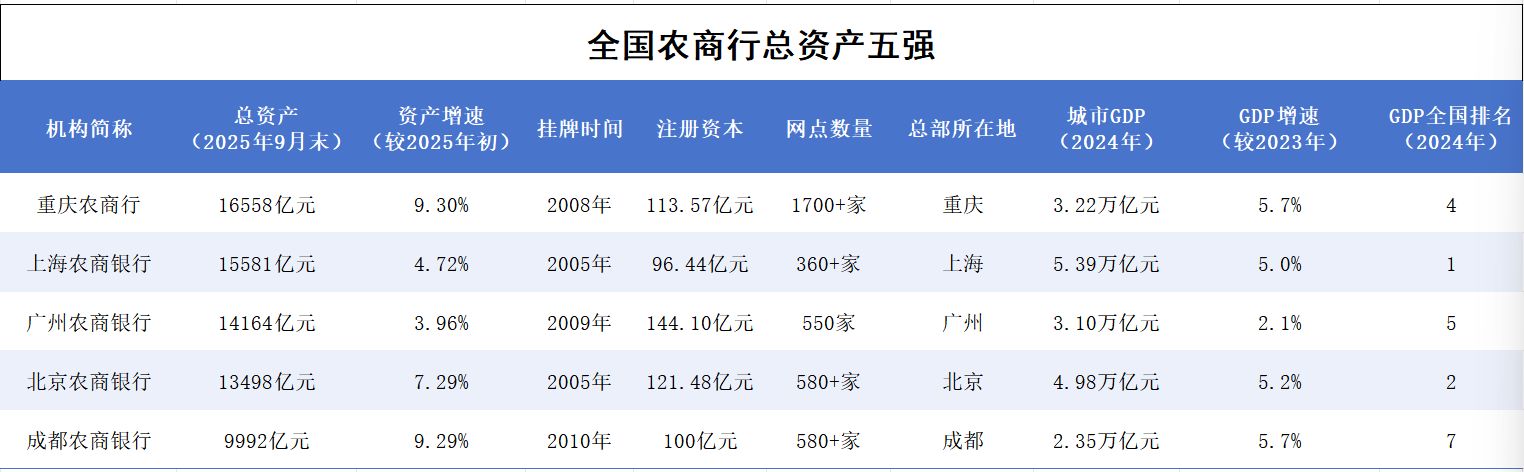
Core Insights - Chengdu Rural Commercial Bank has officially announced that its asset scale has surpassed 1 trillion yuan as of December 31, 2025, joining the "trillion yuan club" alongside four other major rural commercial banks in China [1][3] - The emergence of these banks reflects a trend of financial resource concentration in economically vibrant regions, indicating a shift in China's regional economic development landscape [1][8] Group 1: Overview of the Trillion Yuan Club - The "trillion yuan era" for rural commercial banks began six years ago, with Chongqing Rural Commercial Bank being the first to exceed this threshold in June 2019 [2] - As of September 2025, the total assets of the five major rural commercial banks exceeded 11% of the total assets of all rural financial institutions in China, showcasing significant concentration effects [4] - The five banks—Chongqing, Shanghai, Guangzhou, Beijing, and Chengdu—are primarily located in major cities with strong economic performance, collectively accounting for over 14% of the national GDP [4] Group 2: Individual Bank Performance - As of September 2025, the asset scales of the five banks are as follows: Chongqing Rural Commercial Bank at 1.66 trillion yuan, Shanghai Rural Commercial Bank at 1.56 trillion yuan, Guangzhou Rural Commercial Bank at 1.42 trillion yuan, Beijing Rural Commercial Bank at 1.35 trillion yuan, and Chengdu Rural Commercial Bank at 999.2 billion yuan [6] - Each bank has developed unique strategies based on their regional characteristics, such as Beijing's focus on serving agriculture and small enterprises, and Shanghai's emphasis on wealth management and technology [10][11] Group 3: Strategic Implications - The formation of the "trillion yuan club" among these banks enhances their ability to support local infrastructure projects, providing greater financial autonomy for regional development [15] - The collective strength of these banks facilitates the integration of financial services across administrative boundaries, potentially lowering financing costs for businesses operating in multiple regions [15] - The emergence of this banking cluster is expected to contribute to the establishment of a Western financial center, attracting more financial resources and fostering innovation in financial products tailored to local industries [15]

渝农商行(601077) - 渝农商行H股公告
2026-01-04 08:45
FF301 股份發行人及根據《上市規則》第十九B章上市的香港預託證券發行人的證券變動月報表 截至月份: 2025年12月31日 狀態: 新提交 致:香港交易及結算所有限公司 公司名稱: 重慶農村商業銀行股份有限公司 呈交日期: 2026年1月2日 I. 法定/註冊股本變動 | 1. 股份分類 | 普通股 | 股份類別 | H | | | 於香港聯交所上市 (註1) | | 是 | | | --- | --- | --- | --- | --- | --- | --- | --- | --- | --- | | 證券代號 (如上市) | 03618 | 說明 | | | | | | | | | | | 法定/註冊股份數目 | | | 面值 | | | 法定/註冊股本 | | | 上月底結存 | | | 2,513,336,041 | RMB | | | 1 RMB | | 2,513,336,041 | | 增加 / 減少 (-) | | | | | | | RMB | | | | 本月底結存 | | | 2,513,336,041 | RMB | | | 1 RMB | | 2,513,336,041 | | ...
重庆农村商业银行(03618) - 截至2025年12月31日止月份之股份发行人的证券变动月报表
2026-01-02 08:31
致:香港交易及結算所有限公司 公司名稱: 重慶農村商業銀行股份有限公司 呈交日期: 2026年1月2日 FF301 股份發行人及根據《上市規則》第十九B章上市的香港預託證券發行人的證券變動月報表 截至月份: 2025年12月31日 狀態: 新提交 I. 法定/註冊股本變動 | 1. 股份分類 | 普通股 | 股份類別 | H | | | 於香港聯交所上市 (註1) | | 是 | | | --- | --- | --- | --- | --- | --- | --- | --- | --- | --- | | 證券代號 (如上市) | 03618 | 說明 | | | | | | | | | | | 法定/註冊股份數目 | | | 面值 | | | 法定/註冊股本 | | | 上月底結存 | | | 2,513,336,041 | RMB | | | 1 RMB | | 2,513,336,041 | | 增加 / 減少 (-) | | | | | | | RMB | | | | 本月底結存 | | | 2,513,336,041 | RMB | | | 1 RMB | | 2,513,336,041 | | ...
农商行板块12月31日涨0.94%,渝农商行领涨,主力资金净流入1263.96万元
Zheng Xing Xing Ye Ri Bao· 2025-12-31 09:06
Group 1 - The agricultural commercial bank sector increased by 0.94% on December 31, with Chongqing Rural Commercial Bank leading the gains [1] - The Shanghai Composite Index closed at 3968.84, up 0.09%, while the Shenzhen Component Index closed at 13525.02, down 0.58% [1] - The trading volume and turnover for Chongqing Rural Commercial Bank were 791,700 shares and 509 million yuan, respectively, with a price increase of 2.38% [1] Group 2 - The net inflow of main funds into the agricultural commercial bank sector was 12.64 million yuan, while retail investors experienced a net outflow of 39.35 million yuan [1] - The main net inflow for Changshu Bank was 22.32 million yuan, accounting for 13.28% of its trading volume [2] - Zhangjiagang Bank saw a main net inflow of 15.00 million yuan, representing 11.93% of its trading volume [2]



普益标准发布商业银行综合竞争力评价报告农商行百强榜(2025年),哪些银行上榜?
Xin Lang Cai Jing· 2025-12-31 07:14
Core Viewpoint - The 2025 ranking of the top 100 rural commercial banks in China highlights the competitive landscape, focusing on various dimensions of performance including comprehensive competitiveness, operational scale, profitability, stability, technological innovation, and brand building [3][4][6]. Comprehensive Competitiveness - The top ten banks in comprehensive competitiveness are: Chongqing Rural Commercial Bank, Shanghai Rural Commercial Bank, Beijing Rural Commercial Bank, Shenzhen Rural Commercial Bank, Chengdu Rural Commercial Bank, Dongguan Rural Commercial Bank, Guangzhou Rural Commercial Bank, Jiangsu Jiangnan Rural Commercial Bank, Tianjin Rural Commercial Bank, and Qingdao Rural Commercial Bank [1][8]. Operational Scale and Capital Strength - The leading banks in operational scale and capital strength are: Shanghai Rural Commercial Bank, Chongqing Rural Commercial Bank, Beijing Rural Commercial Bank, Guangzhou Rural Commercial Bank, Dongguan Rural Commercial Bank, Shenzhen Rural Commercial Bank, Chengdu Rural Commercial Bank, Jiangsu Jiangnan Rural Commercial Bank, Tianjin Rural Commercial Bank, and Guangdong Shunde Rural Commercial Bank [1][13]. Profitability - The top banks in profitability are: Shanghai Rural Commercial Bank, Chongqing Rural Commercial Bank, Chengdu Rural Commercial Bank, Jiangsu Changshu Rural Commercial Bank, Shenzhen Rural Commercial Bank, Hangzhou United Rural Commercial Bank, Beijing Rural Commercial Bank, Jiangsu Jiangnan Rural Commercial Bank, Dongguan Rural Commercial Bank, and Zhejiang Xiaoshan Rural Commercial Bank [1][18]. Stability - The banks excelling in stability are: Shanghai Rural Commercial Bank, Chongqing Rural Commercial Bank, Shenzhen Rural Commercial Bank, Dongguan Rural Commercial Bank, Jiangsu Jiangnan Rural Commercial Bank, Tianjin Rural Commercial Bank, Guangzhou Rural Commercial Bank, Beijing Rural Commercial Bank, Shaanxi Qinong Rural Commercial Bank, and Wuhan Rural Commercial Bank [1][6]. Technological and Service Innovation Capability - The top banks in technological and service innovation capability are: Chongqing Rural Commercial Bank, Shanghai Rural Commercial Bank, Beijing Rural Commercial Bank, Chengdu Rural Commercial Bank, Guangzhou Rural Commercial Bank, Jiangsu Suzhou Rural Commercial Bank, Shenzhen Rural Commercial Bank, Qingdao Rural Commercial Bank, Tianjin Rural Commercial Bank, and Dongguan Rural Commercial Bank [2][6]. Brand Building Capability - The leading banks in brand building capability are: Chongqing Rural Commercial Bank, Shanghai Rural Commercial Bank, Jiangsu Zijin Rural Commercial Bank, Dongguan Rural Commercial Bank, Jiangsu Kunshan Rural Commercial Bank, Shenzhen Rural Commercial Bank, Jiangsu Jiangnan Rural Commercial Bank (tied for seventh), Zhejiang Shaoxing Ruifeng Rural Commercial Bank (tied for seventh), Beijing Rural Commercial Bank, and Chengdu Rural Commercial Bank [2][6].

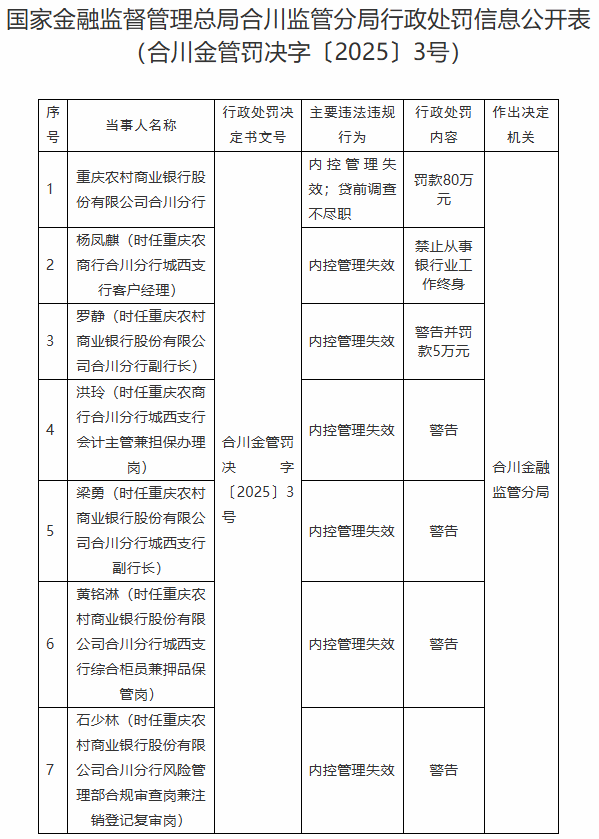
渝农商行合川分行被罚 内控管理失效贷前调查不尽职
Zhong Guo Jing Ji Wang· 2025-12-31 03:25
Summary of Key Points Core Viewpoint - The Chongqing Rural Commercial Bank's Hechuan branch faced administrative penalties due to internal control failures and inadequate pre-loan investigations, resulting in a fine of 800,000 yuan [1][4]. Group 1: Administrative Penalties - The Hechuan branch of Chongqing Rural Commercial Bank was fined 800,000 yuan for internal control management failures and inadequate pre-loan investigations [1][4]. - Yang Fengqi, a customer manager at the Hechuan branch, was held responsible for the internal control failures and is permanently banned from working in the banking industry [1][4]. - Luo Jing, the deputy branch manager, received a warning and a fine of 50,000 yuan for the same violations [1][4]. Group 2: Other Responsible Individuals - Hong Ling, the accounting supervisor and guarantee processing position holder, received a warning for internal control failures [1][2]. - Liang Yong, the deputy branch manager, was also warned for the same violations [1][2]. - Huang Minglin, a comprehensive teller and collateral custodian, received a warning for internal control failures [1][2]. - Shi Shaolin, responsible for compliance review and deregistration at the risk management department, was warned for internal control failures [2].
江苏异地村镇银行“收编”再落子,跨行吸收合并路径清晰
Hua Xia Shi Bao· 2025-12-30 14:44
本报(chinatimes.net.cn)记者张萌 卢梦雪 北京报道 江苏省内村镇银行改革再现新进展。 12月29日,苏州农商银行召开临时会议,审议通过了关于吸收合并江苏张家港渝农商村镇银行股份有限 公司(下称"张家港渝农商村镇银行")并设立分支机构的议案。该议案尚需提交该行股东会审议。 此前,重庆农商银行作为主发起行,曾以2.41亿元挂牌转让其持有的张家港渝农商村镇银行全部90%股 权。如今,该项交易即将落地。 据Wind数据显示,这将是江苏省内第8家由异地主发起行设立、后被省内农商银行吸收合并的村镇银 行。 据Wind数据,截至目前,江苏省内已有8家由异地主发起行设立的村镇银行启动或完成改革。 2.41亿元挂牌转让 12月19日,重庆农商银行在重庆市公共资源交易网披露,拟挂牌转让其持有的张家港渝农商村镇银行全 部1.8亿股股份,占该行总股本的90%,转让底价为2.41亿元。 从经营数据来看,张家港渝农商村镇银行仍保持盈利状态。挂牌信息显示,该行2024年实现营业收入 2457.67万元,净利润达2032.94万元;2025年前10个月,该行营业收入和净利润分别为1909.92万元和 780.75万元。不过 ...

重庆农商行被罚款870万元 两名原高管被终身禁业
Xi Niu Cai Jing· 2025-12-30 08:07
12月25日,国家金融监督管理总局重庆监管局发布的行政处罚公告显示,重庆农商行因存在贷款"三查"不尽职;对大额风险损失的调查和问责不到位;非现 场统计数据差错;未核实保证金来源;滚动开票等违法违规行为,被罚款870万元。 因对贷款"三查"不尽职部分问题负有责任,时任重庆农商行副行长舒静、时任重庆农商行首席审贷官封洪伟被终身禁止从事银行业。 此次被终身禁业的重庆农商行原副行长舒静已经被"双开"。2024年3月,重庆农商行发布公告称,经董事会决议,决定解聘舒静副行长职务。同期,舒静也 正在接受重庆市纪委监委纪律审查和监察调查。 2024年8月,舒静正式被开除党籍和公职。据重庆市纪委监委消息,经查,舒静丧失理想信念,背离初心使命,对抗组织审查;无视中央八项规定精神,违 规收受礼品、礼金,多次违规接受宴请;隐瞒不报个人有关事项;不正确履行职责,对放贷审核把关不力;违反竞业禁止义务中饱私囊,利用职务便利非法 经营同类营业,获取巨额非法利益;将金融资源作为"自留地",挪用公款,数额巨大;靠金融吃金融,将金融审批权作为敛财工具,为他人在贷款审批等方 面谋利,并非法收受巨额财物。 这并非重庆农商行首次因严重风控问题收到大额罚 ...

银行春季躁动布局策略:复盘与展望
Guoxin Securities· 2025-12-30 06:38
Core Insights - The banking sector has shown a high win rate of over 80% in the ten years leading up to the Spring Festival, with significant differentiation among individual stocks, where quality joint-stock banks and city commercial banks often outperform, while state-owned banks provide stable performance [2][4][19] - The Shenyin Wanguo Banking Index has the highest win rate for absolute and excess returns among 31 industry indices, with an average absolute return of 4.4% and an average excess return of 4.9% before the Spring Festival [2][4] - The favorable conditions for the banking sector before the Spring Festival in 2026 are expected to continue, driven by balanced market styles, strong demand for high-dividend stocks, and supportive policies leading to better credit performance [2][16][22] Stock Allocation Recommendations - A suggested allocation strategy is to maintain a stable core position (30% in state-owned banks) and an aggressive portfolio (70% in quality joint-stock banks and city commercial banks) [3][19][22] - Key recommendations for stable state-owned banks include Bank of Communications and Industrial and Commercial Bank of China, while the aggressive portfolio should focus on China Merchants Bank, CITIC Bank, Ningbo Bank, Changsha Bank, and Chongqing Rural Commercial Bank [3][19][22] Individual Stock Performance - Individual stock performance shows significant differentiation, with quality joint-stock banks and city commercial banks more likely to achieve excess returns, while state-owned banks are characterized by strong defensiveness but limited elasticity [13][19] - Historical data indicates that the top-performing bank stocks before the Spring Festival include China Merchants Bank, Industrial Bank, Ningbo Bank, Jiangsu Bank, and Changsha Bank, which frequently appear in the top gainers list [13][14] Market Dynamics and Future Outlook - The high win rate of the banking index before the Spring Festival is attributed to various factors, including balanced market styles, strong demand for high-dividend stocks, and effective policy measures [16][20][22] - For 2026, the expectation is that the banking sector will continue to benefit from stable growth policies, with a likely increase in credit issuance compared to the previous year, favoring banks with strong credit performance [16][22]




破局立新,价值回归:2025年银行业十大动向勾勒发展新图景
Mei Ri Jing Ji Xin Wen· 2025-12-29 13:22
Group 1 - The banking industry is accelerating transformation and restructuring, focusing on enhancing quality over quantity, with a clear path of reforms including consumer loan interest subsidies, penetrating regulation, and optimizing liability structures [12][28] - The introduction of the personal consumer loan interest subsidy policy marks a significant central government initiative to stimulate domestic demand, effective from September 1, 2025, providing a 1% subsidy on loans under certain conditions [13] - The cancellation of the cash withdrawal registration requirement for amounts over 50,000 yuan aims to balance risk prevention and service optimization, enhancing customer convenience [14] Group 2 - The ongoing decline in deposit rates reflects a broader trend in the banking sector, with many banks reducing rates to alleviate pressure on net interest margins, as one-year fixed deposit rates have fallen below 1% [17][24] - The restructuring of small and medium-sized banks is underway, with over 400 institutions expected to exit the market in 2025, indicating a significant consolidation phase [18] - The expansion of financial asset investment companies (AIC) is being promoted, with new AICs being established to enhance investment opportunities and support market-oriented debt-to-equity swaps [19] Group 3 - The issuance of technology innovation bonds (科创债) has gained momentum, with 64 banks participating and a total issuance nearing 300 billion yuan, reflecting a multi-tiered participation structure in the market [20] - The abolition of supervisory boards in several major banks aims to streamline governance and improve decision-making efficiency, with over 20 banks making similar adjustments [21] - The consensus against "involution" in the banking sector emphasizes a shift from scale-driven growth to value-driven strategies, promoting rational competition and operational stability [22][28] Group 4 - The rise in gold prices, surpassing 4,500 USD per ounce, has led banks to increase the minimum thresholds for gold accumulation products, reflecting the impact of international market trends [15][26] - The proposed amendments to the Banking Supervision Law aim to enhance regulatory measures and consumer protection, extending oversight to major shareholders and actual controllers of banking institutions [16]



