CSEC,China Shenhua(601088)
Search documents
高利润公司分红“破冰”:25家季利超30亿企业首派中期红包
2 1 Shi Ji Jing Ji Bao Dao· 2025-11-10 13:25
Core Insights - The A-share market is experiencing an unprecedented wave of dividend reform, with 25 companies announcing their first interim dividend plans since listing, distributing a total of 69.39 billion yuan, averaging 2.78 billion yuan per company [1][3][4] Group 1: Dividend Trends - The trend of interim dividends is becoming a new standard for high-quality companies, with over half of the 207 companies reporting profits exceeding 3 billion yuan in Q3 2025 implementing interim dividends, a significant increase from three years ago [1][3] - The number of companies choosing to implement interim dividends has seen exponential growth, with 72.5% of companies with profits over 10 billion yuan in 2025 participating in interim dividends, compared to only 10% in 2023 [2][3] Group 2: Leading Companies - China Shenhua leads the way with a dividend payout of 19.47 billion yuan, followed by Industrial Fulian and Industrial Bank, with these three companies accounting for 54.73% of the total dividends distributed [4][5] - Notable companies like China Shenhua and Industrial Fulian have significant market capitalizations, with China Shenhua's market cap reaching 852.86 billion yuan and Industrial Fulian's rising from 427.16 billion yuan to 1.44 trillion yuan [3][4] Group 3: Regulatory Influence - Regulatory policies are significantly driving the change in the dividend landscape, with new rules imposing stricter requirements on companies that have not paid dividends for years, thereby encouraging higher dividend payouts [6][7] - The 2025 financial forum introduced policies aimed at promoting long-term investment, emphasizing the importance of companies' long-term dividend capabilities [7][8]
煤炭开采板块11月10日涨0.22%,新集能源领涨,主力资金净流出7723.57万元
Zheng Xing Xing Ye Ri Bao· 2025-11-10 08:49
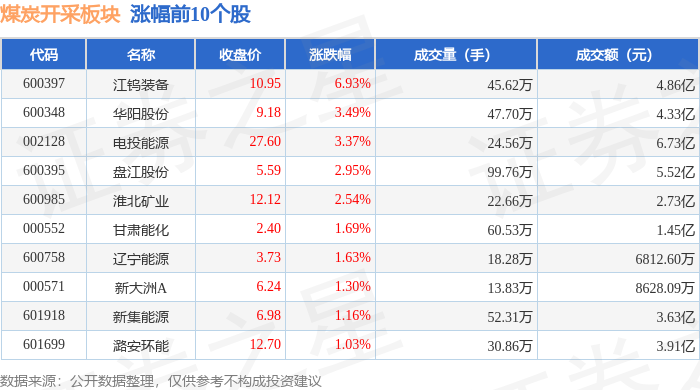
Market Overview - The coal mining sector increased by 0.22% compared to the previous trading day, with Xinjie Energy leading the gains [1] - The Shanghai Composite Index closed at 4018.6, up by 0.53%, while the Shenzhen Component Index closed at 13427.61, up by 0.18% [1] Individual Stock Performance - Xinjie Energy (601918) closed at 7.72, with a rise of 3.49% and a trading volume of 611,500 shares, amounting to a transaction value of 470 million yuan [1] - Electric Power Investment Energy (002128) rose by 3.33% to 27.90, with a trading volume of 203,600 shares and a transaction value of 562 million yuan [1] - Zhongmei Energy (601898) increased by 2.71% to 15.14, with a trading volume of 402,500 shares and a transaction value of 609 million yuan [1] - Shaanxi Coal and Chemical Industry (601225) saw a 2.28% increase, closing at 24.68 with a transaction value of 1.007 billion yuan [1] - Other notable performers include Fakuang Energy (600188) up by 1.88% and Shanghai Energy (600508) up by 1.76% [1] Fund Flow Analysis - The coal mining sector experienced a net outflow of 77.2357 million yuan from institutional investors, while retail investors saw a net inflow of 187 million yuan [2] - The overall fund flow indicates a mixed sentiment, with institutional investors withdrawing capital while retail investors are actively buying [2] Detailed Fund Flow for Selected Stocks - Xinjie Energy had a net inflow of 66.1553 million yuan from institutional investors, while retail investors had a net outflow of 49.5847 million yuan [3] - XD China Shenhua (601088) saw a net inflow of 44.3308 million yuan from institutional investors, with a slight net outflow from retail investors [3] - Other stocks like Daya Energy (600403) and Huaihe Energy (600575) also showed varied fund flows, indicating differing investor sentiments across the sector [3]
浙商证券:煤炭涨势未止 行业基本面向上
Zhi Tong Cai Jing· 2025-11-10 05:56
Core Viewpoint - The report from Zheshang Securities indicates that coal prices are experiencing a strong upward trend, with expectations for further increases in the fourth quarter, driven by supply constraints and rising demand from power plants [1] Group 1: Coal Market Overview - As of November 6, 2025, the average daily coal sales from key monitored enterprises reached 7.25 million tons, a week-on-week increase of 0.6% and a year-on-year increase of 0.1% [1] - The average daily coal production from key monitored enterprises was 7.37 million tons, a week-on-week increase of 2.5% but a year-on-year decrease of 0.4% [1] - Total coal inventory (including port storage) stood at 23.8 million tons, a week-on-week increase of 3.8% and a year-on-year decrease of 19.9% [1] Group 2: Price Trends - The price of thermal coal (Q5500K) in the Bohai Rim region was 694 CNY/ton as of November 7, 2025, reflecting a week-on-week increase of 1.31% [2] - The price of coking coal at Jingtang Port was 1800 CNY/ton, with a week-on-week increase of 3.4% [3] - The price of anthracite coal in Yangquan remained stable at 930 CNY/ton [4] Group 3: Supply and Demand Dynamics - The report anticipates a supply-demand gap to widen, with an expected increase in coal consumption of approximately 50 million tons due to heating needs, potentially leading to localized coal shortages [1] - The cumulative coal sales from key monitored enterprises this year reached 215.6 million tons, a year-on-year decrease of 2.4% [1] Group 4: Investment Recommendations - The report suggests focusing on flexible thermal coal companies such as China Shenhua (601088), Shaanxi Coal and Chemical Industry (601225), and others, as well as coking coal companies like Huaibei Mining (600985) and Shanxi Coking Coal (000983) [5][6]
煤价如期大涨,继续全面看好板块机会
2025-11-10 03:34
Summary of Coal Industry Conference Call Industry Overview - The coal industry is experiencing a significant price increase, with domestic coal prices rising due to a surge in overseas coal prices, specifically a 3.3% increase in Australian coal prices and a 2.1% increase in Indonesian coal prices [1][3] - Despite the rise in overseas prices, the imported coal's tax-inclusive price remains lower than the northern port prices by 50-100 RMB, which may exert potential pressure on domestic coal prices [1][3] Key Points on Coal Prices - Northern nine ports have seen a significant year-on-year decrease in coal inventory, down 18% compared to 2023 and 12% compared to 2024, indicating that the inventory accumulation phase is not meeting expectations, which is a key driver for the current price increase [1][5] - The strong performance of coking coal is attributed to reduced imports from Mongolia, production cuts in Shanxi, and environmental reductions in Wuhai, leading to tight supply of main coking coal varieties [1][6] - The stock performance of thermal coal companies has been robust, with leading Hong Kong thermal coal companies seeing stock increases of 6%-10% [1][7] Supply and Demand Dynamics - The expected increase in coal prices in 2025 is primarily due to a reduction in imported coal (approximately 10 million tons year-on-year) and negative domestic production growth, alongside seasonal demand not following typical patterns [1][9] - The current market is characterized by a significant supply-demand gap, with expectations that if supply does not recover significantly, prices could rise to between 900-1,000 RMB [1][9][15] Challenges Faced by Traders and Power Plants - Traders are facing challenges due to the significant price gap between pit and port prices, leading to losses when shipping coal to ports, which diminishes their willingness to stockpile [1][10] - Power plants are struggling with low long-term contract prices compared to current market prices, leading to procurement challenges and potential rapid depletion of static inventory, which could exacerbate market tensions [1][11] Future Outlook - The coal market is expected to remain tight, with limited immediate relief from increased imports or production from Xinjiang due to stringent safety regulations [1][12][14] - The fourth quarter is anticipated to see a supply-demand gap comparable to 2020, when coal prices surged from 600 RMB to 1,000 RMB, indicating a potential for continued price increases [1][15] - Predictions for 2025 suggest an average price of around 700 RMB, with a confirmed upward trend for 2026, influenced by the fourth quarter's policy environment [1][16] Investment Recommendations - Short-term investment strategies should focus on flexible varieties such as thermal and coking coal, with specific recommendations for companies like Liu'an Huanneng, Yanzhou Coal, and Shanxi International [1][17]
煤炭行业周报:动力煤价上破800元,炼焦煤联动走强-20251109
KAIYUAN SECURITIES· 2025-11-09 14:42
Investment Rating - The investment rating for the coal industry is "Positive" (maintained) [1] Core Viewpoints - The report indicates that thermal coal prices have surpassed 800 RMB per ton, with coking coal prices also rising in tandem. The price of Qinhuangdao Q5500 thermal coal reached 817 RMB per ton as of November 7, marking a significant increase due to supply constraints and rising demand driven by heating needs from a cold wave [3][4] - The report outlines a four-step process for the upward movement of thermal coal prices, including the restoration of long-term contracts and achieving a balance in profitability between coal and power companies, with a target price of around 750 RMB for 2025 [4][13] - Coking coal prices are expected to follow thermal coal trends, with target prices based on the ratio of coking coal to thermal coal prices, indicating potential prices of 1608 RMB to 2064 RMB depending on thermal coal price movements [4][13] Summary by Sections Investment Logic - Thermal coal and coking coal prices are at a turning point, with thermal coal being a policy-driven commodity. The upward price movement is expected to follow a structured process involving the restoration of long-term contracts and achieving a profitability balance [4][13] - Coking coal prices are more influenced by market supply and demand dynamics, with a significant correlation to thermal coal prices [4][13] Investment Recommendations - The report suggests a dual logic for coal stocks: cyclical elasticity and stable dividends. It highlights that both thermal and coking coal prices are at historical lows, providing room for rebound [5][14] - Four main lines of investment are recommended: 1. Cyclical logic: companies like Jinko Coal and Yanzhou Coal 2. Dividend logic: companies like China Shenhua and Zhongmei Energy 3. Diversified aluminum elasticity: companies like Shenhua Holdings and Electric Power Energy 4. Growth logic: companies like Xinji Energy and Guanghui Energy [5][14] Key Market Indicators - The coal index increased by 4.52%, outperforming the CSI 300 index by 3.7 percentage points, with most major coal companies showing positive growth [8][10] - The average PE ratio for the coal sector is 16.36, and the PB ratio is 1.43, indicating a relatively low valuation compared to other sectors [24][29] Thermal Coal Market Overview - As of November 7, the price of Qinhuangdao Q5500 thermal coal is 817 RMB per ton, reflecting a 6.10% increase from the previous week [17] - The report notes a slight increase in coal mine operating rates and a small rise in port inventories, indicating a tightening supply situation [17][28] Coking Coal Market Overview - The price of main coking coal at Jingtang Port reached 1860 RMB per ton, showing a 5.68% increase, with expectations for further price adjustments based on thermal coal trends [18][20]
旺季需求临近,煤价涨势未休
Xinda Securities· 2025-11-09 12:12
1. Report Industry Investment Rating - The investment rating for the coal mining industry is "Bullish" [2] 2. Core Viewpoints of the Report - Currently, the coal economy is at the beginning of a new upward cycle, with fundamental and policy factors in resonance. It is advisable to allocate the coal sector at low levels [11]. - The underlying investment logic of coal production capacity shortage remains unchanged. The coal price has established a bottom and its central level has reached a new platform. High - quality coal enterprises maintain their core asset attributes, and coal assets are still undervalued with potential for valuation improvement. The coal sector has both dividend characteristics and pro - cyclical elasticity [3]. - In the context of energy inflation, the pattern of tight coal supply and demand in the next 3 - 5 years remains unchanged. High - quality coal enterprises have high - barrier, high - cash, high - dividend, and high - dividend - yield attributes. After a short - term correction, the coal sector has shown high investment value [3]. 3. Summaries Based on Relevant Catalogs 3.1 This Week's Core Viewpoints and Key Concerns - **Core Viewpoints**: In the short - term, coal supply and demand are basically balanced, but there is a long - term gap. Coal prices are expected to rise further due to tight supply and upcoming seasonal demand. Coal assets are cost - effective, with high win - rate and high odds. The report continues to be bullish on coal and suggests allocation at low levels [11]. - **Key Concerns**: From January to October 2025, China's coal imports decreased by 11.0% year - on - year. From January to September 2025, coal and coking coal imports in India decreased by 1.0% year - on - year, and in Japan decreased by 2.3% year - on - year [13] 3.2 This Week's Performance of the Coal Sector and Individual Stocks - The coal sector rose 4.43% this week, outperforming the market. The Shanghai and Shenzhen 300 Index rose 0.82% [14]. - The thermal coal sector rose 4.60%, the coking coal sector rose 2.46%, and the coke sector rose 6.42% [15]. - The top three stocks in terms of gains and losses in the coal mining and washing sector were Huayang Co., Ltd. (11.50%), Jinkong Coal Industry (10.11%), and China National Coal Group Corporation (8.54%) [18] 3.3 Coal Price Tracking - **Coal Price Index**: As of November 7, the comprehensive transaction price of CCTD Qinhuangdao thermal coal (Q5500) was 703.0 yuan/ton, up 10.0 yuan/ton week - on - week. The comprehensive average price index of Bohai Rim thermal coal (Q5500) was 694.0 yuan/ton, up 9.0 yuan/ton week - on - week. The annual long - term contract price of CCTD Qinhuangdao thermal coal (Q5500) was 684.0 yuan/ton, up 8.0 yuan/ton month - on - month [23]. - **Thermal Coal Price**: As of November 8, the market price of Qinhuangdao Port thermal coal (Q5500) from Shanxi was 808 yuan/ton, up 40 yuan/ton week - on - week. International thermal coal FOB prices also increased [29]. - **Coking Coal Price**: As of November 7, the ex - warehouse price of primary coking coal from Shanxi at Jingtang Port was 1800 yuan/ton, up 60 yuan/ton week - on - week. The CIF price of Australian Peak View Mine hard coking coal in China was 212.3 US dollars/ton, up 0.6 US dollars/ton week - on - week [31]. - **Anthracite and Pulverized Coal Price**: As of November 7, the wagon - loading price of Jiaozuo anthracite was 1020.0 yuan/ton, unchanged week - on - week. The wagon - loading prices of pulverized coal in Changzhi Lucheng and Yangquan increased [39] 3.4 Coal Supply and Demand Tracking - **Coal Mine Capacity Utilization**: As of November 7, the capacity utilization rate of sample thermal coal mines was 91.1%, up 0.6 percentage points week - on - week, and that of sample coking coal mines was 83.76%, down 1.0 percentage points week - on - week [46]. - **Import Coal Price Difference**: As of November 7, the price difference between domestic and foreign 5000 - kcal thermal coal was - 79.1 yuan/ton, down 19.5 yuan/ton week - on - week; the price difference for 4000 - kcal thermal coal was - 75.2 yuan/ton, down 20.1 yuan/ton week - on - week [42]. - **Coal - fired Power Consumption and Inventory**: Inland 17 provinces' coal inventory increased, while daily consumption decreased. Coastal 8 provinces' coal inventory decreased, while daily consumption increased [45]. - **Downstream Metallurgical Demand**: As of November 7, the Myspic comprehensive steel price index decreased, the price of Tangshan - produced primary metallurgical coke increased, the blast furnace operating rate increased, and the profit per ton of coke in independent coking enterprises increased [64][65]. - **Downstream Chemical and Building Materials Demand**: As of November 7, the prices of urea in some regions decreased, the national methanol, ethylene glycol, and acetic acid price indices decreased, the synthetic ammonia price index increased, the cement price index increased slightly, the cement clinker capacity utilization rate decreased, the float glass operating rate decreased, and the weekly coal consumption in the chemical industry increased [70][74][76] 3.5 Coal Inventory Situation - **Thermal Coal Inventory**: As of November 7, the coal inventory at Qinhuangdao Port increased to 577.0 tons. The 55 - port thermal coal inventory decreased to 6148.7 tons as of October 31, and the production - area inventory decreased to 292.0 tons [91]. - **Coking Coal Inventory**: As of November 7, the production - area coking coal inventory increased to 165.6 tons, the six - port coking coal inventory increased to 304.3 tons, the coking enterprise inventory increased to 923.8 tons, and the steel mill inventory decreased to 787.3 tons [92]. - **Coke Inventory**: As of November 7, the total coke inventory of coking plants, four - port coke inventory, and the total coke inventory of domestic sample steel mills all decreased [94] 3.6 Coal Transportation Situation - **International and Domestic Coal Transportation**: As of November 7, the Baltic Dry Index (BDI) was 2104.0 points, up 138.0 points week - on - week. As of November 6, the average daily coal shipment volume of the Datong - Qinhuangdao Railway increased slightly week - on - week [108]. - **Ratio of Cargo to Ships at Four Ports in the Bohai Rim**: As of November 7, the inventory of four ports in the Bohai Rim was 1449.0 tons, the number of anchored ships was 106, and the cargo - to - ship ratio was 13.7, down 4.03 week - on - week [106] 3.7 Weather Conditions - As of November 7, the Three Gorges outflow was 10200 cubic meters per second, down 23.88% week - on - week. - In the next 10 days (November 9 - 18), there will be precipitation in some areas, with high - impact weather including cooling in Xinjiang and central - eastern regions. - In the next 11 - 14 days (November 19 - 22), there will be light precipitation in some areas, and the average temperature in some regions will be different from the normal level [113] 3.8 Listed Company Valuation Table and Key Announcements - **Listed Company Valuation Table**: The table provides the closing prices, net profits attributable to the parent company, EPS, and P/E ratios of key listed coal companies from 2024A to 2027E [114]. - **Key Announcements**: Companies such as Meijin Energy, China Shenhua, and Hengyuan Coal and Electricity have made announcements regarding project terminations, asset acquisitions, and corporate restructurings [115][116][118]
涨势加速后,如何判断煤价潜在上涨空间?
Changjiang Securities· 2025-11-09 09:45
Investment Rating - The report maintains a "Positive" investment rating for the coal industry [9] Core Viewpoints - The coal price has accelerated its upward trend, with the current market price for Qinhuangdao thermal coal reaching 817 RMB/ton, an increase of 47 RMB/ton week-on-week. The report suggests that the price could potentially rise to 931 RMB/ton based on profit recovery scenarios for power plants [2][6][16] - The report emphasizes the importance of understanding cyclical trends over pinpointing absolute price peaks, highlighting a favorable environment for coal investments due to global monetary easing and a rebound in the coal cycle [2][7] Summary by Sections Weekly Tracking Summary - The coal index (Yangtze) increased by 4.53%, outperforming the CSI 300 index by 3.71 percentage points. The thermal coal index rose by 4.84%, while the coking coal index increased by 1.87% [16][20] - As of November 7, the market price for Qinhuangdao thermal coal was 817 RMB/ton, with a week-on-week increase of 47 RMB/ton. The main coking coal price at Jingtang Port was 1860 RMB/ton, up 100 RMB/ton [6][16] Supply and Demand Analysis - The report notes a tightening supply due to production checks and increased winter demand, predicting that coal prices in Q4 may exceed expectations. It highlights the importance of monitoring winter storage and port inventory changes [6][17] - The daily coal consumption across 25 provinces was 511.7 million tons, a decrease of 0.5% week-on-week, while coal supply increased slightly to 547.3 million tons [34] Price Projections - The report provides calculations indicating that if the profit margins for coal-fired power plants return to long-term averages, the acceptable market price for thermal coal could rise to 789 RMB/ton or even 931 RMB/ton under certain conditions [7][12] - The report also discusses the impact of upcoming capacity price adjustments in 2026, which could further influence coal pricing dynamics [7][12] Investment Recommendations - The report suggests a comprehensive embrace of the coal sector's "Davis Double Play" bottom reversal trend, recommending a diversified selection of stocks based on different strategies: balanced, aggressive, and stable leaders [2][7]
华福证券-煤炭行业:旺季临近煤价持续上涨,进口煤同环比下滑-251108
Xin Lang Cai Jing· 2025-11-08 11:14
Core Insights - The primary goal is to reverse the PPI trend, with September PPI's year-on-year decline narrowing to 2.3%, indicating a stabilization in PPI driven by coal prices [3] - The coal price is expected to remain stable, with 2025 potentially marking a policy bottom for coal prices, as supply-side policies are anticipated to be introduced [3] - The coal industry is experiencing a transformation, with limited supply elasticity due to strict capacity controls and increasing mining difficulties, particularly in eastern regions [3] Industry Summary - As of November 7, 2025, Qinhuangdao's 5500K thermal coal closing price is 817 RMB/ton, up 6.1% week-on-week, with significant price increases in Inner Mongolia, Shaanxi, and Shanxi [1] - Daily average production of thermal coal from 462 sample mines is 5.493 million tons, a week-on-week increase of 42,000 tons but a year-on-year decrease of 6.2% [1] - Methanol and urea operating rates are at 87.8% and 82.7%, respectively, both above historical levels [1] Company Recommendations - Companies with excellent resource endowments and stable operating performance, such as China Shenhua, China Coal Energy, and Shaanxi Coal, are recommended for investment [4] - Companies with production growth potential benefiting from a coal price cycle bottom, including Yanzhou Coal, Huayang Co., Guanghui Energy, Jinkong Coal, and Gansu Energy, are also suggested [4] - Companies with globally scarce resources benefiting from long-term supply tightness, such as Huaibei Mining, Pingmei Shenma, Shanxi Coking Coal, Lu'an Environmental Energy, and Shanmei International, are highlighted [4]
煤炭行业2025年三季报总结:环比大幅改善,龙头再次展现领跑能力
GUOTAI HAITONG SECURITIES· 2025-11-07 14:53
Investment Rating - The report rates the coal industry as "Overweight" [4] Core Views - The coal industry has shown a clear trend of recovery in Q3 2025, confirming that the bottom was reached in Q2 2025. It is expected that Q4 will see a full recovery to the levels seen at the beginning of the year [2][7] - The report recommends leading companies such as China Shenhua, Shaanxi Coal, and China Coal Energy, while also continuing to recommend Yanzhou Coal and Jinneng Holding [4][10] Summary by Sections Investment Highlights - In Q3 2025, the thermal coal sector exhibited a clear trend of revenue performance improvement, with net profit increasing by over 30% quarter-on-quarter. The bottom of the sector cycle was confirmed in Q2 2025 [7] - For the first three quarters of 2025, the electricity generation from thermal power accounted for 64.7% of total generation, remaining the primary source. Total electricity consumption reached 7.8 trillion kWh, a year-on-year increase of 4.6% [7][14] - National coal production in the first three quarters of 2025 increased by 2% year-on-year, with raw coal production at 3.57 billion tons [7][26] - The average price of thermal coal (Q5500) at Huanghua Port was 683.7 RMB/ton, a year-on-year decrease of 21.9% [7][33] Industry Review - Q2 2025 marked the official bottom of the current coal price decline cycle, with a narrowing of price declines in Q3. The total coal production for 2025 is expected to remain stable, with a slight year-on-year decrease in Q4 due to "overproduction" checks [13] - The report indicates that the demand for thermal coal is recovering, with Q3 showing a significant increase in electricity consumption and generation [14] Performance Analysis - In Q3 2025, the coal industry achieved revenues of 638.5 billion RMB, a quarter-on-quarter increase of 3.9% but a year-on-year decrease of 17.6%. Total profit was 77.28 billion RMB, down 45.8% year-on-year but up 12.4% quarter-on-quarter [8][51] - The coal sector's performance improved in Q3 2025, with a revenue of 297.9 billion RMB, a year-on-year decline of 16.5% but a quarter-on-quarter increase of 1.5% [8][53] Financial Analysis - The report notes that the operating cash flow of the coal sector has decreased significantly year-on-year, but there has been an improvement compared to H1 2025. The debt ratio of the coal sector has been continuously optimized, decreasing from 49.2% in 2020 to 46.8% in Q3 2025 [9][40] Outlook for 2026 - The report expresses optimism for a new upward cycle in the coal industry starting in 2026, driven by demand growth and stable supply. It predicts that coal prices may return to above 800 RMB/ton in the second half of 2026 [10][11]
中国神华:市场竞争加剧,未来火电盈利模式重构
Zhong Guo Dian Li Bao· 2025-11-07 09:29
Core Viewpoint - China Shenhua reported a decline in electricity sales and average selling prices due to increased competition in the electricity market and lower long-term contract prices [1][3] Group 1: Electricity Generation and Sales - From January to September 2025, the national power generation increased by 1.6% year-on-year, while thermal power generation decreased by 1.2% [1] - China Shenhua's electricity generation during the same period was 162.87 billion kWh, a year-on-year decline of 5.4% [1] - The company's average selling price for electricity was 382 RMB per MWh, down by 18 RMB per MWh, a decrease of 4.5% year-on-year [1] Group 2: Market Competition and Strategic Response - The decline in sales volume and average selling price is attributed to lower signing prices for long-term contracts and increased participation of renewable energy in market bidding [1] - The company plans to strengthen investment management in thermal power projects and enhance electricity marketing to improve revenue from capacity fees and auxiliary services [1][3] Group 3: New Energy Projects and Carbon Emission Management - China Shenhua is actively engaging with local governments and enterprises to develop multiple new energy projects, with a total planned, under construction, and operational capacity of approximately 3.4587 million kW as of September 2025 [1][2] - The company is conducting research on Scope 3 carbon emissions accounting and has made progress in large-scale CCUS demonstration projects [2] Group 4: Operational Stability and Future Plans - Despite a year-on-year decline in cumulative performance for the first three quarters, the decline rate has narrowed each quarter, indicating strong operational stability [3] - The company aims to enhance coal resource acquisition, optimize coal product structure, and improve the resilience of its integrated industrial chain [3]