CSEC,China Shenhua(601088)

Search documents
紧盯“盈利确定性+产业趋势” 基金提前埋伏绩优股
Zhong Guo Zheng Quan Bao· 2026-02-04 20:20
Core Insights - Over 2900 A-share listed companies have released their 2025 earnings forecasts, with high-performing companies attracting significant interest from fund institutions [1][2] - Notable companies with substantial profit growth include Zijin Mining, which is expected to achieve a net profit of 510-520 billion yuan, and Industrial Fulian, projected to reach 351-357 billion yuan [2][3] Company Performance - Zijin Mining is expected to see a net profit increase of 59%-62% in 2025, with 78 fund companies holding its shares, including well-known fund managers [2] - Industrial Fulian anticipates a net profit growth of 51%-54%, with 96 fund companies holding its shares, primarily managed by E Fund [3] - *ST Songfa is projected to turn a profit with a net profit of 24-27 billion yuan, attracting new institutional investors in Q4 2025 [4] - Tonghua Dongbao expects a net profit of 12.42 billion yuan, also turning a profit, with new institutional investors entering in Q4 2025 [4] - Honghe Technology forecasts a net profit of 1.93-2.26 billion yuan, showing a significant growth of 745%-889%, with new institutional investors in Q4 2025 [4] - Baiwei Storage anticipates a net profit of 8.5-10 billion yuan, with 40 fund companies holding its shares and several increasing their positions in Q4 2025 [5] Market Outlook - The release of earnings forecasts and annual reports is expected to lead to a focus on companies' performance, with a potential for market stabilization and upward movement [6] - Fund institutions suggest that the market may return to a structure driven by "profit certainty + industry trends," with opportunities in core technology and manufacturing sectors [6] - External factors may create short-term pressure, but domestic policy support and a stable capital market are expected to mitigate significant downturns [7] - Investment strategies are recommended to focus on growth sectors like AI and semiconductors, as well as areas benefiting from "anti-involution" policies, such as new energy [7]






印尼削减产量配额,搅动全球煤炭贸易
GUOTAI HAITONG SECURITIES· 2026-02-04 14:36
股票研究 /[Table_Date] 2026.02.04 印尼削减产量配额,搅动全球煤炭贸易 [Table_Industry] 煤炭 行 | [姓名table_Authors] | 电话 | 邮箱 | 登记编号 | | --- | --- | --- | --- | | 黄涛(分析师) | 021-38674879 | huangtao@gtht.com | S0880515090001 | | 邓铖琦(分析师) | 010-83939825 | dengchengqi@gtht.com | S0880523050003 | 本报告导读: 印尼出口政策调整,大幅削减产量配额;全球煤炭 2026 年起供给收缩需求抬升,看 好上升周期;2026 年中国进口煤量或将进一步下降,国内煤价有望恢复增长。 投资要点: [Table_Report] 相关报告 煤炭《持仓略有提升,焦炭第一轮提价》 2026.02.02 煤炭《国泰海通煤炭行业基本面数据库大全 20260202》2026.02.02 煤炭《Q4 基金持仓持续回升,板块拐点确认》 2026.01.30 煤炭《地产政策多部门联动稳预期,非电需求有 望修复》202 ...




CHINA SHENHUA ENERGY(01088.HK):PREANNOUNCED EARNINGS LARGELY IN LINE;RESOURCE INTEGRATION PROGRESSING STEADILY
Ge Long Hui· 2026-02-04 14:27
机构:中金公司 研究员:Yan CHEN/Lingzhi WANG Results Preview According to corporate filings, the firm's acquisition of coal and power assets was approved at the shareholders' general meeting. Looking ahead, we expect the firm to expand its coal resources, increase the capacity of power generation units, and further strengthen its advantages in coal-to-power integration and its leading position in the industry. Financials and valuation Preannounced 2025 H-share earnings down 14.7–6.3% YoY Due to adjustments to our fore ...
中国神华(601088):资产注入稳步推进,业绩稳健支撑持续高分红
Guotou Securities· 2026-02-04 11:29
Investment Rating - The report assigns an "Accumulate-A" investment rating to the company with a target price of 40.1 CNY for the next six months [4][11]. Core Views - The company is expected to achieve a net profit attributable to shareholders of 495-545 billion CNY for 2025, representing a year-on-year decline of 11.3%-2.3% [1]. - The integration of operations and the acquisition of significant assets are expected to enhance the company's operational resilience and support its high dividend policy, with a commitment to maintain a dividend payout ratio of no less than 65% from 2025 to 2027 [1][6]. - The company is actively transitioning its power generation business towards green and low-carbon initiatives, with a focus on increasing renewable energy projects [2]. Financial Performance Summary - The company forecasts revenues of 2957.1 billion CNY, 3177.4 billion CNY, and 3504.3 billion CNY for 2025, 2026, and 2027 respectively, with growth rates of -12.6%, 7.4%, and 10.3% [6][10]. - The expected net profits for the same years are 515.0 billion CNY, 530.9 billion CNY, and 561.2 billion CNY, with growth rates of -12.2%, 3.1%, and 5.7% [6][10]. - The company’s coal production and sales are projected to be 332 million tons and 431 million tons respectively for 2025, reflecting a decrease of 1.7% and 6.4% year-on-year [1]. Operational Insights - The company is enhancing its integrated operations model, which includes coal, power generation, rail transport, and coal chemical production, to maintain stable performance amid external pressures [8]. - The acquisition of 12 assets is expected to increase the company's coal reserves and production capacity significantly, with a projected increase in annual production capacity to 512 million tons, a 57% growth [1][6]. - The company is also optimizing its transportation network and advancing construction projects to support its operational efficiency [1]. Market Positioning - The company maintains a leading position in the integrated operations of coal and power generation, which is expected to provide a solid financial foundation for its high dividend commitments [6][11]. - The report highlights the competitive landscape in the power generation sector, particularly with the increasing participation of renewable energy sources [2].
煤炭行业动态跟踪报告:印尼矿商暂停煤炭出口,煤价上行预期明显加强
Orient Securities· 2026-02-04 10:45
印尼矿商暂停煤炭出口,煤价上行预期明 显加强 ——煤炭行业动态跟踪报告 核心观点 投资建议与投资标的 投资建议:2026 年国内煤炭供需基本稳定,海外扰动可能成为驱动煤价变化的主要因 素,目前印尼方面已出现明显扰动,煤价具有上涨可能。且从长期角度,全球煤炭贸易 成本将逐步抬升,对国内煤价将形成支撑。优质煤企此前的估值仅反映出"类债"价 值,随着煤价上涨可能性的提高,将逐步向"类债"+"煤价看涨期权"演变,这部分"看涨期 权"价值目前市场反应还较为有限,推荐中国神华(601088,增持)、中煤能源(601898, 增持)、陕西煤业(601225,增持)、晋控煤业(601001,增持)。 风险提示 经济增速下滑;水电出力超预期;海外煤价大幅下跌;政策实施力度不及预期。 行业名称 行业研究 | 动态跟踪 国家/地区 中国 行业 煤炭行业 报告发布日期 2026 年 02 月 04 日 看好(维持) | 蒋山 | 执业证书编号:S0860525110006 | | --- | --- | | | jiangshan2@orientsec.com.cn | | | 0755-82819271 | | 李晓渊 | 执业证 ...
一图看懂 | 煤炭概念股
市值风云· 2026-02-04 10:16
Group 1 - The article highlights a significant reduction in coal production quotas by the Indonesian government, which aims to boost coal prices by decreasing export volumes by 40% to 70% for major miners by 2025 [5] - Additionally, the Indonesian government plans to impose an export surcharge, which may further weaken the profitability of the coal industry [5] Group 2 - The article lists several companies involved in coal mining, coal chemical, and coal-electricity integration, including China Shenhua, Zhengzhou Coal Electricity, and Yanzhou Coal Mining [8][9]



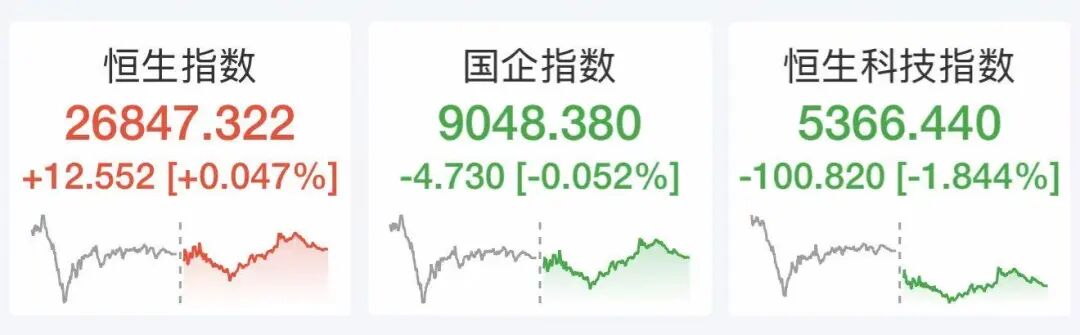
恒生指数收涨0.05%,煤炭、内房股走高,科网股低迷
Jin Rong Jie· 2026-02-04 09:58
作者:观察君 2月4日,港股收盘,恒生指数收涨0.05%,报26847.32点;恒生科技指数收跌1.84%,报5366.44点。 板块方面,煤炭股涨幅居前,兖矿能源涨超10%,中国神华涨超5%;芯片股走势疲软,上海复旦跌超 5%,华虹半导体跌近5%;科网股整体表现低迷,腾讯控股跌近4%,哔哩哔哩跌超3%;内房股集体走 高,世茂集团涨超14%,融创中国涨超8%。恒生指数成分股中,信义玻璃、中国神华、华润置地涨幅 靠前;携程集团-S、腾讯控股、网易-S跌幅居前。恒生科技指数成分股中,理想汽车-W、零跑汽车、 海尔智家涨幅靠前;金蝶国际、携程集团-S、同程旅行跌幅居前。 声明:市场有风险,投资需谨慎。本文为AI基于第三方数据生成,仅供参考,不构成个人投资建议。 本文源自:市场资讯 ...

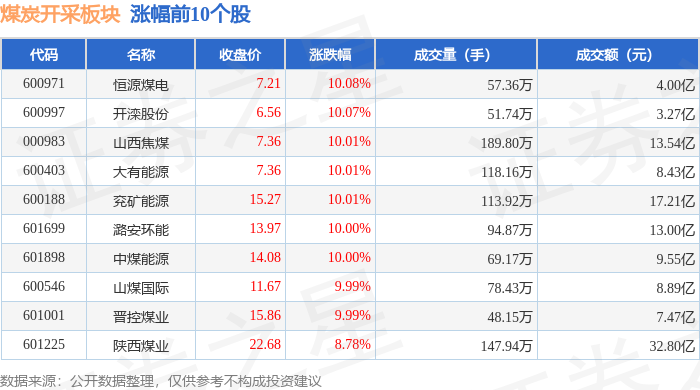
煤炭开采板块2月4日涨7.75%,恒源煤电领涨,主力资金净流入21.32亿元
Zheng Xing Xing Ye Ri Bao· 2026-02-04 08:56
Group 1 - The coal mining sector experienced a significant increase of 7.75% on February 4, with Hengyuan Coal Power leading the gains [1] - The Shanghai Composite Index closed at 4102.2, up 0.85%, while the Shenzhen Component Index closed at 14156.27, up 0.21% [1] - Key stocks in the coal mining sector showed substantial price increases, with Hengyuan Coal Power rising by 10.08% to a closing price of 7.21, and other notable increases from Kailuan Shares and Shanxi Coking Coal, both up by 10.01% [1] Group 2 - The coal mining sector saw a net inflow of 2.132 billion yuan from main funds, while retail investors experienced a net outflow of 1.171 billion yuan [1] - Major stocks like Dazhou Energy and Shanxi Coking Coal had significant main fund inflows, with Dazhou Energy receiving 2.07 billion yuan, representing 24.49% of its trading volume [2] - Retail investors showed a negative trend, with significant outflows from stocks such as Zhongmei Energy and Shanxi Coking Coal, indicating a shift in investor sentiment [2]


港股收盘 | 恒指收涨0.05% Anthropic新工具冲击软件股 煤炭、内房股全天强势
Zhi Tong Cai Jing· 2026-02-04 08:53
Market Overview - The Hong Kong stock market showed mixed performance, with the Hang Seng Index closing up 0.05% at 26,847.32 points, while the Hang Seng Tech Index fell 1.84% to 5,366.44 points [1] - The trading volume for the day was HKD 285.43 billion [1] Blue-Chip Stocks Performance - Tencent (00700) declined by 3.96% to HKD 558, contributing to a drop of 78.28 points in the Hang Seng Index [2] - Other notable blue-chip movements included Xinyi Glass (00868) rising 5.88% to HKD 10.81, and China Shenhua (01088) increasing by 5.67% to HKD 42.9 [2] Sector Performance Coal Sector - The coal sector saw significant gains, with Yancoal Australia (03668) up 11.05% to HKD 34.98, and China Shenhua (01088) up 5.67% [3][4] - Indonesian miners have suspended spot coal exports due to a government plan to cut production by 40% to 70%, which is expected to impact coal prices positively [4] Aviation Sector - Airline stocks performed well, with China Eastern Airlines (00670) rising 6.72% to HKD 6.19, and China Southern Airlines (01055) up 5.57% [4] - The upcoming Spring Festival is expected to set records for passenger volume, with a reported increase of 5.3% in air passenger numbers compared to the same period last year [4] Photovoltaic Sector - The photovoltaic sector experienced a boost, with Xinyi Energy (03868) rising 4.24% to HKD 1.23, following reports of a visit by Elon Musk's team to Chinese solar companies [5] - The visit focused on technology and production capabilities, indicating potential future collaborations [5] Real Estate Sector - The real estate sector showed strong performance, with Sunac China (01918) up 8.77% to HKD 1.24, driven by supportive government measures for the housing market [6] - Recent data indicates a robust performance in the second-hand housing market across major cities [6] Software Sector - The software sector faced significant declines, with Inspur Digital (00596) down 9.92% to HKD 4.27, attributed to fears surrounding AI advancements potentially disrupting traditional software models [7] Notable Stock Movements - Guoen Technology (02768) debuted with a rise of 11.56% to HKD 40.16, following its IPO pricing at HKD 36 per share [8] - COSCO Shipping Energy (01138) increased by 8.1% to HKD 15.35, driven by rising shipping rates due to geopolitical tensions [9] - Goldwind Technology (02208) fell 6.78% to HKD 13.75 amid an EU investigation into its market practices [10]

內房股大涨,融创中国涨超8%,万科涨超6%!恒生科技跳水,大型科技股齐跌 | 港股收盘
Mei Ri Jing Ji Xin Wen· 2026-02-04 08:44
Group 1 - The Hong Kong stock market experienced fluctuations, with the Hang Seng Index closing at 26,847.322, a slight increase of 0.047% [1] - Real estate stocks saw significant gains, with Shimao Group rising over 14%, Sunac China up over 8%, Vanke Enterprises increasing over 6%, and Yuexiu Property up over 6% [1] - Coal stocks also performed well, with Yanzhou Coal Mining rising over 10% and China Shenhua Energy increasing over 5% [1] Group 2 - The Hang Seng Tech Index dropped by 1.844%, with major tech companies showing poor performance [3] - Tencent Holdings fell nearly 4%, Baidu Group declined nearly 3%, Xiaomi Group dropped over 1.8%, JD Group decreased over 1.6%, and Alibaba fell nearly 1% [3][4] - Semiconductor stocks were sluggish, with Fudan Shanghai falling over 5%, Hua Hong Semiconductor down nearly 5%, GigaDevice down over 3%, and SMIC down over 2% [5]