BOB(601169)

Search documents
中科江南中标:北京银行石家庄分行财政一体化综合前端系统采购项目(第三次)成交结果公告
Sou Hu Cai Jing· 2026-02-07 04:10
Group 1 - The core point of the article is the announcement of the successful bid by Beijing Zhongke Jiangnan Information Technology Co., Ltd. for the procurement project of the Beijing Bank Shijiazhuang Branch, with a bid amount of 1,620,000 [1][2] - The procurement project is titled "Comprehensive Front-End System Procurement Project for Financial Integration (Third Time)" [1] - The announcement was published on February 5, 2026, and the project is located in Hebei Province [2] Group 2 - Beijing Zhongke Jiangnan Information Technology Co., Ltd. has made investments in 12 companies and participated in 7,258 bidding projects [1] - The company holds 114 trademark registrations, 60 patents, and 165 copyright registrations, along with 7 administrative licenses [1]

并购贷款新规落地满月:银行战略棋局浮出水面
Zhong Guo Zheng Quan Bao· 2026-02-04 20:29
Core Insights - The implementation of the new regulations for merger and acquisition (M&A) loans has prompted banks to actively expand their M&A loan business, aiming to establish competitive advantages through early entry into the market [1][2] - The new regulations have broadened the scope of M&A loans, allowing for equity acquisitions and optimizing loan conditions, which is expected to enhance banks' asset yield [2][3] Group 1: Market Dynamics - Several banks, including Industrial and Commercial Bank of China (ICBC), China Construction Bank, and Shanghai Pudong Development Bank, have entered the M&A loan market since the new regulations were introduced on December 31, 2025, initiating a "first deal competition" [1][2] - Beijing Bank successfully executed the first M&A loan under the new regulations, providing 21 million yuan to support a private technology company's acquisition of a 35% stake in another firm, with a financing ratio of 60% and a three-year term [1] Group 2: Regulatory Changes - The new M&A loan regulations have evolved from strict to more flexible frameworks, introducing three key changes: expanding the applicable scope of M&A loans, optimizing loan conditions, and setting differentiated qualification requirements for banks [2][4] - The regulations allow for a higher proportion of control-type M&A loans in relation to the total transaction value and extend the maximum loan term [2] Group 3: Strategic Importance - M&A loans are increasingly recognized for their potential to enhance banks' asset yields, especially in the context of narrowing interest margins and sluggish growth in traditional lending [3] - The M&A loan business is characterized by strong customer loyalty, high comprehensive returns, and significant barriers to entry, making it a strategic focus for banks aiming to differentiate themselves in a competitive landscape [3] Group 4: Challenges and Opportunities - Despite the growth potential, the complexity and specialization required for M&A loans present challenges for banks, which must navigate multiple stakeholders and legal relationships [4] - Banks are encouraged to develop a comprehensive ecosystem that includes M&A facilitation, financing, and post-investment management to effectively compete in the M&A finance sector [4]




业务增长新风口!银行拓展并购贷款业务
Zhong Guo Zheng Quan Bao - Zhong Zheng Wang· 2026-02-04 15:49
Core Insights - The implementation of the "Commercial Bank M&A Loan Management Measures" has created new growth opportunities for commercial banks, with several banks actively expanding their M&A loan business to build competitive advantages through case accumulation and brand development [1][4] Group 1: Regulatory Changes and Market Response - The new M&A loan regulations allow for a broader application of loans, including support for equity-based mergers, which is expected to facilitate resource optimization and transformation for traditional industries [1][4] - Banks like Shanghai Pudong Development Bank view the new regulations as a chance to enhance service capabilities and expand their service boundaries, leading to a multi-faceted growth in M&A loan business across various branches [2][3] Group 2: Initial Successes and Competitive Landscape - Since the introduction of the new regulations, banks have begun a "first deal competition," with Beijing Bank successfully providing a loan of 21 million yuan for a 35% equity stake in a private listed technology company, marking one of the first innovative practices under the new guidelines [3] - Industrial and Commercial Bank of China issued a 299 million yuan loan to support a company's acquisition of core assets, representing the first control-type M&A loan after the new regulations came into effect [3] Group 3: Growth Potential and Profitability - The M&A loan business has seen a compound annual growth rate of nearly 30% among leading banks, indicating a growing recognition of the financial value of M&A loans as a means to enhance intermediate business and overall revenue amid narrowing interest margins [4][5] - The new regulations are expected to release significant market potential, particularly in key national strategic areas such as technological innovation and manufacturing upgrades, allowing banks to rapidly scale their business [5] Group 4: Challenges and Strategic Shifts - Despite the growth potential, the complexity and specialization of M&A loans present challenges for commercial banks, necessitating a shift from being mere credit providers to offering comprehensive financial services that include financing, advisory, and post-transaction management [6][7] - Banks are encouraged to build specialized teams and enhance their understanding of industries to better match the complexity of M&A loans with appropriate risk management systems [7]

北京银行(601169) - 北京银行股份有限公司2026年第一次临时股东会会议材料
2026-02-04 11:30
北京银行股份有限公司 2026年第一次临时股东会会议材料 (股票代码:601169) 中国·北京 2026年2月12日 1.审议关于选举关文杰先生为董事的议案; 2.审议关于发行资本补充工具的议案。 I 会议时间:2026 年 2 月 12 日上午 9:00 会议地点:北京银行总行三层新闻发布厅 召开方式:现场会议+网络投票 召 集 人:本行董事会 一、 宣布会议开始 二、 宣读股东会会议须知 三、 选举监票人 四、 审议议案 五、 股东发言或提问 六、 对议案投票表决 七、 集中回答股东提问 八、 宣布表决结果及决议 九、 宣读法律意见书 | 会 | 议 | 议 程 | I | | --- | --- | --- | --- | | 会 | 议 | 须 知 II | | | 议案一 | | 关于选举关文杰先生为董事的议案 | 1 | | 议案二 | | 关于发行资本补充工具的议案 | 3 | 股份有限公司 2026 年第一次临时股东会 会 议 材 料 会 议 议 程 议 程 内 容 股份有限公司 2026 年第一次临时股东会 会 议 材 料 会 议 须 知 为维护全体股东的合法权益,确保股东会会议秩序和议事 ...
北京银行关于落实财政金融促内需一揽子政策工作的公告
Xin Lang Cai Jing· 2026-02-04 10:01
Core Viewpoint - The company is actively implementing policies to support consumer loans, credit card installment plans, and financing for small and micro enterprises, in line with government directives to boost consumption and reduce financing costs [1][2][3] Group 1: Policy Implementation - The company is advancing the implementation of personal consumption loans, credit card installment plans, loans for service industry entities, small and micro enterprises, and equipment upgrade loans [1][2] - The implementation is based on several government notifications aimed at optimizing fiscal subsidy policies for personal consumption and business loans [1][2] Group 2: Operational Guidelines - The company will adhere to market-oriented and legal principles, optimizing business processes and simplifying procedures to expedite policy rollout [1][2] - Specific channels and operational guidelines for these policies will be published through the company's official website, WeChat account, and local branches [1][2] Group 3: Customer Advisory - The company will not charge any service fees for the aforementioned loans and has not partnered with any loan intermediaries or individuals [3] - Customers are advised to remain vigilant against potential scams [3]
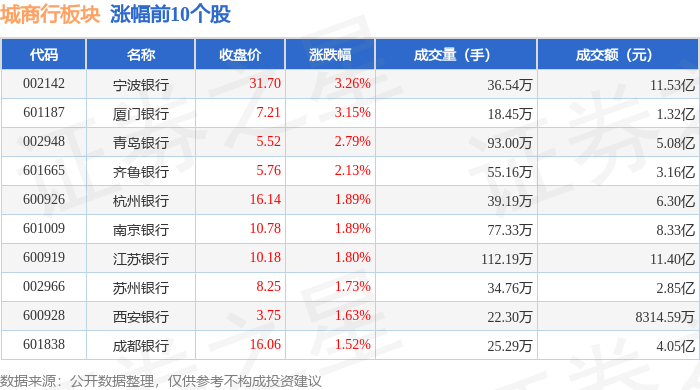
城商行板块2月4日涨1.9%,宁波银行领涨,主力资金净流入1.28亿元
Zheng Xing Xing Ye Ri Bao· 2026-02-04 08:56
证券之星消息,2月4日城商行板块较上一交易日上涨1.9%,宁波银行领涨。当日上证指数报收于 4102.2,上涨0.85%。深证成指报收于14156.27,上涨0.21%。城商行板块个股涨跌见下表: | 代码 | 名称 | 收盘价 | 涨跌幅 | 成交量(手) | 成交额(元) | | --- | --- | --- | --- | --- | --- | | 002142 | 宁波银行 | 31.70 | 3.26% | 36.54万 | 11.53亿 | | 601187 | 厦门银行 | 7.21 | 3.15% | 18.45万 | ● 1.32亿 | | 002948 | 青岛银行 | 5.52 | 2.79% | 93.00万 | 5.08亿 | | 601665 | 齐鲁银行 | 5.76 | 2.13% | 55.16万 | 3.16亿 | | 600926 | 杭州银行 | 16.14 | 1.89% | 39.19万 | 6.30 Z | | 6000000 | 南京银行 | 10.78 | 1.89% | 77.33万 | 8.33亿 | | 616009 | 江苏银行 | 10.18 | ...







丈量地方性银行(2):浙江163家区域性银行全梳理-20260203
GF SECURITIES· 2026-02-03 13:31
Investment Rating - The industry investment rating is "Buy" [2] Core Insights - The report provides a comprehensive analysis of 163 regional banks in Zhejiang Province, highlighting their asset and liability structures, profitability, and asset quality [6][20] - The asset growth rate for major city commercial banks in Zhejiang is 9.4%, which is lower than the 14.2% growth rate of listed city commercial banks, while major rural commercial banks show an asset growth rate of 8.0%, exceeding the 6.7% growth rate of listed rural commercial banks [6][25] - The report indicates that the loan-to-asset ratio for city commercial banks is projected to reach 55.5% in 2024, an increase of 95 basis points year-on-year, while rural commercial banks will see a decrease to 59.3%, down 19 basis points [31] - Profitability metrics show that the average Return on Assets (ROA) for city commercial banks in Zhejiang is 0.78%, slightly above the average of listed city commercial banks, while rural commercial banks have an average ROA of 0.82%, which is below the average of listed rural commercial banks [6][31] - The asset quality of regional banks in Zhejiang is reported to be better than that of listed banks, with non-performing loan ratios lower by 16 basis points for city commercial banks and 9 basis points for rural commercial banks compared to their listed counterparts [6][31] Summary by Sections Section 1: Economic Structure of Zhejiang Province - Zhejiang Province is focused on high-quality development and aims to become a model for common prosperity [13] - The province's GDP is heavily concentrated in cities like Hangzhou, Ningbo, and Wenzhou, with Hangzhou accounting for 24.3% of the total GDP in 2025 [15] Section 2: Overview of 163 Regional Banks - The report categorizes the banks into city commercial banks, rural banks, and others, with a total of 163 banks in the region [20] - The distribution of registered capital among these banks is relatively balanced, with 63 banks having over 500 million yuan in registered capital [22] Section 3: Asset and Liability Structure - The asset growth of major city and rural commercial banks has been declining since 2019, with city banks showing a growth rate of 9.4% in the first half of 2025 [25] - The liability structure indicates that customer deposits account for 77.5% of liabilities for city commercial banks, which is higher than the 66.2% for listed city banks [44] Section 4: Profitability and Asset Quality - The average ROE for city commercial banks in Zhejiang is 11.98%, slightly lower than the average of listed city banks [6][31] - The report highlights that the non-performing loan ratio for city commercial banks is lower than that of listed banks, indicating better asset quality [6][31]


城商行板块2月3日跌0.59%,重庆银行领跌,主力资金净流入1.74亿元
Zheng Xing Xing Ye Ri Bao· 2026-02-03 09:03
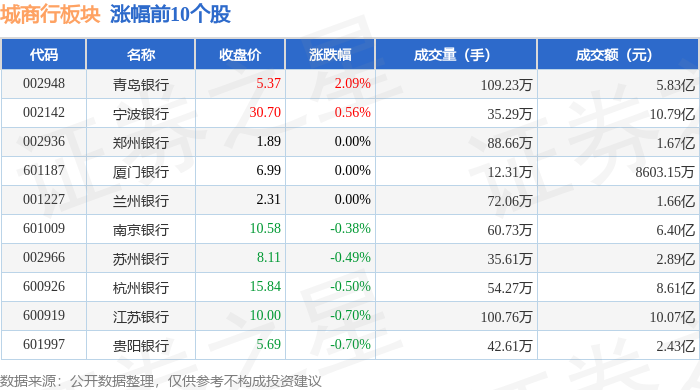
| 代码 | 名称 | 收盘价 | 涨跌幅 | 成交量(手) | 成交额(元) | | --- | --- | --- | --- | --- | --- | | 601963 | 重庆银行 | 10.18 | -1.83% | 12.29万 | 1.25亿 | | 601838 | 成都银行 | 15.82 | -1.62% | 44.70万 | 7.10亿 | | 601665 | 齐鲁银行 | 5.64 | -1.57% | 74.37万 | 4.21亿 | | 601169 | 北京银行 | 5.28 | -1.31% | 196.28万 | 10.39亿 | | 601229 | 上海银行 | 9.27 | -1.28% | 53.77万 | 4.98亿 | | 601577 | 长沙银行 | 9.56 | -0.93% | 19.60万 | 1.87亿 | | 600928 | 西安银行 | 3.69 | -0.81% | 24.44万 | 9033.50万 | | 601997 | 贵阳银行 | 5.69 | -0.70% | 42.61万 | 2.43亿 | | 616009 | 江苏银行 | ...



北京银行官网将在2月3日晚上进行维护升级
Jin Tou Wang· 2026-02-03 03:21
2026年2月2日,北京银行(601169)发布公告称,根据系统维护升级安排,北京银行官网(网站主页系 统)将于2026年2月3日22:00-22:30进行维护升级,维护期间系统将间歇性停机,可能出现访问卡顿、操 作延迟等情况。请您提前做好相关安排,避开系统维护时段。如有疑问,请致电北京银行24小时服务热 线95526。由此给您带来不便,敬请谅解。 ...
城商行板块2月2日跌0.3%,齐鲁银行领跌,主力资金净流入1792.74万元
Zheng Xing Xing Ye Ri Bao· 2026-02-02 09:15
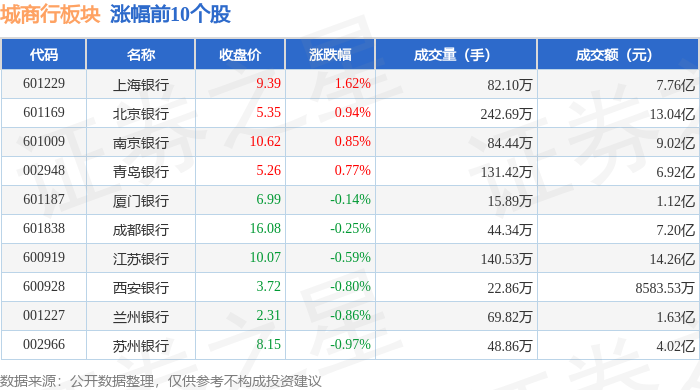
Market Overview - On February 2, the city commercial bank sector declined by 0.3% compared to the previous trading day, with Qilu Bank leading the decline [1] - The Shanghai Composite Index closed at 4015.75, down 2.48%, while the Shenzhen Component Index closed at 13824.35, down 2.69% [1] Individual Bank Performance - Shanghai Bank (601229) closed at 66.6, up 1.62% with a trading volume of 821,000 shares and a transaction value of 776 million [1] - Beijing Bank (601169) closed at 5.35, up 0.94% with a trading volume of 2.4269 million shares and a transaction value of 1.304 billion [1] - Nanjing Bank (6001009) closed at 10.62, up 0.85% with a trading volume of 844,400 shares and a transaction value of 902 million [1] - Qilu Bank (601665) closed at 5.73, down 1.55% with a trading volume of 715,600 shares and a transaction value of 415 million [2] - Hangzhou Bank (600926) closed at 15.92, down 1.49% with a trading volume of 521,800 shares and a transaction value of 840 million [2] Capital Flow Analysis - The city commercial bank sector saw a net inflow of 17.93 million from institutional investors, while retail investors experienced a net outflow of 157.95 million [2] - Major banks like Shanghai Bank and Jiangsu Bank had significant net inflows from institutional investors, with Shanghai Bank receiving 71.52 million, accounting for 9.22% of its total [3] - Conversely, retail investors showed a notable outflow from several banks, including Beijing Bank, which saw a retail net outflow of 64.17 million, representing 4.92% [3]