TKGF(601233)

Search documents
化工周报:钛白粉大厂开启全球化布局,重视行业底部修复机遇-20251019


Shenwan Hongyuan Securities· 2025-10-19 11:42
Investment Rating - The report maintains an "Optimistic" rating for the chemical industry [3][4]. Core Insights - The report highlights the global expansion of major titanium dioxide manufacturers, emphasizing the opportunity for industry recovery from the bottom of the cycle. The acquisition of Venator UK's titanium dioxide assets and the establishment of subsidiaries in Malaysia and the UK are key developments [4][5]. - The macroeconomic outlook for the chemical sector indicates stable oil demand despite a slight slowdown due to tariffs, with global GDP growth projected at 2.8%. The report also notes that coal prices are stabilizing and natural gas export facilities in the U.S. are expected to accelerate [4][5]. - The report suggests investment strategies across various sectors, including textiles, agriculture, and chemicals, with a focus on companies benefiting from the "anti-involution" policies [4][5]. Summary by Sections Industry Dynamics - The report discusses the current macroeconomic conditions affecting the chemical industry, including oil supply and demand dynamics, with a forecast of increased production from non-OPEC sources and stable global oil demand [5][6]. - It notes that the PPI for industrial products decreased by 2.3% year-on-year in September, indicating a stabilization in prices due to improved supply-demand structures [6]. Investment Analysis - The report recommends a diversified investment approach focusing on sectors such as textiles, agriculture, and export-oriented chemicals, highlighting specific companies for potential investment [4][18]. - Key materials for growth are identified, including semiconductor materials and packaging materials, with specific companies mentioned for each category [4][18]. Price Movements - The report provides detailed price movements for various chemical products, including titanium dioxide, fertilizers, and pesticides, indicating a mixed outlook with some prices stabilizing while others show slight declines [11][14][20]. - It highlights the impact of external factors such as raw material costs and international trade dynamics on pricing trends within the chemical sector [11][14].
大炼化周报:成本支撑偏弱,长丝市场价格下行-20251019
Soochow Securities· 2025-10-19 11:20
1. Report Industry Investment Rating No specific industry investment rating is provided in the given text. 2. Core Viewpoints The report presents a weekly overview of the large refining and chemical industry, including data on domestic and foreign refining projects, the polyester, refining, and chemical sectors, as well as performance data of related listed companies. It shows that costs have weak support and filament market prices are declining. [2] 3. Summary by Relevant Catalogs 3.1 Big Refining Weekly Data Briefing - **Price and Spread Data**: The spread of domestic key large refining projects this week was 2,636 yuan/ton, a week - on - week increase of 122 yuan/ton (5%); the spread of foreign key large refining projects was 1,219 yuan/ton, a week - on - week increase of 67 yuan/ton (6%). International crude oil prices fell, with Brent at 62.4 dollars/barrel, down 2.8 dollars/barrel (-4.3%) week - on - week, and WTI at 58.6 dollars/barrel, down 2.8 dollars/barrel (-4.5%) week - on - week. [2][8] - **Polyester Sector**: POY/FDY/DTY industry average prices were 6,521/6,696/7,786 yuan/ton respectively, down 121/100/89 yuan/ton week - on - week. Their weekly average profits were 126/-24/102 yuan/ton respectively, up 4/18/25 yuan/ton week - on - week. POY/FDY/DTY inventories were 16.8/26.1/31.5 days respectively, up 3.2/2.0/2.6 days week - on - week. The filament开工 rate was 91.1%, unchanged week - on - week. [2] - **Refining Sector**: Domestic and US gasoline, diesel, and aviation kerosene prices all decreased this week. [2] - **Chemical Sector**: The average PX price this week was 787.6 dollars/ton, down 16.0 dollars/ton week - on - week, and the spread to crude oil was 332.2 dollars/ton, up 4.3 dollars/ton week - on - week. The PX开工 rate was 87.5%, down 0.4 pct week - on - week. [2] - **Listed Companies**: Related listed companies include Hengli Petrochemical, Rongsheng Petrochemical, Hengyi Petrochemical, Tongkun Co., Ltd., and Xin凤鸣. [2] - **Stock Performance**: The petroleum and petrochemical index fell 2.6% in the past week. Among the six private refining companies, Tongkun Co., Ltd. had the largest decline of 12.4%, while Xin Fengming had a relatively large increase in the past three months and one year. [8] 3.2 Big Refining Weekly Report 3.2.1 Big Refining Index and Project Spread Trends - There are trend charts showing the changes in the Shanghai - Shenzhen 300, petroleum and petrochemical index, Brent crude oil price, and the average index of six large refining companies from 2020 - 2025. [13][15] - There are also trend charts of the market performance of six private large refining companies from 2020 - 2025. [16][17] - Trend charts of the spread of domestic and foreign large refining projects and Brent crude oil prices from 2020 - 2025 are presented. [19][22] 3.2.2 Polyester Sector - Multiple trend charts show the prices and spreads of crude oil, PX, PTA, MEG, and various polyester products from 2020 - 2025, as well as the relationship between their prices and spreads, single - ton net profits, inventories, and开工 rates. [24][25][26] - There are also charts showing the production and sales rates of polyester filaments and short - fibers in the Jiangsu and Zhejiang regions, as well as their annual distribution. [49][50][72] 3.2.3 Refining Sector - Trend charts of the prices and spreads of domestic, US, European, and Singapore gasoline, diesel, and aviation kerosene to crude oil from 2020 - 2025 are provided. [83][84][85] 3.2.4 Chemical Sector - Trend charts of the prices and spreads of various chemical products such as polyethylene, polypropylene, EVA, styrene, acrylonitrile, PC, and MMA to crude oil from 2020 - 2025 are presented. [136][137][147]


大炼化周报:冬季保暖面料需求有所增长,长丝盈利小幅改善-20251019
Xinda Securities· 2025-10-19 08:33
Investment Rating - The industry investment rating is "Positive" as indicated by the report's outlook on the refining sector [153]. Core Insights - The report highlights an increase in demand for winter thermal fabrics, leading to a slight improvement in long filament profitability [2]. - The Brent crude oil average price for the week ending October 17, 2025, was $62.37 per barrel, reflecting a decrease of 4.26% from the previous week [2]. - The domestic key refining project price difference was 2425.56 CNY/ton, with a week-on-week increase of 21.37 CNY/ton (+0.89%) [3]. - The report notes that the international oil price experienced fluctuations due to trade tensions and economic concerns, impacting the overall market sentiment [14]. Summary by Sections Refining Sector - The report discusses the impact of U.S.-China trade tensions on oil prices, with Brent and WTI prices at $61.29 and $57.54 per barrel respectively, showing declines of $1.44 and $1.36 from the previous week [14]. - Domestic refined oil prices have slightly decreased, but the price differentials have improved [14]. - The report tracks the stock performance of six major refining companies, with notable declines in stock prices for several companies over the past week [140]. Chemical Sector - The chemical products in the petrochemical downstream faced price declines due to weak cost support, with polyolefin prices showing slight fluctuations [2]. - EVA demand remains weak, leading to price adjustments and a slight narrowing of price differentials [2]. - The report indicates that pure benzene prices have slightly decreased, but price differentials have improved [2]. Polyester & Nylon Sector - The report notes a decrease in polyester chain product prices due to weak cost support, with PX, MEG, and PTA prices all declining [89]. - The demand for polyester long filaments has increased due to colder temperatures in northern regions, although prices have slightly decreased [110]. - Nylon fiber prices have also shown weakness, with average prices for POY, FDY, and DTY all declining [120].

2025年1-4月中国初级形态的塑料产量为4601.2万吨 累计增长10.1%
Chan Ye Xin Xi Wang· 2025-10-18 02:54
Core Viewpoint - The report by Zhiyan Consulting highlights the growth of China's primary plastic production, projecting a significant increase in output and market potential from 2025 to 2031 [1] Industry Summary - According to the National Bureau of Statistics, China's primary plastic production reached 11.69 million tons in April 2025, marking a year-on-year growth of 12% [1] - From January to April 2025, the cumulative production of primary plastics in China was 46.01 million tons, reflecting a cumulative growth of 10.1% [1] - The report emphasizes the ongoing expansion and future prospects of the plastic products industry in China, indicating a robust market environment for investment [1] Company Summary - Listed companies in the plastic industry include Hengyi Petrochemical (000703), Rongsheng Petrochemical (002493), Shanghai Petrochemical (600688), Sinopec (600028), China National Petroleum (601857), Huajin Co. (000059), Tongkun Co. (601233), Hengli Petrochemical (600346), Satellite Chemical (002648), and ST Hongda (002002) [1] - These companies are positioned to benefit from the anticipated growth in the plastic production sector, aligning with the overall market trends identified in the report [1]





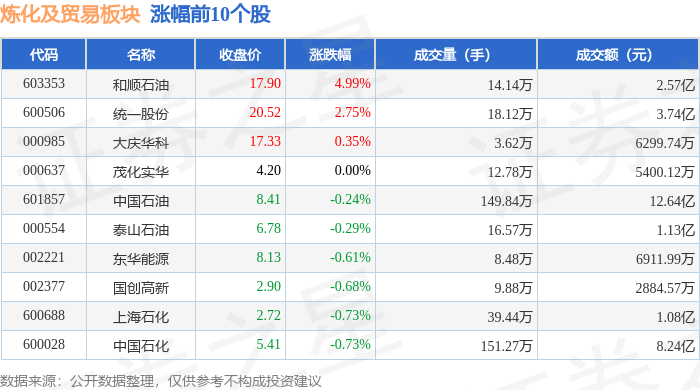
炼化及贸易板块10月17日跌0.68%,桐昆股份领跌,主力资金净流出2.06亿元
Zheng Xing Xing Ye Ri Bao· 2025-10-17 08:37
Market Overview - The refining and trading sector experienced a decline of 0.68% on October 17, with Tongkun Co., Ltd. leading the drop [1] - The Shanghai Composite Index closed at 3839.76, down 1.95%, while the Shenzhen Component Index closed at 12688.94, down 3.04% [1] Stock Performance - Notable gainers in the refining and trading sector included: - Heshun Petroleum, closing at 17.90 with a rise of 4.99% and a trading volume of 141,400 shares, totaling 257 million yuan [1] - Unified Holdings, closing at 20.52 with an increase of 2.75% and a trading volume of 181,200 shares, totaling 374 million yuan [1] - Major decliners included: - Tongkun Co., Ltd., closing at 13.09 with a decrease of 2.97% and a trading volume of 195,600 shares, totaling 260 million yuan [2] - Oriental Energy, closing at 9.04 with a drop of 2.80% and a trading volume of 147,300 shares, totaling 135 million yuan [2] Capital Flow - The refining and trading sector saw a net outflow of 206 million yuan from main funds, while retail investors contributed a net inflow of 216 million yuan [2]
桐昆股份跌2.00%,成交额1.24亿元,主力资金净流出1391.78万元
Xin Lang Cai Jing· 2025-10-17 05:37
Core Viewpoint - Tongkun Co., Ltd. has experienced a decline in stock price recently, with a year-to-date increase of 12.98% but a significant drop of 11.57% over the last five trading days [1] Financial Performance - For the first half of 2025, Tongkun Co., Ltd. reported operating revenue of 44.158 billion yuan, a year-on-year decrease of 8.41%, while net profit attributable to shareholders increased by 2.93% to 1.097 billion yuan [2] - The company has distributed a total of 3.203 billion yuan in dividends since its A-share listing, with 341 million yuan distributed over the last three years [3] Shareholder Information - As of June 30, 2025, the number of shareholders for Tongkun Co., Ltd. was 70,600, a slight decrease of 0.22% from the previous period [2] - The average number of circulating shares per shareholder increased by 0.22% to 33,944 shares [2] - Major shareholders include Hong Kong Central Clearing Limited, which reduced its holdings by 7.3797 million shares, and Southern CSI 500 ETF, which increased its holdings by 3.4825 million shares [3] Stock Market Activity - As of October 17, 2023, Tongkun Co., Ltd.'s stock price was 13.22 yuan per share, with a market capitalization of 31.791 billion yuan [1] - The stock has seen a trading volume of 124 million yuan and a turnover rate of 0.38% [1] - The net outflow of main funds was 13.9178 million yuan, with significant selling pressure observed [1] Business Overview - Tongkun Co., Ltd. specializes in the production and sales of various types of polyester filament and grey cloth, with its main revenue sources being polyester POY (61.10%) and purified terephthalic acid (37.69%) [1] - The company is categorized under the petrochemical industry, specifically in refining and trade [1]
78只个股连续5日或5日以上获主力资金净买入


Zheng Quan Shi Bao Wang· 2025-10-17 03:38
Core Insights - As of October 16, a total of 78 stocks in the Shanghai and Shenzhen markets have experienced net buying from major funds for five consecutive days or more [1] - The stocks with the longest streak of net buying are Kaisheng Technology, Wanxin Media, Jianyou Co., and Jinling Hotel, each having received net buying for nine consecutive trading days [1] - Other notable stocks with significant net buying days include Tiancheng Technology, China Electric Research, Junpu Intelligent, Hangxin Technology, Dongpeng Holdings, Shandong Publishing, Tongkun Co., and Yuanfang Information [1]
中银晨会聚焦-20251017
Bank of China Securities· 2025-10-17 02:17
Key Points Summary Core Insights - The report highlights a positive trend in China's export growth, with a year-on-year increase of 6.1% in the first three quarters, and a notable rise of 8.3% in September alone, supported by ASEAN and EU markets [5][6] - The report indicates a mixed performance in inflation metrics, with the Consumer Price Index (CPI) showing a year-on-year decline of 0.3% in September, while the Producer Price Index (PPI) saw a slight improvement with a year-on-year decrease of 2.3% [9][12] - The report discusses the impact of new port fees imposed by the U.S. on Chinese shipping, which may lead to increased operational costs and a potential restructuring of trade routes [28][31] Macroeconomic Overview - In September, China's exports continued to show positive growth, with a trade surplus of $8750.8 billion and imports declining by 1.1% [5][6] - The report notes that high-tech product imports remain robust, with significant growth in semiconductor and machinery imports [7] - The financial data for September indicates a slight improvement in social financing and M1 growth, while M2 growth remains subdued, reflecting weak demand in the real economy [14][15] Inflation Analysis - The CPI in September showed a 0.1% month-on-month increase, while the core CPI rose by 1.0% year-on-year, indicating a gradual recovery in core inflation metrics [9][11] - Food prices have been a significant factor in the CPI decline, with a year-on-year drop of 4.4% in September, impacting overall inflation [10][11] - The PPI's year-on-year decline has narrowed, suggesting potential stabilization in industrial prices due to policy effects and market adjustments [12][27] Industry Insights - The manufacturing sector's PMI in September was recorded at 49.8%, indicating a slight recovery in manufacturing activity, with new orders and production indices showing positive trends [18][19] - The report emphasizes the need for continued domestic demand policies to support the manufacturing sector amid ongoing challenges [20] - The transportation sector faces increased costs due to new U.S. port fees, which may affect shipping profitability and lead to a shift towards indirect trade routes [28][30] Strategic Considerations - The report suggests that despite short-term market fluctuations, the underlying industrial trends remain strong, with a focus on sectors that can adapt to changing trade dynamics [21][24] - The potential for "迂回贸易" (indirect trade) may reshape logistics and supply chains, particularly in response to increased operational costs from new tariffs [31] - The report highlights the importance of monitoring macroeconomic policies and their impact on market expectations, particularly in light of upcoming economic meetings [22][24]





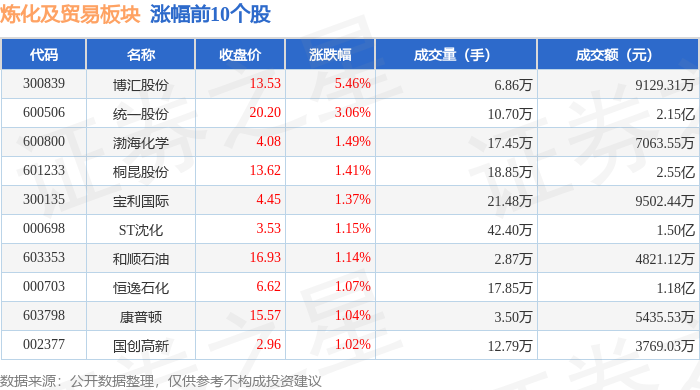
炼化及贸易板块10月15日跌0.4%,岳阳兴长领跌,主力资金净流入1487.54万元
Zheng Xing Xing Ye Ri Bao· 2025-10-15 08:33
Market Overview - The refining and trading sector experienced a decline of 0.4% on October 15, with Yueyang Xingchang leading the drop [1] - The Shanghai Composite Index closed at 3912.21, up 1.22%, while the Shenzhen Component Index closed at 13118.75, up 1.73% [1] Stock Performance - Notable gainers in the refining and trading sector included: - Bohui Co., Ltd. (300839) with a closing price of 13.53, up 5.46% [1] - Unified Co., Ltd. (600506) with a closing price of 20.20, up 3.06% [1] - Tongkun Co., Ltd. (601233) with a closing price of 13.62, up 1.41% [1] - Major decliners included: - Maoyang Xingchang (000819) with a closing price of 19.19, down 5.19% [2] - Baomo Co., Ltd. (002476) with a closing price of 6.10, down 1.61% [2] - China Petroleum (601857) with a closing price of 8.29, down 0.48% [2] Capital Flow - The refining and trading sector saw a net inflow of 14.88 million yuan from institutional investors, while retail investors experienced a net outflow of 106 million yuan [2] - Key stocks with significant capital flow included: - China Petroleum (601857) with a net outflow of 26.10 million yuan from institutional investors [3] - Unified Co., Ltd. (600506) with a net inflow of 21.04 million yuan from institutional investors [3] - Tongkun Co., Ltd. (601233) with a net inflow of 20.04 million yuan from institutional investors [3]

油价环比小幅上行,2025Q3上游景气有所修复,中下游景气有待复苏:——石油化工2025年三季报业绩前瞻
Shenwan Hongyuan Securities· 2025-10-15 08:07
Investment Rating - The report maintains a positive outlook on the polyester sector, suggesting a recovery in profitability as supply and demand improve, and recommends focusing on leading companies in the sector [4][6][9]. Core Insights - The report highlights a slight increase in oil prices in Q3 2025, with Brent crude averaging $68.2 per barrel, a 2.1% increase quarter-on-quarter but a 13.4% decrease year-on-year [4][5]. - The performance of key companies in the oil and petrochemical sector is projected to show stability or slight growth, with specific profit forecasts for major players such as China National Petroleum Corporation and CNOOC [4][6][8]. - The report emphasizes the potential for improved profitability in refining companies due to lower operational costs and favorable market conditions, particularly for leading firms like Hengli Petrochemical and Rongsheng Petrochemical [4][6][9]. Summary by Sections Oil Price Trends - Brent crude oil prices showed a quarter-on-quarter increase of 2.1% and a year-on-year decrease of 13.4%, with Q3 2025 prices averaging $68.2 per barrel [4][5]. - Gasoline and diesel prices experienced a net decrease of 75 yuan per ton over the quarter, with adjustments made in July, August, and September [4]. Price Differentials - The report notes that the price differentials for various petrochemical products have shown mixed trends, with some margins expanding while others contracted [6][7]. - The ethylene-to-naphtha differential was reported at $238 per ton, reflecting a 7.5% decrease quarter-on-quarter but a 23.7% increase year-on-year [6]. Company Performance Forecasts - Key companies are expected to report varying profit results for Q3 2025, with China National Petroleum Corporation projected to achieve a net profit of 38 billion yuan, a year-on-year decrease of 13% but a quarter-on-quarter increase of 2% [4][8]. - CNOOC is forecasted to report a net profit of 34 billion yuan, down 8% year-on-year but up 3% quarter-on-quarter [4][8]. Investment Recommendations - The report recommends focusing on leading polyester companies such as Tongkun Co. and Wankai New Materials, as well as refining companies like Hengli Petrochemical and Rongsheng Petrochemical, due to their favorable market positions [4][6][9]. - It also suggests that the oil exploration and production sector remains robust, with continued high capital expenditures expected for offshore oil service companies [4][9].