
PICC(601319)

Search documents
中国人保于泽回应“反内卷”:减少非理性投入和盲目竞争,实现良性的高质量发展
Bei Jing Shang Bao· 2025-08-28 08:54
北京商报讯8月28日,在中国人保2025中期业绩发布会上,谈及各行各业"反内卷",中国人保副总裁、 人保财险总裁于泽表示,"反内卷"从客户端来讲,保险的需求回归理性,为财产行业的市场秩序规范和 理性营造良好的外部环境。 从保险行业角度,于泽分析,将有利于行业转型升级和内涵发展,引导各个市场主体将资源重点从原来 的比价格、拼规模、抢份额,向产品和技术创新的方向转变,集中精力研发保险技术,提升服务能力, 减少非理性投入和盲目竞争,实现良性的高质量发展。 (文章来源:北京商报) ...


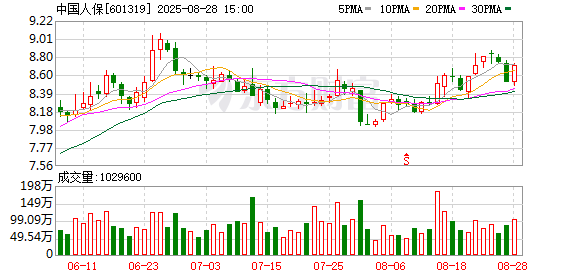
股价为何连创新高?中国人保赵鹏:经济社会高质量发展、发展环境不断改善、公司基本面持续向好
Bei Jing Shang Bao· 2025-08-28 08:49
Group 1 - The core viewpoint of the article highlights that China Pacific Insurance's stock price has reached new highs due to three main reasons [2] - The first reason is the high-quality development of China's economy and society, which presents historical opportunities for the insurance industry [2] - The second reason is the continuous improvement of the development environment, with regulatory bodies guiding the insurance industry to return to its core functions and enhance its capacity for protection and service levels through various policy measures [2] - The third reason is the sustained improvement in the company's fundamentals, leading to a significant enhancement in its value creation capabilities [2]
美银证券:升中国人民保险集团目标价至7港元 上半年稳步增长 重申“中性”评级
Zhi Tong Cai Jing· 2025-08-28 08:43
Core Viewpoint - Bank of America Securities reports that China People's Insurance Group (01339) achieved a 14% year-on-year increase in net profit for the first half of the year [1] Group 1: Financial Performance - The company experienced stable premium growth, with property and casualty insurance business increasing by 4% year-on-year [1] - The combined expense ratio decreased to 94.8% [1] - The new business value for life insurance grew by 27% to 8.8 billion RMB [1] Group 2: Earnings Forecast and Target Price - Bank of America has raised its earnings forecast for the company for 2025 to 2027 by 1% to 10%, reflecting higher investment income assumptions and expectations for property and casualty insurance revenue [1] - The target price for the company has been increased by 7%, from 6.6 HKD to 7 HKD, while maintaining a "Neutral" rating [1]
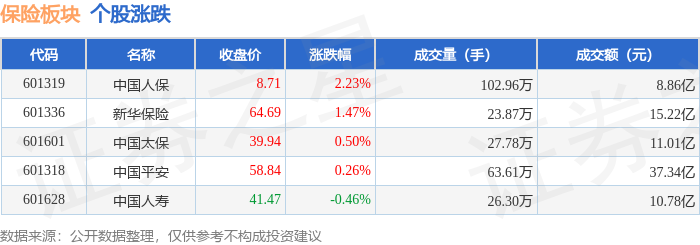
保险板块8月28日涨0.35%,中国人保领涨,主力资金净流出3.56亿元
Zheng Xing Xing Ye Ri Bao· 2025-08-28 08:43
从资金流向上来看,当日保险板块主力资金净流出3.56亿元,游资资金净流入1.19亿元,散户资金净流入 2.37亿元。保险板块个股资金流向见下表: | 代码 | 名称 | 主力净流入 (元) | 主力净占比 游资净流入 (元) | | 游资净占比 散户净流入 (元) | | 散户净占比 | | --- | --- | --- | --- | --- | --- | --- | --- | | 601319 中国人保 | | 4868.47万 | 5.49% | 1812.38万 | 2.04% | -6680.86万 | -7.54% | | 601628 中国人寿 | | -5101.96万 | -4.73% | 5108.35万 | 4.74% | -6.39万 | -0.01% | | 601601 中国太保 | | -8045.81万 | -7.31% | 2581.18万 | 2.34% | 5464.63万 | 4.96% | | 601318 中国平安 | | -1.26亿 | -3.36% | 1861.92万 | 0.50% | 1.07亿 | 2.87% | | 601336 新华保险 | ...




中国人保答证券时报:私募证券基金投资以A股为主
Zheng Quan Shi Bao Wang· 2025-08-28 08:41
Core Viewpoint - China Insurance (601319) is focusing on long-term stock investment strategies primarily in A-shares, emphasizing stable returns and risk management [1] Group 1: Investment Strategy - The investment strategy will prioritize high-potential quality targets while ensuring effective risk control [1] - The long-term stock investment pilot program was approved for 10 billion yuan [1] Group 2: Fund Management - Following the approval, the company quickly established a preparatory group to set up a private fund management company [1] - On August 14, the establishment of the private fund management company received approval from the financial regulatory authority [1] - The private fund management company, Renbao Qiyuan Huizhong (Beijing) Private Fund Management Co., Ltd., was officially established on August 18 [1]
中国人保赵鹏:上半年多个指标创下历史新高
Bei Jing Shang Bao· 2025-08-28 08:35
北京商报讯(记者 李秀梅)8月28日,在中国人保2025中期业绩发布会上,谈及中国人保未来发展,中 国人保总裁赵鹏表示,中国人保推进建设世界一流保险金融集团的战略,今年重在把握好三个重点:一 是重点增强保障功能,二是重点强化发展质量,三是重点深化"六项改革"。 赵鹏介绍,上半年,中国人保高质量发展取得显著成效,财产险综合成本率95.3%,创近10年同期最好 水平;人身险新业务价值88亿元,创历史同期最高;集团总投资收益415亿元,创历史同期新高;集团 合并净利润359亿元,创历史同期新高。 ...
中国人保赵鹏:以分红长期稳定增长为核心,不断提升公司的投资价值
Bei Jing Shang Bao· 2025-08-28 08:35
Core Viewpoint - China Pacific Insurance aims to balance capital strength with shareholder returns by reserving funds for dividends while enhancing underwriting capacity and sustainable development [1] Group 1 - The company emphasizes the need to reserve funds during dividend distribution to maintain capital strength [1] - The focus is on creating long-term value for shareholders through stable growth in dividends per share [1] - The company aims to enhance its profitability to provide predictable returns and share the benefits of its growth with investors [1]
中国人民保险集团发布2025年中期业绩
Xin Lang Cai Jing· 2025-08-28 08:34
Core Viewpoint - China People's Insurance Group reported strong mid-year performance for 2025, highlighting significant growth in premium income, net profit, and new business value, indicating a successful high-quality development strategy. Group 1: Operating Indicators Overview - The original insurance premium income reached 454.625 billion, a 6.4% increase from 427.285 billion in 2024 [1] - Net profit increased by 17.8% to 35.888 billion from 30.455 billion in 2024 [1] - The weighted average return on equity rose by 0.5 percentage points to 8.5% [1] - New business value for life insurance surged by 71.7% to 4.978 billion [1] Group 2: Business Scale and Growth - The group achieved premium income of 454.625 billion, up 6.4% year-on-year [2] - Life insurance premium income grew by 13.8% to 131.2 billion, with first-year premium income reaching a historical high [2] - Investment assets exceeded 1.7 trillion, marking a 7.2% increase since the beginning of the year [2] Group 3: Business Structure Optimization - The proportion of life insurance premium income in total premium income increased by 1.9 percentage points [3] - Non-auto insurance premium income grew by 16.6%, significantly outpacing overall premium income growth [3] - New business value rate improved by 3.9 percentage points, reflecting enhanced business collaboration [3] Group 4: Profitability Foundation - Insurance service performance reached 277 billion, continuing to grow from last year [4] - Investment performance increased by 78.3% to 175 billion [4] - Underwriting profit for property insurance rose by 53.5% to 117 billion [4] Group 5: Risk Management - The group maintained a stable risk preference with no major risk events reported [6] - The solvency adequacy ratio stood at 219%, indicating strong financial health [5] - The net cash flow from operating activities increased by 6.9% year-on-year [6] Group 6: Social and Economic Contributions - The group served 317 million individual clients and 7.94 million institutional clients, with risk coverage amounting to 178 trillion [7] - The company actively participated in disaster relief efforts, handling claims for significant disasters [7] - Investment in the real economy exceeded 1.1 trillion, demonstrating commitment to long-term investments [7] Group 7: Financial Initiatives - The group established a technology insurance center and covered 127,000 high-tech enterprises [9] - Green finance initiatives included insuring 6.16 million new energy vehicles, a 36.8% increase [9] - The group expanded its digital finance capabilities, launching innovative insurance products [9] Group 8: Future Work Focus - The group aims to enhance functionality and support economic development while maintaining high-quality growth [10][11] - Emphasis will be placed on risk prevention and management to ensure sustainable development [12]

中国人保于泽:非车险“报行合一”监管政策有望四季度落地
Xin Lang Cai Jing· 2025-08-28 08:31
今日在2025年中期业绩发布会上,中国人保副总裁于泽表示,非车险的"报行合一"政策多次发布征求意 见稿,目前监管在紧锣密鼓推进,预计在今年四季度有望落地。政策落地之后,可能对公司当季营收有 一定影响,但是对全年的影响不大;预计对2026年非车险的盈利会有很好的改善。 ...
中国人民保险集团(01339):中国人保(601319):人身险NBV增长强劲
HTSC· 2025-08-28 08:26
Investment Rating - The investment rating for the company is "Buy" [7] Core Views - The company reported a strong growth in new business value (NBV) for life insurance, with a year-on-year increase of 63% in 1H25, driven by significant growth in both agency and bancassurance channels [3] - The property insurance segment showed improved underwriting performance, with a combined ratio (COR) decreasing by 1.4 percentage points to 94.8%, leading to a substantial increase in underwriting profit by 44.6% [2] - The total investment return increased by 40.2% year-on-year, with an annualized total investment yield rising by 0.9 percentage points to 5.0%, contributing to profit growth [4] - The company has adjusted its earnings per share (EPS) forecasts for 2025, 2026, and 2027 to RMB 1.02, RMB 1.14, and RMB 1.24 respectively, based on improved performance in property insurance and investment [5] Summary by Sections Property Insurance - The property insurance segment's COR improved due to a 3.1 percentage point decrease in expense ratio, despite a 1.7 percentage point increase in loss ratio [2] - Insurance service revenue for property insurance grew by 5.6% year-on-year, with motor and non-motor insurance increasing by 3.5% and 8.9% respectively [2] - The net profit from property insurance increased by 35% year-on-year, supported by strong premium growth and improved underwriting performance [2] Life Insurance - The life insurance segment's NBV growth was primarily driven by bancassurance, which saw an 81% increase, accounting for 35% of total NBV [3] - The overall new policy premium for the life insurance segment grew by 15.4% year-on-year, indicating resilience in the agency channel [3] - Despite the strong growth in NBV, the profit from life insurance decreased by 13% due to rising service expense ratios [3] Investment Performance - The company capitalized on favorable market conditions, resulting in a significant increase in total investment income and a higher annualized investment yield [4] - The asset allocation strategy included an increase in equity investments, with the stock allocation rising by 1.7 percentage points to 5.4% [4] Earnings Forecast and Valuation - The target price for the company's A/H shares has been raised to RMB 9.3 and HKD 7.0, reflecting the positive adjustments in EPS forecasts [5] - The projected gross premium income for 2025 is estimated at RMB 572.06 billion, with a growth rate of 6.39% [21]