PICC(601319)

Search documents
中国人保集团党委召开扩大会议传达学习中央经济工作会议精神
Xin Lang Cai Jing· 2025-12-15 07:59
专题:金融机构传达学习中央经济工作会议精神 来源:人民保险 12月15日,中国人保集团党委召开扩大会议,传达学习中央经济工作会议精神,结合全国金融系统工作 会议要求,研究部署中国人保贯彻落实措施。集团党委书记、董事长丁向群主持会议并讲话,党委成员 参加会议。 会议指出,习近平总书记在中央经济工作会议上发表的重要讲话,全面总结2025年和"十四五"期间经济 工作,深刻分析当前经济形势,系统部署2026年经济工作,立意高远、内涵丰富,具有很强的政治性、 思想性、指导性,为做好明年乃至今后一个时期的经济工作,注入了强大信心,提供了根本遵循。人保 集团要认真学习贯彻,切实把思想认识统一到中央经济工作会议精神特别是习近平总书记重要讲话精神 上来。 会议强调,要深刻领会2025年和"十四五"时期我国经济社会发展的伟大成就,更加坚定拥护"两个确 立"、坚决做到"两个维护";深刻领会党中央对我国经济发展的重要判断和规律性认识,把"五个必 须"不折不扣落实到发展改革各方面全过程;深刻领会党中央关于做好明年经济工作的总体要求,切实 将党中央的宏观政策部署在保险领域落实到位;深刻领会党中央关于做好明年经济工作的"八个坚持"重 点任 ...

亚太股市集体飘绿,芯片股大跌,芯原股份重挫11%,铂金年内狂飙100%
21世纪经济报道· 2025-12-15 07:45
Market Overview - Major Asia-Pacific stock indices closed mostly lower, with the Nikkei 225 and KOSPI indices both dropping over 1% [1] - A-shares experienced fluctuations, with the Shanghai Composite Index and Shenzhen Component Index both declining, while the Hang Seng Index fell significantly [2] - The total trading volume in the Shanghai and Shenzhen markets was 1.79 trillion yuan, a decrease of 324.6 billion yuan from the previous trading day [2] Sector Performance - Consumer stocks showed resilience, particularly in retail and food & beverage sectors, with notable performances from liquor stocks like Zhongrui Co. and Kweichow Moutai [2] - The insurance sector surged over 4%, led by companies such as China Ping An, which rose nearly 5% to a new four-year high [2][4] - The commercial aerospace sector also strengthened, with stocks like Hualing Cable and Zhongchao Holdings achieving three consecutive trading limits [4] Commodity Market - Gold and silver prices saw strong increases, with spot gold rising over 1% to reach $4,343 per ounce, and silver increasing by over 2% [7][8] - Platinum prices have surged over 100% this year, with analysts predicting further increases in the coming year [6][9] - Analysts expect platinum prices to rise significantly, with projections for 2026 ranging from $2,170 to $2,300 per ounce, indicating a shift towards undervalued precious metals [10]







多重因素促保险股逆势上涨,买入良机已来?
Bei Jing Shang Bao· 2025-12-15 06:03
Core Viewpoint - The insurance sector is experiencing a significant upward trend, driven by multiple factors including market recovery, favorable asset conditions, and ongoing liability transformation [1][3][4]. Group 1: Market Performance - On December 15, insurance stocks collectively rose, with China Ping An increasing by over 5%, leading the sector alongside China Life, China Pacific Insurance, and New China Life [3][4]. - Year-to-date performance shows substantial gains for insurance stocks, with New China Life up over 45%, China Ping An up over 33%, China Pacific Insurance up over 19%, and China Life up over 12% [5]. Group 2: Regulatory and Policy Support - Recent favorable policies include a joint notice from the Ministry of Commerce, the People's Bank of China, and the financial regulatory authority aimed at boosting consumption through the development of various insurance products [3][4]. - The adjustment of risk factors for insurance companies' holdings in certain indices is expected to alleviate solvency pressures and encourage long-term investments in the stock market [4]. Group 3: Future Outlook - Analysts predict that insurance stocks may enter a prolonged bull market, contingent on overall market conditions and increased investment returns [5][6]. - International investment banks and domestic brokerages have recently issued "buy" and "overweight" ratings for several insurance stocks, indicating positive sentiment towards the sector's growth potential [6].



直线拉升!涨停潮,来了
Zhong Guo Ji Jin Bao· 2025-12-15 05:19
Market Overview - On December 15, the A-share market saw all three major indices decline, with the Shanghai Composite Index down 0.11%, the Shenzhen Component down 0.71%, and the ChiNext Index down 1.29% [1] - The total trading volume in the Shanghai and Shenzhen markets was 1.18 trillion yuan, a decrease of 529 billion yuan from the previous trading day [2] Financial Sector Performance - The financial sector experienced a broad rally, particularly in the insurance segment, which rose over 4% [2] - Notable individual stock performances included China Ping An up nearly 5%, China Pacific Insurance up 4%, and New China Life and China Life both up over 2% [4][5] - Several brokerage stocks also saw gains, with Huatai Securities and Dongfang Securities rising over 3% [6][7] Consumer Sector Activity - The consumer sector showed strong performance, with food and beverage stocks, as well as retail, experiencing significant gains [9] - A surge in individual stocks was noted, with companies like Huanlejia and Huangshi Group hitting the daily limit up [9][10] - The Ministry of Commerce and other regulatory bodies announced new policies aimed at boosting consumption, which contributed to the positive sentiment in the consumer sector [10] Alcohol Industry Insights - The liquor sector rebounded, with Kweichow Moutai rising 0.49% to a market value of 1.7878 trillion yuan [11][12] - Moutai's recent policy to control supply has led to a significant increase in wholesale prices for its products [11] Aerospace and Technology Sector - The aerospace sector saw a notable increase, with stocks like Aerospace Electromechanical and Aerospace Technology rising significantly [13][14] - Aerospace Electromechanical achieved a 10% increase, marking a strong performance in the sector [14]




直线拉升!涨停潮,来了
中国基金报· 2025-12-15 05:13
Market Overview - The A-share market experienced a collective decline in the morning session, with the Shanghai Composite Index down by 0.11%, the Shenzhen Component down by 0.71%, and the ChiNext Index down by 1.29% [1] - The total trading volume in the Shanghai and Shenzhen markets reached 1.18 trillion yuan, a decrease of 529 billion yuan compared to the previous trading day [4] Financial Sector Performance - The financial sector saw a broad increase, with the insurance sector leading the market with a rise of over 4% [4] - Notable individual stock performances included China Ping An rising nearly 5%, China Pacific Insurance up 4%, and New China Life and China Life both increasing by over 2% [8][9] - The recent adjustment by the financial regulatory authority to lower risk factors for insurance companies investing in certain indices has positively impacted the sector [9] Consumer Sector Dynamics - The consumer sector showed significant gains, particularly in food and beverage and commercial retail, with many stocks hitting the daily limit [12] - The Ministry of Commerce and other regulatory bodies announced measures to boost consumption, which contributed to the rally in consumer stocks [13] Alcohol Industry Insights - The liquor sector rebounded, with Kweichow Moutai increasing by 0.49% to a market value of 1.7878 trillion yuan [16][19] - Moutai's recent policy to control supply has led to a rise in wholesale prices for its products [18] Aerospace and Technology Sector - The aerospace sector saw a surge, with stocks like Aerospace Electromechanical and Aerospace Technology rising significantly, with some stocks hitting the daily limit [21][22] - The performance of commercial aerospace stocks remains active, reflecting ongoing interest in the sector [21]

宜春监管分局同意中国人保财险袁州支公司金瑞营销服务部变更营业场所
Jin Tou Wang· 2025-12-15 04:08
2025年12月4日,国家金融监督管理总局宜春监管分局发布批复称,《关于中国人民财产保险股份有限 公司袁州支公司金瑞营销服务部地址变更的请示》(宜人保财险发〔2025〕49号)收悉。经审核,现批 复如下: 一、同意中国人民财产保险股份有限公司袁州支公司金瑞营销服务部将营业场所变更为:江西省宜春市 袁州区金瑞镇河西街明月花苑2栋1-2号店面。 二、中国人民财产保险股份有限公司袁州支公司应按照有关规定及时办理变更及许可证换领事宜。 ...
保险股逆势走强,中国平安涨幅超4%
Bei Jing Shang Bao· 2025-12-15 02:56
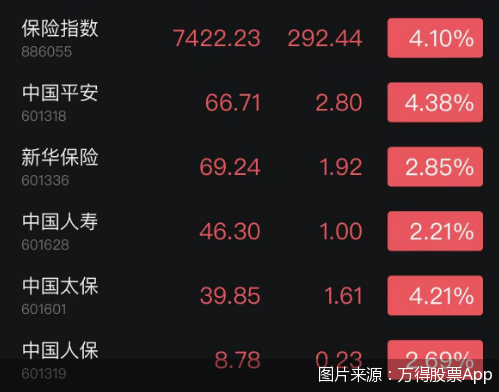
北京商报讯(记者 李秀梅)12月15日,A股三大股指低位震荡,保险板块逆势走强。截至北京商报记者 发稿,A股保险板块中,中国平安、中国太保涨幅均超4%,中国人寿、中国人保和新华保险涨幅也超 过了2%。 | 保险指数 | 7422.23 | 292.44 | 4.10% | | --- | --- | --- | --- | | 886055 | | | | | 中国平安 | 66.71 | 2.80 | 4.38% | | 601318 | | | | | 新华保险 601336 | 69.24 | 1.92 | 2.85% | | 中国人寿 601628 | 46.30 | 1.00 | 2.21% | | 中国太保 | 39.85 | 1.61 | 4.21% | | 601601 | | | | | 中国人保 601319 | 8.78 | | 图片来源:万得股票App | ...
A股保险股走强,中国太保涨近2%
Xin Lang Cai Jing· 2025-12-15 01:49
责任编辑:王馨茹 12月15日金融一线消息,A股保险股走强,中国太保涨近2%,中国平安涨超1%,中国人保、新华保险 等跟涨。 12月15日金融一线消息,A股保险股走强,中国太保涨近2%,中国平安涨超1%,中国人保、新华保险 等跟涨。 责任编辑:王馨茹 ...
A股保险股走强,中国太保涨近2%,中国平安涨超1%,中国人保、新华保险等跟涨。
Xin Lang Cai Jing· 2025-12-15 01:45
A股保险股走强,中国太保涨近2%,中国平安涨超1%,中国人保、新华保险等跟涨。 ...
未来三年分红规划,这些公司已提前布局(名单)
Zheng Quan Shi Bao Wang· 2025-12-15 01:39
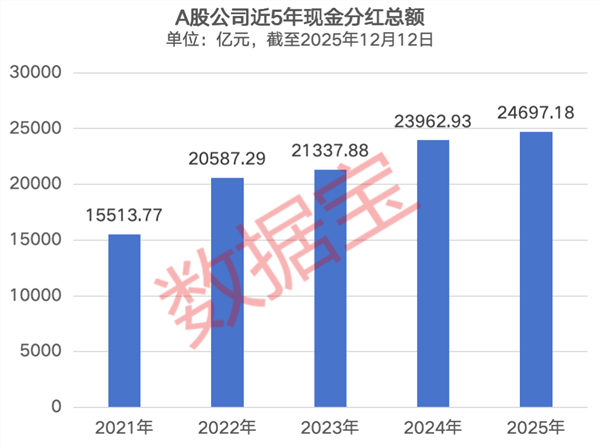
Core Viewpoint - The article highlights the increasing trend of cash dividends among listed companies in China, with a focus on their commitment to return profits to shareholders through substantial cash distributions over the next three years. Group 1: Cash Dividend Trends - Listed companies in China have shown a significant increase in cash dividend intentions, with the total cash dividends exceeding 2.47 trillion yuan this year, surpassing the total for the entire previous year [2][4] - Major companies like BYD, Hikvision, and Zijin Mining have reported cash dividends exceeding 10 billion yuan for the first time this year, with many traditional "dividend giants" increasing their payouts [4][5] Group 2: Future Dividend Plans - Nearly 40 companies have established shareholder return plans for the next three years (2026-2028), with most committing to distribute at least 10% of their annual distributable profits in cash [7] - Specific companies have set higher targets, such as Qibin Group, which plans to distribute over 50% of its annual distributable profits in cash, and China Merchants Shekou, which aims for a minimum of 40% [7][9] Group 3: Market Performance and Institutional Interest - Companies that announced shareholder return plans have seen an average stock price increase of over 4.5%, outperforming the average increase of the CSI 300 index [10] - Notably, companies like Wangzi New Materials and Aibison have experienced stock price increases exceeding 50% since their announcements [10][12] Group 4: Institutional Research Activity - Among the 37 companies with announced return plans, 17 have received significant institutional interest, with some receiving over 350 institutional research inquiries [11][12] - Companies like Baiwei Storage and Shiji Information have also reported substantial stock price increases alongside their active engagement with institutional investors [12][13]