BANK COMM(601328)

Search documents
工行等五大行紧急预警 调整贵金属投资业务
Mei Ri Shang Bao· 2026-02-02 00:37
Core Viewpoint - The recent sharp decline in gold and silver prices has sparked significant market discussion, primarily driven by expectations of a hawkish policy from the newly appointed Federal Reserve chairman, alongside profit-taking and liquidity issues in the market [1][3]. Group 1: Price Movements - On January 31, spot gold prices fell by 12.92%, dropping below $4,700 per ounce to a low of $4,695, marking the largest single-day decline since April 1980 [1] - Spot silver prices experienced a dramatic drop of up to 36%, reaching a low of $77.7 per ounce, the largest single-day decline since February 1983 [1][2]. - The closing price for spot gold was reported at $4,894.49 per ounce, reflecting a decline of over 9%, while spot silver closed at $84.63 per ounce, down nearly 27% [2]. Group 2: Market Reactions - Following the price drop, several banks, including ICBC and CCB, issued risk warnings and adjusted their gold investment services, advising investors to assess their risk tolerance and maintain a rational investment approach [4][5]. - Major jewelry brands have also adjusted their gold prices, with many returning to the range of 1,500-1,600 yuan per gram, reflecting the international price drop [2]. Group 3: Future Outlook - Analysts from China International Capital Corporation (CICC) remain optimistic about the long-term prospects for gold, suggesting that the bull market may not be over despite the recent volatility [3]. - The core reasons for the recent decline include signals from the Federal Reserve regarding delayed interest rate cuts and personnel changes, leading to panic selling [3]. - The long-term support for gold prices is expected to come from continued central bank purchases, anticipated rate cuts by the Federal Reserve, and geopolitical risk factors [3].



近期金价持续创造历史,国有六大银行提示风险
Sou Hu Cai Jing· 2026-02-01 23:26
Core Viewpoint - Recent fluctuations in gold prices have prompted major banks in China to adjust their gold-related business operations and issue risk warnings to clients [1][3][4]. Group 1: Bank Announcements - The Industrial and Commercial Bank of China (ICBC) has issued a risk warning, advising clients to assess their risk tolerance and adopt a rational investment approach amid significant price volatility in precious metals [1]. - Agricultural Bank of China (ABC) has increased the margin requirement for gold trading contracts from 44% to 60%, effective January 30, and has implemented stricter risk assessment measures for clients engaging in gold accumulation transactions [3]. - China Construction Bank (CCB) has raised the minimum investment amount for its gold accumulation business to 1500 yuan, effective February 2, and has warned clients about the heightened market risks due to increased price volatility [4]. Group 2: Risk Management Recommendations - Banks are advising clients to control their positions and conduct transactions based on their financial situation and risk tolerance to mitigate potential losses from gold price fluctuations [4][5]. - The banks emphasize the importance of a diversified investment strategy and suggest clients avoid impulsive trading behaviors such as chasing price increases or following market trends blindly [1][5]. Group 3: Market Outlook - Despite recent volatility, the long-term outlook for gold prices remains positive, supported by various factors, according to industry experts [5].





金价大幅震荡!多家银行紧急发布公告
Sou Hu Cai Jing· 2026-02-01 23:14
Core Viewpoint - Several major Chinese banks have adjusted their gold accumulation business and issued risk warnings due to significant fluctuations in gold prices and increased market uncertainty [1][2][7]. Group 1: Bank Adjustments - Industrial and Commercial Bank of China (ICBC) has modified its gold accumulation business rules, implementing limit management for transactions on non-trading days starting February 7 [3]. - The minimum investment amount for ICBC's gold accumulation was raised from 1,000 yuan to 1,100 yuan as of January 8 [4]. - China Construction Bank increased the minimum investment amount for its gold accumulation business to 1,500 yuan starting February 2 [5]. - Agricultural Bank of China requires clients to complete a risk assessment and achieve at least a cautious rating to engage in gold accumulation activities starting January 30 [14]. Group 2: Risk Warnings - ICBC advises investors to assess their risk tolerance and maintain a rational investment approach, suggesting a diversified investment strategy [2]. - China Bank has highlighted the uncertainties in the precious metals market since 2026 and urges clients to manage their exposure to prevent potential losses [7]. - Bank of Communications has set restrictions on gold wallet transactions based on clients' risk assessment results, allowing only those with higher risk profiles to engage in all business activities [10].
如何稳增长促转型? 2026年银行业经营工作“划重点”
Shang Hai Zheng Quan Bao· 2026-02-01 18:14
◎记者 黄坤 2026年,银行经营工作怎么干?在低利率环境下,银行业如何稳增长、防风险、促转型,成为新一年经 营管理工作的核心命题。 近期,国有大行、股份行以及多家头部城商行、农商行相继召开2026年经营管理工作会议,聚焦服务实 体经济、优化业务结构、强化风险防控和推进数智化转型等重点任务,对全年经营工作"划重点"。 国有大行稳中求进 服务实体是首位 从国有大行的2026年经营管理工作会议部署看,"稳中求进"仍是主基调,服务国家战略和实体经济被普 遍置于首要位置。 一方面,国有大行普遍将加大对重大战略、重点领域和薄弱环节的金融支持,围绕科技创新、普惠金融 等方向持续发力,做好金融稳定的"压舱石"。相关表述中,"专注主责主业""加大重点领域融资供给"为 高频词。 工商银行表示:突出主责主业,投资于物和投资于人紧密结合,加大贷款投放、债券投资力度,做深做 精"五篇大文章",全力服务"四稳";加力支持扩大内需、科技创新、中小微企业等重点领域,以及"十 五五"重大工程、重大项目;靠前服务"两重一薄",积极惠民生促消费,助力服务业扩能提质。 农业银行2026年将加大重点领域融资供给。坚持投资于物与投资于人紧密结合,持续 ...

多家国有银行发布风险提示 调整黄金投资业务
Xin Lang Cai Jing· 2026-02-01 15:14
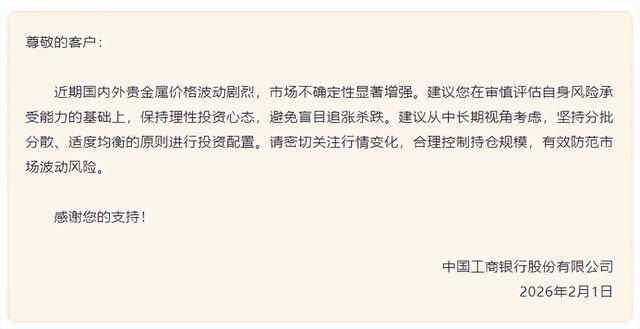
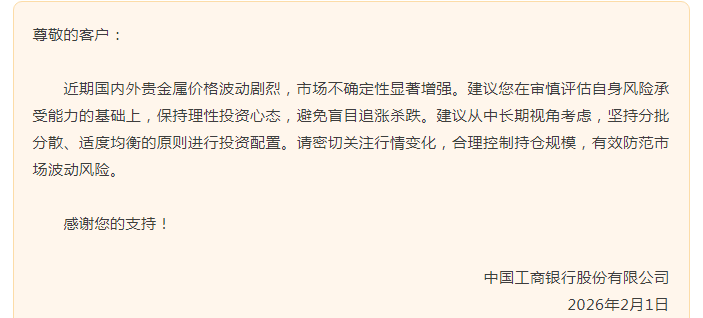
格隆汇2月1日|随着近期金价大幅震荡,工行、农行、中行、建行、交行等多家银行相继调整积存金相 关业务,并发布风险提示。 工商银行今日发布消息称,近期国内外贵金属价格波动剧烈,市场不确定性显着增强。建议投资者在审 慎评估自身风险承受能力的基础上,保持理性投资心态,避免盲目追涨杀跌,合理控制持仓规模,有效 防范市场波动风险。工行还公告,自2月7日起,在周末以及法定节假日等非上海黄金交易所交易日,该 行将对如意金积存业务进行限额管理,限额类型包括全量或单一客户单日积存/赎回上限、单笔积存或 赎回总量上限等,并进行动态设置,提金不受影响。 建设银行称,自2月2日上午9时10分起,个人黄金积存业务定期积存起点金额上调至1500元人民币。农 行建议投资者增强风险防范意识,基於自身财务状况和风险承受能力理性办理存金通黄金积存业务。 中国银行表示,2026年以来,贵金属市场的不确定性因素较多,价格大幅波动。提示各位客户做好市场 风险防范,基於自身财务状况和风险承受能力开展贵金属交易活动,合理控制贵金属持仓规模,防范贵 金属价格波动带来的资金损失风险。 ...
多家银行发布风险提示
Sou Hu Cai Jing· 2026-02-01 14:22
Core Viewpoint - The recent volatility in precious metal prices has prompted major banks in China, including Industrial and Commercial Bank of China (ICBC), to issue risk warnings and adjust their gold accumulation business rules to mitigate market risks [1][4][5]. Group 1: ICBC's Actions - ICBC has issued a warning regarding the significant fluctuations in domestic and international precious metal prices, advising investors to assess their risk tolerance and maintain a rational investment mindset [1]. - The bank recommends a long-term perspective on investments, advocating for a diversified and balanced approach while closely monitoring market changes [1]. - Starting February 7, ICBC will implement limit management on its "Ruyi Gold Accumulation" business, including daily limits on accumulation and redemption for individual clients [2]. Group 2: Other Banks' Responses - China Construction Bank (CCB) has raised the minimum amount for personal gold accumulation to 1500 yuan, effective February 2, and has also issued a risk warning due to increased market volatility [4]. - Bank of China (BOC) has highlighted the uncertainties in the precious metal market since 2026, urging clients to manage their investments based on their financial situation and risk tolerance [5]. - Agricultural Bank of China (ABC) has mandated risk assessments for clients engaging in gold accumulation activities, requiring a cautious rating or higher to proceed with transactions [6].
金价大幅震荡!工行、农行、中行、建行、交行,紧急提示
Sou Hu Cai Jing· 2026-02-01 12:32
Core Viewpoint - Recent fluctuations in gold prices have led multiple banks, including ICBC, ABC, BOC, CCB, and BOCOM, to adjust their gold accumulation services and issue risk warnings [1][2]. Group 1: ICBC Adjustments - ICBC announced on February 1 that the volatility in domestic and international precious metal prices has significantly increased, advising investors to assess their risk tolerance and maintain a rational investment mindset [3]. - Starting February 7, ICBC will implement limit management on its gold accumulation services during non-trading days, including daily limits on accumulation/redemption and total limits on single transactions [4]. - The minimum investment amount for ICBC's gold accumulation was raised from 1,000 yuan to 1,100 yuan as of January 8, and only personal clients with a C3 (balanced) rating or above can engage in gold accumulation starting January 12 [6]. Group 2: CCB Adjustments - CCB announced on January 30 that the minimum investment amount for personal gold accumulation services will increase to 1,500 yuan starting February 2 [8]. - CCB emphasized the heightened market risks due to increased volatility in precious metal prices and urged clients to enhance their risk awareness and manage their positions carefully [10]. Group 3: BOCOM Adjustments - BOCOM stated on January 29 that only clients with a growth, aggressive, or dynamic risk tolerance assessment can engage in all gold wallet services starting January 31 [12]. - Clients with conservative, stable, or balanced assessments can only perform limited actions such as real-time selling and redeeming physical gold [12]. - BOCOM had previously issued a risk warning on December 31, advising investors to monitor market changes and manage their positions effectively [14]. Group 4: ABC Adjustments - ABC announced on January 26 that starting January 30, clients must complete a risk assessment questionnaire and achieve at least a cautious rating to engage in its gold accumulation services [15]. - ABC also recommended that investors enhance their risk awareness and make rational decisions based on their financial situation and risk tolerance [15]. Group 5: BOC Risk Warning - BOC issued a risk warning on January 30, highlighting the uncertainties in the precious metals market since 2026 and advising clients to manage their positions carefully to mitigate potential losses from price fluctuations [17].
金融风向标2026-W04:不一样的“开门红”
CMS· 2026-02-01 12:31
Investment Rating - The report maintains a positive outlook on the banking sector, indicating a potential for stabilization and improvement in operational pressures for banks in 2026 [2][5]. Core Insights - The banking sector has shown a "double opening red" phenomenon in both deposits and loans, with a structural difference in credit allocation. The signs of "deposit migration" are not significant, suggesting a stable deposit base [2][5]. - The total assets of the banking industry reached 471 trillion yuan by the end of 2025, reflecting an 8.0% year-on-year growth. Major banks, joint-stock banks, city commercial banks, and rural commercial banks reported asset growth rates of 11.0%, 4.7%, 9.7%, and 5.2%, respectively [3][14]. - The overall net interest margin is expected to decline further, but at a slower pace, indicating some relief in operational pressures. The banks have passed the phase of accelerated risk exposure and are nearing a "stock digestion period" [5][6]. Summary by Sections Regulatory Dynamics - The Financial Regulatory Bureau released data on the total assets and liabilities of the banking sector for 2025, showing a total asset growth of 8.0% year-on-year [3][14]. Industry Dynamics - Qingdao Bank and Xiamen Bank reported their 2025 performance, with Qingdao Bank achieving a net profit growth of 21.66% and an asset quality improvement, while Xiamen Bank also reported significant growth in total assets and loans [15][16]. Market Dynamics - The overall A-share market saw a decline of 1.59%, while the banking sector increased by 0.86%, indicating a defensive characteristic of the banking stocks [2][18]. Data Overview - The report highlights the central bank's net injection of 0.4 trillion yuan and the mixed movement of interest rates across different maturities, with short-term rates showing slight declines and long-term rates experiencing mixed trends [4][21][23].


喜娜AI速递:今日财经热点要闻回顾|2026年2月1日
Sou Hu Cai Jing· 2026-02-01 11:20
Group 1: Market Trends - The silver market experienced a historic drop, with spot silver prices plunging 36%, marking the largest intraday decline in history, while spot gold prices fell over 12%, the largest single-day drop in 40 years. This decline is attributed to the nomination of Kevin Warsh as the next Federal Reserve Chairman, interpreted as a shift towards a more hawkish monetary policy, alongside factors like an overheated market and a downturn in U.S. stocks [2] - Bitcoin fell below $79,000, reaching its lowest level since April 2025, with over 420,000 investors liquidated, totaling $2.561 billion in liquidation. The price drop is influenced by escalating tensions between Israel and Iran, as well as delays in new regulatory frameworks for the U.S. crypto industry [2] - The semiconductor industry in South Korea saw a significant increase in exports, totaling $20.5 billion in January, a year-on-year surge of over 102%, indicating strong global demand for semiconductors. Additionally, domestic chip manufacturers are raising prices, with increases up to 80% across key segments [3] Group 2: Company Financials - Vanke announced an expected loss of 82 billion yuan for 2025, which would set a record for losses among A-share real estate companies. The anticipated losses are attributed to a decline in project settlement scale, low gross margins, and various impairments [2] - Ten companies, including Deep Konka A and Jiyou Co., have issued warnings about potential delisting due to financial indicators falling below required thresholds, including negative net assets and profits [4] - Several brokerages have released their investment recommendations for February, focusing on sectors such as technology and cyclical stocks, with companies like China Pacific Insurance and Zijin Mining receiving multiple endorsements [5]


澳门一酒店大堂78公斤黄金被连夜撤走?工作人员回应!关于金价震荡,多家银行紧急出手→
Sou Hu Cai Jing· 2026-02-01 11:15
Group 1 - The iconic "Golden Avenue" at the Macau Emperor Entertainment Hotel has lost its 78 kilograms of gold embedded in the lobby floor tiles, raising suspicions among netizens about its removal by staff [1][3] - The gold, valued at over 85.8 million yuan based on the domestic gold price exceeding 1100 yuan per gram, was confirmed to have been removed for internal renovations, not due to gold price fluctuations [3][4] - The Macau Emperor Entertainment Hotel is owned by Emperor Entertainment Hotel Limited, and the "Golden Avenue" was made up of 78 individually numbered gold bars of Swiss 999.9 pure gold [4] Group 2 - Several major banks, including ICBC, ABC, BOC, CCB, and Bank of Communications, have adjusted their gold accumulation business in response to significant fluctuations in gold prices [5] - ICBC announced changes to its gold accumulation business rules, including a new minimum purchase amount of 1100 yuan and limits on transactions during non-trading days [6][9] - CCB raised the minimum amount for personal gold accumulation to 1500 yuan and advised customers to be aware of market risks due to increased volatility in precious metals [10][12] - Bank of Communications implemented restrictions on gold-related transactions based on customers' risk assessment results, allowing only certain profiles to engage in all business activities [13] - ABC required customers to complete a risk assessment before engaging in gold accumulation services, emphasizing the importance of risk awareness [15] - BOC highlighted the uncertainties in the precious metals market since 2026 and urged customers to manage their positions carefully to mitigate potential losses [15]