SFC(601595)

Search documents
2026年传媒互联网行业年度策略:聚焦出海、AI赋能,布局内容新供给
Guoyuan Securities· 2026-01-21 02:16
Group 1 - The media sector outperformed the index in 2025, with a 24.75% increase, ranking 8th among 31 sub-industries, driven primarily by a 60.67% rise in the gaming sector [1][14][21] - The overall revenue growth for the media industry in the first three quarters of 2025 was 5.92%, while net profit increased by 37.12%, indicating strong earnings per share (EPS) performance [1][21][24] - The current valuation of the media industry is at the 47th percentile of the past three years, with attractive valuations in the gaming and film sectors [1][24][25] Group 2 - The mobile gaming market in 2025 achieved sales revenue of 257.08 billion yuan, a year-on-year increase of 7.92%, indicating a recovery in market sentiment [2][26] - New game releases such as "Supernatural Action Group" and "Staff Sword Legend" exceeded expectations, while established titles like "Honor of Kings" and "Peace Elite" continued to perform well [2][26] - The approval process for new game licenses remained stable in 2025, benefiting the supply side of the gaming industry [2][34] Group 3 - The short drama market in China reached a scale of 67.79 billion yuan in 2025, growing by 34.4% year-on-year, with a significant portion attributed to IAA [3][22] - The overseas short drama market is expected to grow by 145.7% in 2025, reaching a scale of 21.07 billion yuan, indicating strong international demand [3][22] - AI-driven animated dramas are emerging rapidly, with the market size expected to exceed 20 billion yuan, benefiting from lower production costs and enhanced efficiency [3][29] Group 4 - AI model capabilities continued to iterate in 2025, with significant advancements in models like Gemini 3 and ChatGPT 5.2, leading to accelerated commercialization [4][38] - The annual recurring revenue (ARR) for OpenAI reached 12 billion USD in 2025, with various AI applications generating over 100 million USD in annual revenue [4][38] - Investment opportunities in AI applications are expected to grow, particularly in AI video, advertising, animated dramas, and gaming [4][38] Group 5 - Recommended companies for investment include Giant Network, Perfect World, Century Huatong, and others, indicating a focus on firms with strong product pipelines and market positions [5][10]




传媒行业周报:千问接入阿里生态,OpenAI测试在ChatGPT中投放广告
Guoyuan Securities· 2026-01-20 05:15
Investment Rating - The report maintains a "Buy" rating for the industry, indicating a positive outlook for the sector's performance relative to the benchmark index [6][34]. Core Insights - The media industry saw a weekly increase of 2.04% from January 12 to January 18, 2026, outperforming major indices. Digital media led the gains with a 10.38% increase, while other segments like publishing and advertising also showed positive growth [2][12]. - Key themes for investment include AI applications and cultural exports, with a focus on sub-sectors such as gaming, intellectual property (IP), short dramas, marketing, and publishing [4][34]. Summary by Sections Market Performance - The media industry outperformed major indices with a 2.04% increase during the week of January 12-18, 2026. Digital media surged by 10.38%, while publishing rose by 3.32%, and advertising marketing increased by 2.58%. The gaming sector saw a modest rise of 1.57%, whereas the film and television broadcasting segments experienced slight declines [2][12]. Industry Key Data AI Applications - Recent downloads for AI applications on iOS were estimated at 27.93K for Deepseek, 208.27K for Doubao, 78.91K for Tencent Yuanbao, and 106.66K for Qianwen, with respective week-on-week changes of -8.79%, -0.67%, -9.86%, and +25.84%. The weekly token call volume on the OpenRouter platform reached 7.65 trillion, marking an 18.97% increase [3][18]. Gaming Data - The top five mobile games on iOS as of January 17, 2026, were "Honor of Kings," "Peacekeeper Elite," "Dungeon & Fighter: Origin," "Three Kingdoms: Strategy Edition," and "Genshin Impact: Moonlight Song." Tencent's "Counterattack: Future" launched and quickly gained over 10 million registered users within three days [3][18][20]. Film Data - The total box office for domestic films during the week was 280 million yuan, with "Hidden Kill" leading at 63.73 million yuan, accounting for 22.7% of the total. Other notable films included "Zootopia 2" and "Avatar 3" [26][27]. Investment Recommendations - The report recommends focusing on AI applications, cultural exports, and specific sub-sectors such as gaming, IP, short dramas, marketing, and publishing. Notable companies to watch include Giant Network, Kying Network, Perfect World, and others [4][34].

传媒行业周报:千问接入阿里生态,OpenAI测试在ChatGPT中投放广告-20260120
Guoyuan Securities· 2026-01-20 02:45
Investment Rating - The report maintains a "Buy" rating for the media industry, indicating a positive outlook for the sector's performance relative to the benchmark index [6][34]. Core Insights - The media industry saw a weekly increase of 2.04% from January 12 to January 18, 2026, outperforming major indices. Digital media led the gains with a 10.38% rise, while publishing and advertising marketing also showed positive growth [2][12]. - Key themes for investment include AI applications and cultural exports, with a focus on sub-sectors such as gaming, intellectual property (IP), short dramas, marketing, and publishing [4][34]. Summary by Sections Market Performance - The media industry outperformed major indices with a 2.04% increase during the week of January 12-18, 2026. Digital media surged by 10.38%, while publishing rose by 3.32%, and advertising marketing increased by 2.58%. The gaming sector saw a modest rise of 1.57%, whereas the film and television broadcasting segments experienced slight declines [2][12]. Industry Key Data AI Applications - Recent downloads for AI applications on iOS were estimated at 27.93K for Deepseek, 208.27K for Doubao, 78.91K for Tencent Yuanbao, and 106.66K for Qianwen, with respective week-over-week changes of -8.79%, -0.67%, -9.86%, and +25.84%. The weekly token call volume on the OpenRouter platform reached 7.65 trillion, marking an 18.97% increase [3][18]. Gaming Data - The top five mobile games on iOS as of January 17, 2026, were "Honor of Kings," "Peacekeeper Elite," "Dungeon & Fighter: Origin," "Three Kingdoms: Strategy Edition," and "Genshin Impact: Moonlight Song." Tencent's "Counterattack: Future" launched and quickly gained over 10 million registered users within three days [3][18][20]. Film and Television Data - The total box office for domestic films during the week was 280 million yuan, with "Hidden Kill" leading at 63.73 million yuan, accounting for 22.7% of the total. Upcoming films include "Flying Life 3," "Boon: Year of the Bear," and "Bounty Hunter: Wind Rises in the Desert" [26][30]. Investment Recommendations - The report recommends focusing on AI applications, cultural exports, and specific sub-sectors such as gaming, IP, short dramas, marketing, and publishing. Notable companies to watch include Giant Network, Kyeing Network, Perfect World, and others [4][34].
影视院线板块1月19日涨0.72%,百纳千成领涨,主力资金净流入1.86亿元
Zheng Xing Xing Ye Ri Bao· 2026-01-19 08:58
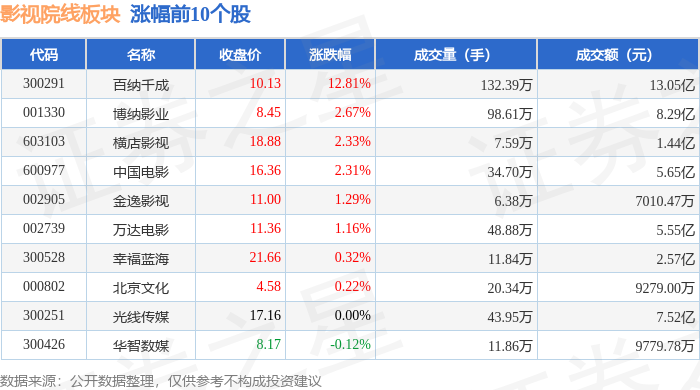
Group 1 - The film and theater sector saw a rise of 0.72% on January 19, with Baina Qiancheng leading the gains [1] - The Shanghai Composite Index closed at 4114.0, up 0.29%, while the Shenzhen Component Index closed at 14294.05, up 0.09% [1] - Baina Qiancheng's stock price increased by 12.81% to 10.13, with a trading volume of 1.32 million shares [1] Group 2 - The film and theater sector experienced a net inflow of 186 million yuan from institutional investors, while retail investors saw a net outflow of 284 million yuan [2] - The trading data indicates that Baina Qiancheng had a net inflow of 107 million yuan from institutional investors, with a net outflow of 87.95 million yuan from retail investors [3] - Other notable stocks included China Film, which had a net inflow of 37.48 million yuan from institutional investors, and Light Media, which saw a net inflow of 28.19 million yuan [3]


上海电影股价跌5.01%,南方基金旗下1只基金位居十大流通股东,持有164.27万股浮亏损失256.26万元
Xin Lang Cai Jing· 2026-01-16 03:06
Group 1 - Shanghai Film Co., Ltd. experienced a decline of 5.01% in stock price, reaching 29.55 CNY per share, with a trading volume of 2.19 billion CNY and a turnover rate of 1.62%, resulting in a total market capitalization of 13.244 billion CNY [1] - The company, established on October 7, 1994, and listed on August 17, 2016, is primarily engaged in film distribution and exhibition, including film distribution and copyright sales, cinema operation, investment and development, advertising marketing, and technical services [1] - The revenue composition of the company's main business includes: 81.28% from film exhibition and others, 11.07% from intellectual property licensing, 6.12% from cinema operation, and 5.33% from film investment management and distribution [1] Group 2 - Among the top ten circulating shareholders of Shanghai Film, a fund under Southern Fund ranks as a new entrant, holding 1.6427 million shares, which accounts for 0.37% of the circulating shares, with an estimated floating loss of approximately 2.5626 million CNY [2] - The Southern CSI 1000 ETF (512100), established on September 29, 2016, has a latest scale of 76.63 billion CNY, with a year-to-date return of 8.51%, ranking 1463 out of 5531 in its category, and a one-year return of 44.65%, ranking 1681 out of 4215 [2] Group 3 - The fund manager of Southern CSI 1000 ETF (512100) is Cui Lei, who has a cumulative tenure of 7 years and 72 days, managing a total fund size of 122.76 billion CNY, with the best fund return during the tenure being 234.52% and the worst being -15.93% [3]
影视院线板块1月14日涨1.01%,博纳影业领涨,主力资金净流出5.3亿元
Zheng Xing Xing Ye Ri Bao· 2026-01-14 08:58
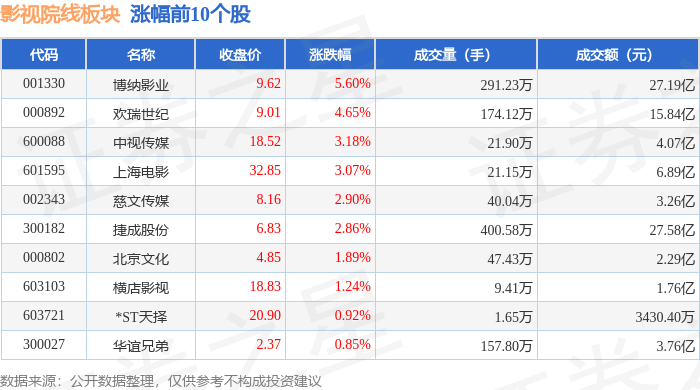
Market Performance - The film and cinema sector increased by 1.01% compared to the previous trading day, with Bona Film Group leading the gains [1] - The Shanghai Composite Index closed at 4126.09, down 0.31%, while the Shenzhen Component Index closed at 14248.6, up 0.56% [1] Individual Stock Performance - Bona Film Group (001330) closed at 9.62, up 5.60%, with a trading volume of 2.91 million shares and a transaction value of 2.719 billion [1] - Huanrui Century (000892) closed at 9.01, up 4.65%, with a trading volume of 1.74 million shares and a transaction value of 1.584 billion [1] - Other notable performers include: - China Vision Media (600088) at 18.52, up 3.18% [1] - Shanghai Film (601595) at 32.85, up 3.07% [1] - Zhengwen Media (002343) at 8.16, up 2.90% [1] Capital Flow Analysis - The film and cinema sector experienced a net outflow of 530 million from institutional investors, while retail investors saw a net inflow of 881 million [2] - The main capital flow for individual stocks shows: - Huanrui Century had a net inflow of 150 million from main investors [3] - Shanghai Film had a net inflow of approximately 28.69 million [3] - Light Media (300251) had a net inflow of about 19.82 million [3] Summary of Stock Flows - The overall trend indicates that while institutional and speculative funds are withdrawing, retail investors are actively buying into the sector [2][3] - Notable stocks with significant retail inflows include: - Huanrui Century with a retail net inflow of 10 million [3] - ST Tianze (603721) with a retail net inflow of 188.16 million [3]


传媒行业周报:GEO重构数字营销,布局AI应用-20260114
Guoyuan Securities· 2026-01-14 04:43
Investment Rating - The report maintains a "Buy" rating for the media industry, indicating a positive outlook for the sector [7][11]. Core Insights - The media industry (Shenwan) saw a significant increase of 13.10% from January 5 to January 11, 2026, outperforming the major indices [14][17]. - Key segments within the industry performed well, with advertising and marketing up 19.17%, television broadcasting up 15.15%, and gaming up 13.14% [14][17]. - The report highlights strong individual stock performances, particularly for companies like Inertia Media and BlueFocus, which saw increases of 52.62% and 49.13% respectively [17][18]. Industry Performance Summary Market Performance - The media industry outperformed the major indices, with the Shanghai Composite Index rising 3.82% and the Shenzhen Component Index rising 4.40% during the same period [14][16]. - The advertising and marketing sector led the gains, followed by television broadcasting and gaming [14][16]. Key Data and Updates AI Applications - AI product rankings showed significant growth, with Gemini and DeepSeek increasing by 28% and 30% respectively [19][20]. - OpenRouter's weekly token usage rose by 15%, indicating a growing demand for AI applications [19][20]. Gaming - The top five mobile games on iOS as of January 10, 2026, included "Honor of Kings" and "Peacekeeper Elite" [23][25]. - New game releases are anticipated, including Tencent's "Counter-Strike: Future" on January 13, 2026 [27][26]. Film and Television - Domestic box office revenue reached 362 million yuan during the week of January 5-11, 2026, with "Hidden Kill" leading the charts [29][30]. - Seven new films are set to be released from January 12 to January 18, 2026 [30][31]. Investment Recommendations - The report recommends focusing on themes such as AI applications and cultural exports, with specific attention to gaming, IP, short dramas, marketing, and publishing sectors [5][34]. - Notable companies to watch include Giant Network, Perfect World, and Kuaishou, all rated as "Buy" [5][34].
万亿影视周边市场,中国企业玩法豹变
3 6 Ke· 2026-01-12 09:13
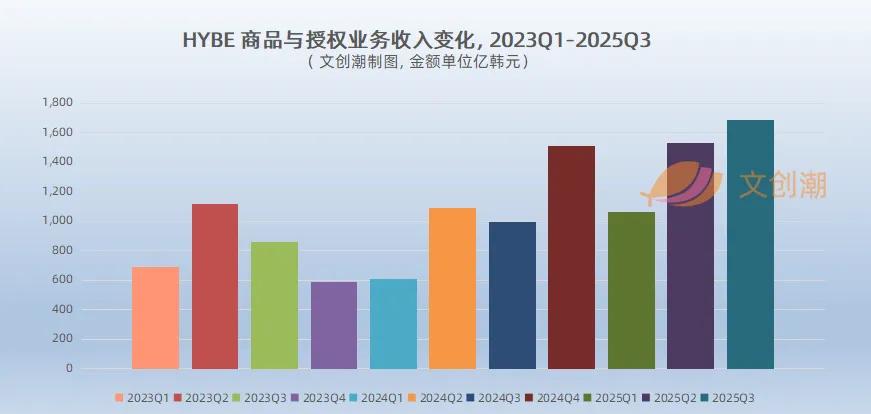
Core Insights - The collectibles card market is experiencing significant growth, with companies like Suplay and Sunnysondi filing for IPOs, indicating a rising interest in high-end collectible cards [1][2] - The integration of IP and collectibles is becoming a standard in the entertainment industry, with a notable increase in the number of projects and collaborations between major platforms and brands [9][12] - The global market for entertainment merchandise is projected to reach $137.4 billion by 2029, highlighting the lucrative potential of this sector [8] Group 1: Market Developments - Suplay has submitted its IPO application to the Hong Kong Stock Exchange, focusing on high-end collectible cards priced above 10 yuan [1] - Sunnysondi's IPO application follows the success of its merchandise from popular animated films, indicating a trend of rising revenues in the collectibles sector [2] - The collectibles card has become a standard offering for popular media, with nearly 100 projects planned for 2025, a significant increase from the previous year [9] Group 2: Financial Performance - HYBE's merchandise and licensing revenue reached 168.3 billion KRW (over 800 million RMB) in Q3 2025, becoming its third-largest revenue source [5] - Major companies like Light Media and Mango TV are ramping up their investments in IP derivative products, with Light Media's market value at 48 billion RMB and Mango TV at 45.7 billion RMB [13] Group 3: Industry Trends - The collectibles card market is evolving, with brands like Hitcard leading the way by collaborating with major IP holders and expanding their product offerings [14][35] - The trend of integrating high-quality products that carry emotional value is becoming crucial for brands to differentiate themselves in a competitive market [19][30] - Companies are increasingly focusing on building comprehensive IP ecosystems, with brands like Hitcard and Uncommon Play aiming to enhance their operational capabilities and market reach [36][38] Group 4: Consumer Engagement - Major platforms are enhancing their consumer engagement strategies by launching themed stores and interactive experiences, such as iQIYI's "Qixiaobei" stores and Youku's themed areas [21][25] - The rise of online sales channels, including live streaming and e-commerce, is reshaping how collectibles are marketed and sold, with significant sales coming from these platforms [30] Group 5: Future Outlook - The industry is expected to see more brands emerge that can successfully navigate the complexities of IP management and product development, potentially leading to the creation of iconic brands similar to LEGO or Hasbro in the future [38]


影视院线板块1月12日涨6.42%,百纳千成领涨,主力资金净流入7.22亿元
Zheng Xing Xing Ye Ri Bao· 2026-01-12 09:10
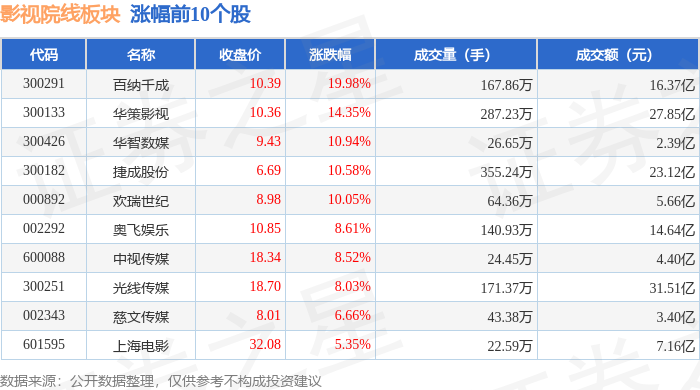
Core Viewpoint - The film and cinema sector experienced a significant increase, with a 6.42% rise in the sector index on January 12, driven by strong performances from individual stocks like Baida Qiancheng, which surged by 19.98% [1] Group 1: Market Performance - The Shanghai Composite Index closed at 4165.29, up 1.09%, while the Shenzhen Component Index closed at 14366.91, up 1.75% [1] - The leading stock in the cinema sector, Baida Qiancheng, closed at 10.39 with a 19.98% increase, achieving a trading volume of 1.6786 million shares and a transaction value of 1.637 billion [1] - Other notable performers included Huace Film & TV, which rose by 14.35% to close at 10.36, and Huazhi Education Media, which increased by 10.94% to close at 9.43 [1] Group 2: Capital Flow - The film and cinema sector saw a net inflow of 722 million in main funds, while retail investors experienced a net outflow of 206 million [2] - The main capital inflow was led by Light Media, which attracted 320 million, while Huace Film & TV saw a net outflow of 177 million from retail investors [3] - Baida Qiancheng had a main capital inflow of approximately 95.94 million, but also faced a retail outflow of 69.62 million [3]
数读2025:动画电影票房超250亿,中国电影的未来究竟在哪?
Xin Lang Cai Jing· 2026-01-11 02:00
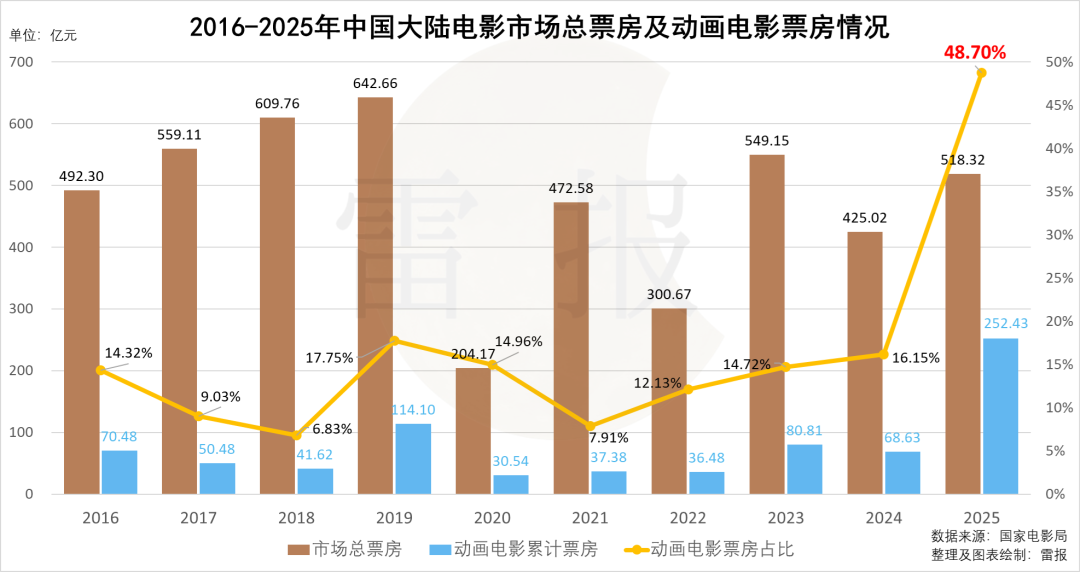
Core Insights - The Chinese film market in 2025 set numerous records, with a total box office of 51.832 billion yuan, a year-on-year increase of 21.95%, and 1.238 billion cinema admissions, up 22.57% from the previous year. However, it still fell short of the 2019 peak by over 12 billion yuan [1][3]. Animation Film Performance - Animation films were the standout category, achieving a total box office of 25.243 billion yuan, a staggering increase of 268% year-on-year, and capturing nearly 50% of the market share [3][4]. - Major hits included "Nezha: The Devil's Child" with a box office of 15.446 billion yuan, accounting for 30% of the annual total, and "Zootopia 2," which surpassed 4.26 billion yuan in just five days [3][4]. - Despite the success of top films, the overall industry faced challenges such as audience attrition and an imbalance in film types, with a significant drop in the under-25 demographic from 39% in 2017-2019 to 15% in 2025 [3][4]. Box Office Trends - The year saw four films surpassing 3 billion yuan, collectively accounting for over half of the total box office, but only 51 films crossed the 100 million yuan mark, indicating a growing gap in mid-tier films [4][9]. - The animation sector released 57 films, with "Nezha 2" leading the box office, yet many domestic animated films struggled to reach the 100 million yuan threshold, highlighting a persistent ceiling in the industry [6][9]. Audience Engagement and Ratings - The average Douban rating for films in 2025 was 7.1, slightly down from the previous year, with 16 films rated above 8, including several re-releases of classic films [13]. - The top-rated new films included "The Legend of Hei 2" and "Demon Slayer: Mugen Train," indicating a strong performance for recent releases [13]. Industry Challenges - The animation sector's reliance on a few major players has led to a "head and shoulders" market structure, with a lack of mid-tier creative output contributing to the industry's challenges [9][11]. - Despite the overall box office growth, the number of films grossing over 100 million yuan decreased, reflecting a decline in the mid-tier film market [9][11]. IP and Revenue Diversification - The film industry is increasingly moving towards a model that emphasizes IP commercialization beyond box office revenue, with companies exploring merchandise and licensing opportunities [21][22]. - Successful films like "Nezha 2" have generated significant revenue from merchandise, with projections suggesting sales could reach hundreds of billions [22][25]. - Companies like Wanda Film and Shanghai Film are actively investing in derivative product lines and diversifying revenue streams through IP collaborations [23][25]. Conclusion - The animation film sector is becoming a leader in the commercialization of film IP, transitioning from a single revenue model to a more integrated approach that combines content, experience, and supply chain management [30].