
CHINA TELECOM(601728)

Search documents
中国电信云南分公司原总经理苗逢源接受审查调查
Xin Lang Cai Jing· 2025-08-27 02:13
Group 1 - The central focus of the article is the investigation of Miao Fengyuan, the former Party Secretary and General Manager of China Telecom's Yunnan branch, for serious violations of discipline and law [1] - The investigation is being conducted by the Central Commission for Discipline Inspection and the National Supervisory Commission, along with the Jiangxi Provincial Commission for Discipline Inspection [1] - The disciplinary review and investigation are part of broader efforts to enforce accountability within state-owned enterprises in China [1]
中国电信云南分公司原党组书记、总经理苗逢源被查
Bei Jing Ri Bao Ke Hu Duan· 2025-08-27 02:13
Group 1 - The former Party Secretary and General Manager of China Telecom Yunnan Branch, Miao Fengyuan, is under investigation for serious violations of discipline and law [1] - The investigation is being conducted by the Central Commission for Discipline Inspection and the National Supervisory Commission stationed at China Telecom, as well as the Supervisory Committee of Jingdezhen City, Jiangxi Province [1]
超400家公司披露中期分红预案!总额达1800亿元,中国移动等三巨头分红均超百亿
Jin Rong Jie· 2025-08-26 23:09
Core Viewpoint - The trend of mid-term dividends among listed companies is increasing, indicating a shift from sporadic occurrences to a regular practice in the market, with multiple dividends becoming the new norm [1][3]. Group 1: Increase in Mid-term Dividends - Over 20 listed companies have recently announced their first mid-term dividend plans, including Taihe Co., China Steel Tianyuan, and Yuchip Technology, with cash dividends per 10 shares of 2 yuan, 0.6 yuan, and 1 yuan respectively [3]. - Major companies like CRRC, Hengli Petrochemical, and Changan Automobile have also announced their first mid-term dividend plans, with CRRC planning to distribute 1.1 yuan per 10 shares, totaling 3.157 billion yuan [3][4]. - The cash dividend ratios for Taihe Co., China Steel Tianyuan, and Yuchip Technology are approximately 49%, 31%, and 19% respectively, reflecting a growing emphasis on shareholder returns [3]. Group 2: Record High Dividend Scale - Approximately 400 companies have disclosed mid-term dividend plans, with a total planned dividend amount of around 180 billion yuan, marking a historical high [4]. - Major companies such as China Mobile, China Telecom, and Sinopec have mid-term dividends exceeding 10 billion yuan, with amounts of 54 billion yuan, 16.581 billion yuan, and 10.67 billion yuan respectively [4]. - More than 60% of listed companies have mid-term dividends in the million yuan range, with banks showing a higher dividend ratio, as evidenced by Changshu Bank and Ping An Bank's announced dividend plans [4]. Group 3: Characteristics of Current Dividends - The current dividend landscape is characterized by high amounts, high ratios, and high frequencies, with 3,720 companies planning cash dividends totaling approximately 2.4 trillion yuan in 2024 [5]. - This figure not only sets a new historical record but also marks the third consecutive year exceeding 2 trillion yuan in total dividends [5]. - Many companies have indicated plans for stable and regular returns to investors, committing to annual profit distributions when conditions allow, including a certain proportion of cash dividends [5].





中国电信股价下跌1.17% 参与成立AI推理工作组
Jin Rong Jie· 2025-08-26 16:26
Group 1 - As of August 26, 2025, China Telecom's stock price is 7.58 yuan, down 0.09 yuan or 1.17% from the previous trading day [1] - The trading volume on that day was 1.5598 million hands, with a transaction amount of 1.182 billion yuan [1] - China Telecom is a major state-owned telecom operator in the communication services industry, providing fixed and mobile communication services, internet access, and information services [1] Group 2 - Recently, China Telecom participated in the establishment of the "Advanced Storage AI Inference Working Group," which aims to promote the development of "storage-computing collaboration and ecological co-construction" in the AI inference field [1] - The company showcased its "Wide-area Intelligent Computing Lossless Networking Technology" at the 2025 China Computing Power Conference, which enables efficient collaboration between distant data centers [1] Group 3 - On August 26, 2025, the net outflow of main funds for China Telecom was 206 million yuan, accounting for 0.04% of its circulating market value [1] - Over the past five trading days, the cumulative net inflow of main funds was 2.00496 million yuan [1]
聊聊卫星互联网牌照那些事
Sou Hu Cai Jing· 2025-08-26 15:50
Group 1 - The Ministry of Industry and Information Technology (MIIT) is set to issue "satellite internet" licenses, which has generated significant interest and inquiries among the public [2] - A business license is a legal permit issued by the government or regulatory bodies that allows organizations or individuals to conduct specific commercial activities, ensuring market access and compliance with regulations [3] - The MIIT's role includes issuing licenses for telecommunications and internet services, ensuring that companies have the necessary technical capabilities and compliance qualifications to operate legally [3] Group 2 - The upcoming satellite internet licenses are expected to fill gaps in existing licenses for China Unicom and China Mobile, allowing them to legally conduct satellite-based mobile services [6] - Companies like Xingwang and Yuanshin are likely to obtain A13-1/2 operational licenses, which would significantly benefit their business development, especially for Yuanshin's focus on satellite internet services along the Belt and Road countries [6] - The rapid deployment of China's satellite constellation, particularly by Xingwang, is anticipated to enhance the country's satellite internet capabilities, with the issuance of operational licenses expected to accelerate the development of this sector [7][8]

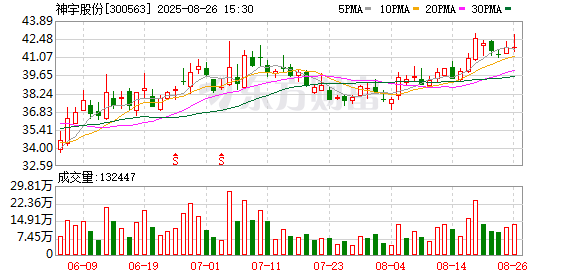
神宇股份2025半年度拟派706.11万元红包
Zheng Quan Shi Bao Wang· 2025-08-26 14:38
Core Viewpoint - Shen Yu Co., Ltd. announced a semi-annual distribution plan for 2025, proposing a cash dividend of 0.4 yuan per 10 shares, totaling approximately 7.06 million yuan, which represents 21.11% of the company's net profit [2][4]. Company Summary - The company reported a total revenue of 396 million yuan for the first half of 2025, reflecting a year-on-year growth of 0.46%. However, net profit decreased by 41.54% to approximately 33.44 million yuan, with basic earnings per share at 0.19 yuan [2][3]. - This distribution marks the 11th time the company has issued dividends since its listing [2]. Industry Context - In the telecommunications sector, 12 companies have announced their semi-annual distribution plans for 2025. China Mobile leads with a cash distribution of approximately 54.09 billion yuan, followed by China Telecom and China Unicom with distributions of about 16.58 billion yuan and 3.48 billion yuan, respectively [3][4].

卡不住我们!中国算力省电省钱十大绝招,个个硬核
2 1 Shi Ji Jing Ji Bao Dao· 2025-08-26 12:53
Core Insights - The 2025 China Computing Power Conference showcased significant breakthroughs in computing power, including the "Jiuzhou" computing power optical network developed by China Mobile, achieving 10 EFLOPS, capable of performing 100 trillion calculations in one second [1] - The conference highlighted ten major advancements in China's computing industry, focusing on both core underlying technologies and ecological solutions that enhance efficiency and sustainability [1][2] - These advancements are expected to drive GDP growth by over 12.6 billion yuan, indicating a strong economic impact from the computing power sector [1] Group 1: Major Breakthroughs - China Mobile's "Jiuzhou" optical network is the world's largest 400G all-optical inter-provincial backbone network [1] - Shanxi Qineng's integrated platform for computing and electricity saves 10 million yuan in electricity costs annually and reduces carbon emissions by 100,000 tons [1] - Super Fusion's FusionOne AI solution enables rapid deployment of AI applications, with over 500 projects already implemented [1] Group 2: Collaborative Technologies - China Telecom's "Wide-area Intelligent Computing Lossless Networking Technology" allows efficient collaboration between distant data centers [2] - China Unicom's "Distributed Training and Inference Key Technology" ensures efficient and secure AI training while protecting data privacy [2] - Lenovo's "Comprehensive Large Model Training and Inference Solution" enhances model inference performance by ten times and enables rapid fault recovery [2] Group 3: Ecosystem Development - Alibaba Cloud's heterogeneous GPU cloud platform facilitates collaboration among different brands of domestic GPUs, supporting over 100 major projects [2] - ZTE's intelligent computing supernode system enables large-scale high-speed interconnection of domestic GPU cards, supporting training of models with over one trillion parameters [2] - Shanghai AI Laboratory's DeepLink solution allows large-scale mixed training across provinces, optimizing national computing resources [2][3]

思特奇:与中国移动、中国联通、中国电信长期保持稳定的传统业务合作关系
Zheng Quan Ri Bao Zhi Sheng· 2025-08-26 08:39
Group 1 - The company, Sitergy, maintains a long-term stable traditional business cooperation relationship with major telecom operators in China, including China Mobile, China Unicom, and China Telecom [1] - Sitergy provides IT system architecture and business operation support services to these telecom companies [1]
上市公司半年报分红哪家强?一图看清
Zheng Quan Shi Bao Wang· 2025-08-26 06:21
Core Viewpoint - The article highlights the mid-year dividend announcements from A-share listed companies, indicating a positive trend in net profit growth and substantial cash dividends being distributed to shareholders [2]. Group 1: Dividend Distribution - As of August 26, 2025, a total of 2,358 A-share listed companies have disclosed their semi-annual reports, with 1,329 companies reporting year-on-year net profit growth [2]. - Among these, 389 companies announced mid-term dividend plans, with a total proposed dividend amount nearing 1,800 billion yuan [2]. Group 2: Major Dividend Payers - Notable companies with significant cash dividends include China Mobile, China Telecom, and Sinopec, each distributing over 10 billion yuan, with China Mobile leading at 540.83 billion yuan [5][7]. - Other companies with substantial dividends include Muyuan Foods (50.02 billion yuan) and Ping An Bank (45.80 billion yuan) [5][7]. Group 3: Dividend Per Share - The article lists companies with notable dividends per share, including: - Gigabit (6.60 yuan) - Ninebot (4.23 yuan) - Shuoshi Biology (3.40 yuan) - China Mobile (2.50 yuan) [10].





通信行业周观点:AI高景气延续,海内外算力链齐发力-20250826
Changjiang Securities· 2025-08-26 05:13
Investment Rating - The report maintains a "Positive" investment rating for the communication industry [13]. Core Insights - The communication sector has seen a significant increase, with a 10.43% rise in the 34th week of 2025, ranking first among major industries. Year-to-date, the sector has risen by 44.59%, also ranking first [2][7]. - Key developments include DeepSeek's launch of the V3.1 model, a major cloud computing deal between Meta and Google worth over $10 billion, and NVIDIA's introduction of Spectrum-XGS technology, all contributing to sustained high demand in AI and computing power [2][11]. Summary by Sections Market Performance - In the 34th week of 2025, the communication sector rose by 10.43%, leading among major industries. Since the beginning of the year, it has increased by 44.59% [2][7]. - Notable stock performances include Shengke Communication (+43.9%), ZTE Corporation (+32.2%), and Ruijie Networks (+32.2%) for gains, while Nanjing Panda (-10.0%), Kesi Technology (-8.9%), and Dingtong Technology (-3.9%) faced declines [7]. Technological Developments - DeepSeek's V3.1 model enhances tool usage and inference capabilities, introducing a "mixed inference" architecture and supporting the UE8M0 FP8 format, which significantly reduces memory usage and improves local inference efficiency [8]. - Meta's six-year cloud computing partnership with Google, valued at over $10 billion, marks one of the largest contracts for Google Cloud, enhancing its service offerings [9]. - NVIDIA's Spectrum-XGS technology aims to connect distributed data centers into a unified AI factory, improving communication performance significantly [10]. Investment Recommendations - Recommended stocks include: - Operators: China Mobile, China Telecom, China Unicom - Optical Modules: Zhongji Xuchuang, Xinyi Sheng, Tianfu Communication - Liquid Cooling: Yingweike - Fiber Optics: Fenghuo Communication, Hengtong Optic-Electric, Zhongtian Technology - Domestic Computing: Runze Technology, Guanghuan New Network, Aofei Data - AI Applications: Heertai, Tuobang Co., Yiyuan Communication - Satellite Applications: Haige Communication, Huace Navigation [11].


