CHINA TELECOM(601728)

Search documents
三大运营商集体公告:基础电信服务增值税率由6%上调至9%
Xin Lang Cai Jing· 2026-02-01 09:29
智通财经2月1日讯,今日,中国移动、中国联通及中国电信国内三大电信运营商相继发布公告,电信服 务增值税税目适用范围调整,税率由6%调整为9%,将对公司收入及利润产生影响。 中国移动今日公告称,近日,中华人民共和国财政部、国家税务总局发布了《关于增值税征税具体范围 有关事项的公告》(财政部 税务总局公告2026年第9号),规定自2026年1月1日起,在中华人民共和国 境内,利用固网、移动网、卫星、互联网,提供手机流量服务、短信和彩信服务、互联网宽带接入服务 的业务活动适用的税目由增值电信服务调整为基础电信服务,对应增值税税率由6%调整为9%。此次税 目适用范围调整,将对公司收入及利润产生影响。 中国联通今日公告称,近日,中华人民共和国财政部、国家税务总局发布《关于增值税征税具体范围有 关事项的公告》(财政部 税务总局公告2026年第9号),规定自2026年1月1日起,在中华人民共和国境 内,利用固网、移动网、卫星、互联网,提供手机流量服务、短信和彩信服务、互联网宽带接入服务的 业务活动适用的税目由增值电信服务调整为基础电信服务,对应增值税税率由6%调整至9%。此次税目 适用范围调整,将对本公司收入及利润产生影响 ...



中国电信(601728) - 中国电信股份有限公司关于电信服务增值税税目适用范围调整的公告
2026-02-01 09:15
本公司董事会及全体董事保证本公告内容不存在任何虚假记载、误导性陈述 或者重大遗漏,并对其内容的真实性、准确性和完整性承担法律责任。 证券代码:601728 证券简称:中国电信 公告编号:2026-002 中国电信股份有限公司 关于电信服务增值税税目适用范围调整的公告 特此公告。 中国电信股份有限公司 董事会 2026 年 2 月 1 日 近日,中华人民共和国财政部、国家税务总局发布《关于增值税 征税具体范围有关事项的公告》(财政部 税务总局公告 2026 年第 9 号),规定自 2026 年 1 月 1 日起,在中华人民共和国境内,利用固网、 移动网、卫星、互联网,提供手机流量服务、短信和彩信服务、互联 网宽带接入服务的业务活动适用的税目由增值电信服务调整为基础 电信服务,对应增值税税率由 6%调整至 9%。 本次增值税税目适用范围调整,将对公司收入和利润产生影响。 公司将全面实施云改数转智惠战略,加快科技型企业建设,全面推进 AI+行动,持续打造"算力+平台+数据+模型+应用"的一体化智能云 服务,加快培育发展新动能,推动提质降本增效,持续推进企业高质 量发展。 ...
中国电信最新公告:电信服务增值税税目适用范围调整将对公司收入和利润产生影响
Sou Hu Cai Jing· 2026-02-01 09:14
以上内容为证券之星据公开信息整理,由AI算法生成(网信算备310104345710301240019号),不构成 投资建议。 中国电信(601728.SH)公告称,近日,中华人民共和国财政部、国家税务总局发布《关于增值税征税具 体范围有关事项的公告》(财政部 税务总局公告2026年第9号),规定自2026年1月1日起,在中华人民共 和国境内,利用固网、移动网、卫星、互联网,提供手机流量服务、短信和彩信服务、互联网宽带接入 服务的业务活动适用的税目由增值电信服务调整为基础电信服务,对应增值税税率由6%调整至9%。本 次增值税税目适用范围调整,将对公司收入和利润产生影响。 ...
中国电信(601728.SH):电信服务增值税税目适用范围调整 将对公司收入和利润产生影响
智通财经网· 2026-02-01 09:09
Core Viewpoint - The adjustment in the VAT tax category for telecommunications services in China will impact the revenue and profit of China Telecom, as the VAT rate will increase from 6% to 9% starting January 1, 2026 [1] Group 1: Tax Policy Changes - The Ministry of Finance and the State Taxation Administration of China announced that from January 1, 2026, the tax category for services such as mobile data, SMS, MMS, and internet broadband access will change from value-added telecommunications services to basic telecommunications services [1] - The corresponding VAT rate for these services will increase from 6% to 9% [1] Group 2: Company Strategy - China Telecom will fully implement its cloud transformation strategy, focusing on building technology-driven enterprises [1] - The company aims to accelerate its AI initiatives and develop an integrated intelligent cloud service model that combines computing power, platforms, data, models, and applications [1] - The strategic focus is on fostering new growth drivers, enhancing quality, reducing costs, and improving efficiency to promote high-quality development [1]
中国电信公布国际专利申请:“业务控制方法、装置、设备、介质和产品”
Sou Hu Cai Jing· 2026-01-30 23:00
Core Viewpoint - China Telecom has filed an international patent application for a "business control method, device, equipment, medium, and product," with the application number PCT/CN2025/109872, set to be published internationally on January 29, 2026 [1] Group 1: Patent Application - The patent application is part of China Telecom's ongoing innovation efforts [1] - This marks the 23rd international patent application filed by China Telecom this year, representing a 61.67% decrease compared to the same period last year [1] Group 2: R&D Investment - In the first half of 2025, China Telecom invested 4.782 billion yuan in research and development, which is a year-on-year increase of 2.65% [1]


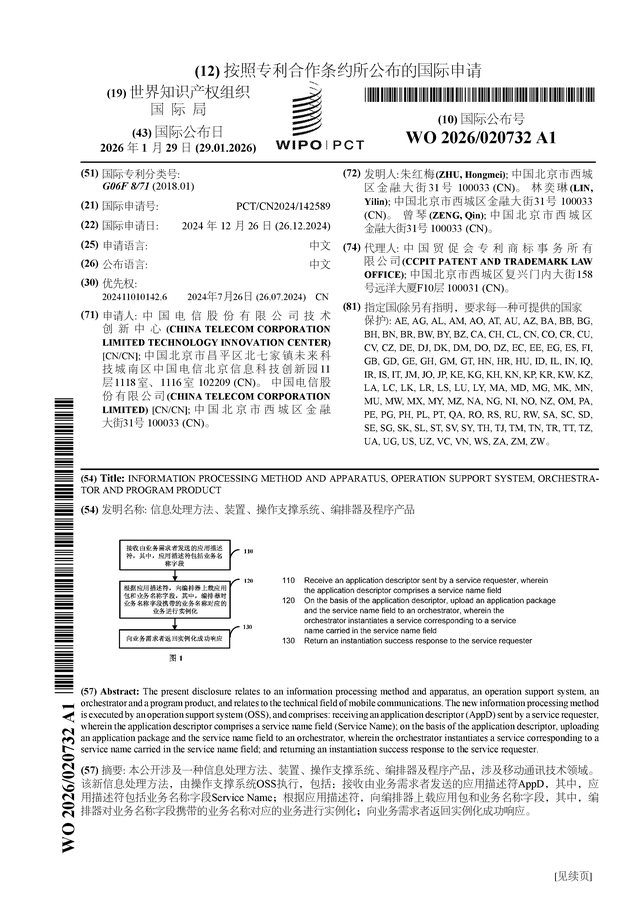
中国电信公布国际专利申请:“信息处理方法、装置、操作支撑系统、编排器及程序产品”
Sou Hu Cai Jing· 2026-01-30 23:00
Group 1 - The core point of the article is that China Telecom has filed an international patent application for a technology related to information processing, with the application number PCT/CN2024/142589 and a publication date set for January 29, 2026 [1] Group 2 - China Telecom has announced a total of 23 international patent applications this year, which represents a decrease of 61.67% compared to the same period last year [3] - In the first half of 2025, China Telecom invested 4.782 billion yuan in research and development, showing a year-on-year increase of 2.65% [3]
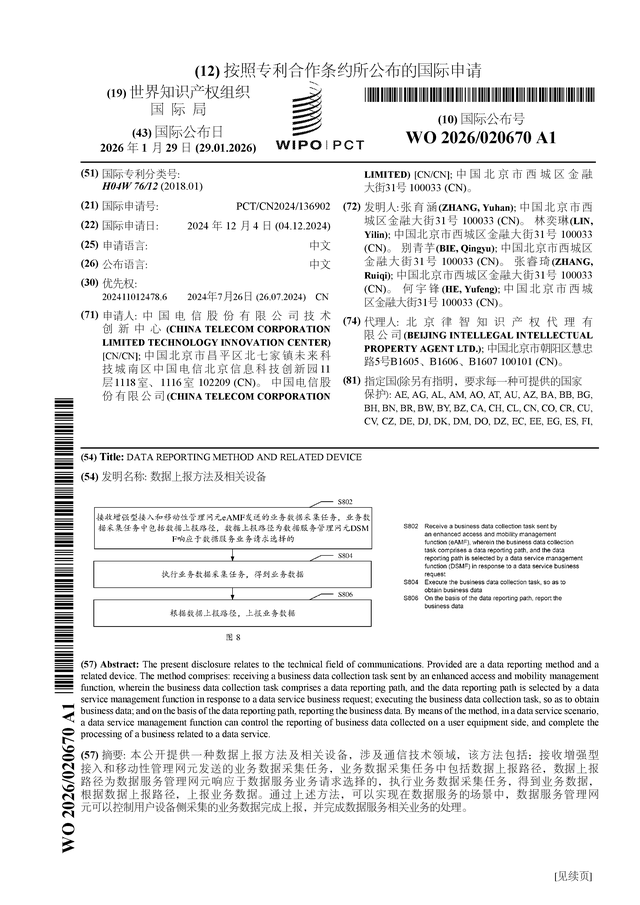
中国电信公布国际专利申请:“数据上报方法及相关设备”
Sou Hu Cai Jing· 2026-01-30 22:54
Group 1 - The core point of the article is that China Telecom has filed an international patent application for a "data reporting method and related equipment," with the application number PCT/CN2024/136902, and the international publication date set for January 29, 2026 [1] Group 2 - China Telecom has announced a total of 23 international patent applications this year, representing a decrease of 61.67% compared to the same period last year [3] - In the first half of 2025, China Telecom invested 4.782 billion yuan in research and development, which is a year-on-year increase of 2.65% [3]
总量向好、增收乏力 通信业仍处转型阵痛期
Zhong Guo Jing Ying Bao· 2026-01-30 19:33
Core Insights - The Chinese telecommunications industry is at a crossroads as the 2025 statistics reveal a mixed performance, with total telecom business volume growing by 9.1% year-on-year, significantly outpacing GDP growth by 4.1 percentage points, contributing positively to economic growth [2] - However, telecom business revenue growth has declined to only 0.7% in 2025, a drop of 2.5 percentage points from 2024, indicating a trend of stagnation in revenue growth despite overall market improvements [3][4] Group 1: Industry Performance - By the end of 2025, the number of 5G base stations reached 4.838 million, accounting for 37.6% of mobile phone base stations, with an average of 34.4 5G base stations per 10,000 people, exceeding the "14th Five-Year Plan" target [2] - The number of mobile phone users in China reached 1.827 billion, with a penetration rate of 130 devices per 100 people, surpassing the global average by 22.5 percentage points [2] - The number of 5G mobile phone users reached 1.204 billion, with a net increase of 190 million users, representing over 65.9% of total mobile phone users, which is 2.1 times the global average [2] Group 2: Revenue Trends - Telecom business revenue for 2025 was 1.75 trillion yuan, with a growth rate of only 0.7%, down from 3.2% in 2024, and significantly lower than the 6.2% and 8% growth rates in 2023 and 2022, respectively [3][4] - Traditional business revenues, including mobile data and voice services, are declining due to competition from OTT services and pricing pressures, with traditional business revenue down by 0.5% in 2025 [4] Group 3: Emerging Business Growth - New emerging businesses, including cloud computing, big data, and IoT, accounted for 25.7% of telecom industry revenue in 2025, growing by 4.7% year-on-year and contributing 1.2 percentage points to overall revenue growth [6] - Big data business revenue grew by 69.2% year-on-year, driven by demand from enterprise clients for data governance and intelligent applications [6] - The number of IoT terminal users reached 2.888 billion, significantly exceeding the number of mobile phone users, indicating a shift from low-value connections to revenue-generating opportunities [7] Group 4: Transition Challenges - The growth rate of cloud computing revenue slowed to 2.9% in 2025, a significant drop from nearly 30% in 2023, highlighting challenges in the sector [8] - Operators face difficulties in the cloud business due to pricing structures and competition from major cloud providers, which limits their market share in high-end cloud services [9] - Continued investment in data centers and computing networks is squeezing profit margins for operators, with China Mobile's computing network investment reaching 37.3 billion yuan in 2025 [9] Group 5: Future Outlook - The ability of emerging businesses to transition from volume growth to high-quality monetization will depend on the industry's execution in building capabilities, ecosystem cooperation, and capital efficiency [10] - If operators can effectively integrate network advantages with computing services into scalable products, emerging businesses may become a sustainable profit driver for the telecommunications industry [10]

山西省政府与中国电信集团签署战略合作框架协议
Xin Lang Cai Jing· 2026-01-30 11:20
Core Viewpoint - The meeting between Shanxi provincial leaders and China Telecom's executives focuses on promoting the integration of the real economy and digital economy, as well as the development of "Artificial Intelligence+" industry applications [1] Group 1 - Shanxi provincial leaders, including Secretary Tang Dengjie and Governor Lu Dongliang, met with China Telecom Group Chairman Ke Ruiwen to discuss collaboration [1] - A strategic cooperation framework agreement was signed between the two parties, represented by Vice Governor Wang Haizhou and China Telecom's Vice General Manager Huang Zhiyong [1]
江西省政协委员建议加速人工智能与实体经济融合
Zhong Guo Xin Wen Wang· 2026-01-30 10:57
中新网南昌1月30日电 (卢梦梦)"希望江西开放智能制造、低空经济等领域的示范性公共应用场景,加速 人工智能与实体经济融合。同时,支持驻赣央企参照江西省级人才引进政策,引进人工智能领域高层次 人才,强化人才保障与智力支撑。"2026年江西省两会上,江西省政协委员,中国电信集团江西省电信 有限公司(以下简称"江西电信")党委书记、总经理刘俭建议。 图为江西省政协委员,中国电信集团江西省电信有限公司党委书记、总经理刘俭在2026年江西省两会现 场。受访者供图 刘俭介绍说,近年来,江西电信积极推动传统数据中心向人工智能数据中心转化,形成覆盖江西全省、 规模领先、绿色低碳的算力供给新格局。2024年,建成江西省首个规模化智能算力枢纽——中国电信鄱 阳湖智算中心,并积极部署"2022年度央企十大超级工程"之一的"息壤"算力调度平台,加快建设立足江 西、辐射中部地区的省级绿色智算基地,夯实"数字江西"发展基石。 刘俭表示,2026年,江西电信还将成立人工智能研究院,主要聚焦算力、模型、应用场景等内容,结合 江西特色产业开展前沿技术研究与成果转化,为江西打造特色"人工智能+"产业生态提供有力支撑。"十 五五"期间,还将围绕 ...