
CHINA TELECOM(601728)

Search documents
通信服务板块12月25日涨0.07%,三维通信领涨,主力资金净流出1867.54万元
Zheng Xing Xing Ye Ri Bao· 2025-12-25 09:15
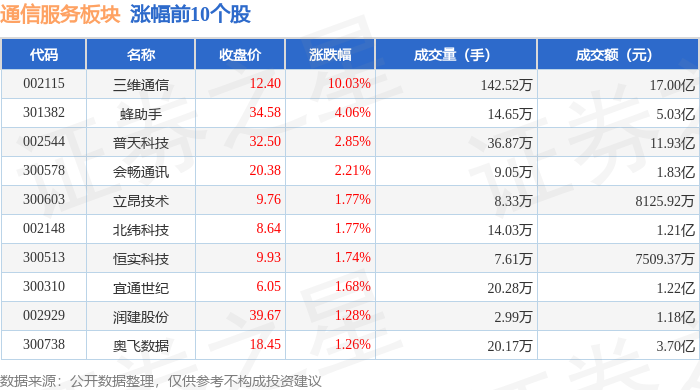
Core Insights - The communication services sector experienced a slight increase of 0.07% on December 25, with Sanwei Communication leading the gains [1] - The Shanghai Composite Index closed at 3959.62, up 0.47%, while the Shenzhen Component Index closed at 13531.41, up 0.33% [1] Stock Performance - Sanwei Communication (002115) closed at 12.40, with a significant increase of 10.03% and a trading volume of 1.4252 million shares, amounting to a transaction value of 1.7 billion [1] - Other notable performers included: - Bee Assistant (301382) at 34.58, up 4.06% with a transaction value of 503 million [1] - Putian Technology (002544) at 32.50, up 2.85% with a transaction value of 1.193 billion [1] - Huichang Communication (300578) at 20.38, up 2.21% with a transaction value of 183 million [1] Fund Flow Analysis - The communication services sector saw a net outflow of 18.6754 million from institutional investors, while retail investors contributed a net inflow of 202 million [2] - Key stocks in terms of fund flow included: - Sanwei Communication with a net inflow of 400 million from institutional investors, but a net outflow of 196 million from speculative funds [3] - Putian Technology had a net inflow of 101 million from institutional investors, with significant outflows from both speculative and retail investors [3] - Bee Assistant recorded a net inflow of 47.4025 million from institutional investors, but outflows from speculative and retail investors [3]





技术深拓,效赢增长,2025中国电信翼支付AI+行动实践
Di Yi Cai Jing· 2025-12-25 08:41
今年8月,《关于深入实施"人工智能+"行动的意见》正式印发,部署"AI+"科学技术、"AI+"产业发 展、"AI+"消费提质等6大重点行动,进一步明确了实施"AI+"行动的总体要求、发展目标和关键领域。 中国电信翼支付推出自主研发的第二代推理加速架构——Talon,通过异步并行执行范式与自适应混合 草稿策略,在保持生成质量无损的前提下,推理速度达到行业常规最高6.52倍,将推理成本降至原先的 六分之一,性能提升50%以上。 凭借其行业领先的技术性能,中国电信翼支付Talon架构技术论文被国际人工智能顶会AAAI(人工智能 促进协会会议)2026接收。这也是继Falcon(AAA 2025)之后,翼支付在大模型推理加速领域关键技术 攻关所取得的再次突破,标志着其创新性再次获得了国际学术界的权威认可。目前,Talon推理加速架 构已集成至中国电信一站式Mass平台Insight AI,服务于"数字人客服""翼小橙""翼点通""翼小财"等核心 业务场景,以及智能化穿透式监管平台、新一代财司数智金融系统等多个科技产品中,显著提升交互流 畅度与系统经济性,为高并发、实时性强的AI应用奠定技术基础,助力企业降本增效,提升 ...
数据筑基,支付赋能!中国电信翼支付2025年双轮科技力激活产业新生态
Di Yi Cai Jing· 2025-12-25 08:39
Core Viewpoint - China Telecom's Yipay is focusing on building a dual-driven development model of "data technology + payment technology" to support the intelligent upgrade and sustainable transformation of modern industrial chains by 2025 [1] Group 1: Smart Regulatory Capabilities - Yipay is implementing a "penetrating regulation" system, named "Yufeng," which utilizes big data and AI to enhance compliance and risk management [2] - The "Yufeng" system addresses traditional management issues such as data silos and delayed responses, enabling real-time tracking of fund flows and identification of hidden transaction patterns [2] - The system has been successfully applied in over ten central state-owned enterprises, improving governance transparency and risk control effectiveness [3] Group 2: Domestic System Development - Yipay has developed the "Chenji" financial system, achieving 100% domestic production from hardware to software, ensuring the security of the technology supply chain [4] - The "Chenji" system supports high concurrency payment processing and disaster recovery, meeting the highest continuity requirements in the financial industry [4] - It integrates intelligent risk control as a core function, providing a comprehensive solution for financial management and transforming traditional functions into value creation centers [4] Group 3: Payment Technology Integration - Yipay is integrating its payment technology into various business scenarios, enhancing operational efficiency across industries [5] - In retail, the "Cloud Guard" solution combines AI and IoT to enable 24-hour smart operations, reducing labor costs and stimulating nighttime consumption [5] - The company is also enhancing payment convenience for foreign nationals in China by launching an international version of its app and supporting various foreign e-wallets [5]
“A+H”,什么情况?H股类别股东大会频现反对票,ESG议题成两地上市新关切
Zheng Quan Shi Bao Wang· 2025-12-25 02:47
Core Viewpoint - The increasing number of dissenting votes from H-share shareholders at various A+H listed companies indicates a growing concern over ESG (Environmental, Social, and Governance) standards, reflecting a shift in the importance of ESG from a supplementary factor to a prerequisite for engaging with global capital markets [3][4][5]. Group 1: Dissenting Votes in H-share Meetings - Numerous H-share shareholder meetings have seen significant opposition to ordinary resolutions, with dissenting votes reaching 3.08 billion shares (12.02%) at China Energy Construction and 1.21 billion shares (16.08%) at GF Securities [4]. - At China Telecom's meeting, two resolutions received 4.37 billion dissenting votes, exceeding 20% of the total [5]. - The trend of high dissenting votes has been persistent, with companies like Huatai Securities and Huaneng International also facing substantial opposition [6]. Group 2: ESG Concerns and Standards - Foreign investment institutions are increasingly critical of the ESG content in Chinese companies' reports, viewing dissenting votes as a statement on corporate governance [3][7]. - The disparity in ESG standards between domestic and international expectations poses a dual challenge for Chinese companies, as they must meet both international rating requirements and local policy directives [3][9]. - The MSCI research indicates that companies with lower ESG ratings face higher financing costs, with a difference of approximately 1.1 percentage points between the highest and lowest rated firms [8]. Group 3: Challenges in ESG Reporting - There is a perception among some overseas institutions that Chinese companies' ESG evaluations are biased, often focusing on documentation rather than practical actions [10]. - The Future Vision report highlights that 73.6% of Chinese companies lag in governance and behavior issues compared to a global average of 44.7%, indicating a significant gap in ESG performance [11]. - The need for a unified and industry-adapted disclosure standard is emphasized, with suggestions for collaborative governance among government, regulatory bodies, investment institutions, and companies to enhance ESG reporting quality [12][13]. Group 4: Progress in A-share ESG Reporting - A-share companies have made significant strides in ESG governance, with the disclosure rate of ESG reports increasing from 34.86% in 2022 to 41.51% in 2023, and projected to reach 46.34% in 2024 [14][15]. - The regulatory framework has evolved, with new guidelines promoting sustainable development reporting and aligning with international climate change disclosure requirements [14]. - Companies are shifting their perspective on ESG from viewing it as a cost to recognizing its potential as a capital-generating asset [15].


中国电信股份有限公司 第八届董事会第二十四次会议决议 公 告
Zhong Guo Zheng Quan Bao - Zhong Zheng Wang· 2025-12-25 01:12
证券代码:601728 证券简称:中国电信 公告编号:2025-037 中国电信股份有限公司 第八届董事会第二十四次会议决议 公 告 本公司董事会及全体董事保证本公告内容不存在任何虚假记载、误导性陈述或者重大遗漏,并对其内容 的真实性、准确性和完整性承担法律责任。 一、董事会召开情况 中国电信股份有限公司(以下称"公司")于2025年12月24日在北京西城区金融大街31号公司总部618会 议室以现场方式召开了第八届董事会第二十四次会议。本次董事会的会议通知及资料已于会前发送给公 司全体董事。本次会议应到董事9人,实到董事8人,公司独立董事吕薇女士因工作原因无法出席本次现 场会议,委托公司独立董事吴嘉宁先生在本次董事会上对会议议案行使表决权。会议由董事长柯瑞文先 生主持,会议的召开及其程序符合有关法律、法规和公司章程的规定。 二、董事会审议情况 该议案已经公司第八届董事会审核委员会第二十次会议审议通过。 表决结果:赞成票:9票,反对票:0票,弃权票:0票。 (二)批准《关于预计与中国铁塔股份有限公司2026年度关联交易金额上限的议案》 具体内容详见公司同日披露于上海证券交易所网站(www.sse.com.cn) ...
中国电信:关于变更签字注册会计师的公告
Zheng Quan Ri Bao· 2025-12-24 12:45
证券日报网讯 12月24日,中国电信发布公告称,因工作调整,毕马威华振指派谭亚红接替刘婧媛作为 签字注册会计师,继续完成中国电信2025年度财务报表审计和内部控制审计相关工作。变更后的财务报 表审计和内部控制审计项目合伙人为况琳,签字注册会计师为况琳、谭亚红,质量控制复核人为高智 纬。 (文章来源:证券日报) ...
中国电信:第八届董事会第二十四次会议决议公告
Zheng Quan Ri Bao· 2025-12-24 12:12
(文章来源:证券日报) 证券日报网讯 12月24日,中国电信发布公告称,公司第八届董事会第二十四次会议于12月24日召开, 审议通过《关于外部审计师2025年度审计费用的议案》《关于预计与中国铁塔股份有限公司2026年度关 联交易金额上限的议案》。 ...
中国电信(00728) - 海外监管公告 - 中国电信股份有限公司关於变更签字註册会计师的公告
2025-12-24 10:16
香港交易及結算所有限公司及香港聯合交易所有限公司對本公告的內容概不負責,對其準確性或完整性亦不發表任何聲 明,並明確表示概不對因本公告全部或任何部份內容而產生或因倚賴該等內容而引致的任何損失承擔任何責任。 China Telecom Corporation Limited 中国电信股份有限公司 (於中華人民共和國註冊成立之股份有限公司) (股份編號:728) 海外監管公告 中國電信股份有限公司關於變更簽字註冊會計師的公告 本公告乃根據香港聯合交易所有限公司證券上市規則第 13.10B 條而作出。 兹載列中國電信股份有限公司(「本公司」)在上海證券交易所網站刊登的《中國電信股份有 限公司關於變更簽字註冊會計師的公告》,僅供參考。 承董事會命 中國電信股份有限公司 董事長兼首席執行官 柯瑞文 中國北京,2025 年 12 月 24 日 於本公告刊發之日的本公司董事會包括柯瑞文(董事長兼首席執行官);劉桂清(總裁兼首席 運營官);唐珂、李英輝(財務總監)(皆為執行副總裁);呂永鐘(非執行董事);吳嘉寧、 陳東琪、呂薇、李惠光(皆為獨立非執行董事)。 1 后的财务报表审计和内部控制审计项目合伙人为况琳,签字注册会计 ...
中国电信(00728) - 海外监管公告 - 中国电信股份有限公司第八届董事会第二十四次会议决议公告
2025-12-24 10:15
香港交易及結算所有限公司及香港聯合交易所有限公司對本公告的內容概不負責,對其準確性或完整性亦不發表任何聲 明,並明確表示概不對因本公告全部或任何部份內容而產生或因倚賴該等內容而引致的任何損失承擔任何責任。 China Telecom Corporation Limited 中国电信股份有限公司 (於中華人民共和國註冊成立之股份有限公司) (股份編號:728) 海外監管公告 中國電信股份有限公司第八屆董事會第二十四次會議決議公告 本公司董事会及全体董事保证本公告内容不存在任何虚假记载、误导性陈 述或者重大遗漏,并对其内容的真实性、准确性和完整性承担法律责任。 一、董事会召开情况 承董事會命 中國電信股份有限公司 董事長兼首席執行官 柯瑞文 中國北京,2025 年 12 月 24 日 於本公告刊發之日的本公司董事會包括柯瑞文(董事長兼首席執行官);劉桂清(總裁兼首席 運營官);唐珂、李英輝(財務總監)(皆為執行副總裁);呂永鐘(非執行董事);吳嘉寧、 陳東琪、呂薇、李惠光(皆為獨立非執行董事)。 证券代码:601728 证券简称:中国电信 公告编号:2025-037 中国电信股份有限公司 第八届董事会第二十四次会 ...
中国电信(00728) - 海外监管公告 - 中国电信股份有限公司关於预计与中国铁塔股份有限公司20...
2025-12-24 10:14
香港交易及結算所有限公司及香港聯合交易所有限公司對本公告的內容概不負責,對其準確性或完整性亦不發表任何聲 明,並明確表示概不對因本公告全部或任何部份內容而產生或因倚賴該等內容而引致的任何損失承擔任何責任。 China Telecom Corporation Limited 中国电信股份有限公司 (於中華人民共和國註冊成立之股份有限公司) 海外監管公告 中國電信股份有限公司關於預計與中國鐵塔股份有限公司 2026 年度關聯交易金額上限的公告 本公告乃根據香港聯合交易所有限公司證券上市規則第 13.10B 條而作出。 兹載列中國電信股份有限公司(「本公司」)在上海證券交易所網站刊登的《中國電信股份有 限公司關於預計與中國鐵塔股份有限公司 2026 年度關聯交易金額上限的公告》,僅供參考。 承董事會命 中國電信股份有限公司 董事長兼首席執行官 柯瑞文 中國北京,2025 年 12 月 24 日 於本公告刊發之日的本公司董事會包括柯瑞文(董事長兼首席執行官);劉桂清(總裁兼首席 運營官);唐珂、李英輝(財務總監)(皆為執行副總裁);呂永鐘(非執行董事);吳嘉寧、 陳東琪、呂薇、李惠光(皆為獨立非執行董事)。 证券代码 ...