
CCB(601939)

Search documents
建行取得报文转换方法及相关产品专利
Sou Hu Cai Jing· 2025-11-24 12:53
Group 1 - The core point of the article is that China Construction Bank has obtained a patent for a "message conversion method, device, equipment, storage medium, and program product," with the authorization announcement number CN 119484635 B, and the application date is September 2024 [1] Group 2 - China Construction Bank was established in 2004 and is located in Beijing, primarily engaged in monetary financial services [1] - The registered capital of China Construction Bank is approximately 25,001,097.7486 million RMB [1] - According to data analysis, China Construction Bank has invested in 1,038 enterprises, participated in 5,000 bidding projects, has 1,908 trademark information entries, 5,000 patent information entries, and holds 148 administrative licenses [1]
24家A股银行将现金分红超2600亿元
21世纪经济报道· 2025-11-24 12:38
Core Viewpoint - The recent surge in stock prices of major banks in China is driven by their mid-term dividend announcements, with a total cash dividend amounting to 2638 billion yuan for 2025, indicating significant value potential in the banking sector [2][3][4]. Dividend Announcements - As of November 24, 2025, 24 A-share listed banks have disclosed their mid-term dividend plans, with a total cash dividend of 2638 billion yuan, including first-time mid-term dividends from seven banks [2][4]. - Notably, Wuxi Bank announced a cash dividend of 0.11 yuan per share, totaling 2.41 billion yuan, with the ex-dividend date on November 25, 2025 [4]. - Hangzhou Bank plans to distribute a cash dividend of 0.38 yuan per share, amounting to 27.55 billion yuan, reflecting a 24.10% increase from the previous year [4]. Dividend Yields - The average dividend yield for listed banks as of November 24 is 4.48%, with 12 banks yielding over 5% and 26 banks over 4% [5]. - Major banks like Bank of Communications and Agricultural Bank of China have lower yields, ranging from 3% to 4.18% [5]. Shareholder and Executive Buybacks - There has been a notable increase in share buybacks by major shareholders and executives, signaling positive market sentiment [7][8]. - For instance, Chengdu Bank's major shareholders increased their holdings by approximately 34.24 million shares, investing 611 million yuan [7]. - The banking sector has seen a total of 126.30 billion yuan in buybacks this year, ranking second among industry sectors [8]. Market Performance and Outlook - The banking sector has experienced a net increase in holdings exceeding 90 billion yuan, with significant support for stock prices from shareholder buybacks [6][9]. - Analysts suggest that the upcoming long-term capital allocation period at year-end will further enhance the market performance of bank stocks [9].








建行取得一种异步消息容量评估方法及系统专利
Sou Hu Cai Jing· 2025-11-24 12:38
声明:市场有风险,投资需谨慎。本文为AI基于第三方数据生成,仅供参考,不构成个人投资建议。 来源:市场资讯 国家知识产权局信息显示,中国建设银行股份有限公司取得一项名为"一种异步消息容量评估方法及系 统"的专利,授权公告号CN 115883425 B,申请日期为2022年12月。 天眼查资料显示,中国建设银行股份有限公司,成立于2004年,位于北京市,是一家以从事货币金融服 务为主的企业。企业注册资本25001097.7486万人民币。通过天眼查大数据分析,中国建设银行股份有 限公司共对外投资了1038家企业,参与招投标项目5000次,财产线索方面有商标信息1908条,专利信息 5000条,此外企业还拥有行政许可148个。 ...
多家银行密集挂牌信用卡不良资产 邮储、平安、建行等推进风险出清
Jing Ji Guan Cha Wang· 2025-11-24 11:43
平安银行同日发布两期转让项目:第70期与第71期,基准日均为2025年10月14日。第70期包含33,631笔 贷款,未偿本息总额为4.77亿元;第71期含27,522笔贷款,未偿本息总额为3.28亿元。两个资产包均全 部为损失类、纯信用贷款,且全部处于"未诉"状态。 建行湖南省分行则挂牌2025年第4期项目(重新挂牌),规模相对较小:481笔贷款、294户借款人,未偿 本息总额2854.58万元。该资产包加权平均逾期天数为425天,全部未进入诉讼程序。其他费用达378.19 万元,主要由违约金、年费及手续费构成,不含诉讼费或律师费。 三类资产包在交易结构上呈现高度一致性:均采用线上多轮公开竞价方式,不设保证金,不使用银登中 心标准协议文本,也不通过银登中心办理资金结算。邮储银行要求受让方在竞价成功后7个工作日内签 署协议,3日内付款;平安银行与建行则要求3日内完成协议签署及全额付款。这种安排凸显银行对快速 完成债权交割、实现风险隔离的诉求,而非追求高溢价回收。 多家银行密集挂牌信用卡不良资产 邮储、平安、建行等推进风险出清 作者 胡群 11月24日,邮储银行(601658.SH)、平安银行(000001.S ...

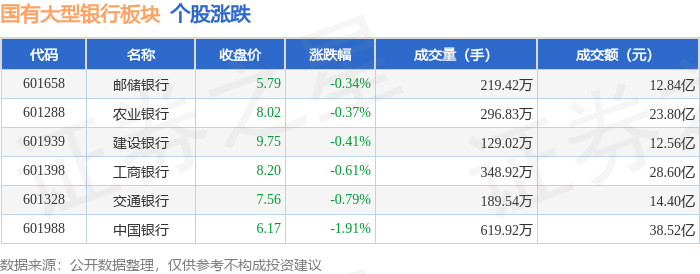
国有大型银行板块11月24日跌0.76%,中国银行领跌,主力资金净流出4767.27万元
Zheng Xing Xing Ye Ri Bao· 2025-11-24 09:12
Core Insights - The state-owned large bank sector experienced a decline of 0.76% on November 24, with China Bank leading the drop [1] - The Shanghai Composite Index closed at 3836.77, up 0.05%, while the Shenzhen Component Index closed at 12585.08, up 0.37% [1] Bank Performance - Postal Savings Bank closed at 5.79, down 0.34% with a trading volume of 2.19 million shares [1] - Agricultural Bank closed at 8.02, down 0.37% with a trading volume of 2.97 million shares [1] - Construction Bank closed at 9.75, down 0.41% with a trading volume of 1.29 million shares [1] - Industrial and Commercial Bank closed at 8.20, down 0.61% with a trading volume of 3.49 million shares [1] - Bank of Communications closed at 7.56, down 0.79% with a trading volume of 1.90 million shares [1] - China Bank closed at 6.17, down 1.91% with a trading volume of 6.20 million shares [1] Capital Flow Analysis - The state-owned large bank sector saw a net outflow of 47.67 million yuan from institutional investors and 23.99 million yuan from retail investors, while individual investors had a net inflow of 71.67 million yuan [1] - The capital flow for individual banks showed varied trends, with Bank of Communications having a net inflow of 72.53 million yuan from institutional investors, while China Bank had a net outflow of 49.25 million yuan [2] - Agricultural Bank experienced a net inflow of 54.10 million yuan from institutional investors, but a net outflow of 66.31 million yuan from retail investors [2]

建行取得数据库管理相关专利
Sou Hu Cai Jing· 2025-11-24 05:39
Group 1 - The core point of the article is that China Construction Bank has obtained a patent for a "database management method, device, equipment, medium, and program product," with the authorization announcement number CN 116414897 B, and the application date being February 2023 [1] Group 2 - China Construction Bank, established in 2004 and located in Beijing, primarily engages in monetary financial services, with a registered capital of 25,001,097.7486 million RMB [1] - According to data analysis from Tianyancha, China Construction Bank has invested in 1,038 enterprises, participated in 5,000 bidding projects, and has 1,908 trademark information entries and 5,000 patent information entries [1] - The company also holds 148 administrative licenses [1]
国有行2046亿分红将落地 股价迭创新高年内市值增2.45万亿
Chang Jiang Shang Bao· 2025-11-24 05:25
Core Viewpoint - The A-share banking sector is experiencing a strong "buying frenzy" driven by market style shifts and substantial mid-term dividend distributions, with Agricultural Bank of China leading the surge with a nearly 60% increase year-to-date [1][4]. Market Performance - As of November 21, the total market capitalization of the six major state-owned banks reached 10.61 trillion yuan, accounting for 69.5% of all listed banks, and increased by 2.45 trillion yuan compared to the end of 2024 [1][5]. - The average dividend yield for listed banks is 4.47%, with 12 banks yielding over 5% [7]. Dividend Distribution - A total of 24 listed banks have announced mid-term dividend plans, with a combined payout of 263.8 billion yuan, of which the six major state-owned banks plan to distribute over 204.6 billion yuan [1][6][7]. - The mid-term dividend distribution is occurring earlier than in 2024, with the record date set for mid-December [7]. Stock Performance - Agricultural Bank of China has seen a year-to-date increase of 57.9%, while other major banks like Industrial and Commercial Bank of China and China Bank have also performed well, with respective increases of 24.77% and 19.41% [4][6]. - The banking sector index has shown a recovery, with a year-to-date increase of nearly 12% as of November 21 [3][5]. Fundamental Strength - The fundamentals of the banking sector remain robust, with state-owned banks reporting a total revenue of 2.72 trillion yuan and a net profit of 1.07 trillion yuan for the first three quarters of 2025, both showing growth [6][7]. - The proportion of net interest income to total revenue has improved to 71.78%, indicating a positive trend [6].

保障金融权益 助力美好生活——建行盐城分行深入企业开展金融宣教
Sou Hu Cai Jing· 2025-11-24 05:11
Core Insights - The event organized by the Bank of China Yancheng Branch aimed to deepen cooperation between banks and enterprises while enhancing employees' financial literacy and risk awareness [1][2] - The financial knowledge promotion activity focused on educating employees about the latest trends in telecom network fraud and common scams, providing practical advice on how to avoid them [1] - The initiative reflects the bank's commitment to the "finance for the people" philosophy and aims to provide diversified and precise financial support to enterprises and their employees [2] Summary by Sections - **Event Overview** - The Bank of China Yancheng Branch's financial service team conducted a financial knowledge promotion event at Guolao Polygonum Multiflorum Technology Co., Ltd. [1] - The theme of the event was "Protecting Financial Rights and Supporting a Better Life" [1] - **Content of the Activity** - The event included face-to-face interactions and a consultation desk, where promotional materials were distributed [1] - Topics covered included new characteristics of telecom fraud, fake loans, rebate scams, fake shopping, and online dating scams [1] - Employees were educated on the principles of fraud prevention: "Do not trust easily, do not disclose information, do not transfer money, and verify multiple times" [1] - **Employee Engagement** - The atmosphere was interactive and lively, with employees expressing newfound understanding of financial knowledge and its relevance to their daily lives [1] - Personalized financial consulting services were provided, covering areas such as pension allocation, consumer loans, and credit card usage, which received positive feedback from employees [1] - **Future Directions** - The bank plans to continue innovating service formats and expanding financial service coverage to support the healthy development of the real economy [2]
中国建设银行取得任务调度方法、装置、设备及存储介质专利
Sou Hu Cai Jing· 2025-11-24 05:05
Core Insights - China Construction Bank Co., Ltd. has obtained a patent for a "task scheduling method, device, equipment, and storage medium," with the authorization announcement number CN 113010294 B, and the application date was March 2021 [1] Company Overview - China Construction Bank Co., Ltd. was established in 2004 and is located in Beijing, primarily engaged in monetary financial services [1] - The company has a registered capital of 25,001,097.7486 thousand RMB [1] - According to data analysis from Tianyancha, the company has invested in 1,038 enterprises and participated in 5,000 bidding projects [1] - The company holds 1,908 trademark information and 5,000 patent information, in addition to having 148 administrative licenses [1]
建设银行广州分行:助力“12218”体系建设
Sou Hu Cai Jing· 2025-11-24 04:30
Core Viewpoint - Guangzhou is actively promoting the construction of a modern industrial system through a series of initiatives, focusing on strategic industrial clusters and future industries, with the support of financial services from China Construction Bank (CCB) Guangzhou Branch [1][2]. Group 1: Financial Innovation and Support - CCB Guangzhou Branch is enhancing its financial services to support the real economy, particularly in the context of the "12218" modern industrial system, which includes the development of six future industries such as intelligent unmanned systems [2][3]. - The bank has introduced innovative financial products like "Investment E-loan," which allows for the transformation of intellectual property and collaborative research as credit bases, catering to the unique financing needs of technology-driven enterprises [3][4]. - The bank's rapid loan approval process, taking only five working days, exemplifies its commitment to providing timely financial support to enterprises, enabling them to focus on technological advancements [3][4]. Group 2: Low-altitude Economy and Strategic Industries - CCB Guangzhou Branch is extending its services to the low-altitude economy and aerospace industries, recognizing the growing market demand in these sectors [4][5]. - A flying car manufacturing company in Guangzhou is working towards establishing a large-scale production base for flying cars, facing challenges such as tight schedules and high initial investments, which necessitate significant financing [4][5]. - The bank has formed a specialized service team for the low-altitude economy, conducting on-site research to understand project progress and financial needs, thereby facilitating effective financial solutions [4][5]. Group 3: Comprehensive Financial Services - CCB Guangzhou Branch is committed to providing comprehensive financial services tailored to the entire lifecycle of enterprises, particularly in the low-altitude economy, ensuring that financial support aligns with future development plans [6]. - The bank's approach includes not only fixed asset loans but also a full suite of financial services designed to meet the specific needs of enterprises in emerging industries [6].