
Bank Of Chongqing(601963)

Search documents
非银化增长,波动率加大
KAIYUAN SECURITIES· 2025-11-19 06:38
Investment Rating - Investment rating: Positive (maintained) [1] Core Views - The current credit growth continues to slow down, and social financing growth is also declining from high levels. Although policies are in place to support the market, their impact on demand recovery has not yet been reflected due to time lags. The retail risk for listed banks has increased but remains manageable, supported by substantial provisioning and stable dividend policies, which together form a "stable anchor" for the "dividend revaluation" logic of banks. The banks' advantages in capital markets, wealth management, and investment banking create a "growth sail" for differentiated valuations. Bank valuations are still at historically low levels, and medium to long-term funds have the potential for allocation, making increased allocation to the banking sector a favorable choice under the "high cut low" and balanced allocation strategy. It is recommended to invest in state-owned banks as they still offer good value compared to risk-free interest rates. Specific recommendations include CITIC Bank, benefiting from China Construction Bank, Agricultural Bank of China, China Merchants Bank, Jiangsu Bank, Chongqing Bank, Hangzhou Bank, and Chongqing Rural Commercial Bank [7]. Summary by Sections Deposit and Loan Growth - The deposit and loan growth rates for small and medium-sized banks continued to recover, with the national large banks' deposit-loan growth rate difference at -1.31% at the end of October, a decrease of 0.33 percentage points from the end of September. The four major banks' deposit-loan growth rate difference narrowed by 0.02 percentage points to -2.10%. Small and medium-sized banks recorded a deposit-loan growth rate difference of 3.74%, an increase of 0.08 percentage points [3][4]. Deposit Structure - In October, both large and small banks saw an acceleration in deposit growth, with large banks and small banks' deposit growth rates at 7.40% and 9.33%, respectively, increasing by 0.16 and 0.22 percentage points month-on-month. However, corporate deposits faced pressure, with both large and small banks experiencing negative growth in corporate deposits for the month. The increase in deposits was primarily driven by non-bank contributions, indicating a trend of "deposit migration" [4][5]. Credit Demand and Supply - The overall credit volume and structure remain poor, with small and medium-sized banks increasing lending. The total loans from deposit-taking financial institutions to residents and enterprises saw a year-on-year decrease. The credit growth is under pressure due to unfulfilled demand and other factors, including banks completing most of their annual credit targets in the first three quarters and a lack of actual credit demand conversion from policy measures [6]. Investment Recommendations - Given the current environment, increasing allocation to the banking sector is recommended as it presents a favorable opportunity for investors. The report emphasizes the potential of state-owned banks and suggests specific banks for investment based on their performance and market conditions [7].



区域银行频获增持,银行ETF天弘(515290)规模近62亿元,机构:银行营收端增速有望持续改善
2 1 Shi Ji Jing Ji Bao Dao· 2025-11-19 03:31
Group 1 - The A-share market showed a positive trend on November 19, with the banking index rising by 0.93% [1] - The Tianhong Bank ETF (515290) recorded a trading volume exceeding 35 million yuan, indicating strong investor interest [1] - Major banks such as Bank of China, Everbright Bank, and Postal Savings Bank saw their stock prices increase by over 2% [1] Group 2 - As of November 18, the Tianhong Bank ETF had a total scale of nearly 6.2 billion yuan, covering 42 listed banks across various categories [2] - There has been significant insider buying in regional banks this year, with several banks announcing plans for share buybacks in November [2] - Securities firms noted that the profit growth rate for listed banks improved in Q3, driven by reduced provisioning, stabilized net interest margins, and improved wealth management income [2]






中国银行股价创新高
Di Yi Cai Jing Zi Xun· 2025-11-19 02:53
Core Points - Bank stocks experienced a volatile rise on November 19, with notable gains among several banks [1] - China Bank's stock price reached a new high, increasing by over 2% [1] Group 1: Stock Performance - China Bank's stock rose by 2.94%, reaching a price of 5.95 [2] - Everbright Bank's stock increased by 1.98%, with a price of 3.60 [2] - Jiangsu Bank's stock saw a rise of 1.49%, priced at 10.89 [2] - Traffic Bank's stock rose by 1.75%, reaching 7.56 [2] - Chongqing Bank's stock increased by 1.07%, priced at 11.32 [2] - CITIC Bank's stock rose by 1.52%, with a price of 8.04 [2] - China Merchants Bank's stock increased by 1.21%, priced at 43.40 [2]


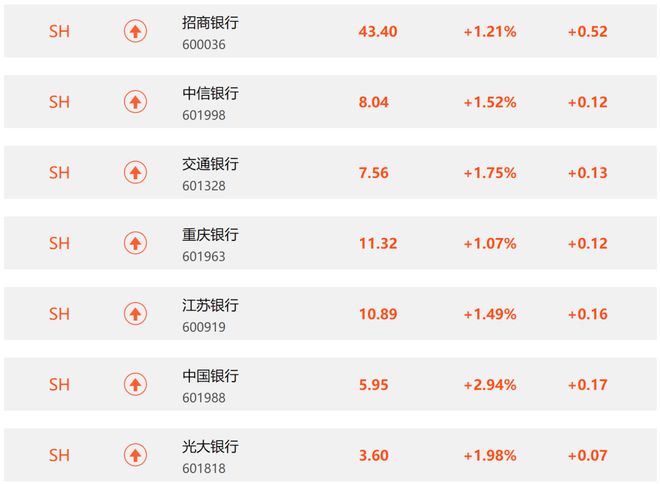
银行股震荡走高,中国银行涨近2%
Mei Ri Jing Ji Xin Wen· 2025-11-19 02:34
Core Viewpoint - Bank stocks experienced fluctuations but ultimately rose, with notable gains in several major Chinese banks on November 19 [1]. Group 1: Stock Performance - China Bank saw an increase of nearly 2% [1]. - Other banks that performed well include Everbright Bank, Jiangsu Bank, Transportation Bank, Chongqing Bank, Citic Bank, and China Merchants Bank, which had significant gains [1].
地方上市银行高管频频增持自家银行股份
Zheng Quan Shi Bao· 2025-11-18 18:13
Core Viewpoint - The announcement from Hu Nong Commercial Bank indicates significant insider buying by top executives, reflecting confidence in the bank's future performance and aligning with a broader trend of regional banks experiencing similar increases in executive and institutional shareholdings [1]. Group 1: Executive Purchases - Five senior executives of Hu Nong Commercial Bank, including the president and several vice presidents, purchased a total of 259,100 shares from November 13 to November 17, 2025, at prices ranging from 9.02 to 9.08 yuan [1]. - This trend of executive share purchases is not isolated, as other regional banks such as Nanjing Bank, Wuxi Bank, and Suzhou Bank have also seen similar actions from their management teams [1]. Group 2: Institutional Purchases - Qingdao Bank reported that its major shareholder, Qingdao Guoxin Financial Holdings Group Co., Ltd., increased its holdings through the Hong Kong Stock Connect, raising its total stake to 15.42%, making it the largest shareholder of the bank [1]. - In addition, Su Nong Bank's executives plan to purchase at least 1.8 million yuan worth of A-shares within six months starting from November 11, 2025 [1]. - Qilu Bank disclosed that its management has already purchased approximately 3.15 million yuan worth of shares, achieving 90% of its planned increase since announcing its buyback plan in mid-September [1].

申万宏源:险资密集增配银行已验证趋势 期待2026年行业基本面新变化
Zhi Tong Cai Jing· 2025-11-18 08:25
Core Viewpoint - The report from Shenwan Hongyuan indicates a significant trend of long-term capital, represented by insurance funds, increasingly allocating to the banking sector, with a potential inflow space of approximately 600 billion yuan if 40% of new funds are allocated to bank stocks [1][2]. Group 1: Capital Inflow and Allocation - The unprecedented low interest rate environment is driving incremental capital towards dividend sectors, with the banking sector offering superior value. The current banking index dividend yield is about 4.3%, significantly higher than the ten-year government bond yield, making it an attractive investment option [1]. - Assuming that 40% of the new capital is allocated to OCI and 40% to bank stocks, this could lead to a potential inflow of around 600 billion yuan. Additionally, public fund reforms are expected to increase capital allocation to underrepresented sectors, with bank stock holdings in public funds dropping to a near ten-year low of 1.74% in Q3 2025, suggesting an additional potential inflow of over 370 billion yuan if allocations align with the CSI 300 [2]. Group 2: Expected Changes in Banking Fundamentals - The central bank has explicitly stated its support for stabilizing net interest margins, linking this to the expansion of monetary policy's counter-cyclical adjustment space. It is anticipated that by 2026, bank interest margins may reverse their downward trend and show a slight year-on-year increase, with banks that can improve deposit costs expected to perform better than their peers [3]. - The importance of "high provisioning" is becoming more pronounced as banks' provisioning capacity is gradually consumed. While systemic risks from real estate and platforms may ease, risks in retail sectors still require provisioning. Focus should be on banks with low non-performing loans and high loan-to-deposit ratios, as well as those with clear asset quality improvements [3]. - Some small and medium-sized banks may face revenue growth challenges due to high base pressures in their capital market operations, with reduced non-interest income growth and declining financial investment yields [3]. Group 3: Capital Focus and Investment Recommendations - Bank capital is becoming a focal point, with banks that have strong internal capital generation or substantial reserves being better positioned for stable lending and dividends. External financing remains challenging, making convertible bonds a scarce resource [4]. - The banking sector is entering a new cycle of stable profitability, with long-term capital inflows ongoing. If the macro environment sees a gradual recovery in PPI and marginal increases in long-term interest rates, this will create favorable operating conditions for banks. Even under economic pressure, banks with clear risk thresholds and stable dividend expectations remain attractive dividend assets [5]. - The report recommends focusing on a dual strategy of "leading banks (state-owned and China Merchants Bank) as the foundation" and "bottom-tier joint-stock banks and quality city commercial banks as the performers." Leading banks are expected to see valuation recovery, while quality small and medium-sized banks with improving fundamentals are likely to exhibit stock price elasticity in response to economic recovery [5].




城商行板块11月18日跌0.75%,郑州银行领跌,主力资金净流出1.83亿元
Zheng Xing Xing Ye Ri Bao· 2025-11-18 08:11
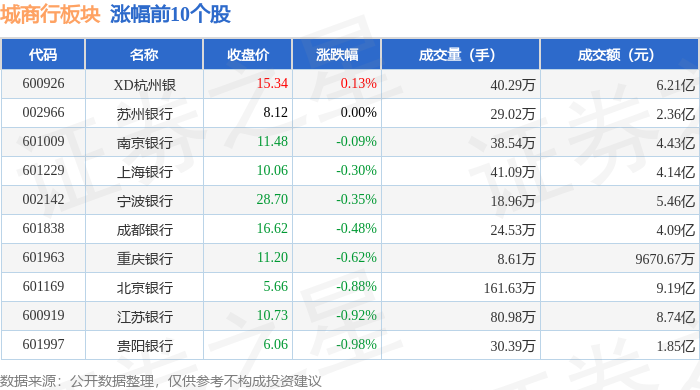
Market Overview - The city commercial bank sector experienced a decline of 0.75% on November 18, with Zhengzhou Bank leading the drop [1] - The Shanghai Composite Index closed at 3939.81, down 0.81%, while the Shenzhen Component Index closed at 13080.49, down 0.92% [1] Individual Stock Performance - Zhengzhou Bank's stock closed at 2.03, down 1.46% with a trading volume of 1.3032 million shares and a transaction value of 266 million [2] - Xiamen Bank closed at 7.13, down 1.38%, with a trading volume of 144,000 shares [2] - Nanjing Bank closed at 11.48, down 0.09%, with a trading volume of 385,400 shares [1] - The highest closing price was for Ningbo Bank at 28.70, down 0.35% [1] Capital Flow Analysis - The city commercial bank sector saw a net outflow of 183 million from institutional investors, while retail investors contributed a net inflow of 74.99 million [2] - The main capital inflow was observed in stocks like Nanjing Bank, which had a net inflow of 62.45 million from institutional investors [3] - Conversely, stocks like Xiamen Bank and Zhengzhou Bank experienced significant net outflows from institutional investors, amounting to 8.32 million and 4.80 million respectively [3]


银行业投资策略:中期分红抢筹行情尾声阶段如何布局?
Guoxin Securities· 2025-11-18 05:12
Core Viewpoints - The mid-term dividend rush in the banking sector is nearing its end but is not yet finished, potentially extending until the end of November [4][11][26] - The four major banks have announced mid-term dividends earlier this year compared to last year, with the record date for dividends set for mid-December, which is nearly one month earlier than last year [7][11] - The recent rise in the banking sector is primarily driven by changes in market investment style, with mid-term dividends acting as a catalyst [4][11][26] Investment Strategy Post-Dividend Rush - After the mid-term dividend rush, the banking sector may experience short-term fluctuations, but it is unlikely that the overall trend has ended [5][14][26] - There are expected investment opportunities in the banking sector before the main spring rally is identified, suggesting that investors should overlook short-term volatility [5][16][26] - The demand for insurance funds and the need for asset allocation in a low-interest-rate environment make stable bank stocks attractive [5][16][26] Stock Selection Recommendations - Focus on high-dividend, fundamentally strong stocks in the short term, while also considering quality stocks for potential upside [6][26] - Recommended stocks include Industrial and Commercial Bank of China and China Merchants Bank for their stability, as well as Ningbo Bank and Chongqing Bank for their upward momentum [6][26] - Low-valuation banks such as Changsha Bank and Chongqing Rural Commercial Bank are also suggested for consideration [6][26] Market Performance Insights - The banking index has shown a cumulative increase of 7.7% from October 14 to November 14, 2025, with individual banks like ICBC and ABC showing significant gains [11][26] - The cumulative gains of the four major banks from December 2024 were 12.5%, 11.0%, 10.2%, and 10.0%, respectively, indicating a strong performance leading into the new year [7][11] Fundamental Analysis - The banking sector's fundamentals are expected to stabilize, with net interest margins showing signs of improvement [23][26] - The asset quality of listed banks is at its best level in recent years, with retail non-performing loans gradually being cleared [23][26]



行业深度报告:2025Q4上市银行AC潜在兑现及回补债券评估
KAIYUAN SECURITIES· 2025-11-18 05:10
Investment Rating - The industry investment rating is optimistic (maintained) [1] Core Insights - The report highlights that listed banks have sold approximately 2 trillion yuan in bonds to realize floating profits from their available-for-sale (AC) accounts in the first three quarters of 2025 [13] - It is estimated that in Q4 2025, listed banks will need to sell about 900 billion yuan in bonds to support non-interest income [10] - The cumulative floating profit of listed banks' AC accounts is approximately 3.3 trillion yuan as of the end of H1 2025, accounting for 58.3% of the total revenue for the year 2024 [30] Summary by Sections Investment Growth - Since 2024, the investment growth rate of listed banks' AC accounts has consistently lagged behind the growth rate of financial investments, with a year-on-year growth of 11.5% in Q3 2025, which is 4.28 percentage points lower than that of financial investments [13][15] - The growth rates for different types of banks from Q2 2023 to Q2 2025 are as follows: state-owned banks 14.7%, joint-stock banks 2.8%, city commercial banks 9.7%, and rural commercial banks -3.8% [13] Bond Selling and Profit Realization - The report estimates that the floating profit realization ratio for listed banks' AC accounts in the first three quarters of 2025 is about 3.06%, with a bond selling scale of approximately 2.04 trillion yuan [36] - The selling proportions for different bank types are: state-owned banks 2.26%, joint-stock banks 5.29%, city commercial banks 5.57%, and rural commercial banks 9.65%, with rural commercial banks showing the highest selling intensity [36] Financial Performance - The floating profit from the sale of bonds in the first three quarters of 2025 is estimated to be 1,078 billion yuan, which represents 2.50% of the total revenue, an increase of 1.59 percentage points compared to 2024 [22][25] - The breakdown of floating profit realization ratios by bank type is as follows: state-owned banks 2.24%, joint-stock banks 2.44%, city commercial banks 3.79%, and rural commercial banks 5.52% [22] Investment Recommendations - The report suggests a bottom-line allocation to large state-owned banks, with beneficiaries including Agricultural Bank of China and Industrial and Commercial Bank of China [6] - Core allocations should focus on leading comprehensive banks such as China Merchants Bank, CITIC Bank, and Industrial Bank [6] - Flexible allocations can be made to banks like Jiangsu Bank, Chongqing Bank, and Chongqing Rural Commercial Bank [6]
2026年银行业投资策略:盈利新周期,估值新起点,迎银行长牛
Shenwan Hongyuan Securities· 2025-11-18 04:45
Core Viewpoints - The banking sector is at the beginning of a long-term recovery cycle, with current valuations around 0.7 times PB, significantly improved from the low of 0.49 times PB in 2018 [3][9] - The low interest rate environment is a key driver for capital inflow into dividend-paying stocks, with the banking sector offering a dividend yield of approximately 4.3%, which is over 250 basis points higher than the 10-year government bond yield [12][14] - The expectation for 2026 includes a stabilization and potential slight increase in net interest margins, driven by central bank policies aimed at supporting banks [3][4] Investment Highlights - The banking sector is expected to benefit from a new cycle of stable profitability, with long-term capital inflows continuing to support the sector [3][30] - The focus should be on leading banks and quality regional banks, as they are likely to outperform in terms of valuation recovery and profitability [3][30] - The report emphasizes the importance of high provisioning and capital adequacy for banks to navigate through economic challenges [4][30] Market Dynamics - The banking sector has seen a shift in risk perception, with systemic risks significantly alleviated, allowing for a more favorable outlook on bank valuations [27][28] - The report highlights that banks have actively managed their asset quality, with significant write-offs contributing to improved financial stability [27] - The structural changes in credit allocation are expected to resolve existing issues, with a focus on sectors that contribute positively to economic growth [25][27] Future Expectations - The banking sector is anticipated to enter a new phase of stable return on equity (ROE), with steady profit growth already being validated [30] - The report suggests that the valuation of banks is likely to trend towards 1 times PB, reflecting a return to more normalized risk assessments [23][28] - The potential for increased capital inflows from institutional investors, particularly insurance funds, is expected to further support the banking sector's recovery [3][12]