
XZB(603040)

Search documents
方寸潮变,“小邮票”上演破圈突围
Xin Hua Ri Bao· 2026-01-07 00:40
Core Viewpoint - The launch of the "Year of the Horse" zodiac stamps and related cultural products has successfully attracted the attention of young people, marking a significant shift in the traditional stamp industry towards a more dynamic and engaging cultural experience [1][2][4]. Group 1: Cultural Engagement and Innovation - The "Year of the Horse" zodiac stamps are the first in China's history to involve public participation in the design process, utilizing a dual-review system of public and expert evaluations [2]. - The stamps, named "Chiyue Hongtu" and "Wanjun Zhenfu," feature vibrant designs that symbolize progress and hope for national prosperity [2]. - The introduction of the "Wujia Ge" plush toy, based on the stamp design, has resonated with young consumers, leading to a rapid sell-out of certain styles [2][3]. Group 2: Market Trends and Demographics - The stamp industry faces challenges, including a declining collector base, with over 60% of stamp subscribers in Jiangsu being over 50 years old [4]. - The initiative to open design submissions to the public reflects a proactive approach to rejuvenate traditional stamp culture and attract younger audiences [4]. - Collaborations with popular games and events, such as the partnership with "Black Myth: Wukong," have generated significant revenue and interest from younger demographics [4][5]. Group 3: Transformative Experiences - The establishment of themed post offices and cultural activities has transformed traditional postal services into interactive cultural hubs, enhancing visitor engagement [7][8]. - The integration of local cultural elements, such as the "Meng Xiong" themed post office, showcases the potential for innovative cultural expressions through stamps and postal services [7]. - The future of stamps lies in their ability to evolve from static symbols to dynamic cultural experiences, leveraging modern technology and popular culture to connect with younger audiences [9].

跻身“百万车企俱乐部” 蔚来探寻“第三发展阶段”新坐标
Zheng Quan Shi Bao Wang· 2026-01-06 14:36
Core Insights - NIO has achieved a significant milestone by rolling out its one millionth electric vehicle, marking an important point in the company's development journey [1] - The company is entering a new phase focused on high-quality growth, with plans to enhance technology, infrastructure, and market share [2] Company Strategy - NIO's founder, Li Bin, outlined a strategic focus on technology and product leadership, aiming for over 10,000 battery swap stations by 2030 and maintaining an annual growth rate of 40%-50% [2] - The company has categorized its development into three phases: rapid growth (2018-2021), adjustment (2022-2025), and a new phase starting in the second half of 2025 [2] - NIO has invested over 65 billion yuan in R&D since its first vehicle delivery in 2018, positioning itself as a leader in pure electric and battery swap technology [2] Operational Performance - In 2025, NIO delivered a total of 326,028 vehicles, a year-on-year increase of 46.9%, with December alone seeing a record delivery of 48,135 vehicles [2] - Li Bin expressed confidence in achieving profitability in Q4 2025, citing improved gross margins and increased deliveries of the new ES8 model [3] Future Product Plans - NIO plans to launch several new models in 2026, including the ES9 and L80, with new vehicle releases scheduled for Q2 and Q3 of this year [4] - The company is accelerating its global expansion strategy, aiming to enter 40 countries and regions, with the Firefly brand leading the charge [4] Industry Outlook - Li Bin believes that the automotive industry will not consolidate to just a few players, predicting at least ten Chinese brands will thrive, with an annual production target of 35 million vehicles [6] - The penetration rate of new energy vehicles in China is expected to exceed 90% by 2030, with pure electric vehicles making up at least 80% of that [6] - NIO's infrastructure strategy, including plans for over 10,000 battery swap and charging stations by 2030, is seen as a critical support for navigating industry cycles [6]

新坐标1月6日龙虎榜数据
Zheng Quan Shi Bao Wang· 2026-01-06 09:45
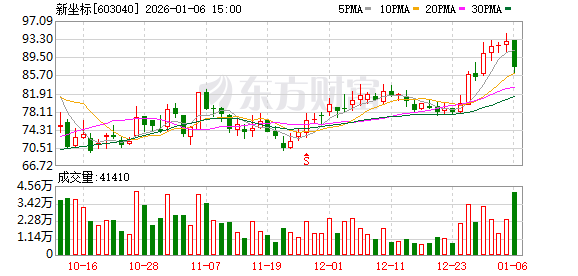
Core Viewpoint - The stock of New Coordinates (603040) experienced a significant decline of 5.97% in a single trading day, with notable net selling by institutional investors and a high turnover rate [2] Group 1: Stock Performance - New Coordinates' stock fell by 5.97% with a turnover rate of 3.05% and a total trading volume of 366 million yuan, showing a price fluctuation of 8.15% throughout the day [2] - The stock was listed on the Shanghai Stock Exchange for a deviation of -7.47% in daily price change [2] Group 2: Institutional Activity - Institutional investors net sold 88.39 million yuan, while the Shanghai-Hong Kong Stock Connect recorded a net sell of 6.27 million yuan [2] - The top five trading departments accounted for a total transaction volume of 195 million yuan, with a net sell of 89.12 million yuan [2] Group 3: Fund Flow - The stock saw a net outflow of 7.48 million yuan in principal funds, with a significant outflow of 18.43 million yuan from large orders, while smaller orders saw a net inflow of 10.95 million yuan [2] - Over the past five days, the stock experienced a net inflow of 32.56 million yuan in principal funds [2] Group 4: Financial Performance - For the first three quarters, New Coordinates reported a revenue of 593 million yuan, representing a year-on-year growth of 19.45%, and a net profit of 209 million yuan, reflecting a year-on-year increase of 29.41% [3]

“舟山价格”何以锚定国际船燃市场新坐标?
Zheng Quan Shi Bao Wang· 2026-01-05 03:30
Core Viewpoint - The "Zhoushan Price" has emerged as a significant pricing mechanism for ship fuel in China, reducing reliance on international pricing and enhancing the local shipping industry's development [2][3][4]. Group 1: Overview of Zhoushan Price - Zhoushan, located at the eastern edge of Hangzhou Bay, is a crucial shipping hub and the largest ship refueling port in China, with an annual refueling volume exceeding 7 million tons [2]. - The "Zhoushan Price" was established on June 21, 2021, based on the Shanghai Futures Exchange's low-sulfur fuel oil futures price, marking the first domestic spot pricing mechanism using a futures price as a basis [2][3]. - The pricing system has evolved to include various components such as buyer quotes, storage prices, and weather indices, creating a comprehensive index system that supports the ship fuel supply chain [2][3]. Group 2: Impact on Market Transparency and Efficiency - The introduction of the "Zhoushan Price" has significantly improved market transparency and stability, enhancing operational efficiency for enterprises and expanding the application of fuel oil futures prices in the spot market [3][4]. - Over 90% of the participants in the low-sulfur seller quote are now involved in the Zhoushan ship fuel market, indicating its widespread acceptance and influence [4]. Group 3: Role of Zhejiang Dazong - Zhejiang Dazong, established in 2015, serves as a major platform for bulk commodity trading and has been instrumental in promoting the integrated oil and gas trading market in the Yangtze River Delta [5][6]. - The collaboration among various stakeholders has facilitated the integration of futures and spot markets, enhancing the overall trading efficiency and service delivery to the real economy [6][8]. Group 4: Future Developments and Innovations - The ongoing exploration of integrated pricing mechanisms extends beyond the "Zhoushan Price," with initiatives such as the establishment of a national bulk commodity registration center and the launch of various trading models [9]. - The Zhoushan Price is expected to further break down international pricing barriers and elevate China's ship fuel industry within the global value chain, contributing to higher quality growth [9].
本周交易热度上升,人形板块持续贡献超额收益
Zhong Guo Neng Yuan Wang· 2026-01-05 02:33
Group 1 - The SW auto parts index increased by 2.91% this week, ranking first in the SW automotive sector, with a year-to-date increase of 42.58% since the beginning of 2025 [2][3] - The latest trading day PE (TTM) for the SW auto parts index is at the 79.44% historical percentile, while the PB (LF) is at the 75.50% historical percentile [3] - The robot index rose by 3.73% this week, with a year-to-date increase of 62.08% since the beginning of 2025, outperforming the SW auto parts index by 0.83% [2][3] Group 2 - Key companies' weekly changes include Silver Wheel Co., which invested 380 million yuan in Sichuan Silver Wheel for capacity construction of water-cooled plates and front-end modules, expected to reach production capacity by 2029 [3] - Huada Technology announced a mid-term dividend plan for 2025, proposing a cash dividend of 0.15 yuan per share (tax included), totaling 70.46 million yuan [3] - Fuda Co. completed the transfer of 25% equity in Guilin Fuda Alfin for 48 million yuan [3] Group 3 - The top five companies by weekly increase are Xinquan Co. (+14.05%), Beite Technology (+11.64%), Top Group (+8.26%), Daimai Co. (+8.01%), and New Coordinates (+7.97%) [4] - Investment recommendations for auto parts focus on product-oriented companies and those entering high-value sectors, prioritizing potential leaders with production capacity in Europe, North America, and Southeast Asia [4] - For the robotics sector, the focus is on certainty opportunities, with the Optimus V3 expected to launch in Q1 2026, and attention on domestic applications from companies like Xiaopeng, Yushu, and Zhiyuan [4]




新坐标盘中创历史新高
Zheng Quan Shi Bao Wang· 2026-01-05 02:18
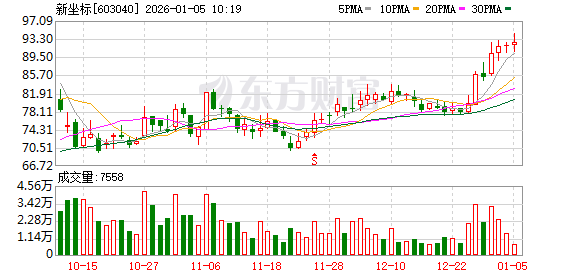
Company Performance - The company's stock price reached a historical high, increasing by 1.78% to 93.63 yuan, with a trading volume of 327,600 shares and a transaction amount of 30.285 million yuan, resulting in a turnover rate of 0.24% [2] - The latest total market capitalization of the company in A-shares is 12.779 billion yuan, with a circulating market value of 12.713 billion yuan [2] - The company reported a revenue of 593 million yuan for the first three quarters, representing a year-on-year growth of 19.45%, and a net profit of 209 million yuan, reflecting a year-on-year increase of 29.41% [2] - The basic earnings per share are 1.5500 yuan, and the weighted average return on equity is 14.69% [2] Industry Overview - The overall automotive industry has seen a rise of 0.31%, with 127 stocks increasing in price, including notable gainers such as Siling Zhichu, Suoling Co., and Fusaikeji, which rose by 17.49%, 10.08%, and 5.92% respectively [2] - Conversely, 164 stocks in the industry experienced price declines, with significant losers including Jinhongshun, Tianming Technology, and Aerospace Science and Technology, which fell by 8.33%, 7.71%, and 7.38% respectively [2]
国有大行新年寄语:锚定价值新坐标 拓展服务新格局
Shang Hai Zheng Quan Bao· 2026-01-04 20:27
Core Viewpoint - The New Year messages from major state-owned banks emphasize their roles as the "main force" and "leading geese" in the financial industry, focusing on risk prevention, strong regulation, and promoting high-quality development while addressing both macroeconomic stability and micro-level public needs [1][2]. Group 1: National Responsibility and Public Service - Major banks highlight their commitment to national priorities and public welfare, with ICBC pledging to support employment and market stability through increased lending and bond investments [1] - Agricultural Bank of China emphasizes its mission in rural development, achieving over 1 trillion yuan in county loans for four consecutive years and a loan balance of 1.8 trillion yuan for farmers [1] - Banks are actively addressing public needs, with initiatives like Bank of China’s tea garden project generating over 100 million yuan in value and Agricultural Bank providing over 1 million home services for the elderly [2] Group 2: Financial Innovation and Globalization - The "Five Major Articles" of financial services—technology finance, green finance, inclusive finance, pension finance, and digital finance—are integrated into the development strategies of major banks, with ICBC leading in manufacturing and green loans [3] - Agricultural Bank has launched an AI innovation framework to enhance customer service and risk management, while ICBC has achieved full coverage of its smart risk control centers [3] - Chinese banks are expanding their global service capabilities, exemplified by Bank of China’s issuance of 4 billion euros in sovereign bonds in Luxembourg and participation in cross-border payment projects [4][5] Group 3: Stability and Long-term Vision - State-owned banks emphasize a focus on stable operations and long-term strategies, with China Bank highlighting the importance of maintaining strategic determination amid market volatility [5][6] - Agricultural Bank stresses the need for a correct performance outlook and the importance of addressing challenges while ensuring high-quality development and risk management [6] - The commitment to employee recognition and appreciation is evident, with banks acknowledging the contributions of their staff in supporting major national events and initiatives [7]





锚定开放新坐标 激活外事新动能 滨州市外办以“滨企创世界”行动谱写高水平开放新篇章
Xin Lang Cai Jing· 2026-01-04 15:53
Core Viewpoint - The article emphasizes the "Binhai Enterprises Create the World" initiative by the Binzhou Municipal Government, aimed at enhancing international cooperation and supporting local enterprises in their global expansion efforts, aligning with China's broader strategy for high-level opening up and cooperation [1][9]. Group 1: Institutional Framework and Policy Support - The Binzhou Municipal Foreign Affairs Office has established a systematic framework to support enterprises in their international ventures, including the issuance of guiding opinions and the formation of a specialized working group involving 22 foreign-related departments [2]. - A memorandum of cooperation was signed between the provincial foreign affairs office and the Binzhou government to enhance high-quality development in foreign affairs, along with the release of a service list for internationalization that includes 100 items and 29 service flowcharts [3]. Group 2: International Cooperation and Networking - The city successfully hosted the International Friendship Cities Day and a business matchmaking event, attracting nearly 80 foreign guests from 24 countries, marking a record scale for foreign affairs events in Binzhou [4]. - The city has expanded its network of international friendship cities to 15 countries and 19 cities, enhancing its global outreach and collaboration opportunities [4]. Group 3: Resource Integration and Service Optimization - A comprehensive foreign affairs resource database has been established, covering 175 countries and 10 major UN agencies, providing over 18,000 instances of overseas information consulting services to local enterprises [7]. - The city has implemented a three-tier foreign affairs service network to ensure efficient problem-solving and service delivery to enterprises, enhancing the overall support for international cooperation [8]. Group 4: Performance and Achievements - Over 200 enterprises were organized for international ventures, resulting in nearly 400 trade matching activities with 71 countries, achieving a record signing amount of over 6 billion yuan [5]. - The city has successfully invited foreign delegations, including a group from South Africa, facilitating significant agricultural exchanges and collaborations [6].
大变局、新蓝海:九方智投首席策略荟解码“十五五”投资新坐标
Di Yi Cai Jing· 2025-12-31 13:51
Core Insights - The event held by Jiufang Zhituo focused on investment opportunities and challenges in the context of China's economic landscape as it transitions into the 14th Five-Year Plan's conclusion and the 15th Five-Year Plan's initiation [1][2] Economic Outlook - China's economy is expected to maintain a growth rate of 4% to 5% in 2026, supported by fiscal policies and technological advancements [1][4] - The global economy is projected to continue its stable recovery, with the U.S. economy growing around 3% and Europe experiencing moderate recovery [4] Policy and Market Dynamics - The 15th Five-Year Plan emphasizes stabilizing economic growth, enhancing consumption rates above 50%, and driving industrial upgrades through technological innovation [4][6] - The capital market is shifting from a "financing main channel" to a "capital allocation hub," focusing on innovation and balanced investment [11] Investment Opportunities - High-end manufacturing, technology consumption, and artificial intelligence are identified as key sectors for structural investment opportunities [1][4] - The A-share market is expected to see a growth range of 10% to 20% in 2026, with a focus on technology, resources, and consumer sectors [10][12] Sector-Specific Insights - The AI sector is anticipated to shift from upstream computing power to downstream applications, with significant investment opportunities in mobile technology and AI healthcare applications [14][19] - The precious metals market is expected to remain strong, with gold and silver benefiting from ongoing demand and market dynamics [15][21] Technological Advancements - The fourth technological revolution, characterized by AI, green energy, and quantum information, positions China to potentially lead in new technological arenas during the 15th Five-Year Plan [7][19] - The nuclear fusion sector is highlighted as a strategic focus, with significant investment opportunities in companies involved in core equipment and large scientific projects [21]

房地产告别“旧周期” 锚定“新坐标”
Zhong Guo Jing Ying Bao· 2025-12-31 12:39
Core Insights - The real estate industry is undergoing a structural transformation in 2025, moving away from large-scale expansion to a focus on "quality improvement" and "functional regeneration" [1][2] - The shift is characterized by a significant decline in traditional housing development, with a 15.9% drop in real estate development investment and a 7.8% decrease in commodity housing sales area in the first 11 months of the year [1][4] - Urban renewal is emerging as a key driver for industry stability and future growth, with investments in this area expected to exceed 9 trillion yuan by 2029 [4][5] Group 1: Industry Transition - The year 2025 marks a critical point for the transition from old to new models in the real estate sector, with the focus shifting to new operational models as risks from previous expansions are addressed [2][3] - The central government has recognized the significant changes in supply-demand dynamics within the real estate market, setting the stage for a new development model [2][4] Group 2: Urban Renewal - Urban renewal is increasingly recognized as a mainstream approach, moving from marginal exploration to a central strategy for stabilizing investment and expanding domestic demand [4][5] - The focus of urban renewal has shifted from maximizing land value through large-scale demolition to enhancing the functionality of existing buildings and spaces [5][6] Group 3: Investment and Market Dynamics - In the first 11 months of 2025, total real estate development investment reached 7.86 trillion yuan, reflecting a 15.9% year-on-year decline, while urban renewal investments continue to grow [4][9] - The market is experiencing a divergence, with second-hand housing prices dropping by 7.46% across 100 cities, while first-tier cities see price increases, indicating a complex landscape for real estate investment [9][10] Group 4: Business Model Evolution - Real estate companies are shifting from a "development-driven" model to a dual focus on "development and operation," with leading firms increasing their revenue from property management and services [10][11] - Companies are encouraged to adopt a mindset of asset management and urban operation, moving away from high-turnover development strategies to long-term value extraction [11]