
Hopewind(603063)

Search documents
南华期货玉米、淀粉产业日报-20251105
Nan Hua Qi Huo· 2025-11-05 08:29
Report Information - Report Name: Nanhua Futures Corn & Starch Industry Daily Report - Date: November 05, 2025 - Analyst: Dai Hongxu (Investment Consulting License No.: Z0021819) - Investment Consulting Business Qualification: CSRC License [2011] No. 1290 [1] Investment Rating - No investment rating information is provided in the report. Core Views - After entering November, the selling pressure of moist corn in domestic corn - producing areas began to weaken. In North China, the selling pressure was released after the "fire - sale" of moist corn. In Northeast China, after the peak of centralized harvest and listing, the selling pressure eased with the drop in temperature. The overall grass - roots in the producing areas were more reluctant to sell, and the purchasing end raised prices to increase purchases, leading to a short - term rebound in corn prices. After the first peak of selling pressure of new grain listing, the resilience of corn prices has strengthened, and the subsequent price pressure has eased as it turns into a phased release of selling pressure. On Tuesday, the upward trend of the corn futures market paused. The main 01 contract closed at 2135 yuan, with significantly reduced trading volume, slightly increased open interest, and the registered warehouse receipts increased to 66,351 lots. Starch futures followed corn and closed lower. The main 01 contract closed at 2444 yuan, with decreased trading volume and slightly reduced open interest. On Tuesday, CBOT corn futures closed lower following the decline of soybeans. StoneX raised its forecast of US corn yield per acre by 10 bushels to 186.0 bushels per acre, which weighed on prices [2]. Summary by Related Catalogs Core Contradictions - The selling pressure of moist corn in domestic corn - producing areas has weakened, and the grass - roots are reluctant to sell. The purchasing end raises prices, leading to a short - term rebound in corn prices. After the first peak of selling pressure of new grain listing, the price pressure eases. The corn and starch futures markets closed lower on Tuesday, and CBOT corn futures also declined [2]. Bullish Factors - The selling pressure has become more dispersed, and the urgency to sell grain has decreased, alleviating price pressure. The state - reserve purchase in Northeast China has significantly supported prices, limiting price declines. The unconfirmed news of wheat auctions in November has increased the bullish sentiment in the market [5]. Bearish Factors - The weak operation of hog prices and the industry's capacity adjustment may affect the long - term feed demand for corn. However, the high inventory in the fourth quarter and the current entry of second - fattening pigs still support the feed demand at a relatively good level. From mid - to early November, the late - harvested corn will still be harvested and listed, and the selling pressure needs to be released in a phased and concentrated manner, which restricts the continuous upward momentum of prices. Chinese importers have inquired about wheat cargoes and plan to load them from the end of this year to February next year. The resumption of grain imports will increase the pressure on domestic corn, and the purchase volume should be monitored [3]. Price Range Forecast | Commodity | Price Range Forecast (Monthly) | Current Volatility | Volatility Percentile | | --- | --- | --- | --- | | Corn | 2050 - 2200 | 9.43% | 54.6% | | Starch | 2350 - 2550 | 10.64% | 42.31% | [3] Spot Price and Main - Contract Basis | Corn | Price & Basis | Change | Corn Starch | Price & Basis | Change | | --- | --- | --- | --- | --- | --- | | Jinzhou Port | 2165 | 0 | Shandong | 2750 | 0 | | Shekou Port | 2250 | 0 | Jilin | 2550 | 0 | | Harbin | 2010 | 0 | Heilongjiang | 2450 | 0 | | Jinzhou Port Main - Contract Basis | 30 | 21 | Shandong Main - Contract Basis | 306 | 9 | [3] Futures Market Prices - Specific price data for different contracts of corn and corn starch on November 03 and 04, 2025, are provided, including prices, changes, and change rates. For example, the corn 11 contract closed at 2129 yuan on November 03 and 2120 yuan on November 04, with a change of - 9 yuan and a change rate of - 0.42% [6]. U.S. Corn Price and Import Profit | | Price | Daily Change | Increase | Import Profit | | --- | --- | --- | --- | --- | | CBOT Corn Main - Contract | 430.75 | - 4 | - 0.92% | | | COBT Soybean Main - Contract | 1120.25 | - 14.25 | - 1.26% | | | CBOT Wheat Main - Contract | 550 | 5.25 | 0.96% | | | U.S. Gulf Port CIF Duty - Paid Price | 2151.26 | 0.92 | 0.04% | 98.74 | | U.S. West Coast CIF Duty - Paid Price | 2035.3 | 0.87 | 0.04% | 214.7 | [30]

南华期货玉米、淀粉产业日报-20251104
Nan Hua Qi Huo· 2025-11-04 02:05
Report Summary 1) Report Industry Investment Rating No investment rating information is provided in the report. 2) Core Viewpoints - In November, the corn harvest is gradually ending, and the first - round selling pressure peak of new grain has passed. Corn prices first declined and then rebounded, showing stronger resilience. The performance varies by region: the Northeast region is supported by state - reserve purchases, and prices have stabilized after falling in mid - and early - October; the North China region has recovered from the impact of rainfall in October, and prices have risen as the selling pressure has weakened. Recently, the number of trucks arriving in Shandong has decreased, and enterprises have continuously raised purchase prices. The atmosphere in the corn spot market has gradually stabilized, and the selling pressure has become more dispersed, alleviating price pressure. In the past two days, the spot and futures prices of corn have risen in resonance, and the market atmosphere has improved. The starch market has shown a slightly stronger upward trend than the corn market [1]. - There are both positive and negative factors affecting corn prices. Positive factors include the dispersion of selling pressure, support from state - reserve purchases in the Northeast, the比价 effect of rising soybean prices, and the unconfirmed news of wheat auctions in November, which has increased market bullish sentiment. Negative factors include the continuous decline in pig prices and the potential impact on long - term corn feed demand, as well as the potential for concentrated selling pressure when late - harvested corn is listed in mid - and early - November [2][4]. 3) Summary by Relevant Content Price Forecast - The monthly price range forecast for corn is 2050 - 2200 yuan, with a current volatility of 9.47% and a volatility percentile of 55.3%. For starch, the monthly price range forecast is 2350 - 2550 yuan, with a current volatility of 10.58% and a volatility percentile of 42.10% [2]. Spot Price and Basis - Corn spot prices: Jinzhou Port is at 2150 yuan (up 20 yuan), Shekou Port is at 2250 yuan (up 20 yuan), and Harbin is at 2010 yuan (unchanged). Starch spot prices: Shandong is at 2750 yuan (up 10 yuan), Jilin is at 2550 yuan (unchanged), and Heilongjiang is at 2450 yuan (down 10 yuan). The basis of Jinzhou Port's main - continuous contract for corn is 9 yuan (up 9 yuan), and the basis of Shandong's main - continuous contract for starch is 297 yuan (down 3 yuan) [2]. Futures Price Changes - Corn futures: Contracts from 11 to 09 have different degrees of price increases, with the largest increase of 24 yuan (1.14%) in the corn 11 contract and the smallest increase of 0 yuan (0.00%) in the corn 09 contract. Starch futures: Contracts from 11 to 09 also show price increases, with the largest increase of 18 yuan (0.75%) in the corn starch 11 contract and the smallest increase of 6 yuan (0.23%) in the corn starch 07 contract [5]. Seasonal Data - The report presents multiple seasonal data, including corn futures monthly spreads (such as 01 - 05, 11 - 01, 01 - 03, 03 - 05), starch futures monthly spreads (such as 11 - 01, 01 - 03, 03 - 05), the basis of Jinzhou Port's main - continuous contract for corn, the basis of Shandong's main - continuous contract for starch, the difference between starch and corn prices for the 01 contract, the weekly inventory of major deep - processing enterprises in China, the available inventory days of Chinese corn feed enterprises, the closing price of CBOT corn, and the import price and profit of US corn [6][14][28]. International Market Data - In the international market, CBOT corn futures closed slightly higher on Monday, supported by good export inspection data and the continued rise of soybeans. The prices of CBOT corn, soybean, and wheat main - continuous contracts all increased, with the CBOT wheat main - continuous contract having the largest increase of 2.06%. The import prices of US corn from the Gulf of Mexico and the West Coast have also increased slightly, and both have import profits [1][29].
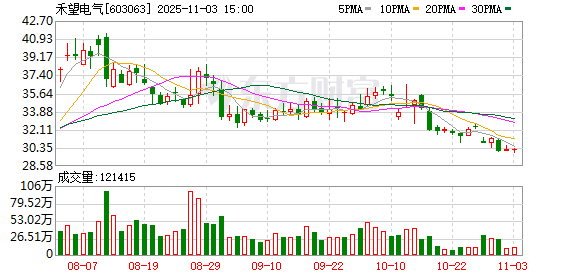
禾望电气:累计回购公司股份31000股
Zheng Quan Ri Bao· 2025-11-03 13:39
Group 1 - The core point of the article is that Hewei Electric announced a share buyback, indicating a commitment to returning value to shareholders [2] - As of October 31, 2025, the company has repurchased a total of 31,000 shares, which represents 0.0068% of its total share capital [2]

禾望电气(603063) - 深圳市禾望电气股份有限公司关于以集中竞价交易方式回购公司股份进展的公告
2025-11-03 08:00
关于以集中竞价交易方式回购公司股份进展的公告 本公司董事会及全体董事保证本公告内容不存在任何虚假记载、误导性陈述 或者重大遗漏,并对其内容的真实性、准确性和完整性承担法律责任。 回购方案首次披露日 2025/4/12,由公司董事长韩玉先生提议 回购方案实施期限 2025 年 4 月 12 日~2026 年 4 月 11 日 预计回购金额 1,000万元~2,000万元 回购用途 □减少注册资本 √用于员工持股计划或股权激励 □用于转换公司可转债 □为维护公司价值及股东权益 累计已回购股数 31,000股 累计已回购股数占总股本比例 0.0068% 累计已回购金额 99.9770万元 实际回购价格区间 31.08元/股~33.50元/股 重要内容提示: 2025 年 4 月 11 日,深圳市禾望电气股份有限公司(以下简称"公司")召开 2025 年第一次临时董事会会议,审议通过了《关于回购公司股份方案的议案》,同 意公司使用自有资金以集中竞价交易方式回购公司股份,回购资金总额不低于人 民币 1,000 万元(含),不超过人民币 2,000 万元(含),回购价格不超过 46.31 元/ 股,回购期限自董事会审议通 ...
禾望电气(603063.SH):累计回购3.1万股股份
Ge Long Hui A P P· 2025-11-03 07:46
Core Viewpoint - Hezhong Electric (603063.SH) announced a share repurchase plan, indicating a commitment to enhancing shareholder value through buybacks [1] Summary by Categories Share Repurchase Details - As of October 31, 2025, the company has repurchased a total of 31,000 shares, which represents 0.0068% of the total share capital [1] - The highest repurchase price was 33.50 CNY per share, while the lowest was 31.08 CNY per share [1] - The total amount spent on the repurchase was 999,770.00 CNY, excluding transaction fees such as stamp duty and commissions [1]
禾望电气:预计1000万-2000万元回购股份,已回购近100万元
Xin Lang Cai Jing· 2025-11-03 07:46
Core Viewpoint - The company plans to repurchase shares through centralized bidding, with a budget of 10 million to 20 million yuan, to support employee stock ownership plans or equity incentives [1] Summary by Relevant Sections Share Repurchase Plan - The board of directors approved a share repurchase plan on April 11, 2025, with a total budget of 10 million to 20 million yuan [1] - The maximum repurchase price is set at 46.31 yuan per share, and the repurchase period extends until April 11, 2026 [1] Current Repurchase Status - As of October 31, the company has repurchased a total of 31,000 shares, which represents 0.0068% of the total share capital [1] - The highest repurchase price recorded was 33.50 yuan per share, while the lowest was 31.08 yuan per share [1] - The total amount spent on repurchases so far is 99.98 thousand yuan [1]
禾望电气:累计回购3.1万股股份
Ge Long Hui· 2025-11-03 07:39
Core Viewpoint - Hezhong Electric (603063.SH) announced a share buyback program, indicating a commitment to returning value to shareholders through repurchasing shares at specified price ranges [1] Summary by Categories Share Buyback Details - As of October 31, 2025, the company has repurchased a total of 31,000 shares, which represents 0.0068% of the total share capital [1] - The highest price paid for the shares was 33.50 CNY per share, while the lowest price was 31.08 CNY per share [1] - The total amount spent on the buyback was 999,770.00 CNY, excluding transaction costs such as stamp duty and commissions [1]
昔日香饽饽遇冷!光伏设备、逆变器业绩重构,支架企业开始亏损
Hua Xia Shi Bao· 2025-11-01 01:58
Core Viewpoint - The photovoltaic industry is experiencing a significant performance restructuring, with major companies in key sectors such as equipment, inverters, junction boxes, and mounting brackets facing declining profits and some even reporting losses, indicating a shift in the industry's profitability logic [1] Equipment Sector - Equipment suppliers are seeing the most pronounced decline, with several leading companies reporting both revenue and net profit decreases in Q3 [2] - Jiejia Weichuang (捷佳伟创) reported Q3 revenue of 4.734 billion yuan, a decrease of 17.26% year-on-year, and net profit of 858 million yuan, a sharp decline from previous growth rates [2] - Jing Sheng Machinery (晶盛机电) experienced a dramatic drop in Q3 revenue to 2.474 billion yuan, down 42.87%, and net profit of 262 million yuan, down 69.65% [2] - Maiwei Co., Ltd. (迈为股份) reported Q3 revenue of 1.991 billion yuan, a decline of 31.3%, and net profit of 269 million yuan, down 9.42% [4][5] - Aotewei (奥特维) saw its Q3 revenue drop to 1.292 billion yuan, down 48.65%, with net profit plummeting 90.04% to 50 million yuan [6] Inverter Sector - The inverter industry is experiencing a bifurcated performance, with some companies like Sungrow (阳光电源) and GoodWe (固德威) reporting significant profit increases, while others face profit declines [7] - Sungrow achieved a net profit of 4.147 billion yuan in Q3, up 57.04% year-on-year, while GoodWe's net profit surged by 200.83% [7] - Conversely, companies like Jinlang Technology (锦浪科技) and Deye (德业股份) reported net profit declines of 16.85% and 17.84%, respectively [7] Junction Box Sector - The junction box sector has also seen significant profit declines, with Zairun New Energy (泽润新能) reporting a net loss of approximately 3.856 million yuan in Q3, a 115.93% year-on-year drop [8] - Kuai Ke Electronics (快可电子) reported Q3 revenue of 328 million yuan, up 66.1%, but net profit decreased by 64.47% [8] Mounting Bracket Sector - The mounting bracket sector is facing similar challenges, with Qingyuan Co. (清源股份) reporting Q3 revenue of 470 million yuan, a 5.47% increase, but net profit down 73.94% [8] - Leading company Zhongxinbo (中信博) reported a net profit decline of 74.49% year-on-year, with Q3 losses reaching 48.39 million yuan, a 119.76% drop [9][10] Overall Industry Outlook - The overall profitability of the photovoltaic equipment, inverter, junction box, and mounting bracket sectors is declining, with industry experts indicating that the stability of returns from photovoltaic power stations is not as strong as before, complicating investment decisions [10]





南华期货玉米、淀粉产业日报-20251031
Nan Hua Qi Huo· 2025-10-31 02:04
Group 1: Report Overview - The report is the South China Futures Corn & Starch Industry Daily on October 31, 2025, written by Dai Hongxu and research assistant Kang Quangui [1] Group 2: Core Views - New - season corn harvest is nearing completion in October, with grain sales and circulation peaking. After the concentrated listing in October, the bottom of corn prices is emerging, and the current price is in a consolidation phase with limited upward and downward driving forces [2] - Corn prices in major producing areas remained stable yesterday. In the Northeast, state - reserve purchases signaled price support, curbing the selling sentiment of upstream suppliers and weakening the downward price momentum, while downstream buyers were more active. In North China and the Huang - Huai region, prices were also stable. As the low - quality grain affected by precipitation was gradually sold, the price of high - quality corn remained firm. In the sales areas, arrivals increased, but downstream buyers were cautious, mostly purchasing as needed with weak short - term inventory - building intentions, providing limited price support [2] - On Thursday, the corn futures market oscillated weakly. The main 01 contract closed at 2111 yuan, with slightly increased trading volume and open interest, and 63,966 registered warrants. The starch futures market also weakened, with the main 01 contract closing at 2419 yuan [2] Group 3: Influencing Factors Bullish Factors - The first peak of new - season corn listing has passed, and prices are stabilizing [6] - State - reserve purchases in the Northeast have significantly supported prices, limiting price declines [6] - The reduction of high - quality corn in North China will gradually become apparent over time, supporting the expectation of stronger long - term prices [6] Bearish Factors - The pig industry is in the process of capacity regulation, which may affect the long - term feed demand for corn. However, the high inventory in the fourth quarter and the current entry of second - fattening pigs support the feed demand at a relatively good level. Attention should also be paid to whether the news of the wheat directional auction in November will affect corn prices [3] - The supply level remains high in the fourth quarter, and prices are consolidating at a low level [3] - Sino - US negotiations have achieved good progress, and relevant national departments have confirmed that China and the US have reached a consensus on expanding agricultural product trade. Attention should be paid to whether it extends to the corn variety [3] Group 4: Price Forecast and Market Data Price Forecast - The monthly price forecast for corn is in the range of 2050 - 2200 yuan, with a current volatility of 8.82% and a volatility percentile of 23.6%. The monthly price forecast for starch is in the range of 2350 - 2550 yuan, with a current volatility of 9.92% and a volatility percentile of 4.92% [4] Spot Price and Basis - In the corn market, the price at Jinzhou Port is 2130 yuan (down 10 yuan), at Shekou Port is 2250 yuan (unchanged), and in Harbin is 2010 yuan (unchanged). The basis of Jinzhou Port's main - continuous contract is 19 yuan (down 5 yuan). In the corn starch market, the price in Shandong is 2740 yuan (unchanged), in Jilin is 2550 yuan (unchanged), and in Heilongjiang is 2460 yuan (unchanged). The basis of Shandong's main - continuous contract is 321 yuan (up 8 yuan) [4] Futures Price - For corn futures, the 11 - contract price changed from 2101 to 2103 yuan (up 2 yuan, 0.10%), the 01 - contract from 2116 to 2111 yuan (down 5 yuan, - 0.24%), the 03 - contract from 2145 to 2141 yuan (down 4 yuan, - 0.19%), the 05 - contract from 2221 to 2213 yuan (down 8 yuan, - 0.36%), the 07 - contract from 2244 to 2238 yuan (down 6 yuan, - 0.27%), and the 09 - contract remained at 2247 yuan (unchanged). For corn starch futures, the 11 - contract price changed from 2438 to 2431 yuan (down 7 yuan, - 0.29%), the 01 - contract from 2427 to 2419 yuan (down 8 yuan, - 0.33%), the 03 - contract from 2438 to 2429 yuan (down 9 yuan, - 0.37%), the 05 - contract from 2540 to 2530 yuan (down 10 yuan, - 0.39%), the 07 - contract from 2558 to 2548 yuan (down 10 yuan, - 0.39%), and the 09 - contract from 2590 to 2584 yuan (down 6 yuan, - 0.23%). The average wheat price rose from 2500 to 2504 yuan (up 4 yuan, 0.16%) [7] US Corn Market - The price of CBOT corn main - continuous contract was 429.5 (down 5, - 1.15%), COBT soybean main - continuous contract was 1107 (up 13.75, 1.26%), CBOT wheat main - continuous contract was 524.25 (down 9.25, - 1.73%). The duty - paid price at the US Gulf was 2154.54 yuan (up 5.9, 0.27%) with an import profit of 95.46 yuan, and the duty - paid price at the US West Coast was 2032.78 yuan (up 5.91, 0.29%) with an import profit of 217.22 yuan [30]
深圳市禾望电气股份有限公司关于公司部分股票期权注销完成的公告
Shang Hai Zheng Quan Bao· 2025-10-29 23:17
Core Points - The company announced the completion of the cancellation of certain stock options from the 2023 stock option incentive plan due to the departure of seven incentive recipients [1][2] - A total of 168,000 stock options will be canceled, which will not affect the company's share capital [2] Summary by Sections - **Announcement Details** - The board of directors and all directors of the company guarantee that the announcement contains no false records, misleading statements, or major omissions [1] - The board held a meeting on October 27, 2025, to review and approve the cancellation of stock options [1] - **Cancellation Process** - The company submitted an application for the cancellation of the stock options to the China Securities Depository and Clearing Corporation Limited, Shanghai Branch, which confirmed the cancellation on October 29, 2025 [2] - The cancellation involves stock options that cannot be exercised by the departing employees [2]