Darbond Technology (688035)

Search documents
1300+份新材料报告下载:做新材料领域的「攻坚者」
材料汇· 2026-02-26 14:06
Core Viewpoint - The article discusses the rapid growth and investment opportunities in the advanced packaging materials sector, highlighting the potential for domestic companies to replace foreign imports in critical areas of technology [7][8]. Market Overview - The global market for advanced packaging materials is projected to reach $2.032 billion by 2028, with the Chinese market expected to grow to 9.67 billion yuan by 2025 [8]. - Specific materials such as PSPI, epoxy resin, and conductive adhesives are identified as key growth areas, with significant market sizes and growth rates anticipated [8]. Investment Opportunities - The article outlines various advanced packaging materials and their respective market sizes, including: - PSPI: $528 million in 2023, expected to grow significantly [8]. - Conductive adhesives: projected to reach $3 billion by 2026 [8]. - Chip bonding materials: expected to grow from approximately $485 million in 2023 to $684 million by 2029 [8]. - The investment landscape is characterized by a shift towards domestic production, with numerous Chinese companies emerging as competitors to established foreign firms [7][8]. Industry Trends - The article emphasizes the trend of domestic substitution in advanced materials, particularly in sectors heavily reliant on imports from countries like Japan [7][8]. - It highlights the importance of innovation and R&D in maintaining competitive advantages within the industry [7][8]. Strategic Insights - Investment strategies vary across different stages of company development, from seed rounds to pre-IPO phases, with a focus on team capabilities, market potential, and product maturity [10]. - The article suggests that the current market conditions present a favorable environment for investments in advanced materials, particularly for companies that can demonstrate strong growth potential and innovative capabilities [10].


未知机构:招商电新开工大吉关注叠瓦组件设备叠瓦粘胶太空光伏-20260224
未知机构· 2026-02-24 02:45
Summary of Conference Call Notes Industry Overview - The focus is on the **bifacial solar cell technology** and its applications in both space and terrestrial photovoltaic systems. The bifacial structure allows for flexible connections of silicon wafers, reducing mechanical stress and minimizing risks of micro-cracks and breakage [1][2][4]. Key Points - **Bifacial Structure Benefits**: - The use of a bifacial structure enables zero spacing between solar cells, which increases the effective power generation area for the same solar wing area [3][5]. - The flexible connections and reduced number of solder joints effectively disperse mechanical stress, leading to lower risks of hidden cracks and breakage [2][4]. - **Market Adoption**: - The bifacial structure has been widely adopted in space photovoltaic applications since the launch of the "Shijian-1" satellite in 1971. Notably, a well-known North American renewable energy company is also utilizing bifacial solutions for ground-mounted solar components [6]. - **Equipment and Material Insights**: - Bifacial component production lines have a value that is over **twice** that of conventional soldering methods [6]. - The bifacial conductive paste and adhesive are projected to have a value that is **five times** higher than current glass powder inflation [6]. Company Highlights - **ST Jingji**: - The company’s subsidiary, Shengcheng, leads in the production of bifacial component equipment, holding over **50%** market share in North America. It has been supplying major North American companies [6]. - The company has early reserves of bifacial equipment and is recognized as the sole supplier for a prominent North American ground bifacial production line [6]. - **Dike Co., Ltd.**: - A leading company in photovoltaic silver paste, with significant R&D capabilities. It holds global core patents for high and low-temperature silver paste through its subsidiary, Sote [6]. - The company has nearly **100%** market share in North America for conductive paste and adhesive products, having promoted bifacial adhesive products since 2019 [6]. - **Debang Technology**: - A core supplier of domestic bifacial conductive adhesives, with products already applied at scale by major companies like Tongwei and Canadian Solar, and holds a significant market share [6]. - **Juhe Materials**: - A leading company in photovoltaic silver paste, currently testing and small-scale shipping copper paste products, which are expected to benefit from the future adoption of high-purity copper paste [7]. - **Aotwei**: - A leading company in photovoltaic component equipment, with key products including soldering machines and silicon wafer sorting machines, and has made investments in bifacial equipment [9]. Additional Insights - The integration of semiconductor material assets by some companies is expected to help address domestic supply chain issues [8].



1300+份新材料报告下载:做新材料领域的「攻坚者」
材料汇· 2026-02-23 15:28
Core Viewpoint - The article discusses the rapid growth and investment opportunities in the advanced packaging materials sector, highlighting the potential for domestic companies to replace foreign imports in critical areas of technology [7][8]. Market Overview - The global market for advanced packaging materials is projected to reach $2.032 billion by 2028, with the Chinese market expected to grow to 9.67 billion yuan by 2025 [8]. - Specific materials such as PSPI and Al-X photoresist are highlighted, with PSPI's market size in China estimated at 7.12 billion yuan in 2023 [8]. Investment Opportunities - The article identifies 14 key advanced packaging materials that are critical for the semiconductor industry, emphasizing the potential for domestic companies to capture market share from foreign competitors [7][8]. - Companies like 鼎龙股份, 国风新材, and 三月科 are mentioned as potential leaders in the domestic market for advanced packaging materials [8]. Growth Projections - The market for conductive adhesives is expected to reach 3 billion yuan by 2026, while the chip bonding materials market is projected to grow from approximately $4.85 billion in 2023 to $6.84 billion by 2029 [8]. - The epoxy encapsulation materials market is anticipated to grow to $9.9 billion by 2027, indicating strong demand in the sector [8]. Competitive Landscape - The article outlines the competitive landscape, noting that foreign companies such as Fujifilm, Toray, and Dow are currently dominant in the market, but domestic firms are rapidly advancing [8]. - The need for innovation and investment in R&D is emphasized for domestic companies to compete effectively against established foreign players [8].
德邦科技股东减持、回购进展及募投项目变更引关注
Jing Ji Guan Cha Wang· 2026-02-14 05:12
Group 1: Executive Actions - Major shareholder Zhoushan Taizhong Venture Capital Partnership plans to reduce its stake by up to 2% of the total share capital (up to 2.8448 million shares) from March 3, 2026, to June 2, 2026, due to personal funding needs [1] Group 2: Company Status - The second share repurchase plan is ongoing, with a repurchase period from April 2, 2025, to April 1, 2026, aiming to buy back between 40 million yuan and 80 million yuan. As of January 31, 2026, the company has repurchased 991,897 shares, accounting for 0.6973% of the total share capital, with a total expenditure of approximately 40.0128 million yuan [2] Group 3: Project Developments - On February 4, 2026, the company held its first extraordinary general meeting of 2026, approving a proposal to change part of the fundraising investment projects, optimizing it to focus on the South China semiconductor materials base project to strengthen the advanced packaging materials layout [3] Group 4: Stock Performance - On February 11, 2026, the stock price of Debang Technology hit the daily limit, closing at 61.82 yuan, with a net inflow of 147 million yuan in main funds. This fluctuation is related to the upgrade of fundraising projects, the National Big Fund's shareholding (18.65%), and bulk supply of products across multiple fields [4]
未知机构:天风电新重视TS的叠瓦技术下一个天地共振的方向0212-20260213
未知机构· 2026-02-13 02:00
Summary of Key Points from the Conference Call Industry and Company Involvement - The discussion primarily revolves around the solar energy industry, specifically focusing on the advancements in solar module manufacturing techniques, particularly the **Tiling and Stacking (叠瓦)** technology being adopted by companies like **Tesla** and **聚和材料** [1][3][5]. Core Insights and Arguments - **Tesla's Manufacturing Resumption**: Tesla is set to restart its component manufacturing at its Buffalo, New York facility, utilizing the Tiling technology for its solar modules [1]. - **Potential Issues with Space Applications**: During a recent materials exchange meeting, it was noted that components welded in space may lead to micro-cracks, suggesting a possible shift towards Tiling methods to mitigate these risks [2][4]. - **Innovations in Manufacturing Processes**: The Tiling process introduces several new manufacturing steps compared to traditional lines, including: 1. **Slicing and Splitting**: The battery cells are divided into six segments, increasing the slicing and splitting processes [5]. 2. **Welding Method Changes**: A new welding technique using conductive glue is implemented to connect the split battery cells, which adds to the coating and stacking processes [5]. 3. **Layout Adjustments**: The new processes necessitate changes in the layout and busbar welding techniques to accommodate the modified battery cell arrangement [5]. Investment Recommendations - **Inflation Logic in Component Equipment**: The Tiling technology is expected to create inflationary pressures in component equipment, leading to investment recommendations for: - **ST京机**: A supplier of module lamination equipment and automated production lines, which stands to benefit directly from the inflation in component lines [5]. - **奥特维**: This company faces higher requirements for the Tiling components compared to conventional ones, with an anticipated increase in value [5]. - **Material Suppliers**: The primary growth in materials is expected to come from conductive glue, with recommendations for: - **德邦科技**: Recognized as a leader in Tiling conductive glue, supplying major companies like SunPower, 通威, and 阿特斯 [6]. - **聚和材料**: Currently testing silver paste and conductive glue samples with North American clients [7]. Additional Important Content - The emphasis on Tiling technology indicates a significant shift in the solar module manufacturing landscape, with potential implications for both production efficiency and product reliability in various applications, including space [2][4].

未知机构:招商电新关注叠瓦在太空光伏应用1太空光伏电池片极致减重与柔-20260213
未知机构· 2026-02-13 01:55
Summary of Conference Call Notes Industry Overview - The focus is on the application of **tandem solar cells** in **space photovoltaic** systems, highlighting the challenges and advancements in technology related to lightweight and flexible solar panels [1][2]. Key Points and Arguments 1. **Challenges with Thin Silicon Cells**: - Space photovoltaic cells require extreme weight reduction and flexibility, making ultra-thin silicon cells very fragile. The use of string welding can lead to mechanical stress and high-temperature welding issues, increasing the risk of silicon cell breakage and detachment under extreme temperature variations in space [1][2]. 2. **Advantages of Tandem Structure**: - The tandem structure allows for flexible connections of silicon cells, reducing the number of solder joints. This effectively disperses mechanical stress, minimizing the risks of hidden cracks and breakage [1][2]. 3. **Increased Effective Power Generation**: - The tandem structure can achieve zero spacing between solar cells, which enhances the effective power generation area for the same solar wing size [3]. 4. **Historical Context**: - The application of tandem structures in space photovoltaics is well-established, with the "Shijian-1" satellite launched in 1971 being an early example of a solar panel using a "comb-type" structure designed in China [4]. 5. **Industry Feedback**: - Leading North American renewable energy companies are currently using tandem solutions for ground photovoltaic modules. The production line for tandem components is reported to be more than twice the cost of conventional string welding lines, indicating significant market interest [4]. Company Highlights 1. **ST Jingji**: - The wholly-owned subsidiary, Shengcheng Photovoltaics, possesses competitive manufacturing technology for tandem components. It is noted for being the sole supplier of ground tandem production lines to a well-known North American company and has also supplied coating equipment to overseas space perovskite enterprises. The company holds a significant market share in North America, estimated to exceed 50% [4]. 2. **Dike Co., Ltd.**: - A leading company in photovoltaic silver paste, known for its R&D capabilities. It has nearly 100% market share in North America and has been promoting tandem adhesive products since 2019, leveraging its core patent advantages in conductive paste solutions [5]. 3. **Debang Technology**: - A core supplier of tandem conductive adhesives, with products widely used in leading photovoltaic companies such as Tongwei, Canadian Solar, and major North American renewable energy firms, holding a strong competitive position in the market [5]. 4. **Juhe Materials**: - A leading company in photovoltaic silver paste, developing copper paste products suitable for photovoltaic cells, currently undergoing testing with major clients and expected to benefit from the adoption of high/pure copper paste materials [5]. 5. **Aotewei**: - A leading company in photovoltaic component equipment, with key products including string welding machines and silicon wafer sorting machines. The company has also made advancements in tandem equipment, achieving high precision and yield rates [6]. Additional Important Insights - The integration of semiconductor material assets by companies is seen as a solution to domestic supply chain issues, addressing critical bottlenecks in the industry [5][6].
光伏系列报告:叠瓦方案有望在太空光伏得到应用
CMS· 2026-02-12 14:31
Investment Rating - The report maintains a strong recommendation for companies such as 帝科股份 (Dike Co., Ltd.) and 聚和材料 (Juhua Materials) [3][4] - ST 京机 (ST Jingji) and 德邦科技 (Debang Technology) are not rated [3] Core Insights - The report highlights the potential application of the tile structure in space photovoltaic systems, which can reduce the risk of damage to solar cells and improve power output per unit area [1][7] - The use of tile structures is expected to create new demand scenarios for conductive adhesives and related equipment, benefiting companies involved in these technologies [1][7] Industry Overview - The industry consists of 308 listed companies with a total market capitalization of 792.4 billion and a circulating market value of 693.8 billion [4] - The industry has shown strong performance with absolute returns of 63.1% over 12 months [6] Key Companies - **ST 京机 (ST Jingji)**: A leader in automated manufacturing technology for photovoltaic modules, with a significant market share and established partnerships in tile technology [8] - **帝科股份 (Dike Co., Ltd.)**: A leading company in photovoltaic silver paste, with a strong market position and potential for growth in space photovoltaic applications [9] - **德邦科技 (Debang Technology)**: A core supplier of conductive adhesives for tile photovoltaic cells, with a strong competitive advantage [10] - **聚和材料 (Juhua Materials)**: A leading company in photovoltaic silver paste, developing copper paste products and addressing domestic supply chain issues [11] - **奥特维 (Aotewi)**: A prominent manufacturer of photovoltaic equipment, with deep reserves in tile technology and a comprehensive solution for vacuum process equipment [12]
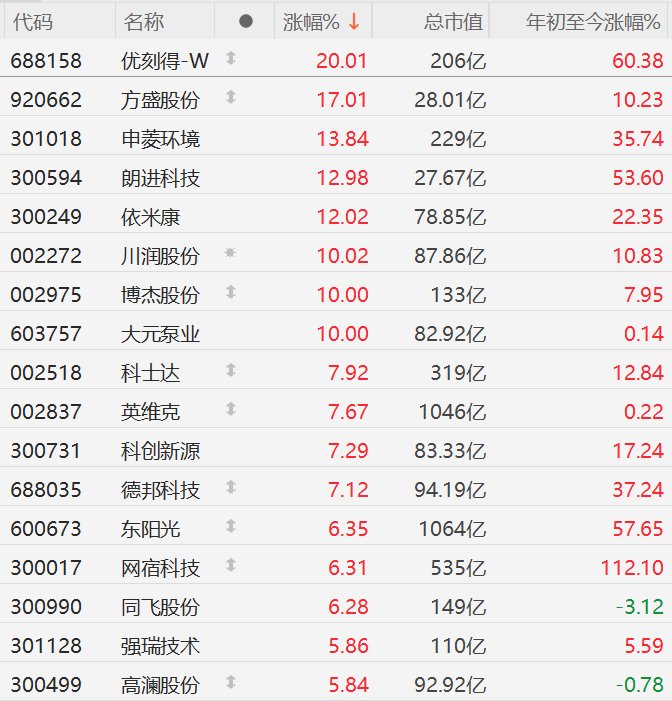
A股液冷概念股集体走强,川润股份涨停,同飞股份涨超6%
Ge Long Hui A P P· 2026-02-12 02:50
Group 1 - The A-share market saw a collective surge in liquid cooling concept stocks, with Fangsheng Co. rising by 17%, Shenling Environment increasing by over 13%, and Langjin Technology and Yimikang both up by over 12% [1] - Other notable performers included Chuanrun Co., Bojie Co., and Dayuan Pump Industry, which all hit the daily limit of 10%, while Keda, Yingweik, Kexin Innovation, and Debang Technology rose by over 7% [1] Group 2 - The table lists several stocks with their respective price changes and market capitalizations, highlighting that Youkede-W had a price increase of 20.01% with a total market value of 20.6 billion, and a year-to-date increase of 60.38% [2] - Wansheng Co. experienced a 17.01% rise, with a market cap of 2.801 billion and a year-to-date increase of 10.23% [2] - Shenmeng Environment saw a 13.84% increase, with a market cap of 22.9 billion and a year-to-date increase of 35.74% [2]


450吨导热材料及EMI材料项目官宣
DT新材料· 2026-02-11 16:04
Core Viewpoint - Debang Technology has announced a change in its fundraising project, reallocating the remaining funds of 62.3699 million yuan from the "Annual Production of 35 Tons of Semiconductor Electronic Packaging Materials Project" to a new project focused on the "Debang Semiconductor Material R&D and Production Base in South China" to align with industry trends and optimize strategic layout [2][4]. Group 1 - The new project will be implemented by Debang Technology's wholly-owned subsidiary, Shenzhen Debang Interface Materials Co., Ltd., located in Longgang District, Shenzhen, with a construction period of 2 years and a total investment of 230 million yuan [2]. - The new project aims to achieve an annual production capacity of 450 tons of thermal management and EMI materials, including subcategories such as thermal paste, thermal mud, thermal gel, thermal pads, phase change materials, and conductive adhesives, focusing on the core semiconductor materials sector [3]. - The original project, which has been terminated, was planned to produce 15 tons of electronic packaging materials for semiconductor chips and systems, and 20 tons of photovoltaic stacking materials, but faced significant delays and low funding utilization [3]. Group 2 - The change in fundraising projects reflects Debang Technology's quick response to changes in industry demand and is a strategic move to optimize regional production capacity and strengthen core competitiveness, potentially injecting new momentum into the company's development in the high-end semiconductor materials sector [4].
1300+份新材料报告下载:做新材料领域的「攻坚者」
材料汇· 2026-02-10 15:37
Core Viewpoint - The article discusses the rapid growth and investment opportunities in the advanced packaging materials sector, highlighting the potential for domestic companies to replace foreign imports in critical areas of technology [7][8]. Market Overview - The global market for advanced packaging materials is projected to reach $2.032 billion by 2028, with the Chinese market expected to grow to 9.67 billion yuan by 2025 [8]. - Specific materials such as PSPI and Al-X photoresist are highlighted, with PSPI's market size in China estimated at 7.12 billion yuan in 2023 [8]. Investment Opportunities - The article identifies 14 key advanced packaging materials that are critical for the semiconductor industry, emphasizing the potential for domestic companies to capture market share from established foreign players [7][8]. - Companies like 鼎龙股份, 国风新材, and 三月科 are mentioned as potential leaders in the domestic market for advanced packaging materials [8]. Growth Projections - The market for conductive adhesives is expected to reach 3 billion yuan by 2026, while the chip bonding materials market is projected to grow from approximately $4.85 billion in 2023 to $6.84 billion by 2029 [8]. - The epoxy encapsulant market is anticipated to grow to $9.9 billion by 2027, indicating strong demand for these materials in the electronics sector [8]. Competitive Landscape - The article outlines the competitive landscape, noting that foreign companies like Fujifilm, Toray, and JSR dominate certain segments, while domestic firms are emerging as strong competitors [8]. - The need for innovation and investment in R&D is emphasized for domestic companies to successfully compete against established international players [8].