
Roborock(688169)

Search documents
科创ETF(588050)开盘跌1.15%,重仓股中芯国际跌1.54%,海光信息跌2.38%
Xin Lang Cai Jing· 2025-11-07 01:40
Group 1 - The core point of the article highlights the performance of the Science and Technology Innovation ETF (588050), which opened down by 1.15% at 1.457 yuan on November 7 [1] - Major holdings in the ETF experienced declines, with notable drops including SMIC down 1.54%, Haiguang Information down 2.38%, and Cambrian down 1.65% [1] - The ETF's performance benchmark is the Shanghai Stock Exchange Science and Technology Innovation Board 50 Index, managed by ICBC Credit Suisse Asset Management Company, with a return of 2.74% since its inception on September 28, 2020, and a recent one-month return of -3.88% [1]






科创ETF(588050)开盘涨0.63%,重仓股中芯国际涨1.77%,海光信息涨2.25%
Xin Lang Cai Jing· 2025-11-06 04:01
Core Viewpoint - The Sci-Tech ETF (588050) opened with a slight increase of 0.63%, indicating a positive market sentiment towards technology stocks [1] Group 1: ETF Performance - The Sci-Tech ETF (588050) opened at 1.435 yuan, reflecting a modest gain [1] - The ETF's performance benchmark is the Shanghai Stock Exchange Sci-Tech 50 Index [1] - Since its inception on September 28, 2020, the ETF has returned -0.57%, while its return over the past month is -6.98% [1] Group 2: Major Holdings - Key stocks within the ETF include: - SMIC (中芯国际) up by 1.77% - Haiguang Information (海光信息) up by 2.25% - Cambrian (寒武纪) up by 2.82% - Lanke Technology (澜起科技) up by 1.30% - Zhongwei Company (中微公司) up by 1.42% - United Imaging Healthcare (联影医疗) up by 0.11% - Kingsoft Office (金山办公) down by 0.52% - Chipone (芯原股份) up by 2.41% - Roborock (石头科技) up by 0.33% - Transsion Holdings (传音控股) unchanged [1]
科创50ETF增强(588450)开盘涨0.97%,重仓股中芯国际涨1.77%,寒武纪涨2.82%
Xin Lang Cai Jing· 2025-11-06 03:19
Core Viewpoint - The article discusses the performance of the Kexin 50 ETF Enhanced (588450), highlighting its opening price and the performance of its major holdings [1] Group 1: ETF Performance - Kexin 50 ETF Enhanced (588450) opened with a gain of 0.97%, priced at 1.763 yuan [1] - Since its inception on May 6, 2024, the fund has achieved a return of 75.05%, while its return over the past month has been -7.16% [1] Group 2: Major Holdings Performance - Major holdings include: - SMIC (中芯国际) up by 1.77% - Cambrian (寒武纪) up by 2.82% - Lattice Semiconductor (澜起科技) up by 1.30% - Haiguang Information (海光信息) up by 2.25% - Zhongwei Company (中微公司) up by 1.42% - United Imaging Healthcare (联影医疗) up by 0.11% - Kingsoft Office (金山办公) down by 0.52% - Roborock (石头科技) up by 0.33% - Amlogic (晶晨股份) up by 0.51% - Western Superconducting (西部超导) down by 0.48% [1]
浙商证券:割草机器人低渗透空间大 国内机器人公司有望持续抢占市场
智通财经网· 2025-11-06 02:33
Core Viewpoint - The lawn mowing robot industry is in a technological growth phase with significant potential for market penetration, as the sales of smart lawn mowing robots are projected to increase from 29,000 units in 2022 to 380,000 units by 2024, indicating a low penetration rate of approximately 6%-8% for lawn mowing robots and only 2%-3% for smart lawn mowing robots [1][2]. Group 1: Market Potential - The lawn mowing robot market is characterized by strong demand, a technological growth phase, and low penetration rates, making it a lucrative business opportunity [1]. - In developed countries like the US, lawn care is culturally significant, with regulations in place that necessitate timely lawn maintenance, further driving demand for lawn mowing robots [1]. Group 2: Sales and Growth Projections - Global annual sales of lawn mowing robots are estimated to be between 1.2 million and 1.3 million units, with a significant increase in smart lawn mowing robots due to advancements in RTK and laser radar technologies [1]. - The conservative estimate suggests that the market for boundary-less lawn mowing robots could reach approximately 3.84 million units, and if fully replacing riding mowers, it could approach 6 million units, representing a 15-fold increase compared to 2024 [2]. Group 3: Competitive Landscape - The main competitive barriers in the lawn mowing robot industry are based on algorithms and distribution channels, with navigation and positioning technology being crucial for smart and efficient operation [3]. - The offline sales channel plays a significant role in consumer purchasing decisions, with 71% of sales occurring through this channel, highlighting the importance of brand recognition and established relationships with local distributors [3]. - Domestic robot companies are noted for their strong product technology and competitive pricing, which positions them well to capture market share [3]. Group 4: Key Players - Recommended companies to watch in the lawn mowing robot sector include Ninebot (leading in boundary-less lawn mowing robots with strong product reputation and channel advantages), Ecovacs (rapidly increasing volume of boundary-less lawn mowing robots with potential for enhanced product competitiveness), Roborock (newly launched lawn mowing robots expected to contribute to market growth), and Tengya Precision (selling related products to affiliated companies) [3].


家电行业25年三季报总结:分化趋势延续,龙头经营稳健
INDUSTRIAL SECURITIES· 2025-11-05 11:07
Group 1 - The core view of the report indicates that the home appliance industry demonstrated resilience in Q3 2025, with revenue and profit showing steady growth, with a year-on-year revenue increase of 2.6% and a net profit increase of 4.8% [3][15][18] - The white goods sector continued to show stable growth, with a year-on-year revenue increase of 3.7%, while the kitchen appliances and lighting sectors saw a narrowing decline [3][15][25] - The small appliances sector experienced a year-on-year revenue growth of 6.4%, with notable performance from companies like Bear Electric and Beiding, which benefited from low base effects and improved internal operations [3][39] Group 2 - In the white goods segment, major companies such as Gree Electric and Midea Group reported mixed results, with Gree's revenue declining by 15.1% while Midea's increased by 9.9% [25][26] - The profitability of the white goods sector remained stable, with a year-on-year net profit increase of 3.5% and a slight decline in net profit margin by 0.1 percentage points [29][30] - The small appliances sector showed internal performance differentiation, with leading companies like Ecovacs and Roborock achieving significant revenue growth of 29.3% and 60.7% respectively [39][40] Group 3 - The black goods sector maintained stable volume and price increases, with companies like Hisense and Skyworth reporting revenue growth of 2.7% and 9.1% respectively [3][15] - The overall profitability in the black goods sector improved, with a year-on-year net profit margin increase of 0.7 percentage points for Hisense [3][18] - Investment recommendations suggest focusing on leading companies in the white goods sector such as Midea Group and Haier, as well as the black goods leader Hisense, due to their stable operational performance and dividend value [3][39]



割草机器人行业深度:智领全球,竞逐蓝海
ZHESHANG SECURITIES· 2025-11-05 10:22
Investment Rating - The industry investment rating is optimistic [3] Core Insights - The lawn mowing robot industry is characterized by strong demand, a technological growth phase, and significant room for penetration [6] - The global annual sales of lawn mowing robots are estimated to be between 1.2 to 1.3 million units, with a rapid increase in smart lawn mowing robots from 29,000 units in 2022 to 380,000 units in 2024 [6][13] - The penetration rate of lawn mowing robots is approximately 6%-8%, with smart lawn mowing robots having a penetration rate of only 2%-3% [6][13] - The industry faces competitive barriers primarily in algorithms and distribution channels [6] - Domestic robot companies are expected to continue capturing market share due to their strong product technology and competitive pricing [6] Summary by Sections Section 1: Market Demand and Growth - Lawn mowing is a cultural necessity in developed countries, particularly in Europe and North America, where lawn maintenance is often regulated [11] - The traditional lawn mower market sees annual sales between 15 million to 20 million units, indicating a substantial replacement demand [12] - The global market for lawn mowing robots is projected to reach approximately $2.5 billion by 2024 [13] Section 2: Technological Advancements - The transition from boundary-based to boundary-less lawn mowing robots marks a significant technological revolution, with the latter expected to dominate the market [19] - The sales of smart lawn mowing robots are forecasted to grow at a compound annual growth rate (CAGR) of 55% from 2024 to 2029 [19] Section 3: Competitive Landscape - The competitive landscape is dominated by traditional garden tool manufacturers and emerging robot companies, with key players including Husqvarna, Worx, and domestic brands like Ninebot and Ecovacs [43] - The market is segmented into three categories: traditional garden tool manufacturers, robot companies, and startups [44] Section 4: Distribution Channels - Offline sales dominate the market, accounting for 71% of total sales, with consumers preferring to test products in-store before purchase [42] - The primary online sales channel is Amazon, while offline channels include modern garden centers and traditional dealer stores [42] Section 5: Recommended Companies - Recommended companies to watch include Ninebot (leading in boundary-less lawn mowing robots), Ecovacs (rapidly increasing market share), and Stone Technology (new product launches expected to contribute to growth) [53]
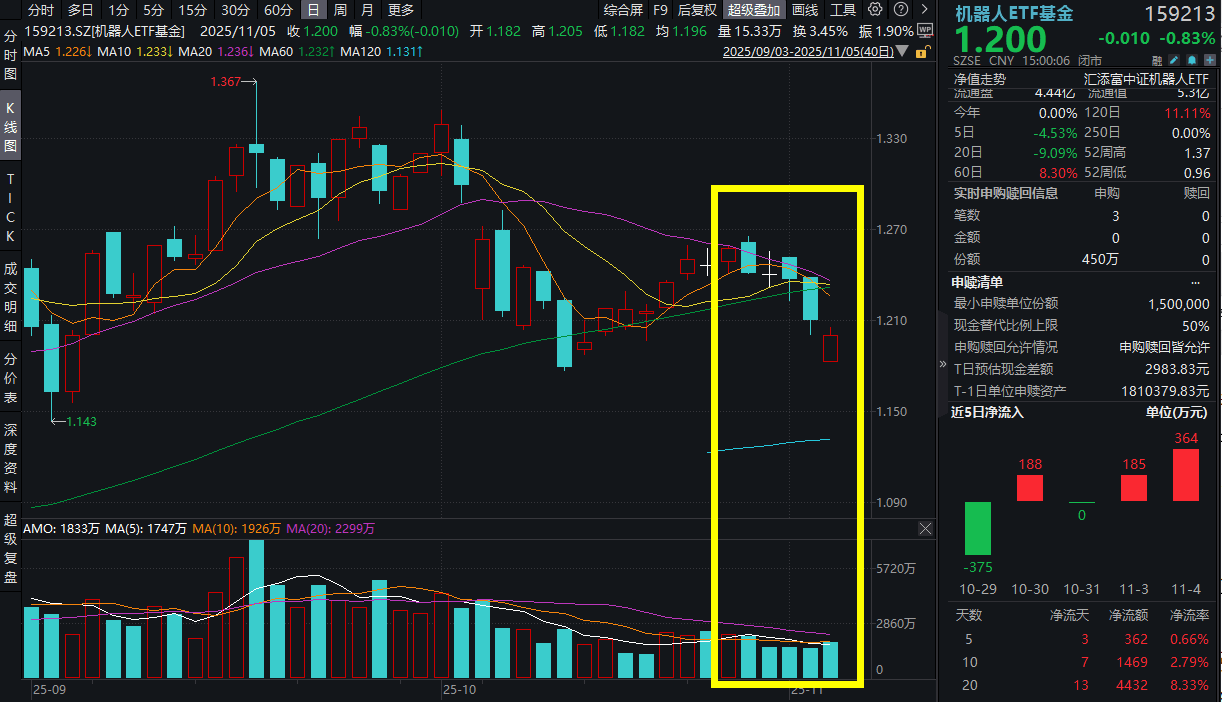
马斯克“万亿薪酬”要黄?机器人板块承压!机器人ETF基金(159213)弱势五连阴,再获资金逆势加仓!机构坚定看好人形机器人产业趋势!
Sou Hu Cai Jing· 2025-11-05 08:57
Group 1 - The robotics sector remains under pressure, with the Robotics ETF (159213) experiencing a slight decline of 0.83%, marking five consecutive days of weakness, although it showed signs of recovery today with a low-open high-close candlestick pattern [1] - The Robotics ETF (159213) saw a net inflow of 5.4 million yuan, indicating a strong buying trend as funds continue to flow into the ETF despite market declines [1] - The China Securities Robotics Index (H30590) fell by 0.62%, with mixed performance among constituent stocks, including notable gains from Guomao Co. (+4.66%) and Tianzhun Technology (+3.65%) [3][4] Group 2 - The robotics industry is experiencing significant growth, with revenue projected to increase from 106.1 billion yuan in 2020 to 237.89 billion yuan by 2024, effectively doubling in size [6] - In the first three quarters of this year, the industry revenue grew by 29.5%, with industrial robot production reaching 595,000 units and service robot production hitting 13.5 million units, both exceeding the total production targets for 2024 [6] - The 2025 China Robotics Industry Development Conference is scheduled to take place from November 10 to 12 in Shanghai, organized by the China Machinery Industry Federation [6] Group 3 - Recent developments include Leju Intelligent's registration for IPO guidance in Shenzhen, marking it as the second humanoid robot company to pursue listing on the A-share market [7] - Gigastar Legend announced a sales contract with Adata Technology for 1,000 quadruped robots, valued at over 20 million yuan, with Utree Technology responsible for the product's technology and production [7] - Utree Technology has established a significant barrier in the quadruped robot sector through self-developed hardware and software, achieving over 70% localization of core components [8] Group 4 - The humanoid robot industry is on the verge of a breakthrough, with Tesla's Gen3 model and potential mass production expected to support market optimism [9] - The industry is anticipated to enter a phase of validation and consolidation, with a focus on key players that have clear advantages in the supply chain [9] - Global tech giants are increasingly investing in humanoid robotics, indicating that the industry is approaching a critical mass for production [9]





“扫地茅”光环消退,石头科技港股IPO遭遇三重门
Zhong Guo Neng Yuan Wang· 2025-11-05 04:22
Core Insights - Stone Technology, once hailed as a leader in the cleaning appliance sector, is currently facing a dilemma of increasing revenue without corresponding profit growth, with a 72% year-on-year revenue increase but a 30% decline in net profit for the first three quarters of 2025 [1][2] Financial Performance - For the first three quarters of 2025, Stone Technology reported a revenue of 12.066 billion yuan, a 72.22% increase year-on-year, while net profit attributable to shareholders fell by 29.51% to 1.038 billion yuan [2] - In Q3 2025, revenue reached 4.163 billion yuan, up 60.71% year-on-year, but net profit only slightly increased by 2.51% to 360 million yuan [2] - Sales expenses surged to 3.180 billion yuan, doubling from 1.564 billion yuan in the previous year, indicating high investment costs [2][4] - R&D expenses also rose by 60.56% to 1.028 billion yuan [3] - The gross profit margin decreased from 53.86% to 43.73%, and the net profit margin fell from 21.01% to 8.60% [4] - Cash flow from operating activities was negative at -1.06 billion yuan, a 200% decline year-on-year, with inventory increasing by 110.06% to 3.13 billion yuan [4] Strategic Challenges - Stone Technology is attempting to balance its core business with diversification, focusing on a dual growth engine of stable core categories and emerging categories [5][6] - The washing machine division, established in 2024, faced significant layoffs within a year, indicating challenges in the diversification strategy [6] - Founder Chang Jing's involvement in the electric vehicle company, Extreme Stone Automotive, raises concerns about divided attention, with the automotive venture underperforming [6][7] IPO and Regulatory Concerns - Stone Technology is pursuing an IPO on the Hong Kong Stock Exchange, aiming to raise 1.5 billion HKD for international expansion and R&D [8] - The China Securities Regulatory Commission has raised three major compliance issues regarding data security, shareholder identification, and foreign investment qualifications, which could impact the IPO process [8]
三季报已阅,小家电需要新故事
3 6 Ke· 2025-11-05 04:00
Core Insights - The small appliance industry has experienced significant growth post a "black swan" event five years ago, but recent quarterly reports indicate a divergence in performance among companies within the sector [2][12] - Leading companies in the cleaning appliance segment, such as Ecovacs and Roborock, continue to show strong growth, while traditional kitchen appliance manufacturers like Supor and Joyoung face revenue declines [2][12] Cleaning Appliances - Ecovacs reported a revenue of 12.877 billion yuan for the first three quarters, a year-on-year increase of 25.93%, with a net profit of 1.418 billion yuan, reflecting a staggering growth of 130.55% [3] - Roborock achieved a revenue of 4.163 billion yuan in the third quarter, a year-on-year growth of 60.71%, significantly surpassing the global average growth rate of 28% for smart cleaning devices [3] - The growth in cleaning appliances is driven by continuous technological upgrades, product innovations, and global channel expansion [3][4] - Despite high growth rates, Ecovacs faces challenges with a sequential decline in revenue and net profit in the third quarter compared to the second quarter, indicating potential market saturation [5] - Roborock is experiencing a "revenue growth without profit increase" scenario, with a net profit decline of 29.51% despite a revenue increase of 72.22% [6] Kitchen Appliances - The kitchen appliance sector is under pressure, with Supor reporting a slight revenue increase of 2.33% but a net profit decline of 4.66% for the first three quarters [7] - Joyoung's revenue decreased by 9.7% in the first three quarters, highlighting the overall market demand weakness in kitchen appliances [7] - Supor's performance is hindered by a reliance on the domestic market, which has stagnated, and an over-dependence on its parent company, SEB Group, for overseas sales [8] - Joyoung needs to find new growth avenues as its traditional product lines, like soybean milk machines, face declining market interest due to increased competition [11] Market Dynamics - The small appliance industry is witnessing a clear divide in performance based on product categories, with cleaning appliances benefiting from low penetration rates and innovation, while kitchen appliances struggle with market transformation challenges [12] - Companies like Bear Electric have managed to achieve growth through product innovation and channel optimization, indicating that adaptability is key in the current market landscape [12] - Recent developments in US-China trade relations may provide opportunities for small appliance companies to negotiate better pricing with overseas clients, potentially benefiting manufacturers like Supor [12]


石头科技:10月份公司未进行回购
Zheng Quan Ri Bao Zhi Sheng· 2025-11-04 12:41
Core Points - Stone Technology announced that it did not conduct any share repurchases in October 2025 [1] - As of October 31, 2025, the company has repurchased a total of 369,036 shares through the Shanghai Stock Exchange, which represents 0.1424% of the total share capital [1]