Roborock(688169)

Search documents
石头科技20260205
2026-02-10 03:24
Summary of Stone Technology Conference Call Company Overview - **Company**: Stone Technology (石头科技) - **Industry**: Robotic Cleaning Devices Key Points Financial Performance - **2025 Profitability**: The net profit from the overseas market for robotic vacuum cleaners is stable, with profit margins of approximately 20% in Europe and Asia-Pacific, and around 5% in the US, contributing an estimated net profit of 2 billion RMB for the year [2][8] - **Domestic Market Losses**: The domestic market faced a loss of 100 million RMB due to intensified competition and self-subsidy measures, marking the first loss in a decade [2][4] - **New Business Losses**: The washing machine business is expected to incur losses of 500-600 million RMB, the floor washing machine business 200 million RMB, and the lawn mower business 100 million RMB, with new businesses being the main financial drag [2][8] Strategic Adjustments for 2026 - **Cost-Cutting Measures**: Stone Technology plans to reduce losses from new businesses by 700 million RMB through the closure of the washing machine division, cessation of self-subsidies for floor washing machines, and timely delivery of lawn mower orders [2][7] - **Revenue Projections**: The revenue from floor washing machines is expected to reach 5 billion RMB in 2026, with 30% from overseas sales, potentially achieving a profit margin close to 10% [2][11] Market Expansion Strategies - **US Market Penetration**: The company is expanding its presence in the US market through Costco and Target, utilizing a streamlined SKU strategy and competitive pricing to drive rapid growth [2][28] - **European Market Promotion**: Increased marketing efforts in Europe, including a partnership with Real Madrid, aim to enhance brand recognition and drive sales growth [3][29] Competitive Landscape - **Comparison with Competitors**: Stone Technology's strategy contrasts with competitors like Ecovacs, which focuses on a simplified product strategy to reduce costs. Stone Technology emphasizes adding features without significantly raising prices, which affects short-term profitability [15][17] - **Product Strategy**: The introduction of low-cost cylindrical vacuum robots aims to counter competition while maintaining the integrity of existing product lines [15][20] Future Outlook - **Profitability Forecast for 2026**: The company anticipates a total profit of approximately 2.4 billion RMB in 2026, with a valuation of only 16 times earnings, indicating a positive outlook [35] - **Emerging Product Categories**: The washing machine segment is projected to generate over 2 billion RMB in sales in 2025, with expectations to reach 4-5 billion RMB in 2026, and the lawn mower business is expected to break even [33] Challenges and Risks - **Domestic Market Concerns**: The company does not foresee long-term losses in the domestic market, provided it maintains market share without initiating price wars [18][19] - **Product Limitations**: The cylindrical vacuum robot is not expected to become the sole mainstream solution due to its limitations, with other models like flat mops and dual-disc designs continuing to evolve [20] Conclusion - Stone Technology is navigating a challenging market landscape with strategic adjustments aimed at reducing losses and enhancing profitability. The focus on overseas expansion, product innovation, and brand promotion positions the company for potential growth in the coming years.

未知机构:申万宏源家电扫地机1月数据更新1月扫地机线上数据由于受以-20260210
未知机构· 2026-02-10 01:50
Summary of Key Points from the Conference Call Industry Overview - The conference call focuses on the vacuum cleaner industry, specifically the performance of various brands in January, including Stone Technology, Ecovacs, Yunji, and Chasing. - The data indicates a significant impact from the trade-in policy and pre-Spring Festival consumption, leading to a year-on-year increase in sales. Core Insights and Arguments - **Sales Growth**: In January, online sales of vacuum cleaners increased by 7.9% year-on-year, with sales volume up by 4.5% and average price down by 1% [1] - **Market Share**: The online market share for Stone Technology, Ecovacs, Yunji, and Chasing in January was 31.0%, 29.1%, 11.0%, and 11.6% respectively, with Stone's share increasing by 8.0% year-on-year [1] - **Sales Performance**: Stone Technology's sales in the US market reached $62 million in December, while in Germany, it led with $66 million, marking a 171% year-on-year increase [2] - **Product Leadership**: The best-selling product in January was the Stone P20 Ultra Plus, maintaining the highest market share since its launch in August, with a price advantage over Ecovacs' T80s series [2] - **Competitive Landscape**: The industry shows a clear head effect, with Stone Technology enhancing its leading position, while non-listed companies face ongoing pressure. Yunji is in a Pre-IPO stage, focusing on profit demands, and Chasing is diversifying its product categories but prioritizing profit maintenance [2][3] Additional Important Insights - **Product Strategy**: Stone's P20 series is noted for its high cost-performance ratio, contributing significantly to its market share growth. The company has also launched a new roller-type product that is now in the sales cycle [3] - **Market Challenges**: Yunji's new products, despite covering advanced features, have not met market expectations since their launch in August, leading to a decline in market share [3] - **Chasing's Strategy**: Chasing faces noticeable pressure on sales share, with its new products not yet showing significant impact due to a scattered focus across multiple categories [3]

海外品牌发布财报,产能外迁是主方向
Orient Securities· 2026-02-09 13:11
Investment Rating - The report maintains a "Positive" outlook for the home appliance industry, indicating an expectation of returns exceeding the market benchmark by over 5% [4]. Core Insights - The report highlights that while the domestic subsidy effect is slowing, the "Two New" policy is expected to stimulate greater consumer potential in the home appliance sector. Leading white goods companies with higher energy efficiency product ratios and mature trade-in management processes are likely to benefit more significantly [3]. - The long-term strategy of expanding overseas production capacity remains a key focus, with companies that diversify their production locations expected to outperform. The report anticipates a valuation shift in 2026, particularly for companies like Roborock Technology and Lek Electric [3]. - The report emphasizes the importance of stable performance in core businesses and the potential for developing secondary growth avenues, with companies like Anfu Technology being highlighted for their strong cash flow and manufacturing capabilities [3]. Summary by Sections Domestic Market Insights - The report notes that the domestic market is experiencing a marginal slowdown in subsidy effects, but ongoing policy optimizations are expected to unlock more consumer potential [3]. Overseas Expansion - Companies are increasingly focusing on overseas production as a long-term strategy, with expectations of accelerated price increases starting in Q1 2026 due to tariff impacts and rising raw material costs [3]. Investment Recommendations - Key investment themes include: - Leading companies with higher operational efficiency and stable dividend yields are recommended for conservative allocation, with Haier Smart Home and Hisense Visual Technology as notable mentions [3]. - Companies with a focus on international expansion are expected to see valuation shifts, with Roborock Technology and Lek Electric recommended for buying [3]. - Companies with stable core business performance and potential for secondary growth avenues, such as Anfu Technology, are also highlighted [3].




2026年石头科技公司深度报告:新业务大幅减亏+扫地机行业竞争缓和,2026年净利率迎来拐点(附下载)
Xin Lang Cai Jing· 2026-02-09 10:20
Core Viewpoint - The company's stock price has declined since Q3 2025, primarily due to losses in the domestic vacuum cleaner business and concerns over net profit margins amid industry competition [1][7] Group 1: Financial Performance - The company's net profit margin decreased significantly in 2025, mainly attributed to losses in non-vacuum cleaner businesses, with expected losses of 500-600 million yuan in washing machines, approximately 200 million yuan in floor scrubbers, and around 100 million yuan in lawn mowers [2][8] - The estimated net profit margin for vacuum cleaners in 2025 is around 13%, with expectations of reduced losses in 2026 across various product lines [2][8] - The company anticipates that external sales of vacuum cleaners will maintain over 20% revenue growth, while internal sales may not significantly impact overall net profit [2][9] Group 2: Market Dynamics - The domestic vacuum cleaner business faced losses in Q3 2025 due to the suspension of government subsidies and competitive pricing strategies from industry peers, leading to a decision to maintain market share during peak sales periods [1][7] - In North America, the net profit margin for vacuum cleaners is expected to be in the mid-single digits, with improvements anticipated as production capacity in Vietnam meets demand and tariffs decrease [3][9] - The European market is projected to have a vacuum cleaner net profit margin close to 20%, driven by rapid expansion in Southern European countries [3][9] Group 3: Competitive Landscape - The company's product strategy focuses on "more features without increasing prices," which has led to higher costs compared to competitors like Ecovacs, which employs a cost-reduction strategy [4][10] - The marketing efficiency of Ecovacs' lower-cost products has allowed it to compete effectively against the company's higher-cost offerings, resulting in a divergence in net profit margins [5][12] - The company plans to introduce more roller products in 2026 to address competitive pressures and improve its market position [6][12]
满300.01元减300元!广东发放新一轮消费券!
Xin Lang Cai Jing· 2026-02-08 07:10
Group 1 - The event includes both physical prizes and consumption vouchers from the "Yuegonghui" mall [2][3] - A variety of physical prizes are available, including 3 Stone robotic vacuum cleaners, 5 Dyson lightweight vacuum cleaners, and 10 Gree air purifiers, among others [2] - Consumption vouchers have different discount thresholds, such as a 300.01 reduction for a purchase of 300, and a 20 reduction for a purchase of 20 [2] Group 2 - Participants must pre-fill their shipping information before the event, which is limited to Guangdong Province [3] - Winners will be notified via SMS and must confirm their shipping information by February 10, 2026, to receive physical prizes [3][4] - Consumption vouchers will be issued by February 12, 2026, and can be used in the "Yuegonghui" mall for one month, with specific usage rules [4]



经济越来越差,这八大行业越赚爆!
创业家· 2026-02-07 10:24
Core Insights - The article discusses how certain industries are thriving despite a general perception of economic downturn, highlighting eight key sectors that present significant business opportunities in a low-desire society [3][4]. Group 1: Key Industries - **Second-Hand Economy**: The second-hand luxury market in Japan, represented by companies like Daikokuya, has seen a surge in revenue. In China, platforms like Hongbulin and Panghu are experiencing similar growth, indicating a shift in consumer spending towards second-hand goods [6][7][8][9]. - **Pet Economy**: With declining birth rates, young people are spending more on pets, leading to significant growth in pet food and healthcare products. Companies like Inaba in Japan and Guobao in China are capitalizing on this trend [11][12][14][15]. - **Adult Care Products**: The adult diaper market in Japan has surpassed $10 billion, indicating a growing demand for adult care products in China, with companies like Kexin showing potential for growth [16][17][18]. - **Health Food and Beverages**: The rise in health consciousness has led to increased demand for sugar-free beverages and functional drinks. Brands like Dongfang Shuye and Jianchun are gaining traction in this sector [21][22]. - **Beauty Economy**: The demand for beauty products, including collagen supplements and at-home beauty devices, is on the rise. Companies like Jinbo Biological are seeing significant market value growth [23][25]. - **Outdoor and Leisure Products**: The outdoor equipment market is thriving, with brands like Kailas and Camel experiencing rapid sales growth, as consumers seek leisure activities despite economic constraints [25][26][27]. - **Emotional Economy**: Brands like Labubu and Rio are tapping into the emotional needs of consumers, providing products that offer comfort and joy, even in a tight economic climate [28][29][30]. - **Convenience Economy**: The demand for convenience products, such as frozen foods and smart home appliances, is increasing as younger generations spend less time cooking. Companies like Anjijia and Kewot are benefiting from this trend [33][35][36]. Group 2: Market Trends - The article emphasizes that the current economic climate, often viewed as a "winter," presents opportunities for those willing to invest in counter-cyclical sectors. The key to success lies in recognizing and seizing these opportunities [39].




家电行业专题:汇率升值,出海后势如何?
Guolian Minsheng Securities· 2026-02-06 11:37
Investment Rating - The report maintains a "Recommended" rating for the home appliance industry [1] Core Insights - The report highlights that the nominal appreciation of the RMB is expected to have limited impact on export recovery and external sales profitability, as leading brands have strong pricing power, overseas production capacity, and effective foreign exchange hedging [8][11] - The report emphasizes that the home appliance sector is likely to benefit from increased foreign capital inflow due to RMB appreciation, with the sector's valuation and holdings at historical lows, indicating significant upside potential [7][8] Summary by Sections 1. Industry: Nominal Appreciation and Dollar Price Elasticity - Since Q2 2025, the RMB has appreciated approximately 5% due to the easing of trade tensions and economic recovery expectations, with the CFETS index remaining close to its 3-5 year average [11][12] - The report discusses the impact of exchange rates on export volume and pricing, noting that during appreciation phases, exporters may adjust dollar prices or lower RMB prices to mitigate the effects of appreciation [12][22] 2. Financial Statements: External Sales Profitability and Hedging - External sales gross margins have been under pressure, with historical data showing that external sales margins are generally weaker than domestic sales margins [4][6] - The report indicates that major companies have high foreign exchange hedging ratios, which effectively mitigate the impact of exchange rate fluctuations on their financials [4][6] 3. Capital: High Foreign Ownership Proportion - The report notes a strong correlation between RMB appreciation and net inflows of foreign capital, with the home appliance sector consistently attracting significant foreign investment [7][8] - The sector's Northbound trading and public fund holdings are at historical lows, suggesting ample room for upward movement [7] 4. Industry Perspective and Investment Recommendations - The report suggests that under the expectation of moderate appreciation, the competitive edge of leading companies backed by domestic supply chain advantages and proactive overseas capacity expansion will remain intact [8] - Recommended stocks include high-quality white goods leaders such as Midea Group, Haier Smart Home, Gree Electric Appliances, and Hisense Home Appliances, as well as TV leader Hisense Visual and global leaders in robotic vacuum cleaners like Roborock and Ecovacs [8]

AI应用催化不断,人工智能AIETF(515070)持仓股石头科技涨超2.7%
Mei Ri Jing Ji Xin Wen· 2026-02-05 06:29
Group 1 - The core viewpoint of the articles highlights the rapid acceleration of AI application deployment, with significant developments in open-source AI projects and new model launches by major companies [1][2] - The Clawdbot project has gained popularity, allowing users to remotely control local computer tasks through messaging software, sparking discussions in the overseas open-source community [1] - The software ETF Huaxia (159256) has seen notable stock increases in companies like Wangsu Science & Technology, Kunlun Wanwei, and Yihualu, while the AI ETF (515070) includes stocks like Stone Technology and Hikvision, which have risen over 2% [1] Group 2 - The AI application landscape is continuously evolving, with new models such as Keling 3.0 and Alibaba's Qwen3-Max-Thinking being launched, showcasing significant advancements in high-level reasoning capabilities [2] - The market is expected to undergo a value reassessment in AI applications, particularly for companies with strong user engagement and high-frequency entry points, which can monetize their traffic and data through AI [2] - The software industry plays a crucial role in the AI value chain, providing essential technology support in the midstream and facilitating application deployment in the downstream [2]
PPI上行周期,中高端卡位机会显现
Orient Securities· 2026-02-05 02:41
Investment Rating - The report maintains a "Positive" outlook for the home appliance industry, indicating a strong performance relative to market benchmarks [5]. Core Insights - The PPI (Producer Price Index) upcycle presents opportunities for mid-to-high-end positioning, with leading companies demonstrating stronger pricing power and higher profit certainty [2][3]. - The report identifies two main investment themes: 1. Leading companies exhibit higher operational efficiency and stability during cost upcycles, making them preferred choices for stable allocations. Recommended stocks include Haier Smart Home (600690, not rated) and Hisense Visual (600060, increase holding) [3]. 2. International expansion remains a long-term theme, with potential valuation shifts expected by 2026. Recommended stocks include Stone Technology (688169, buy) and Lek Electric (603355, buy) [3]. Summary by Sections - **PPI Upcycle and Pricing Dynamics**: The report notes that from July 1, 2025, to January 30, 2026, LME copper prices increased by 32%, prompting home appliance brands to raise prices. For instance, Hisense announced a price increase of 5%-10% for its air conditioning products starting February 11, 2026, while Midea announced a cumulative price increase exceeding 6% [7]. - **Sales Impact and Market Concentration**: Price increases have not significantly affected overall sales volumes but have contributed to market concentration. Historical data shows that after previous raw material price hikes, leading companies have successfully increased their market share, particularly in the air conditioning and refrigerator segments [7]. - **Mid-to-High-End Market Opportunities**: The report emphasizes that the PPI upcycle is a positive signal for industrial enterprises and economic stabilization. It highlights opportunities in mid-to-high-end segments, where consumer price sensitivity is lower, allowing for better price transmission during commodity upcycles [7].
小家电板块2月4日涨0.89%,富佳股份领涨,主力资金净流出5684.65万元
Zheng Xing Xing Ye Ri Bao· 2026-02-04 08:56
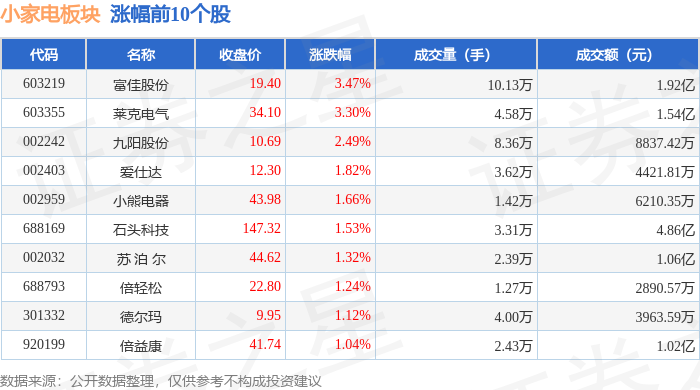
Market Performance - The small home appliance sector increased by 0.89% on February 4, with Fujia Co., Ltd. leading the gains [1] - The Shanghai Composite Index closed at 4102.2, up 0.85%, while the Shenzhen Component Index closed at 14156.27, up 0.21% [1] Stock Performance - Fujia Co., Ltd. (603219) closed at 19.40, up 3.47% with a trading volume of 101,300 shares and a transaction value of 192 million [1] - Lek Electric (603355) closed at 34.10, up 3.30% with a trading volume of 45,800 shares and a transaction value of 154 million [1] - Joyoung Co., Ltd. (002242) closed at 10.69, up 2.49% with a trading volume of 83,600 shares and a transaction value of 88.37 million [1] - Other notable stocks include Stone Technology (688169) which closed at 147.32, up 1.53% with a transaction value of 486 million [1] Capital Flow - The small home appliance sector experienced a net outflow of 56.84 million from institutional investors, while retail investors saw a net outflow of 6.16 million [2] - Conversely, speculative funds recorded a net inflow of 63.01 million [2] Individual Stock Capital Flow - Fujia Co., Ltd. had a net inflow of 29.21 million from institutional investors, but a net outflow of 28.55 million from retail investors [3] - Joyoung Co., Ltd. saw a net inflow of 6.15 million from institutional investors, with a net outflow of 4.35 million from retail investors [3] - Lek Electric had a net inflow of 4.43 million from institutional investors and a net inflow of 9.39 million from speculative funds [3]