Roborock(688169)

Search documents
小家电板块1月30日跌1.22%,鸿智科技领跌,主力资金净流出1.23亿元
Zheng Xing Xing Ye Ri Bao· 2026-01-30 08:54
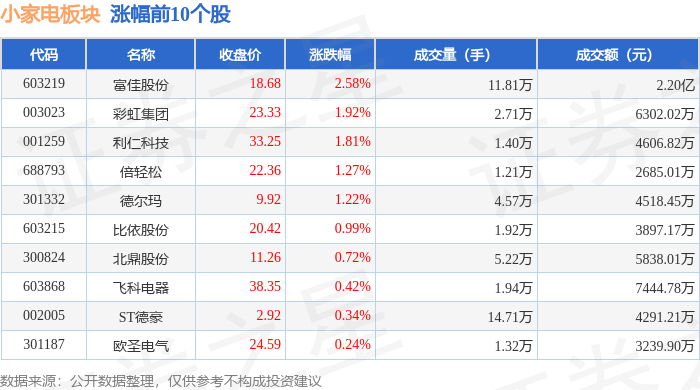
Group 1 - The small home appliance sector experienced a decline of 1.22% on January 30, with Hongzhi Technology leading the drop [1] - The Shanghai Composite Index closed at 4117.95, down 0.96%, while the Shenzhen Component Index closed at 14205.89, down 0.66% [1] - Notable gainers in the small appliance sector included Fujia Co., which rose by 2.58% to a closing price of 18.68, and Rainbow Group, which increased by 1.92% to 23.33 [1] Group 2 - The small home appliance sector saw a net outflow of 123 million yuan from main funds, while retail investors contributed a net inflow of 105 million yuan [2] - Key stocks with significant fund flows included Feike Shiqi, which had a main fund net inflow of 8.34 million yuan, and Delmar, which saw a net inflow of 6.38 million yuan [3] - Conversely, Hongzhi Technology experienced a main fund net inflow of 739,500 yuan, but also had a significant retail net inflow of 610,200 yuan [3]


家电消费新主张,要大美好,更要“真智能”|世研消费指数品牌榜Vol.100
3 6 Ke· 2026-01-27 09:48
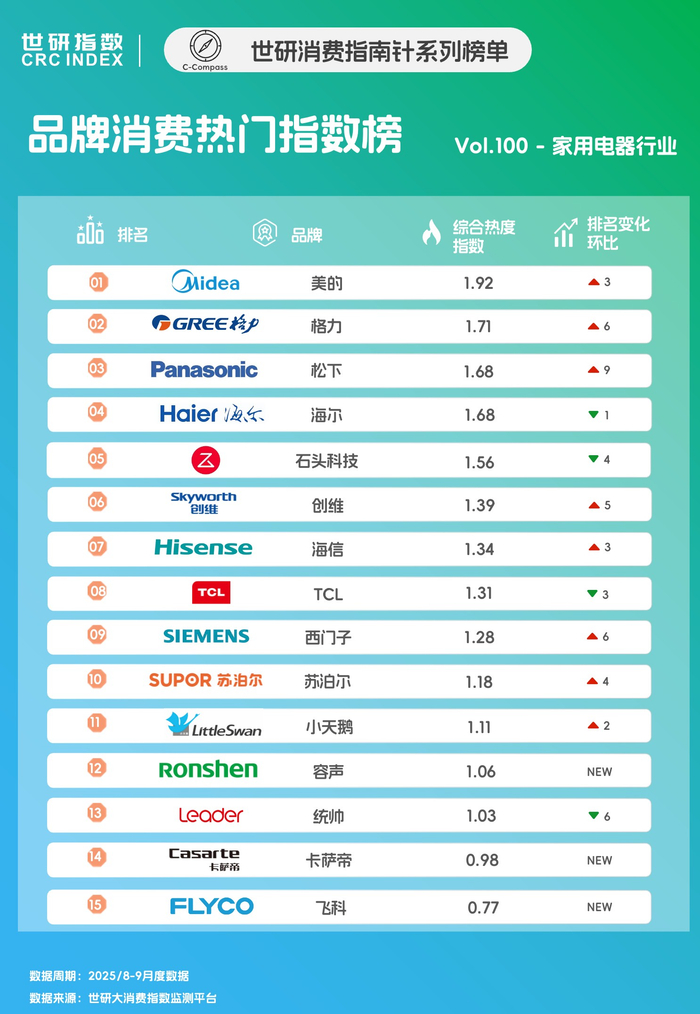
Core Insights - The traditional growth logic of "price for volume" is becoming unsustainable as market growth slows and consumer behavior becomes more rational, prompting leading brands to focus on technological innovation and strategic transformation in the home appliance industry [1] Group 1: Industry Trends - Key trends reshaping the home appliance industry include AI empowerment, health concepts, high-end positioning, and cross-industry integration [1] - The current monitoring period shows that Midea, GREE, and Panasonic lead the heat index rankings with scores of 1.92, 1.71, and 1.68 respectively [2][3] Group 2: Technological Innovations - Midea has launched a new dual-air outlet central air conditioning system aimed at providing a revolutionary user experience, while GREE focuses on AI and energy-saving technologies with its new product lines [4] - Haier emphasizes comprehensive air solutions and has introduced several innovative products, including the industry's first AI air conditioning group standard [4] Group 3: Strategic Transformations - The slowdown in industry growth has led brands to pursue high-end and cross-industry strategies for counter-cyclical growth, as seen with Skyworth's significant revenue increase driven by its new energy business [5] - High-end brands like Casarte have shown resilience, achieving positive growth in a challenging market, highlighting the importance of differentiated competitive strategies [5]





2025Q4家电板块基金持仓点评:行业重仓仍处低位,白电持仓环比提升
Guolian Minsheng Securities· 2026-01-26 06:04
Investment Rating - The report maintains an "Outperform" rating for the home appliance industry [3] Core Insights - The home appliance sector's fund holding ratio remains low at 2.40% for Q4 2025, with a slight increase of 0.08 percentage points from the previous quarter, which is still at a low level compared to historical data since 2010 [6][9] - The white goods segment saw an increase in holdings, while the vacuum cleaner segment experienced a reduction in allocation [17][21] - There is a divergence in northbound holdings, with some companies like Hisense Home Appliances and Bull Group seeing increases, while others like Vatti and Roborock saw declines [42] Summary by Sections Home Appliance Sector Fund Holding Ratio - The fund holding ratio for the home appliance sector in Q4 2025 is 2.40%, ranking 12th among all sectors, with a cumulative increase of 4.09% in the CITIC home appliance index, also ranking 12th in absolute returns [6][9][14] White Goods Increase and Vacuum Cleaner Reduction - The fund holding ratios for sub-segments in Q4 2025 are as follows: white goods at 1.88% (+0.24 percentage points), small appliances at 0.71% (+0.08 percentage points), upstream appliances at 0.27% (-0.16 percentage points), black goods at 0.08% (-0.03 percentage points), kitchen appliances at 0.03% (-0.01 percentage points), and lighting at 0.03% (stable) [17][21] Northbound Holdings Divergence - The northbound holdings for the home appliance sector showed mixed results in Q4 2025, with increases for Hisense Home Appliances (+0.78 percentage points), Bull Group (+0.41 percentage points), and Yitian Smart (+0.41 percentage points), while declines were noted for Vatti (-2.31 percentage points), Roborock (-1.69 percentage points), and XGIMI (-1.47 percentage points) [42][44] Investment Recommendations - The report recommends leading white goods companies such as Midea Group, Haier Smart Home, Gree Electric Appliances, and Hisense Home Appliances, as well as TV leader Hisense Visual and cleaning appliance leaders Roborock and Ecovacs [57]
中国消费行业:2026 年 GCC 会议要点 -估值仍具吸引力,消费复苏迹象显现-China Consumer Sector_ 2026 GCC takeaways_ Sector valuation remains attractive with signs of consumption recovery
2026-01-26 02:50
Summary of Key Points from the Conference Call Industry Overview - **Sector**: China Consumer Sector - **Key Insights**: The sector shows signs of consumption recovery despite a near-term property market downturn. Valuation remains attractive, approximately 1 standard deviation below 10-year averages, indicating that a consumption recovery is not yet priced in [2][21]. Consumer Staples - **Baijiu**: Anticipated demand support for mid-end baijiu due to easing alcohol bans and private consumption growth. Companies are expected to accelerate channel transformations for sustainable EPS growth [3][8]. - **Beer**: Premiumization continues through product diversification and in-home channel expansion, despite on-trade softness. CR Beer expects low-single-digit volume growth in 2025, with Heineken volumes projected to grow by 20% YoY [3][8]. - **Dairy**: Liquid milk sales are expected to recover modestly in 2026, driven by marketing and innovation, despite a weak 2025. Fresh milk shows resilience with double-digit growth [3][8]. - **Freshly-Made Beverages (FMB)**: Guming is expected to maintain steady SSSG in 2026 through category expansion and dine-in growth, despite the phase-out of delivery subsidies [3][8][19]. - **Condiments**: Sequentially improving demand is expected, with Haitian focusing on multi-product categories and Jonjee anticipating a cleaner 2026 after a weak 4Q25 [3][8]. Consumer Discretionary - **Home Appliances**: Companies like Midea and Haier expect higher overseas growth compared to domestic markets in 2026. Strategies include price hikes and operational efficiencies [4][10]. - **Jewelry**: Brands with unique designs may consolidate post-VAT reform. Laopu is expected to achieve strong sales growth due to increased focus on value-added services [4][10]. - **Restaurants**: Intense competition leads to divergent strategies, with some companies lowering prices while others upgrade offerings. DPC Dash is on track for expansion despite market uncertainties [4][10]. Stock Implications - **Most Preferred Stocks**: CR Beer, Guming, MIXUE, China Foods, YUM China, among others, are highlighted as preferred investments due to their growth potential [5]. - **Least Preferred Stocks**: Companies like Swellfun, Nongfu, and Gree are noted as less favorable due to various challenges [5]. Key Risks - Risks include demand recovery uncertainties, cost inflation or deflation, and changes in the competitive landscape. These factors could significantly impact the consumer sector's performance [21]. Additional Insights - **Pet Food**: The industry is shifting towards online sales, with over 85% of sales occurring digitally. Competition is intensifying, pushing brands towards innovation and product differentiation [13]. - **Snack Sector**: Rapid category diversification and channel restructuring are creating growth opportunities, particularly through snack discounters [9][12]. This summary encapsulates the essential insights and projections from the conference call, providing a comprehensive overview of the current state and future outlook of the China consumer sector.



餐饮、潮玩及家电行业周报-20260125
Haitong Securities International· 2026-01-25 13:33
Investment Rating - The report assigns an "Outperform" rating to several companies, including Pop Mart, Anta Sports, Huazhu Group, Li Ning, Miniso, and others, with target prices ranging from 6.99 to 354.00 [1]. Core Insights - The report highlights the enhanced subsidized interest policy for personal consumption loans, which has been extended until the end of 2026, including support for credit card installment payments and the removal of certain limits on subsidy amounts [2]. - Pop Mart's new PUCKY series has gained significant popularity, being referred to as the "electronic wooden fish" due to its unique design and emotional stress-relief features [3]. - Weekly performance shows TCL Electronics (+24.8%), Pop Mart (+23.0%), and others leading the market, while companies like Ecovacs (-1.2%) and Haier Smart Home (-2.2%) lag behind [5][9]. Company Summaries - **Pop Mart**: Recently launched the PUCKY series, which quickly sold out and is now being resold at a premium on secondary markets [3]. The company also repurchased 1.9 million shares [7]. - **TCL Electronics**: Established a joint venture with Sony to take over Sony's home entertainment business, reflecting strategic growth initiatives [8]. - **Huazhu Group**: Engaged in strategic partnerships and is expected to benefit from the ongoing trends in the hospitality sector [4]. - **Li Ning**: Continues to perform well in the market, maintaining a positive outlook with an "Outperform" rating [1]. Industry Dynamics - The report notes significant strategic partnerships, such as Saint Bella's collaboration with Yunji Technology to explore AI and robotics in home care [15]. - The IPO of Busy Ming was oversubscribed by over 1,500 times, indicating strong market interest [10]. - Regulatory developments include the State Council's solicitation of opinions on national standards for pre-made dishes, which could impact the food and beverage sector [10].

家电行业 2026W04 周报:家电基金持仓略有下降,欧盟对割草机进口展开登记
GUOTAI HAITONG SECURITIES· 2026-01-25 10:45
Investment Rating - The report assigns an "Overweight" rating to the home appliance industry [4]. Core Insights - The report highlights a slight decline in fund holdings in the home appliance sector, with a 2.6% allocation in actively managed equity funds for Q4 2025, down 0.2 percentage points from Q3 [2][4]. - December retail sales for home appliances showed a year-on-year decline of 18.7%, indicating ongoing pressure despite a high base in the previous year [2][4]. - The European Union has mandated registration for imports of robotic lawn mowers from China, with potential anti-dumping duties estimated between 21.4% and 57.4% [2][4]. Summary by Sections Investment Recommendations - The report suggests that national subsidies are expected to transition smoothly, and leading companies in both black and white appliances are recommended for their stable operations and high dividends, including Midea Group (13.1X PE), Haier Smart Home (11.4X), TCL Electronics (12.7X), and Hisense Visual (12.7X) [4]. - It emphasizes the core drivers of smart home appliances' overseas expansion, recommending leading robotic vacuum manufacturers Roborock (20.3X) and Ecovacs (22.5X) [4]. - Companies with stable performance and upward potential include Ninebot (19.9X), Anfu Technology (56.8X), Hailong Cold Chain (15.9X), and Beiding Co. (35.3X) [4]. - The report also notes that home appliance companies are diversifying into new areas, recommending Rongtai Health (21.3X) and Wanlong Magnetic Plastic (21.9X) [4]. Market Data - In December 2025, the production of home air conditioners was 14.782 million units, down 18.7% year-on-year, with domestic sales at 5.397 million units, down 26.7% [2][4]. - The total domestic sales for the year reached 10.521 million units, a slight increase of 0.7% year-on-year, while total exports were 9.318 million units, down 3.4% [2][4]. - The overall retail sales for home appliances in December 2025 amounted to 97.1 billion yuan, with a cumulative annual total of 1,169.5 billion yuan, reflecting an 11.0% year-on-year increase [2][4].



家电周报:亿田智能发布2025年业绩预告,石头科技发布新品-20260125
Shenwan Hongyuan Securities· 2026-01-25 09:28
Investment Rating - The report maintains a positive outlook on the home appliance industry, particularly on leading companies in the white and black goods sectors, highlighting their low valuations, high dividends, and stable growth potential [2][3]. Core Insights - The report identifies three main investment themes: 1. **Dividend and Growth**: Leading companies in the white and black goods sectors are characterized by low valuations, high dividends, and stable growth, providing a high safety margin and significant price elasticity. The impact of the trade-in policy is expected to continue positively into 2026 [2][3]. 2. **Technological Transition**: Key upstream component manufacturers are diversifying into emerging technology sectors such as robotics, data center temperature control, and semiconductors, seeking cross-industry transformation [2][3]. 3. **Market Demand**: Both domestic and international markets show promising demand, with established companies expanding production bases globally to mitigate trade fluctuations and capture growth in emerging markets [2][3]. Sales Data Summary - **Air Conditioning**: In December 2025, online retail sales volume was 720,000 units, a year-on-year decrease of 38.5%, while offline sales volume was 162,000 units, down 42.9%. The average online retail price decreased by 4.2% to 2,981 yuan per unit, and the offline average price fell by 20.1% to 3,801 yuan per unit [2][3][35]. - **Kitchen Appliances**: - **Range Hoods**: Online sales volume was 443,000 units, down 16.8%, while offline sales were 57,000 units, down 32.1%. The online average price increased by 14.4% to 1,739 yuan per unit, while the offline average price decreased by 14.4% to 3,813 yuan per unit [3][41]. - **Dishwashers**: Online sales volume was 49,000 units, down 10.2%, and offline sales were 5,000 units, down 44.2%. The online average price decreased by 1.1% to 4,245 yuan per unit, while the offline average price increased by 1.4% to 7,990 yuan per unit [3][41]. Company Updates - **Yitian Intelligent**: Forecasts a net loss of 186 to 152 million yuan for 2025, compared to a profit of 26.54 million yuan in 2024 [5][11]. - **Roborock Technology**: Launched new products including the G30S Pro and P20 Ultra, featuring advanced cleaning technologies and high efficiency [5][12]. - **Stock Performance**: The home appliance sector outperformed the CSI 300 index, with notable gains from companies like Aojiahua (10.1%) and Hisense Visual (5.7%) [5][6][8]. Macro Economic Environment - As of January 23, 2026, the USD to RMB exchange rate was 6.9929, reflecting a decrease of 0.51% since the beginning of the year [46][48]. - In December 2025, the total retail sales of consumer goods reached 45,135.90 billion yuan, a year-on-year increase of 0.86% [48][49].
家电行业 2026W04 周报:家电基金持仓略有下降,欧盟对割草机进口展开登记-20260125
GUOTAI HAITONG SECURITIES· 2026-01-25 07:47
Investment Rating - The report assigns an "Accumulate" rating for the home appliance industry [4]. Core Insights - The report highlights a slight decline in fund holdings in the home appliance sector, with a 2.6% allocation in actively managed equity funds for Q4 2025, down 0.2 percentage points from Q3 [2][4]. - The report notes that the production of household air conditioners in December 2025 was 14.782 million units, a year-on-year decrease of 18.7%, with domestic sales down 26.7% and exports down 13.2% [2][4]. - The report mentions that the EU has mandated registration for imports of robotic lawn mowers from China, with potential anti-dumping duties estimated between 21.4% and 57.4% [2][4]. Summary by Sections Investment Recommendations - The report suggests that national subsidies are expected to transition smoothly, and recommends several companies for investment based on their stable operations and high dividends, including Midea Group (13.1X), Haier Smart Home (11.4X), TCL Electronics (12.7X), and Hisense Visual (12.7X) [4]. - It highlights the core drivers for smart home appliances' overseas expansion, recommending leading robotic vacuum companies Roborock (20.3X) and Ecovacs (22.5X) [4]. - The report also recommends companies with stable performance and upward potential, such as Ninebot (19.9X), Anfu Technology (56.8X), Hailong Cold Chain (15.9X), and Beiding Co. (35.3X) [4]. - Additionally, it points out companies expanding into new business lines, recommending Rongtai Health (21.3X) and Wanlong Magnetic Plastic (21.9X) [4]. Market Data - The report provides data on the top five holdings in the home appliance sector, with Midea Group valued at 19.9 billion, Haier Smart Home at 6 billion, and others showing varying changes in market value [4]. - It notes that the overall retail sales of home appliances in December 2025 were 97.1 billion, a year-on-year decrease of 18.7% [2][4]. - The report indicates that the total domestic sales volume for the air conditioning industry in 2025 was 10.521 million units, a slight increase of 0.7% year-on-year, while total exports were 9.318 million units, down 3.4% [2][4].
石头科技IPO等待临门一脚,全球第一能否经受住考验
Sou Hu Cai Jing· 2026-01-25 07:36
Group 1 - The core point of the article is that Stone Technology has received preliminary approval from the Hong Kong Stock Exchange for its H-share listing, pending final approval, which could make it the first company in the "robot vacuum" sector to be listed in Hong Kong [2] - The market reaction to this news has been notably tepid, indicating a sense of disappointment or melancholy regarding the company's prospects [2] - In June 2021, Stone Technology's stock price peaked at 1494.99 yuan per share, with its market capitalization approaching 100 billion yuan, making it the second-largest "robot vacuum" company in the A-share market after Moutai [2]

小家电板块1月23日涨0.65%,ST德豪领涨,主力资金净流出4504.04万元
Zheng Xing Xing Ye Ri Bao· 2026-01-23 09:04
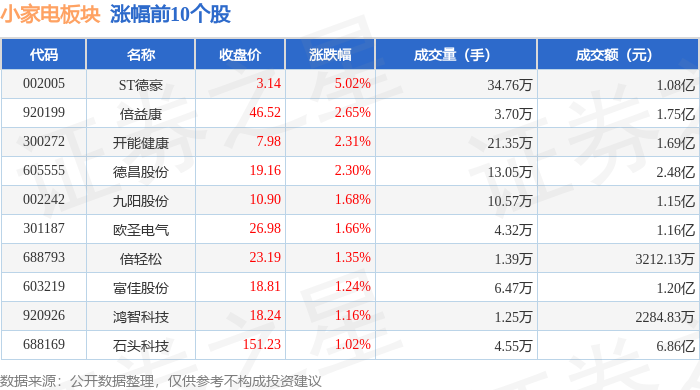
Market Performance - The small home appliance sector increased by 0.65% on January 23, with ST Dehao leading the gains [1] - The Shanghai Composite Index closed at 4136.16, up 0.33%, while the Shenzhen Component Index closed at 14439.66, up 0.79% [1] Stock Performance - ST Dehao (002005) closed at 3.14, up 5.02% with a trading volume of 347,600 shares and a transaction value of 108 million yuan [1] - Other notable performers include: - Beiyikang (6610Z6) at 46.52, up 2.65% [1] - Kaineng Health (300272) at 7.98, up 2.31% [1] - Dechang Co. (605555) at 19.16, up 2.30% [1] - Joyoung (002242) at 10.90, up 1.68% [1] Capital Flow - The small home appliance sector experienced a net outflow of 45.04 million yuan from institutional investors, while retail investors saw a net inflow of 82.44 million yuan [2] - The overall capital flow indicates a mixed sentiment among different investor types [2] Individual Stock Capital Flow - Lek Electric (603355) had a net inflow of 23.46 million yuan from institutional investors but a net outflow of 10.31 million yuan from retail investors [3] - ST Dehao (002005) saw a net inflow of 19.80 million yuan from institutional investors, with retail investors also showing a net outflow [3] - Other stocks like Dechang Co. (605555) and Kaineng Health (300272) also reflected similar trends in capital flow [3]