
Roborock(688169)

Search documents
国信证券:原材料价格上涨对白电龙头影响有限 白电排产表现有所修复
智通财经网· 2026-02-03 07:32
Core Viewpoint - Recent increases in raw material prices, particularly copper and aluminum, have raised concerns about the profitability of leading white goods companies, but historical data suggests that the negative impact on gross margins may diminish over time [1][2] Group 1: Raw Material Price Impact - Since 2008, the home appliance industry has experienced three significant raw material price increase cycles, with the impact on gross margins decreasing over time: the highest quarterly gross margin decline was 5-7 percentage points during 2009-2011, around 5 percentage points in 2016-2017, and approximately 2 percentage points from 2020-2022 [1] - In January 2026, copper and aluminum prices increased by 36.7% and 20.9% year-on-year, respectively, which is lower than the increases seen from 2020-2022, suggesting that the current raw material cost impact on white goods companies may be less severe [2] Group 2: Production and Demand Trends - In February, the total production of white goods in China reached 23.79 million units, a 22.1% decrease compared to the same period last year, with a projected 5.0% decline for January-February combined [3] - The production performance of white goods has shown signs of recovery, with the impact of the Spring Festival timing affecting February production, but cumulative growth for January-February has slightly improved [3] Group 3: Retail Market Performance - In 2025, the retail scale of China's home appliance market is expected to decline by 4.3% year-on-year to 893.1 billion yuan, with specific categories like air conditioners and refrigerators experiencing declines of 0.4% and 11.5%, respectively [4] - Small home appliances are expected to perform better, with an overall retail growth of 3.8%, indicating a relative resilience compared to larger appliances [4] Group 4: Key Data Tracking - In January, the home appliance sector experienced a relative return of -2.6%, with raw material prices for copper and aluminum increasing by 7.8% and 4.8% month-on-month, respectively [5] Group 5: Investment Recommendations - Recommended stocks in the white goods sector include Midea Group, Haier Smart Home, TCL Smart Home, and Hisense Home Appliances, while TCL Electronics and Hisense Visual are recommended in the black goods sector [6]




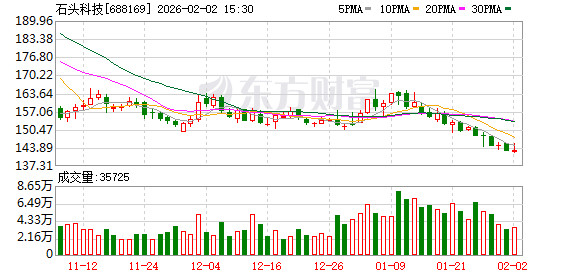
石头科技:关于以集中竞价交易方式回购公司股份的进展公告
Zheng Quan Ri Bao· 2026-02-02 12:40
Group 1 - The core point of the article is that Stone Technology announced it did not conduct any share buybacks in January 2026, and as of January 31, 2026, it had repurchased a total of 369,036 shares, which represents 0.1424% of the company's total share capital [2] Group 2 - The share repurchase was executed through the Shanghai Stock Exchange trading system using a centralized bidding method [2] - The announcement highlights the company's ongoing strategy regarding share buybacks and capital management [2]


家电行业2026年2月投资策略:材料价格上涨对白电龙头影响有限,白电1-2月排产增速环改善
Guoxin Securities· 2026-02-02 11:56
Core Views - The report maintains an "Outperform" rating for the home appliance industry, indicating a positive outlook despite recent challenges [5][3] - Rising raw material prices, particularly copper and aluminum, are expected to have a limited impact on the profitability of leading white goods manufacturers, as historical data shows diminishing effects over time [1][17] - The report anticipates that the overall gross margin decline for white goods companies will be less than 2 percentage points due to price adjustments and cost-saving measures [1][17] Production and Demand Trends - In February, the total production of white goods in China reached 23.79 million units, reflecting a year-on-year decline of 22.1%, but the rate of decline is improving compared to previous months [2][24] - The cumulative production decline for January and February is estimated at 5%, showing signs of recovery driven by government subsidy policies [2][24] - The report highlights that the demand for white goods is expected to stabilize and recover as the effects of national subsidy policies continue to manifest [2][24] Retail Market Performance - The retail scale of China's home appliance market is projected to decline by 4.3% in 2025, with small appliances showing relatively better performance [2][31] - Specific categories such as air conditioners and refrigerators are experiencing significant declines in retail sales, while kitchen small appliances are expected to see growth [2][31] Key Investment Recommendations - The report recommends several companies for investment, including Midea Group, Haier Smart Home, TCL Smart Home, and Hisense Home Appliances in the white goods sector, and Stone Technology and Bear Electric in the small appliances sector [3][12] - The report emphasizes the importance of companies with strong overseas growth potential and solid domestic performance, particularly those benefiting from cost reduction and efficiency improvements [12][14] Company Profitability Forecasts - The report provides profitability forecasts for key companies, indicating expected earnings per share (EPS) growth for Midea Group, Haier Smart Home, and TCL Smart Home, among others [4][50] - The projected price-to-earnings (PE) ratios for these companies suggest favorable valuations compared to historical averages, supporting the investment thesis [4][50]

家电行业 2026 年 2 月投资策略:原材料价格上涨对白电龙头影响有限,白电 1-2 月排产增速环比改善
Guoxin Securities· 2026-02-02 11:09
Core Views - The report maintains an "Outperform" rating for the home appliance industry, indicating a positive outlook despite challenges from rising raw material prices and market competition [1][5][11]. Raw Material Price Impact - Recent increases in copper and aluminum prices have raised concerns about the profitability of leading white goods manufacturers. However, historical analysis shows that the negative impact of raw material cost increases on gross margins has diminished over time. For instance, during previous cycles from 2008 to 2022, the maximum quarterly gross margin decline for leading white goods companies was 5-7 percentage points in 2009-2011, around 5 percentage points in 2016-2017, and only about 2 percentage points in 2020-2022. The current price increases are expected to have a lesser impact, with an anticipated gross margin decline of less than 2 percentage points [1][17][18]. Production and Demand Trends - In January and February 2026, the total production of white goods in China was 23.79 million units, reflecting a year-on-year decline of 22.1%. However, the cumulative production decline for the first two months is expected to be around 5%. The production performance has shown signs of recovery compared to a more than 10% decline in Q4 2025. The demand is expected to stabilize due to the effects of national subsidy policies [2][24]. Retail Market Performance - The retail market for home appliances in China is projected to decline by 4.3% in 2025, with a total retail scale of 893.1 billion yuan. Specific categories such as air conditioners and refrigerators are expected to see declines of 0.4% and 11.5%, respectively, while small kitchen appliances are expected to grow by 3.8% [2][31]. Investment Recommendations - The report recommends several companies for investment based on their performance and market position. For white goods, companies like Midea Group, Haier Smart Home, TCL Home, and Hisense Home Appliances are highlighted. In the small appliance sector, Stone Technology, Bear Electric, and New Treasure are recommended. For black goods, TCL Electronics and Hisense Visual are suggested [3][12][50]. Company Earnings Forecasts - The report provides earnings forecasts for key companies, indicating that Midea Group is expected to have an EPS of 5.84 yuan in 2025 and 6.43 yuan in 2026, with a PE ratio of 13 for 2025. Haier Smart Home is projected to have an EPS of 2.27 yuan in 2025 and 2.53 yuan in 2026, with a PE ratio of 11 for 2025 [4][50].

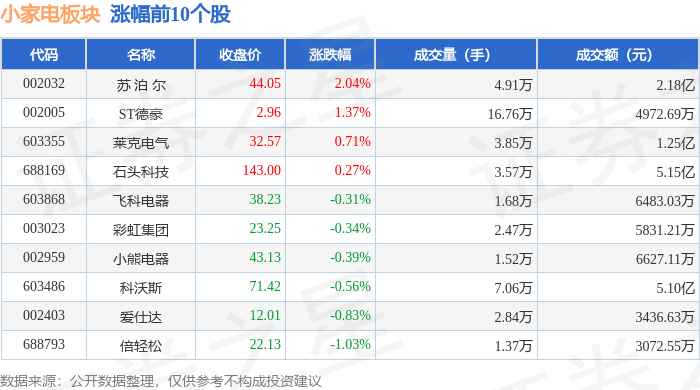
小家电板块2月2日跌0.35%,倍益康领跌,主力资金净流出2287.8万元
Zheng Xing Xing Ye Ri Bao· 2026-02-02 09:15
Market Overview - The small home appliance sector experienced a decline of 0.35% on February 2, with BeiYikang leading the drop [1] - The Shanghai Composite Index closed at 4015.75, down 2.48%, while the Shenzhen Component Index closed at 13824.35, down 2.69% [1] Stock Performance - Notable gainers in the small home appliance sector included: - Supor (002032) with a closing price of 44.05, up 2.04% and a trading volume of 49,100 shares, totaling 218 million yuan [1] - ST Dehao (002005) closed at 2.96, up 1.37% with a trading volume of 167,600 shares, totaling 49.73 million yuan [1] - Major decliners included: - BeiYikang (6610Z6) with a closing price of 40.53, down 3.48% and a trading volume of 15,100 shares, totaling 62.29 million yuan [2] - Fuhua Co. (603219) closed at 18.06, down 3.32% with a trading volume of 65,600 shares, totaling 120 million yuan [2] Capital Flow - The small home appliance sector saw a net outflow of 22.88 million yuan from institutional investors, while retail investors had a net inflow of 18.71 million yuan [2] - The capital flow for key stocks showed: - Supor had a net inflow of 21.56 million yuan from institutional investors, while retail investors had a net outflow of 12.38 million yuan [3] - LeiKe Electric (603355) experienced a net inflow of 16.44 million yuan from institutional investors, with a net outflow of 15.57 million yuan from retail investors [3]


石头科技(688169) - 北京石头世纪科技股份有限公司关于以集中竞价交易方式回购公司股份的进展公告
2026-02-02 08:00
证券代码:688169 证券简称:石头科技 公告编号:2026-003 北京石头世纪科技股份有限公司 关于以集中竞价交易方式回购公司股份的进展公告 本公司董事会及全体董事保证本公告内容不存在任何虚假记载、误导性陈 述或者重大遗漏,并对其内容的真实性、准确性和完整性承担法律责任。 重要内容提示: | 回购方案首次披露日 | 2025/4/4 | | | | | | | --- | --- | --- | --- | --- | --- | --- | | 回购方案实施期限 | 2025 年 4 月 1 | 4 月 | 2 | 日~2026 | 年 | 日 | | 预计回购金额 | 5,000万元~10,000万元 | | | | | | | 回购用途 | □减少注册资本 √用于员工持股计划或股权激励 | | | | | | | | □用于转换公司可转债 □为维护公司价值及股东权益 | | | | | | | 累计已回购股数 | 36.9036万股 | | | | | | | 累计已回购股数占总股本比例 | 0.1424% | | | | | | | 累计已回购金额 | 7,386.52万元 | | | | | ...
家电行业 2026W04 周报:关注地产链复苏机会,重点家电公司披露年报预告
GUOTAI HAITONG SECURITIES· 2026-02-02 02:40
Investment Rating - The industry investment rating is "Increase Holding" [6][13]. Core Insights - The real estate market is expected to stabilize, creating opportunities for recovery in the real estate supply chain, with a focus on key home appliance companies' annual report forecasts [2][6]. - Key home appliance companies are showing significant profit growth, with notable increases in net profits for companies like Ecovacs and Ninebot, while others like Roborock are experiencing declines [3][4][6]. Summary by Relevant Sections Key Home Appliance Company Forecasts - Ecovacs is projected to achieve a net profit of 1.7-1.8 billion yuan in 2025, representing a year-on-year increase of 111%-123% [3]. - Ninebot expects a net profit of 1.67-1.85 billion yuan in 2025, a year-on-year increase of 54%-71% [3]. - Roborock anticipates a net profit of no less than 1.34 billion yuan in 2025, a year-on-year decrease of 31% [3]. - Anfu Technology forecasts a net profit of 220-250 million yuan in 2025, a year-on-year increase of 29%-51% [3]. - TCL Electronics expects an adjusted net profit of 2.33-2.57 billion HKD in 2025, a year-on-year increase of 45%-60% [4]. - Beiding Co. anticipates a revenue of 950 million yuan in 2025, a year-on-year increase of 26% [4]. Investment Recommendations - The report recommends increasing holdings in companies such as Midea Group, Haier Smart Home, TCL Electronics, and Hisense Visual, which are expected to perform well due to stable operations and high dividends [6][7]. - The report highlights the potential for smart home appliances to drive growth, particularly for leading robotic vacuum companies like Roborock and Ecovacs [6]. - Companies like Ninebot and Anfu Technology are noted for their stable performance and upward potential, making them attractive investment options [6].

家电行业周报(26/1/26-26/1/30):AI Agent有望开启NAS成长新空间-20260201
Hua Yuan Zheng Quan· 2026-02-01 14:38
Investment Rating - The investment rating for the home appliance industry is "Positive" (maintained) [4] Core Insights - The rise of AI NAS, driven by Clawdbot, is expected to expand the demand for NAS, with Ugreen Technology likely to benefit significantly from this trend [5][14] - TCL Electronics is set to collaborate with Sony to take over Sony's television business, potentially allowing them to surpass Samsung and become the global leader in market share [22][23] - Stone Technology has launched new domestic floor cleaning robots, focusing on dual technology lines to enhance market penetration [25] - XGIMI continues to experience high growth overseas, with its new product Horizon 20 performing well in international markets [28] Summary by Sections AI NAS and Ugreen Technology - Clawdbot's popularity signifies a shift in AI applications towards local AI agents, creating a demand for edge hardware [8] - NAS is positioned as the optimal hardware for local AI agents due to its data centralization, low power consumption, and scalable computing power [11][12][13] - Ugreen Technology, as a leading consumer NAS provider in China, is expected to gain from the increased demand for local data platforms driven by AI agents [14][16] TCL Electronics and Sony Collaboration - TCL Electronics plans to establish a joint venture with Sony to manage Sony's home entertainment business, which could enhance their global market share [22] - This partnership is anticipated to leverage TCL's resources in panel production and Sony's brand strength to penetrate high-end markets [23] Stone Technology's Product Launch - Stone Technology has introduced two new high-end floor cleaning robots, targeting different market segments with innovative features [25] - The G30S Pro series and P20 Ultra are designed to address existing pain points in cleaning efficiency and user experience [25] XGIMI's Overseas Growth - XGIMI's Horizon 20 has shown strong sales performance in international markets, indicating successful product positioning and market strategy [28] - The company is expected to continue its growth trajectory as it challenges established competitors in the high-end projector market [28] Market Performance - The home appliance sector experienced a decline of 2.9% in the week of January 26 to January 30, 2026, underperforming against the Shanghai Composite Index [32][35] - Specific segments such as black appliances saw a significant drop of 7.2%, indicating varying performance across categories [32]

家电周报:三大白电 2 月排产数据发布,民爆光电公告收购预案-20260131
Shenwan Hongyuan Securities· 2026-01-31 12:12
Investment Rating - The report indicates a cautious outlook for the home appliance sector, with a recommendation to focus on leading companies that exhibit low valuations, high dividends, and stable growth potential [5][10]. Core Insights - The home appliance sector underperformed compared to the Shanghai and Shenzhen 300 Index, with a decline of 2.4% in the appliance index while the broader index rose by 1.1% [5][6]. - Major companies like Opple Lighting, Boss Electric, and Midea Group showed positive performance, while companies like Ecovacs, Lek Electric, and Huaxiang suffered significant declines [5][8]. - Production data for major appliances in February 2026 revealed substantial year-on-year declines, with air conditioner production down 31.6%, refrigerators down 17%, and washing machines down 3.2% [10][11]. - The report highlights three main investment themes: 1. **Dividend Play**: Leading white and black appliance companies are characterized by low valuations and high dividend yields, providing a safety margin and growth potential [5]. 2. **Technology Transition**: Key component manufacturers are diversifying into emerging tech sectors such as robotics and semiconductor cooling, indicating a shift in business strategy [5]. 3. **Export Opportunities**: Major appliance firms are well-positioned in global markets, with production bases in various regions to mitigate trade risks and capitalize on demand in emerging markets [5]. Industry Dynamics - The report notes a significant drop in production for major appliances in February 2026, with air conditioners at 11.49 million units, refrigerators at 6 million units, and washing machines at 6.3 million units, all showing declines compared to the previous year [10]. - The report also mentions a planned acquisition by Minexplosion Optoelectronics, which aims to purchase a 49% stake in Xiamen Maida and a 51% stake in cash, with a total consideration not exceeding 250 million yuan [11]. Data Observations - Sales data for cleaning appliances in December 2025 showed an increase in volume but a decrease in revenue and average price, with robotic vacuum sales up 29.11% but revenue down 2.14% [34]. - Personal care products like hair dryers saw a decline in sales volume and revenue, while electric shaver sales revenue increased despite a drop in volume [40][41]. Macro Economic Environment - As of January 30, 2026, the USD to RMB exchange rate showed a decrease of 0.87% since the beginning of the year, indicating potential impacts on import costs for raw materials [47]. Company Announcements - Ecovacs announced a bond buyback option, with no investors opting for the buyback during the specified period, indicating confidence in the company's stock performance [63]. - Other companies like Aojiahua and Foshan Lighting provided profit forecasts indicating significant declines in net profits for 2025, reflecting broader industry challenges [60][64].
三大白电2月排产数据发布,民爆光电公告收购预案
Shenwan Hongyuan Securities· 2026-01-31 09:49
Investment Rating - The report maintains a positive outlook on the home appliance sector, particularly recommending leading companies in the white and black goods categories due to their low valuations, high dividends, and stable growth potential [5][11]. Core Insights - The home appliance sector underperformed compared to the Shanghai and Shenzhen 300 Index, with a decline of 2.4% in the home appliance index while the broader index rose by 1.1% [5][6]. - Production data for major home appliances in February 2026 shows significant year-on-year declines: air conditioners down 31.6%, refrigerators down 17%, and washing machines down 3.2% [11][12]. - The report highlights the resilience of leading companies in the face of international trade fluctuations and emphasizes the growth potential in emerging markets [5][11]. Summary by Sections Industry Performance - The home appliance sector index decreased by 2.4%, while the Shanghai and Shenzhen 300 Index increased by 1.1% [5][6]. - Key companies such as Opple Lighting, Boss Electric, and Midea Group showed gains, while companies like Ecovacs and Lek Electric faced significant declines [5][8]. Production Data - February 2026 production figures indicate a total of 11.49 million air conditioners produced, a 31.6% decrease from the previous year; 6 million refrigerators, down 17%; and 6.3 million washing machines, down 3.2% [11][12]. Company Developments - Minexplosion Optoelectronics announced plans to acquire a 49% stake in Xiamen Maida and a cash purchase of 51% stake in Xiamen Precision, with a total cash consideration not exceeding 250 million yuan [12]. Market Trends - The report notes a year-on-year increase in sales of cleaning appliances, with robotic vacuum sales up 29.11% in December 2025, although sales revenue decreased by 2.14% [35][40]. - Personal care products showed mixed results, with hairdryer sales down 26.36% but electric shaver sales revenue up by 1.78% [42][45]. Investment Opportunities - The report identifies three main investment themes: 1. Leading white and black goods companies with low valuations and high dividends [5]. 2. Core component manufacturers expanding into new technology sectors [5]. 3. Companies like Ecovacs and Roborock benefiting from strong demand for cleaning appliances [5][11]. Economic Environment - As of January 30, 2026, the USD to RMB exchange rate has decreased by 0.87% since the beginning of the year [50][51]. - Retail sales in December 2025 showed a slight increase of 0.86% year-on-year, while disposable income for urban residents rose by 4.27% [52][53]. Regulatory Developments - Shenzhen's three-year action plan aims to enhance the consumption environment, promoting smart home products and digital consumption [73][75]. - The plan encourages the integration of artificial intelligence in home appliances and aims to boost home renovation and smart home adoption [75][76].