
Junshi Biosciences(688180)

Search documents
A股央企ESG系列报告之十四:有色金属行业央企ESG评价结果分析:充分履行环境责任
Shenwan Hongyuan Securities· 2025-11-07 09:42
Investment Rating - The report indicates a positive outlook for the non-ferrous metals industry, with a focus on ESG performance management among central enterprises [3][4]. Core Insights - The report evaluates 18 central enterprises in the non-ferrous metals sector based on an established ESG rating system, highlighting that 11 companies scored over 100 points, reflecting a systematic approach to ESG management [4][12]. - Environmental management is prioritized, with comprehensive disclosure on pollution control, waste management, and energy utilization, although there is room for improvement in areas like green mining and circular economy indicators [4][24]. - The report emphasizes the importance of climate-related governance, with many companies actively addressing climate change and setting reduction targets, though mechanisms for information acquisition need enhancement [4][42]. - Social responsibility is a key focus, with all companies covering social indicators, but there is a noted deficiency in disclosures related to technology ethics [4][61]. - Governance structures are generally robust, but there is a need for improvement in due diligence practices, particularly concerning compliance checks of supply chain partners [4][75]. Summary by Sections 1. Overall Scores and ESG Governance - The overall ESG scores for the 18 central enterprises are high, with 61.1% scoring above 100 points, indicating a well-established ESG management framework [12]. 2. Importance Assessment: Need for Third-Party Verification - All companies disclosed financial and impact importance assessments, but only 11% provided third-party verification, indicating a gap in independent validation [16][17]. 3. Environmental: Mature Disclosure, Comprehensive Management - Environmental indicators show high scores, with 67% of companies achieving full marks, reflecting strong environmental protection awareness [24][27]. 4. Climate: Accelerating Disclosure Framework - 67% of companies received full scores for climate-related disclosures, demonstrating a high level of commitment to addressing climate change [42][49]. 5. Social: Commitment to Social and Management Responsibilities - Social responsibility indicators are fully covered by all companies, but technology ethics disclosures are lacking [61][64]. 6. Governance: Well-Structured, Need for Enhanced Due Diligence - Governance structures are generally well-defined, with high coverage of governance mechanisms, but due diligence practices require further development [75][76].


君实生物股价连续5天下跌累计跌幅6.39%,易方达基金旗下1只基金持1939.29万股,浮亏损失5003.37万元
Xin Lang Cai Jing· 2025-11-07 09:23
来源:新浪基金∞工作室 11月7日,君实生物跌1.92%,截至发稿,报37.79元/股,成交2.92亿元,换手率1.00%,总市值387.99亿 元。君实生物股价已经连续5天下跌,区间累计跌幅6.39%。 资料显示,上海君实生物医药科技股份有限公司位于上海市浦东新区平家桥路100弄6号7幢16层,香港铜 锣湾希慎道33号利园1期19楼1918室,成立日期2012年12月27日,上市日期2020年7月15日,公司主营业 务涉及单克隆抗体药物和其他治疗型蛋白药物的研发与产业化,单克隆抗体药物研发的技术服务与技术 转让等。主营业务收入构成为:药品销售90.67%,技术许可及特许权使用收入8.74%,技术服务及其他 0.59%。 成曦累计任职时间9年187天,现任基金资产总规模2501.21亿元,任职期间最佳基金回报131.04%, 任 职期间最差基金回报-67.89%。 从君实生物十大流通股东角度 风险提示:市场有风险,投资需谨慎。本文为AI大模型自动发布,任何在本文出现的信息(包括但不 限于个股、评论、预测、图表、指标、理论、任何形式的表述等)均只作为参考,不构成个人投资建 议。 易方达上证科创板50ETF(58 ...
君实生物股价连续5天下跌累计跌幅6.39%,新疆前海联合基金旗下1只基金持2.02万股,浮亏损失5.2万元
Xin Lang Cai Jing· 2025-11-07 09:10
来源:新浪基金∞工作室 11月7日,君实生物跌1.92%,截至发稿,报37.79元/股,成交2.92亿元,换手率1.00%,总市值387.99亿 元。君实生物股价已经连续5天下跌,区间累计跌幅6.39%。 资料显示,上海君实生物医药科技股份有限公司位于上海市浦东新区平家桥路100弄6号7幢16层,香港铜 锣湾希慎道33号利园1期19楼1918室,成立日期2012年12月27日,上市日期2020年7月15日,公司主营业 务涉及单克隆抗体药物和其他治疗型蛋白药物的研发与产业化,单克隆抗体药物研发的技术服务与技术 转让等。主营业务收入构成为:药品销售90.67%,技术许可及特许权使用收入8.74%,技术服务及其他 0.59%。 风险提示:市场有风险,投资需谨慎。本文为AI大模型自动发布,任何在本文出现的信息(包括但不 限于个股、评论、预测、图表、指标、理论、任何形式的表述等)均只作为参考,不构成个人投资建 议。 前海联合国民健康混合A(003581)成立日期2016年12月29日,最新规模1564.76万。今年以来收益 6.95%,同类排名6475/8148;近一年收益0.76%,同类排名7710/8053;成立以 ...
君实生物跌1.92%,成交额2.92亿元,今日主力净流入-4670.81万
Xin Lang Cai Jing· 2025-11-07 07:38
Core Viewpoint - The company, Junshi Biosciences, aims to establish itself as a global innovative pharmaceutical company with a complete industry chain capability from drug discovery to commercialization, focusing on quality and innovation in drug development [2][3]. Company Overview - Junshi Biosciences was founded on December 27, 2012, and went public on July 15, 2020. Its main business involves the research and commercialization of monoclonal antibody drugs and other therapeutic proteins, with 90.67% of revenue coming from drug sales [7]. - As of September 30, 2025, the company reported a revenue of 1.806 billion yuan, a year-on-year increase of 42.06%, while the net profit attributable to shareholders was -596 million yuan, a year-on-year increase of 35.72% [8]. Product Development - The company has developed a strong portfolio of innovative drugs, including the first domestically approved PD-1 monoclonal antibody, Toripalimab, which has received approval for 11 indications in mainland China and is also approved in multiple countries including the US and EU [2]. - Junshi Biosciences is also advancing its pipeline with Tifcemalimab, the first anti-BTLA monoclonal antibody entering clinical development, currently undergoing two Phase III trials [2]. Collaborations and Research - The company is collaborating with institutions such as Peking University and the Chinese Academy of Sciences to develop vaccines, including a monkeypox vaccine, which is currently in the preclinical development stage [3][8]. Market Performance - On November 7, the company's stock fell by 1.92%, with a trading volume of 292 million yuan and a market capitalization of 38.799 billion yuan [1]. - The stock has seen a net outflow of 458.376 million yuan from major investors, indicating a trend of reduced holdings over the past three days [4][5]. Technical Analysis - The average trading cost of the stock is 41.33 yuan, with the current price approaching a resistance level of 38.99 yuan, suggesting potential volatility in the near term [6].
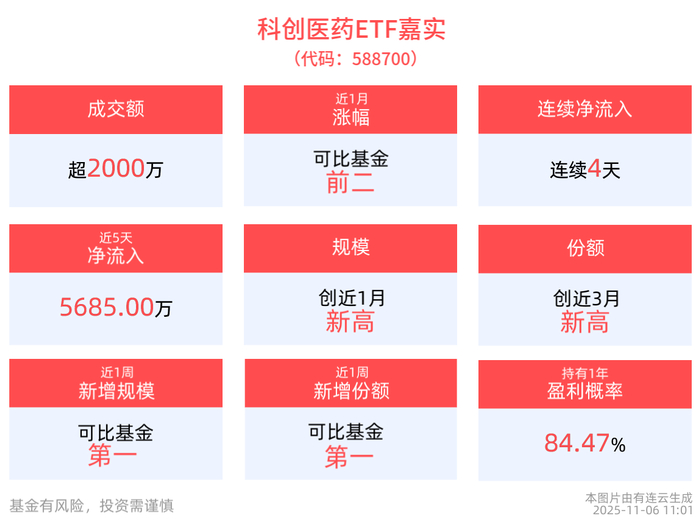
机构称医药板块近期已呈现结构性修复趋势,科创医药ETF嘉实(588700)盘中蓄势,近4日合计“吸金”5685.00万元
Xin Lang Cai Jing· 2025-11-06 03:23
Core Viewpoint - The biopharmaceutical sector on the STAR Market has shown mixed performance, with the STAR Biopharmaceutical Index declining by 0.60% as of November 6, 2025, while individual stocks exhibited varied movements, indicating a potential for structural recovery in the sector [1][4]. Group 1: Market Performance - The STAR Biopharmaceutical Index decreased by 0.60% as of November 6, 2025, with stocks like Huaheng Biological leading gains at 2.86%, while Yifang Biological experienced the largest decline [1]. - The Jiashi STAR Biopharmaceutical ETF recorded a turnover of 6.67% and a transaction volume of 21.39 million yuan, reaching a new high of 322 million yuan in scale, ranking first among comparable funds [3]. - The Jiashi STAR Biopharmaceutical ETF has seen a net inflow of 56.85 million yuan over the past four days, with a peak single-day net inflow of 16.85 million yuan [3]. Group 2: Fund Performance - As of November 5, 2025, the Jiashi STAR Biopharmaceutical ETF has achieved a one-year net value increase of 26.53%, with the highest monthly return since inception being 23.29% and the longest consecutive monthly gain lasting seven months [3]. - The average monthly return during the rising months of the Jiashi STAR Biopharmaceutical ETF is 7.85% [3]. Group 3: Industry Outlook - Recent adjustments in the pharmaceutical sector are attributed to a recovery in capital market financing and an increase in the scale of innovative drug exports, leading to a rebound in domestic innovative drug research and development [3]. - The outlook for the innovative drug sector remains focused on business development (BD) expectations, with BD activities typically accounting for about 40% of annual transactions in the fourth quarter [3]. - According to data, the top ten weighted stocks in the STAR Biopharmaceutical Index account for 49.74% of the index, indicating a concentration of investment in key players [4][6].



君实生物11月5日获融资买入3995.20万元,融资余额13.91亿元
Xin Lang Cai Jing· 2025-11-06 01:27
Core Viewpoint - Junshi Biosciences experienced a slight decline in stock price, with significant trading activity in both margin financing and securities lending, indicating high investor interest and potential volatility in the stock [1][2]. Financing Summary - On November 5, Junshi Biosciences had a financing buy-in amount of 39.95 million yuan, with a net buy of 572,900 yuan after repayments [1]. - The total margin financing and securities lending balance reached 1.404 billion yuan, with the financing balance accounting for 4.68% of the circulating market value, indicating a high level of leverage compared to the past year [1]. - The company’s financing balance of 1.391 billion yuan is above the 90th percentile of the past year, suggesting strong investor confidence [1]. Securities Lending Summary - On the same day, Junshi Biosciences repaid 4,500 shares in securities lending while selling 600 shares, with a total selling amount of 23,300 yuan based on the closing price [1]. - The remaining securities lending balance was 32,710 shares, with a total value of 12.697 million yuan, also exceeding the 90th percentile of the past year [1]. Company Overview - Junshi Biosciences, established on December 27, 2012, focuses on the research and commercialization of monoclonal antibody drugs and other therapeutic protein drugs, with 90.67% of its revenue coming from drug sales [2]. - As of September 30, 2025, the company reported a revenue of 1.806 billion yuan, a year-on-year increase of 42.06%, while the net profit attributable to shareholders was -596 million yuan, reflecting a 35.72% increase in losses [2]. - The number of shareholders increased by 15.17% to 35,900, while the average circulating shares per person decreased by 12.96% to 21,361 shares [2].
光大证券晨会速递-20251104
EBSCN· 2025-11-04 00:54
Macro Analysis - The report indicates that the current macro environment in Japan is conducive to moderate economic growth, with manageable debt sustainability, improving consumer sentiment, and favorable manufacturing investment trends [1] - The report anticipates an upward potential for the yen by 2026, while the Japanese stock market's previous gains have largely reflected policy expectations, suggesting that future market momentum will depend on the effectiveness of policy implementation [1] Financial Engineering - The report predicts a year-on-year decline in profit for the coal, steel, and cement industries, while float glass profitability is expected to show positive growth [2] - A slight decrease in the breeding sow inventory is noted, with stable recovery potential for pork prices expected until Q1 of next year [2] - Weak PMI data and housing sales indicate a need to monitor the potential resumption of infrastructure support expectations [2] Real Estate - In October, the sales of the top 10 and top 100 real estate companies increased by 6% and 4% month-on-month, respectively, but year-to-date sales show a decline of 16% and 17% year-on-year [3] - The report recommends focusing on structurally strong companies with high product reputation and strong sales rankings in core cities, such as China Merchants Shekou and China Jinmao [3] - Long-term growth potential in property services is highlighted, with recommendations for companies like China Merchants Jiyu and Greentown Service [3] Petrochemical - OPEC+ announced a production increase of 137,000 barrels per day in December and a pause in production plans from January to March 2026, which is expected to support oil prices in the short term [4] - The report maintains a positive outlook on the long-term investment value of major oil companies amid ongoing geopolitical uncertainties [4] Company Research - Sanyou Chemical's profitability has declined due to falling soda ash prices, leading to a downward revision of profit forecasts for 2025-2027 [7] - Aokai Co. has seen a continuous improvement in performance, although profit forecasts for 2025-2027 have been adjusted downward due to weaker-than-expected downstream demand [8] - Qiaoyuan Co. has optimized its product structure and expanded its market, resulting in an upward revision of profit forecasts for 2025-2026 [9] - Xiyes Co. reported a 17.81% year-on-year increase in revenue for the first three quarters of 2025, with a 35.99% increase in net profit [10] - China Metallurgical Group's revenue and net profit have declined significantly, but new contracts have shown positive growth [11] - Times Electric's revenue grew by 14.9% year-on-year, with a stable growth outlook for its rail transit equipment business [12] - Oulutong's revenue reached a record high in Q3, driven by strong demand for high-power server power supplies [13] - Junshi Biosciences has adjusted its profit forecasts downward due to ongoing R&D investments and the gradual ramp-up of product sales [14] - Jinjiang Hotels reported a decline in revenue but an increase in net profit margin, leading to a downward revision of profit forecasts for 2025-2027 [15]




君实生物(688180):特瑞普利单抗销售放量,研发持续推进:——君实生物(688180.SH、1877.HK)2025年三季报点评
EBSCN· 2025-11-03 09:23
Investment Rating - The report maintains a "Buy" rating for both A-shares and H-shares of the company [5][6]. Core Insights - The company's core product, Toripalimab, has shown significant sales growth, with revenue reaching approximately 1.495 billion yuan in the first three quarters of 2025, a year-on-year increase of about 40% [3]. - The company continues to expand its research and development efforts, with R&D investment reaching 982 million yuan in the first three quarters of 2025, a year-on-year increase of 12.34% [4]. - The company has a strong cash reserve of 3.27 billion yuan as of the end of Q3 2025, indicating sufficient funding for ongoing projects [4]. Financial Performance Summary - For the first three quarters of 2025, the company reported total revenue of 1.806 billion yuan, a year-on-year increase of 42.06%, while the net profit attributable to shareholders was a loss of 596 million yuan, a reduction in loss by 331 million yuan compared to the previous year [2]. - The third quarter alone saw revenue of 637 million yuan, a year-on-year increase of 31.40%, with a net profit loss of 183 million yuan [2]. Revenue and Profit Forecast - The company has adjusted its net profit forecasts for 2025 and 2026 to losses of 890 million yuan and 290 million yuan, respectively, while projecting a profit of 98 million yuan in 2027 [5]. - Revenue projections for the upcoming years are as follows: 2.595 billion yuan in 2025, 3.304 billion yuan in 2026, and 4.120 billion yuan in 2027, with growth rates of 33.18%, 27.32%, and 24.70% respectively [6]. R&D Pipeline and Approvals - The company is advancing multiple late-stage pipeline projects, including a first-in-class anti-BTLA monoclonal antibody and an anti-IL-17A monoclonal antibody, with significant clinical trial progress [4]. - The company has received regulatory approval for several new indications for Toripalimab, including a recent application for treating HER2-expressing urothelial carcinoma [3].
君实生物(688180) - 君实生物H股公告
2025-11-03 09:15
FF301 股份發行人及根據《上市規則》第十九B章上市的香港預託證券發行人的證券變動月報表 截至月份: 2025年10月31日 狀態: 新提交 致:香港交易及結算所有限公司 公司名稱: 上海君實生物醫藥科技股份有限公司 呈交日期: 2025年11月3日 I. 法定/註冊股本變動 | 1. 股份分類 | 普通股 | 股份類別 | H | | | 於香港聯交所上市 (註1) | | 是 | | | --- | --- | --- | --- | --- | --- | --- | --- | --- | --- | | 證券代號 (如上市) | 01877 | 說明 | | | | | | | | | | | 法定/註冊股份數目 | | | 面值 | | | 法定/註冊股本 | | | 上月底結存 | | | 260,295,700 | RMB | | 1 | RMB | | 260,295,700 | | 增加 / 減少 (-) | | | 0 | | | | RMB | | 0 | | 本月底結存 | | | 260,295,700 | RMB | | | 1 RMB | | 260,295,700 | | ...
君实生物(01877) - 截至二零二五年十月三十一日止月份之股份发行人的证券变动月报表
2025-11-03 08:30
FF301 股份發行人及根據《上市規則》第十九B章上市的香港預託證券發行人的證券變動月報表 截至月份: 2025年10月31日 狀態: 新提交 致:香港交易及結算所有限公司 公司名稱: 上海君實生物醫藥科技股份有限公司 呈交日期: 2025年11月3日 I. 法定/註冊股本變動 | 1. 股份分類 | 普通股 | 股份類別 | H | | | 於香港聯交所上市 (註1) | | 是 | | | --- | --- | --- | --- | --- | --- | --- | --- | --- | --- | | 證券代號 (如上市) | 01877 | 說明 | | | | | | | | | | | 法定/註冊股份數目 | | | 面值 | | | 法定/註冊股本 | | | 上月底結存 | | | 260,295,700 | RMB | | 1 | RMB | | 260,295,700 | | 增加 / 減少 (-) | | | 0 | | | | RMB | | 0 | | 本月底結存 | | | 260,295,700 | RMB | | | 1 RMB | | 260,295,700 | | ...