
Junshi Biosciences(688180)

Search documents
港股异动 | 部分医药股午后拉升 康希诺生物(06185)超10% 君实生物(01877)涨超5%
智通财经网· 2026-01-26 05:47
消息面上,1月26日,印度出现尼帕病毒疫情相关话题冲上热搜,引发关注。据新华社报道,印度出现 尼帕病毒疫情。邻近国家正严阵以待。感染者集中在印度西孟加拉邦。截至本文发稿,确诊感染病例已 达5例,至少一人病情危重,另有近百人被要求居家隔离。 公开资料显示,尼帕是人畜共患的RNA病毒,主要由果蝠和猪携带,死亡率在40%至75%之间,潜伏期 一般为4天至14天。目前尚无专门的疫苗和有效疗法,治疗侧重于控制症状和提供支持性护理。 智通财经APP获悉,部分医药股午后拉升。截至发稿,康希诺生物(06185)涨10.13%,报40.86港元;君 实生物(01877)涨5.19%,报23.92港元;复旦张江(01349)涨4.11%,报3.29港元。 ...

君实生物:商业化产线EBR系统搭建,以数字化升级赋能生物医药产业高质量发展
Jing Ji Guan Cha Wang· 2026-01-23 04:14
该项目不仅为君实生物自身提供了高效合规的解决方案,也为生物医药行业数字化转型提供了可复制、 可推广的实施路径。未来,君实生物将持续深化数字化、智能化转型,以技术创新驱动生产效率与产品 质量双提升,为全球患者提供更安全、更可及的创新药物,助力生物医药产业高质量发展。 2025年,君实生物在上海临港生产基地开展的"商业化产线电子批记录(EBR)系统搭建"项目,开创了生 物制药行业在商业化生产中全面应用EBR的先例。传统纸质批记录依赖人工操作,存在数据易偏差、流 程效率低等痛点。为此,君实生物构建了一套覆盖制剂生产全流程的多系统集成数字化管控体系。该系 统以MES/EBR为核心,严格遵循ISA-95标准分层设计,深度融合DCS、WMS、EMS等系统,实现从原 液处理到成品入库的全链路标准化与透明化管理。项目通过"所见即所得"的电子工作指引,将复杂工艺 分解为1780个标准化操作步骤,并设置4380项异常监控点,形成数字化工作流。其核心亮点包括:全链 路数据自动采集,消除人工录入误差;合规性自动核实与实时预警,替代传统人工核对;以及"异常驱 动的审核模式",大幅提升批记录审核与放行效率。项目落地后,在合规、效率与供应 ...

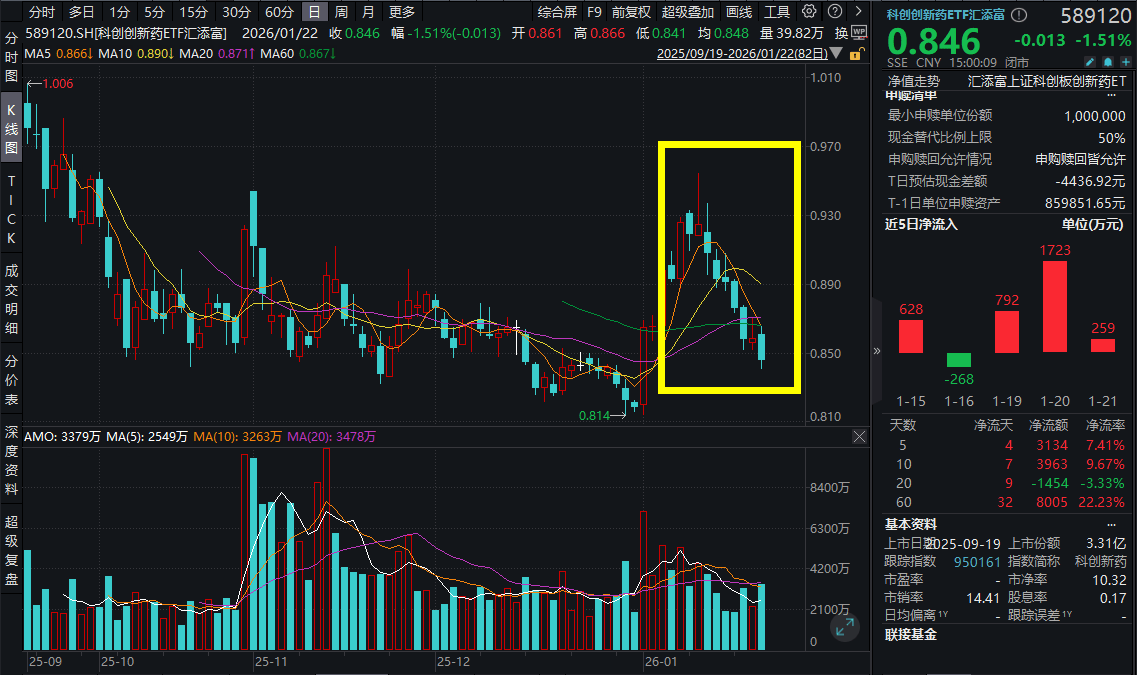
创新药继续承压,益方生物跌超6%,科创创新药ETF汇添富(589120)跌1.5%,连续3日吸金近2800万元,资金逢跌坚定增仓!什么信号?
Sou Hu Cai Jing· 2026-01-22 08:38
Core Viewpoint - The A-share market experienced fluctuations on January 22, with the Shanghai Composite Index rising by 0.14%. The innovative drug sector faced pressure, as evidenced by the decline of the Science and Technology Innovation Drug ETF Huatai (589120) by 1.51% by 15:00. However, the ETF saw a net inflow of funds totaling 27.7361 million yuan over the past three days, indicating a trend of buying on dips [1]. Group 1: Market Performance - The Science and Technology Innovation Drug ETF Huatai (589120) recorded a net inflow of 27.7361 million yuan over three days, showing a clear trend of increased buying despite market declines [1]. - By 15:00, the ETF's component stocks exhibited mixed performance, with notable gains from Kangxinuo at 1.81%, Baiaotai at 0.49%, and Haoyuan Pharmaceutical at 0.48%. Conversely, Yifang Bio fell over 6%, Rongchang Bio dropped over 4%, and Baili Tianheng decreased by over 3% [6]. Group 2: Industry Insights - According to the National Medical Insurance Administration, 76 innovative drugs are expected to be approved for market entry by the National Medical Products Administration by 2025, marking a record high and indicating a trend towards diversified innovative therapies in China [4]. - Donghai Securities predicts that the innovative drug sector is entering a new era, transitioning from a generics-dominated market (pre-2018) to a period of transformation (2018-2025) characterized by price reductions and increased R&D investments in innovative drugs. By 2026, innovative drugs are expected to dominate the pharmaceutical industry in China, supported by complementary insurance policies and a focus on the pace of new drug launches and competitive dynamics [5].





君实生物在上海成立新科技公司 注册资本5亿元
Mei Ri Jing Ji Xin Wen· 2026-01-21 07:31
(文章来源:每日经济新闻) 每经AI快讯,天眼查工商信息显示,近日,上海君亦乐生物科技有限公司成立,注册资本5亿元人民 币,经营范围包括货物进出口、技术进出口、信息咨询服务等。股东信息显示,该公司由君实生物全资 持股。 ...
上海君亦乐生物科技有限公司成立,注册资本50000万人民币
Sou Hu Cai Jing· 2026-01-20 17:27
Core Viewpoint - Shanghai Junyile Biotechnology Co., Ltd. has been established with a registered capital of 500 million RMB, fully owned by Shanghai Junshi Biosciences Co., Ltd. [1] Company Information - The legal representative of Shanghai Junyile Biotechnology Co., Ltd. is Xie Wan [1] - The company is registered with a capital of 500 million RMB [1] - The business scope includes technology services, development, consulting, exchange, transfer, promotion, import and export of goods, and information consulting services [1] - The company is classified under the national standard industry of scientific research and technical service industry, specifically technology promotion and application service industry [1] - The registered address is located in the China (Shanghai) Pilot Free Trade Zone Lingang New Area [1] - The company is a limited liability company with no fixed term of operation [1] Shareholding Structure - Shanghai Junshi Biosciences Co., Ltd. holds 100% of the shares in Shanghai Junyile Biotechnology Co., Ltd. [1]
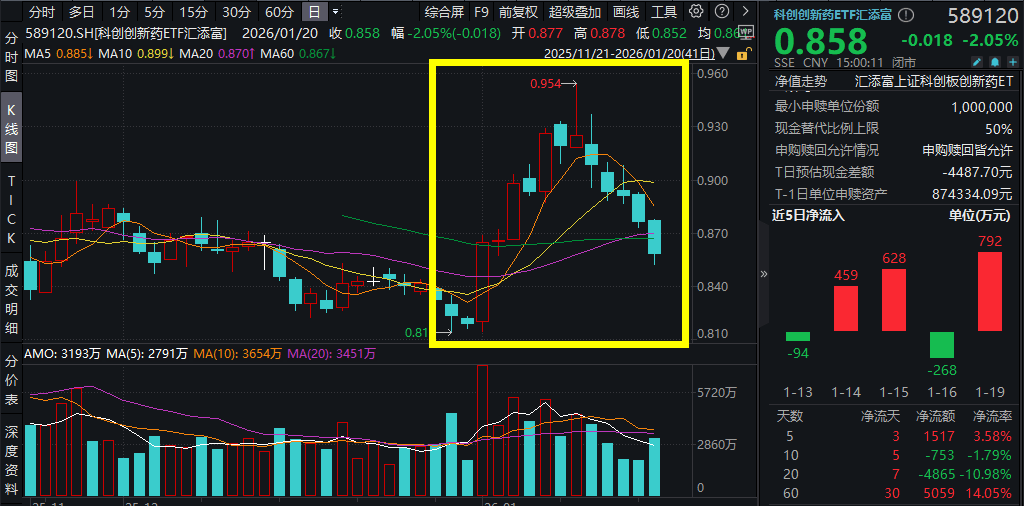
创新药板块承压,益方生物等跌超3%,科创创新药ETF汇添富(589120)跌超2%,资金逆势涌入!"全球创新药春晚"JPM召开,中国创新药闪耀全球
Sou Hu Cai Jing· 2026-01-20 11:33
Core Viewpoint - The A-share market is experiencing fluctuations, particularly affecting the innovative drug sector, with the ETF Huatai Innovation Drug (589120) declining by 2.05% and facing a five-day losing streak, despite attracting over 7.9 million yuan in funds [1][3]. Group 1: Market Performance - The Huatai Innovation Drug ETF (589120) has seen a decline in its constituent stocks, with major players like I-Mab and Junshi Biosciences dropping over 3%, and others like BeiGene and Zai Lab falling more than 2% [3]. - The top ten constituent stocks of the ETF show a negative trend, with BeiGene-U down by 2.38% and Junshi Biosciences-U down by 3.42%, indicating a general downturn in the sector [3]. Group 2: Long-term Outlook - Despite the short-term market pressure, the long-term outlook for the innovative drug sector remains positive, with expectations of a clear beta market driven by liquidity recovery at the beginning of the year [4]. - The JPM conference highlighted the achievements of over 20 Chinese pharmaceutical companies, with projections for significant revenue growth in innovative drugs, such as a 25% increase for Heng Rui in 2026 [4]. Group 3: Business Development (BD) Trends - The BD activities in the sector are at a peak, with 17 transactions occurring since January, totaling approximately 10.15 billion USD in upfront payments, significantly exceeding market expectations [5]. - The ongoing trend of foreign companies expanding in China and the increasing flow of funds into the innovative drug sector suggest a favorable environment for growth and investment [5]. Group 4: Investment Strategy - The innovative drug sector is recommended for increased allocation, particularly in Hong Kong stocks, as the market is currently at a relative bottom, with potential for new historical highs [5]. - The ETF focuses on leading innovative drug companies, providing a high degree of exposure to the opportunities presented by the rise of Chinese innovative drugs [5].

君实生物跌3.42% 连亏9年3季2020年上市2募资共86亿
Zhong Guo Jing Ji Wang· 2026-01-20 08:45
Core Viewpoint - Junshi Biosciences (688180.SH) is currently experiencing a decline in stock price, closing at 35.29 yuan with a drop of 3.42%, indicating a state of being below its initial public offering (IPO) price [1] Fundraising and Financial Performance - Junshi Biosciences raised a total of 4.836 billion yuan from its IPO on July 15, 2020, with a net amount of 4.497 billion yuan after deducting issuance costs, exceeding the original plan by 1.797 billion yuan [1] - The company planned to raise 2.7 billion yuan for innovative drug research, industrialization projects, bank loan repayment, and working capital [1] - The company raised an additional 3.7765 billion yuan through a private placement of 70 million shares at 53.95 yuan per share in 2022, with a net amount of approximately 3.7448 billion yuan after costs [2] - The total funds raised by Junshi Biosciences from both public and private placements amount to 8.612 billion yuan [3] Profitability and Revenue Trends - From 2016 to 2024, Junshi Biosciences reported negative net profits, with figures ranging from -1.35 billion yuan to -23.88 billion yuan [3] - For the first three quarters of 2025, the company achieved a revenue of 1.806 billion yuan, reflecting a year-on-year growth of 42.06%, while the net profit attributable to shareholders was -596 million yuan, an improvement from -927 million yuan in the previous year [3] - The net cash flow from operating activities for the same period was -343 million yuan, compared to -1.113 billion yuan in the previous year [3]
君实生物跌2.00%,成交额1.76亿元,主力资金净流入279.43万元
Xin Lang Cai Jing· 2026-01-16 02:55
Core Viewpoint - Junshi Biosciences has experienced fluctuations in stock price and trading volume, with a recent decline in share price despite a year-to-date increase. The company is involved in the research and commercialization of monoclonal antibody drugs and other therapeutic proteins, with a significant portion of its revenue coming from drug sales [1][2]. Group 1: Stock Performance - On January 16, Junshi Biosciences' stock fell by 2.00%, trading at 36.72 CNY per share, with a total market capitalization of 37.7 billion CNY [1]. - The stock has increased by 7.49% year-to-date but has seen a decline of 6.33% over the last five trading days [1]. - The trading volume was 1.76 billion CNY, with a turnover rate of 0.62% [1]. Group 2: Financial Performance - For the period from January to September 2025, Junshi Biosciences reported a revenue of 1.806 billion CNY, representing a year-on-year growth of 42.06% [2]. - The company recorded a net profit attributable to shareholders of -596 million CNY, which is a 35.72% increase compared to the previous period [2]. Group 3: Shareholder Information - As of September 30, 2025, the number of shareholders for Junshi Biosciences increased to 35,900, a rise of 15.17% from the previous period [2]. - The average number of circulating shares per shareholder decreased by 12.96% to 21,361 shares [2]. Group 4: Company Overview - Junshi Biosciences, established on December 27, 2012, and listed on July 15, 2020, is based in Shanghai and focuses on the development and commercialization of monoclonal antibody drugs and other therapeutic proteins [1]. - The company's main revenue sources include drug sales (90.67%), technology licensing and royalties (8.74%), and technical services (0.59%) [1].
君实生物跌2.06%,成交额2.38亿元,主力资金净流出1105.94万元
Xin Lang Cai Jing· 2026-01-15 03:35
Core Viewpoint - Junshi Biosciences' stock price has shown fluctuations, with a recent decline of 2.06% and a year-to-date increase of 10.16%, indicating volatility in market performance [1][2]. Group 1: Stock Performance - As of January 15, Junshi Biosciences' stock price is reported at 37.63 CNY per share, with a total market capitalization of 38.634 billion CNY [1]. - The stock has experienced a 0.08% decline over the last five trading days, a 5.17% increase over the last 20 days, and a 3.49% decline over the last 60 days [2]. Group 2: Financial Performance - For the period from January to September 2025, Junshi Biosciences achieved a revenue of 1.806 billion CNY, representing a year-on-year growth of 42.06% [2]. - The company reported a net profit attributable to shareholders of -596 million CNY, which is a year-on-year increase of 35.72% [2]. Group 3: Shareholder Information - As of September 30, 2025, the number of shareholders for Junshi Biosciences increased by 15.17% to 35,900, while the average circulating shares per person decreased by 12.96% to 21,361 shares [2]. - The top ten circulating shareholders include notable ETFs, with E Fund's SSE STAR 50 ETF holding 19.3929 million shares, a decrease of 2.8203 million shares from the previous period [3].
君实生物1月14日获融资买入5575.72万元,融资余额13.25亿元
Xin Lang Cai Jing· 2026-01-15 01:27
Group 1 - The core viewpoint of the news is that Junshi Biosciences experienced a decline in stock price and significant trading activity, indicating potential investor concerns and market volatility [1] - On January 14, Junshi Biosciences' stock fell by 2.36%, with a trading volume of 678 million yuan, and a net financing outflow of 24.32 million yuan [1] - As of January 14, the total margin balance for Junshi Biosciences was 1.341 billion yuan, with a financing balance of 1.325 billion yuan, representing 4.50% of the circulating market value, which is above the 60th percentile of the past year [1] Group 2 - Junshi Biosciences, established on December 27, 2012, focuses on the research and commercialization of monoclonal antibody drugs, with 90.67% of its revenue coming from drug sales [2] - For the period from January to September 2025, Junshi Biosciences reported revenue of 1.806 billion yuan, a year-on-year increase of 42.06%, while the net profit attributable to shareholders was -596 million yuan, reflecting a 35.72% increase [2] - As of September 30, 2025, the number of shareholders increased by 15.17% to 35,900, while the average circulating shares per person decreased by 12.96% to 21,361 shares [2]