Jinko Solar(688223)
Search documents
光伏出口退税将取消,有销售拼手速抢货
Xin Lang Cai Jing· 2026-01-12 12:28
1月9日,财政部、税务总局发布《关于调整光伏等产品出口退税政策的公告》,宣布自2026年4月1日起,取消光伏产品增值税出口退税。这意味着光伏 的"退税补贴时代"即将结束。 源:中华人民共和国财政部 出口退税指退返出口企业在国内缴纳的增值税,由于企业在海外国家还要缴税,为避免重复缴税,提振产品国际竞争力,中国自1985年开始实施出口退税 政策。 现行光伏产品的增值税出口退税的税率为9%。2024年11月15日,财政部、税务总局发布关于调整出口退税政策的公告称,2024年12月1日起,光伏产品出 口退税从13%下降至9%。 行业分析机构SMM分析,此次出口退税明确取消时间后,光伏产品尤其以光伏组件产品受到冲击最大,其主要影响为企业直接成本增加以及价格竞争力 度下降。"相当于每块210R组件,出口利润将减少46~51元/块,企业出口毛利率将被压缩,企业出口成本增加。"SMM光伏分析师郑天鸿表示。 中国光伏行业协会指出,自2024年以来,我国光伏产品在海外市场面临日益激烈的恶性竞争,出口价格持续走低,呈现"量增价减"态势。部分企业在出口 过程中,不仅低价竞争还将出口退税额折算为对外议价空间,导致原本用于对冲国内增值税 ...
光伏锂电出口退税归零 晶科能源出口占比超6成或受冲击最大
Xin Lang Cai Jing· 2026-01-12 09:49
电池产品的调整相对缓和,将从2026年4月1日起将退税率由9%下调至6%,并在2027年1月1日全面取 消。这一政策调整的背景是新能源行业面临的内外双重压力。 国内光伏与锂电池相关产品的全球产能占比已近绝对主导,光伏上游在全球产能中占比超95%、中游超 90%、组件超80%,锂电池则约占三分之二。 来源:新浪财经 财政部和国家税务总局日前宣布,光伏产品自2026年4月1日起,将全面取消增值税出口退税。这距离 2024年11月出口退税率从13%降至9%,仅一年有余。 根据中国光伏行业协会咨询专家的测算,仅2025年1-10月,中国光伏出口额为244.2亿美元,按9%的退 税率计算,涉及退税额约22亿美元(约153亿元人民币)。 中国光伏行业协会认为,部分企业在出口过程中,将出口退税额折算为对外议价空间,导致原本用于对 冲国内增值税负担的财政资金在议价环节被让渡给境外采购方。 政策调整对企业的影响程度,与其获得的出口退税额直接相关。在光伏组件四大厂商中,晶科能源2025 年上半年应收出口退税款期末账面价值达9.13亿元,位居首位。 天合光能2025年上半年应收增值税出口退税期初账面价值为0.21亿元,晶澳科技同期 ...
——光伏行业点评:光伏产品出口退税取消,有望促使行业高质量发展
Shenwan Hongyuan Securities· 2026-01-12 08:30
Investment Rating - The industry investment rating is "Overweight" indicating a positive outlook for the photovoltaic sector [2][7]. Core Insights - The cancellation of the export VAT rebate for photovoltaic products, effective from April 1, 2026, marks the end of over a decade of direct fiscal support for photovoltaic exports, potentially leading the industry towards high-quality development [1][2]. - A "window period" is expected to create a surge in export orders and production increases in Q1 2026, improving the performance of companies heavily reliant on exports [2]. - Following the end of the export rebate, overseas pricing for photovoltaic components is anticipated to rise, benefiting leading companies with strong brand and channel advantages [2]. - The cancellation of the rebate is seen as a response to the industry's call to reduce low-price competition, which may accelerate the exit of inefficient production capacities and allow leading firms to gain market share [2]. - Companies with overseas production capabilities and local market presence are expected to benefit from the reduced cost disadvantage of local manufacturing [2]. Summary by Sections Policy Impact - The export VAT rebate for photovoltaic products will be eliminated, transitioning the industry towards a more sustainable growth model [1][2]. Market Dynamics - A surge in orders and production is expected in Q1 2026 due to the impending policy change, similar to previous "rush to install" phenomena [2]. - The end of the rebate is likely to lead to a reevaluation of overseas component prices, with stronger pricing power for top-tier companies [2]. Competitive Landscape - The cancellation of the rebate is anticipated to facilitate the exit of low-efficiency production capacities, allowing leading companies to enhance their market share through technological and brand advantages [2]. - Companies with advanced technologies and cost advantages, such as those focusing on TOPCon/BC technologies and silicon material upgrades, are highlighted as potential investment opportunities [2]. Valuation of Key Companies - A table of key companies with their respective valuations and projected earnings for 2025-2027 is provided, indicating varying levels of profitability and market performance [3].
研报掘金丨国投证券:予晶科能源“买入-A”评级,目标价7.35元
Ge Long Hui· 2026-01-12 08:09
国投证券研报指出,近日,晶科能源宣布与晶泰科技签署AI+机器人高通量叠层太阳能电池研发项目合 作协议。认为公司作为光伏技术创新的领先者,此次战略合作有望加速公司在钙钛矿叠层电池技术的商 业化进程,建立先发优势,加快获取新增市场份额。同时储能业务的高速增长有望快速成长为公司的第 二增长曲线,在未来贡献显著的业绩增量。选择光伏一体化组件龙头隆基绿能、晶澳科技、天合光能作 为对比。隆基绿能是BC技术代表的龙头企业,与公司的TOPCon技术同为N型替代P型浪潮中的标志性 技术;晶澳科技专注于光伏一体化业务发展,同样具备较高的TOPCon产能及业务布局;天合光能在光 伏一体化业务之余,更早布局储能业务,跟公司业务结构有一定可比性。结合可比公司情况,鉴于公司 在TOPCon领域的领先地位以及快速成长的储能业务布局,给予公司2026年35倍PE,12个月目标价为 7.35元,给予"买入-A"评级。 ...
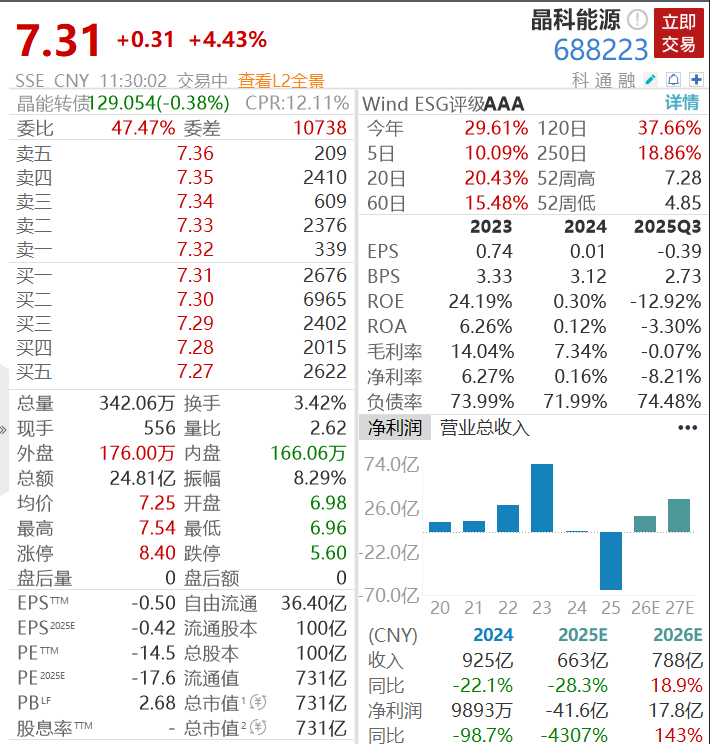
晶科能源涨3.56%,成交额15.59亿元,今日主力净流入-2848.71万
Xin Lang Cai Jing· 2026-01-12 07:28
Core Viewpoint - JinkoSolar is focusing on advancing its N-type TOPCon technology and aims to maintain its leadership position in the solar energy sector, with significant investments planned for future growth [2]. Company Overview - JinkoSolar Co., Ltd. specializes in the research, production, and sales of solar photovoltaic modules, cells, and wafers, providing high-quality solar energy products globally [3][7]. - The company was established on December 13, 2006, and went public on January 26, 2022 [7]. Business Performance - As of September 30, 2025, JinkoSolar reported a revenue of 47.986 billion yuan, a year-on-year decrease of 33.14%, and a net profit attributable to shareholders of -3.92 billion yuan, a significant decline of 422.67% [7][8]. - The company has distributed a total of 3.355 billion yuan in dividends since its A-share listing, with 3.125 billion yuan distributed over the past three years [9]. Technological Advancements - JinkoSolar has made substantial progress in its N-type TOPCon battery production, achieving a mass production efficiency of 24.7% at its Hefei factory, which is now operating at full capacity [2]. - The company is also actively developing new technologies, including IBC and perovskite batteries, and has set a world record for the efficiency of its perovskite/TOPCon tandem cells [2]. Market Activity - On January 12, JinkoSolar's stock rose by 3.56%, with a trading volume of 1.559 billion yuan and a turnover rate of 2.42%, bringing its total market capitalization to 64.033 billion yuan [1]. - The stock has seen a net outflow of 28.4871 million yuan from major investors, indicating a reduction in holdings over the past two days [4][5].
光伏行业点评:光伏产品出口退税取消,有望促使行业高质量发展
Shenwan Hongyuan Securities· 2026-01-12 07:14
Investment Rating - The report rates the photovoltaic industry as "Overweight," indicating that the industry is expected to outperform the overall market [2]. Core Insights - The cancellation of the export VAT rebate for photovoltaic products, effective April 1, 2026, marks the end of over a decade of direct fiscal support for photovoltaic exports, potentially leading the industry into a phase of high-quality development [1]. - A "window period" is anticipated, leading to increased overseas orders and production ramp-up in Q1 2026, similar to previous phases of accelerated installations, which is expected to improve the performance of export-oriented photovoltaic companies [2]. - After the policy window closes, overseas component prices are likely to be renegotiated, as China, being the largest exporter of photovoltaic components, will have stronger pricing power due to the cancellation of the rebate, which is expected to lead to price increases [2]. - The cancellation of the export rebate is seen as a response to the call for reducing low-price competition in the photovoltaic industry, which will accelerate the exit of inefficient production capacities and reshape the market landscape [2]. - Companies with overseas production capacity and strong brand/channel advantages are expected to benefit from the narrowing cost disadvantage of local manufacturing, particularly in regions like the Middle East and North Africa [2]. Summary by Relevant Sections Industry Outlook - The cancellation of the export VAT rebate is expected to enhance the industry's quality of development and reduce fiscal funds being transferred to overseas terminals [2]. - The report suggests that leading companies with technological advantages (TOPCon/BC), strong brands, and distribution channels will continue to gain market share [2]. Investment Recommendations - The report recommends focusing on leading companies with overseas production capabilities, such as Longi Green Energy, JinkoSolar, Trina Solar, and others, which are expected to benefit from the "price adjustment and capacity exit" [2]. - Companies that are advancing new technologies and material upgrades, such as Aiko Solar and Dongfang Risheng, are also highlighted for their potential to enhance product efficiency and pricing power [2]. - Cost-advantaged silicon material companies like Tongwei Co. and Daqo New Energy are recommended for investment consideration [2]. Valuation Table - A valuation table is provided, detailing the estimated net profits and price-to-earnings (PE) ratios for key companies in the industry, indicating varying performance expectations for 2025 to 2027 [3].
晶科能源1月9日获融资买入1.79亿元,融资余额10.75亿元
Xin Lang Cai Jing· 2026-01-12 02:27
Group 1 - JinkoSolar's stock price decreased by 3.29% on January 9, with a trading volume of 1.325 billion yuan, and a net financing buy of -33.61 million yuan for the day [1] - As of January 9, the total margin balance for JinkoSolar was 1.077 billion yuan, with a financing balance of 1.075 billion yuan, accounting for 1.74% of the circulating market value, indicating a high level compared to the past year [1] - The company repaid 521,400 shares of margin trading on January 9, with a margin balance of 1.5029 million yuan, which is below the 10% percentile level for the past year, indicating a low level of short selling [1] Group 2 - As of September 30, JinkoSolar had 77,300 shareholders, an increase of 4.14%, while the average circulating shares per person decreased by 3.97% [2] - For the period from January to September 2025, JinkoSolar reported operating revenue of 47.986 billion yuan, a year-on-year decrease of 33.14%, and a net profit attributable to shareholders of -3.92 billion yuan, a year-on-year decrease of 422.67% [2] - Since its A-share listing, JinkoSolar has distributed a total of 3.355 billion yuan in dividends, with 3.125 billion yuan distributed over the past three years [3]
光伏概念盘初活跃 东方日升等多股涨超10%
Xin Lang Cai Jing· 2026-01-12 01:52
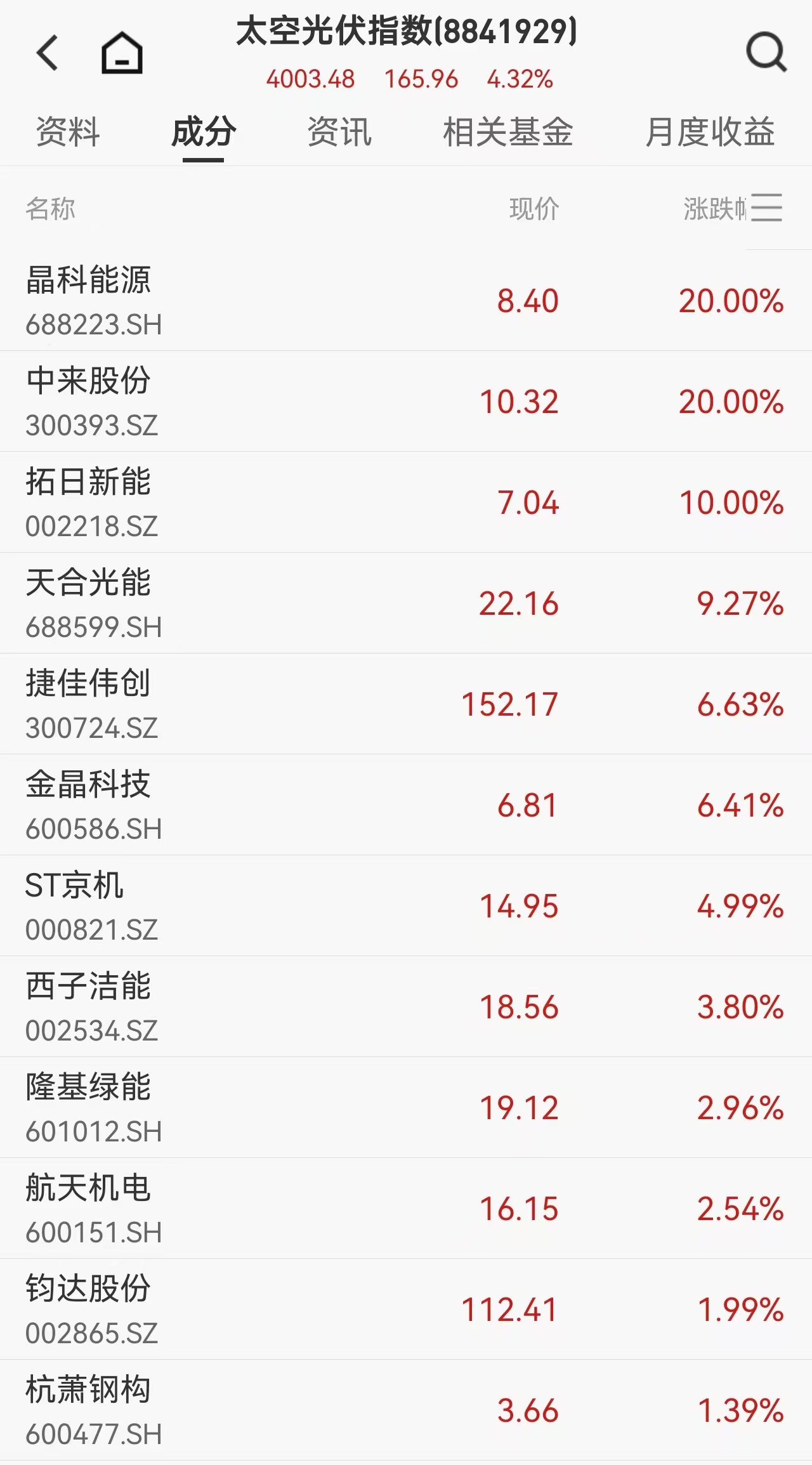
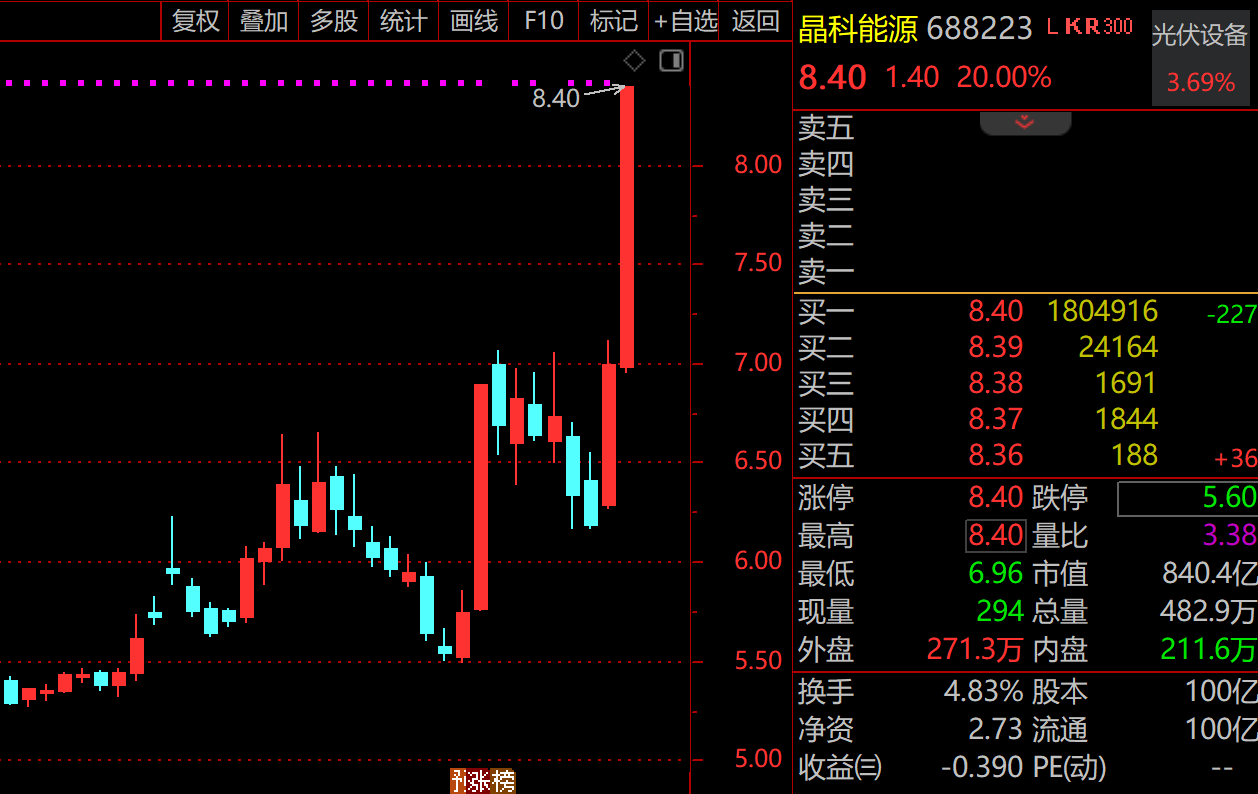
【光伏概念盘初活跃 东方日升等多股涨超10%】智通财经1月12日电,早盘光伏概念再度活跃,钙钛矿 电池、太空光伏方向领涨,东方日升、迈为股份、捷佳伟创涨超10%,此前杭萧钢构、金晶科技涨停, 国晟科技触及涨停续创历史新高,天合光能、金辰股份等跟涨。消息面上,近期钧达股份、晶科能源、 天合光能等光伏上市公司对太空光伏的关注度显著提升,并且均重点提到钙钛矿技术在太空的应用前 景。 转自:智通财经 ...
4月1日起执行!光伏出口退税全面取消,行业影响几何
Bei Jing Shang Bao· 2026-01-11 13:01
Core Viewpoint - The cancellation of the export VAT rebate for photovoltaic products marks the end of the "rebate subsidy era," significantly impacting component manufacturers and potentially leading to a surge in exports before the policy takes effect [1][3][5]. Policy Changes - The Ministry of Finance and the State Taxation Administration announced the cancellation of the export VAT rebate for photovoltaic products effective April 1, 2026, with a reduction in the rebate rate for battery products from 9% to 6% until the end of 2026 [3][4]. - The announcement includes a list of 249 products related to photovoltaic and 22 battery products affected by the policy change [4]. Industry Impact - The cancellation of the export VAT rebate is expected to have a significant impact on component manufacturers, with predictions of a "rush to export" before the policy takes effect [5][6]. - Major manufacturers such as JinkoSolar, Trina Solar, JA Solar, and LONGi Green Energy reported substantial losses in the first three quarters of 2025, with JinkoSolar's overseas revenue exceeding 60% of its total revenue [5][6]. Market Dynamics - The Chinese Photovoltaic Industry Association indicated that the adjustment of export VAT rebates could help stabilize overseas market prices, which have been declining due to fierce competition [4][10]. - The industry is experiencing a shift from "price competition" to "value competition," as companies will need to focus on technological upgrades and high-value segments to maintain competitiveness [10][11]. Regulatory Environment - Recent meetings involving the China Photovoltaic Industry Association and leading polysilicon companies addressed concerns about monopolistic practices and market regulation, indicating a tightening regulatory environment [8][9]. - The cancellation of export rebates and potential changes in the polysilicon storage plan are seen as part of a broader effort to combat "internal competition" within the industry [10].
大能源行业2026年第1周周报(20260111):星河主场,太阳光伏即将启航-20260111
Hua Yuan Zheng Quan· 2026-01-11 07:23
Investment Rating - The industry investment rating is "Positive" (maintained) [1] Core Insights - The commercial aerospace sector is experiencing robust growth driven by policy support, indicating a critical turning point in commercialization. Satellite frequency and orbital resources are scarce strategic assets globally, with developed countries like the US leveraging early investments and SpaceX's advantages to secure significant frequency resources. China has recognized commercial aerospace as a vital strategic area, intensifying policy support to accelerate satellite network deployment [3][8] - Solar photovoltaic (PV) technology is the primary long-term energy source for satellites, with current applications focused on communication satellites. The global solar PV market is projected to reach between 80 billion to 120 billion yuan, assuming the price of gallium arsenide batteries is approximately 200,000 yuan per square meter and an annual launch of 4,000 to 6,000 satellites, each with solar wings of 100 square meters. Elon Musk's plan to deploy 100GW of computing power annually by 2030 could transition space PV from "satellite auxiliary power" to "large-scale energy infrastructure," potentially expanding the market from a hundred billion to a trillion yuan scale [4][8][9] Summary by Sections Section 1: Electric New Energy - The solar PV market is set to expand significantly, driven by the unique energy demands of satellites and large-scale space data centers. The technology is evolving from multi-junction gallium arsenide to P-type HJT and perovskite/silicon tandem cells, which are better suited for the harsh conditions of space. P-type HJT batteries offer advantages such as radiation resistance, lightweight, high efficiency, and cost-effectiveness, making them ideal for space applications [9] - The market for HJT technology is expected to grow as it moves away from competitive pressures in the terrestrial PV market, positioning it as a mainstream technology globally [9][10] Section 2: Investment Recommendations - Key companies recommended for investment include Maiwei Co., Jin Feng Technology (H), and Zhongji Anruike. Companies related to equipment such as Jiejia Weichuang and Aotewei are suggested for attention, along with battery and module companies like Dongfang Risheng, Junda Co., Jinko Solar, Trina Solar, and Mingyang Smart Energy. Other companies in the commercial aerospace supply chain include Jin Feng Technology (A), Jiufeng Energy, Xinle Energy, Guoci Materials, Jing Shan Light Machine, Saiwu Technology, Jinjing Technology, and Taisheng Wind Energy [10]