Workflow
BeiGene(688235)
icon
Search documents
百济神州股价跌5.27%,摩根士丹利基金旗下1只基金重仓,持有23.18万股浮亏损失341.23万元
Xin Lang Ji Jin· 2026-02-26 06:31
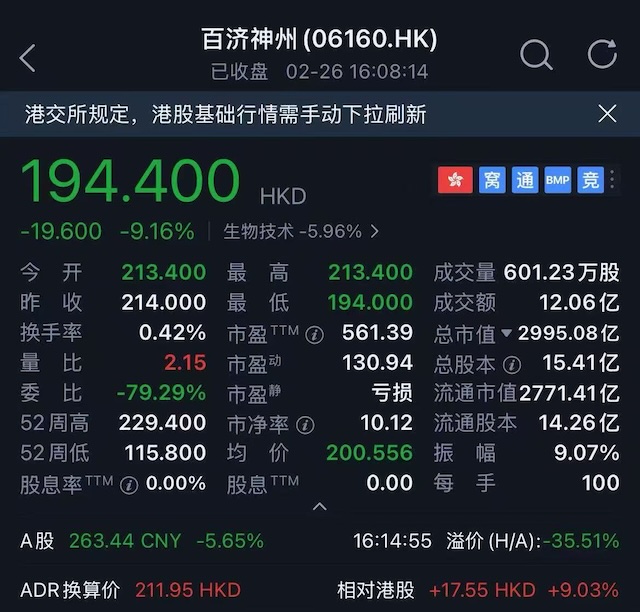
2月26日,百济神州跌5.27%,截至发稿,报264.50元/股,成交10.74亿元,换手率3.47%,总市值 4075.09亿元。 资料显示,百济神州有限公司位于北京市昌平区中关村生命科学园科学园路30号,成立日期2010年10月 28日,上市日期2021年12月15日,公司主营业务涉及研究、开发、生产以及商业化创新型药物。主营业 务收入构成为:药品销售收入99.10%,合作安排收入0.90%。 从基金十大重仓股角度 数据显示,摩根士丹利基金旗下1只基金重仓百济神州。大摩健康产业混合A(002708)四季度持有股 数23.18万股,与上期相比持股数量不变,占基金净值比例为4.12%,位居第七大重仓股。根据测算,今 日浮亏损失约341.23万元。 大摩健康产业混合A(002708)成立日期2016年6月30日,最新规模14.23亿。今年以来亏损0.47%,同 类排名8462/8887;近一年收益0.89%,同类排名7892/8134;成立以来收益69.9%。 大摩健康产业混合A(002708)基金经理为王大鹏。 截至发稿,王大鹏累计任职时间11年39天,现任基金资产总规模19.97亿元,任职期间最佳基金回报 ...
百济神州股价跌5.27%,中信保诚基金旗下1只基金重仓,持有1.19万股浮亏损失17.55万元
Xin Lang Ji Jin· 2026-02-26 06:31
2月26日,百济神州跌5.27%,截至发稿,报264.50元/股,成交10.74亿元,换手率3.47%,总市值 4075.09亿元。 资料显示,百济神州有限公司位于北京市昌平区中关村生命科学园科学园路30号,成立日期2010年10月 28日,上市日期2021年12月15日,公司主营业务涉及研究、开发、生产以及商业化创新型药物。主营业 务收入构成为:药品销售收入99.10%,合作安排收入0.90%。 从基金十大重仓股角度 数据显示,中信保诚基金旗下1只基金重仓百济神州。中信保诚中证800医药指数(LOF)A(165519)四 季度持有股数1.19万股,占基金净值比例为1.99%,位居第十大重仓股。根据测算,今日浮亏损失约 17.55万元。 中信保诚中证800医药指数(LOF)A(165519)成立日期2021年1月1日,最新规模1.47亿。今年以来收益 1.77%,同类排名4581/5572;近一年收益16.18%,同类排名3257/4311;成立以来收益89.35%。 中信保诚中证800医药指数(LOF)A(165519)基金经理为黄稚。 截至发稿,黄稚累计任职时间7年219天,现任基金资产总规模44.18亿 ...
利弗莫尔中概股龙头指数盘初跌0.1%
Mei Ri Jing Ji Xin Wen· 2026-02-25 14:50
每经AI快讯,2月25日,利弗莫尔中概股龙头指数盘初跌0.1%。成分股中,百济神州跌超3%,腾讯音 乐、小鹏汽车、网易跌超2%。 ...
美联储降息预期下修,恒生科技指数ETF、恒生互联网ETF开年走低
Sou Hu Cai Jing· 2026-02-24 06:41
恒生科技指数ETF(513180.SH)恒生互联网ETF(513330.SH)开年走低,权重股阿里巴巴、腾讯控 股、小米集团等再陷调整。 消息面上,春节假期,美联储降息预期下修,港股作为对外部流动性极为敏感的市场,节后表现较弱。 美国当地时间2月18日下午,美联储公布1月议息会议纪要,美联储官员对未来政策展望呈现巨大分歧, 市场认为短期内降息节奏可能放缓;2月19日,美国公布的初请失业金人数显示美国就业市场仍保持一 定韧性,而就业是降息周期中美联储重点关注的指标,基于此市场降低对美联储降息预期;2月20日, 美国公布的12月PCE高于预期,强化美联储暂缓降息预期,市场对6月降息预期下降至45.6%,降息预期 推迟至7月。 招商证券张夏团队点评称:短期美联储政策预期反复有扰动,但流动性冲击最大的阶段已经过去,且美 联储仍处降息周期,一旦降息预期重新稳固,港股作为离岸市场将显著受益;且春节后随着南下资金的 流入,也将为港股带来流动性支持。 投资工具方面,持续关注港股科技相关ETF:恒生科技指数ETF(513180.SH)、恒生互联网ETF (513330.SH)、港股通科技ETF基金(159101.SZ)。其中, ...
未知机构:国泰海通医药春节期间创新药领域重点新闻梳理全球BD根据医药-20260224
未知机构· 2026-02-24 02:45
Summary of Key Points from Conference Call Industry Overview - The conference call discusses the global business development (BD) activities in the pharmaceutical sector during the Chinese New Year period from February 13 to February 23, 2026, highlighting a total of 18 BD transactions globally [1] Core Insights and Arguments - **Key Transactions**: - Qinhai Bio licensed its MAT2A inhibitor (GH31), which has received IND approval in China and the US and is currently in Phase I clinical trials, to Gilead. Qinhai will receive an upfront payment of $80 million, $1.45 billion in milestone payments, and a tiered double-digit percentage royalty based on net sales [1] - Other notable transactions include: - Novartis partnered with Unnatural Products to develop macrocyclic peptide drugs, focusing on cardiovascular applications, with Unnatural Products receiving an upfront payment of $100 million and potential milestone payments of $1.7 billion [1] - Eli Lilly acquired global rights for the IL6 monoclonal antibody clazakizumab from CSL for all indications except end-stage renal disease, with CSL receiving an upfront payment of $100 million [1] - Merck collaborated with Mayo Clinic to integrate clinical and genomic data, focusing on early research translation in inflammatory bowel disease, skin diseases, and neurology [1] - **Year-to-Date Transactions**: - From January 1 to February 23, 2026, there have been 36 BD transactions involving Chinese companies, with 13 of these transactions involving multinational corporations (MNCs) [1] Additional Important Insights - **Comparison with Previous Year**: - In comparison, there were 26 BD transactions during the same period in 2025, with only 3 involving MNCs [2] - **Future Outlook**: - The analysis indicates that MNCs have increased their focus on Chinese BD teams and asset searches since the second half of 2025, suggesting a positive outlook for more BD transactions involving Chinese assets and MNCs in 2026 [2]
百济神州皮下注射剂型获临床默示许可,股价波动待业绩催化
Jing Ji Guan Cha Wang· 2026-02-14 21:18
Core Viewpoint - BeiGene's subcutaneous formulation of Tislelizumab has received implied approval from the National Medical Products Administration for clinical trial supplementation, aimed at treating malignant tumors, marking a significant advancement in drug formulation that is expected to enhance patient compliance and market potential [1] Stock Performance - As of February 13, 2026, BeiGene's A-shares (688235) were priced at 279.62 CNY, with a 5-day cumulative increase of 2.61%; Hong Kong shares (06160) were at 208.60 HKD, up 1.66% over the same period; while U.S. shares (ONC.OQ) were at 346.07 USD, down 2.22% [2] - On February 13, 2026, A-share net outflow of main funds was 8.49 million CNY, with a trading volume of 316 million CNY, indicating short-term profit-taking pressure influenced by market sentiment and company events [2] Financial Report Analysis - BeiGene plans to release its financial results for Q4 and the full year of 2025 on February 26, 2026; preliminary data shows a revenue of 27.595 billion CNY for the first nine months of 2025, a year-on-year increase of 44.21%, and a net profit attributable to shareholders of 1.139 billion CNY, up 130.88% year-on-year [3] - The high growth in performance is primarily driven by the sales expansion of core products like Tislelizumab, with investors advised to focus on annual profitability and globalization progress [3] Institutional Perspectives - In the past 90 days, 9 institutions have rated BeiGene, with 8 giving a buy rating and 1 an outperform rating, setting a target average price of 320.0 CNY [4] - Analysts indicate that the company's fundamentals are robust, with strong globalization progress and profitability, although financial risks and market competition should be monitored [4]
百济神州总裁兼首席运营官吴晓滨:让创新走得更远,让希望触手可及
Jing Ji Guan Cha Wang· 2026-02-14 12:25
Core Insights - The company has achieved significant global growth over the past year, marking a critical turning point towards profitability with its core self-developed BTK inhibitor, Baiyueze, establishing a leading position globally [1] - The company has launched its second self-developed product in the hematology field, the BCL2 inhibitor Baiyueda (Sotuximab), which is now commercially available [1] - The company has expanded its global footprint, with products available in over 75 markets and more than 2 million patients receiving treatment worldwide [1] Global Expansion and Market Impact - In Thailand, the approval process for Baizean took only 7 months, significantly reducing the time for patients to access innovative treatments [2] - In India, two self-developed products have benefited over 1,500 patients with positive clinical feedback [2] - The company is supporting the first immunotherapy clinical trial in sub-Saharan Africa through the provision of PD-1 inhibitors [2] - The Guangzhou production base not only serves domestic patients but also extends to markets in Indonesia, India, and South Korea, continuously expanding the company's global reach [2] Commitment to Innovation and Accessibility - The company aims to enhance drug accessibility in more countries and regions while continuing to expand its pipeline with a focus on scientific innovation [3] - The commitment to making innovative treatments available to more patients globally is seen as a long-term investment and a driving force for the company [3] Milestone Year - The year 2025 is highlighted as a milestone for the company, marking its 15th anniversary and a clearer, more determined new starting point in its globalization journey [4] Collaboration and Knowledge Sharing - The company emphasizes the importance of collaboration with various industry stakeholders to gather diverse experiences and insights, aiming to illuminate hope for more patients through scientific exploration [5]
跟着大资金选股!公募调仓科创板,猛攻电子、医药
市值风云· 2026-02-14 10:09
Core Viewpoint - The article discusses the current funding logic in the market, highlighting the significant movements of public funds in the technology sector, particularly in the semiconductor and biopharmaceutical industries, as they adjust their portfolios based on performance and valuation metrics [3][8]. Group 1: Public Fund Movements - Public funds have shown a notable shift in their holdings, particularly in the STAR Market, with the STAR 50 Index rising by 12.1% this year [3][4]. - The total market capitalization of STAR Market companies reached 10.4 trillion yuan, with the technology sector dominating, accounting for 62.1% of the total market cap [5][6]. - The semiconductor industry remains the core focus for fund allocation, with 12 companies in the sector having a market capitalization exceeding 10 billion yuan [9][11]. Group 2: Semiconductor Sector Insights - The market's pricing anchor for the semiconductor sector has shifted from "valuation expansion" to "performance realization," emphasizing the importance of actual earnings [13][14]. - Key drivers for future growth in the semiconductor sector include strong order backlogs, profit growth through acquisitions and expansions, and sustained price increases in advanced processes [13][14]. - Public funds have significantly increased their holdings in semiconductor materials, chip design, and equipment, with companies like ShenGong Co. seeing an 11% increase in fund holdings [15][21]. Group 3: Biopharmaceutical Sector Insights - The biopharmaceutical sector is a critical area for public funds, with major holdings in companies like BeiGene and United Imaging Healthcare, although the sector has faced a reduction in holdings for several key companies [24][26]. - The article notes that innovative drug companies are currently under pressure, with significant reductions in holdings observed in companies like BaiLi TianHeng and RongChang Biopharma [26][28]. - Despite the challenges, companies with strong earnings potential and innovative drug pipelines are still attracting interest from public funds, indicating a selective investment approach [35][40].
中国创新药对外授权年交易额突破千亿美元,4年增长近10倍
Di Yi Cai Jing· 2026-02-14 06:37
Core Insights - Many multinational companies are increasingly viewing China as a crucial part of their global R&D infrastructure, especially as they face patent cliffs and seek to cut costs [1][4] - The value of licensing agreements for new drugs from Chinese biopharmaceutical companies is expected to reach a historic high of over $100 billion by 2025, with a total of $137.7 billion in licensing deals signed in 2025, nearly a tenfold increase from 2021 [1][4] Group 1 - Global pharmaceutical giants, including Novartis, AstraZeneca, and GSK, signed multiple significant agreements with Chinese companies last year [3] - Tom Barsha, head of Asia-Pacific M&A at Bank of America Securities, predicts that the total value of these licensing deals could double again in the next 18 to 24 months, as global companies focus on finding next-generation innovative drug pipelines in China [3] - There have been nearly 40 licensing transactions involving Chinese biopharmaceutical companies this year, with average deal sizes significantly higher than last year [3] Group 2 - The average deal size for licensing agreements from Chinese pharmaceutical companies this year has reached $1.3 billion, a 76% increase from 2025 levels and approximately six times the average from 2021 [4] - The average upfront payment this year is $77.7 million, doubling from $38.8 million in 2025 and tripling from the average in 2021 [4] - Macquarie Capital's Asia healthcare research department predicts that a class of drugs considered foundational for cancer treatment will continue to attract global pharmaceutical interest [4] Group 3 - Many multinational companies are recognizing China's strength in chemical fields, allowing them to obtain promising molecular licenses at lower costs compared to internal R&D [4] - Vision Lifesciences' report highlights that China is a world leader in specific molecular types, with Chinese companies accounting for nearly 90% of global licensing deals for antibody-drug conjugates (ADCs) [4]
百济神州皮下注射剂型获临床试验许可,将发布2025年业绩
Jing Ji Guan Cha Wang· 2026-02-13 22:39
Core Insights - Recent developments for BeiGene include the approval of a supplemental application for the subcutaneous formulation of Tislelizumab for malignant tumor treatment, which is expected to enhance patient compliance and market potential [1] - The company plans to release its financial results for Q4 and the full year of 2025 on February 26, 2026, which will be followed by a board meeting and a conference call for investors [1] Stock Performance - BeiGene's stock has shown volatility recently, with A-shares closing at 279.62 CNY, down 1.09% on February 13, 2026, but up 2.61% over the past five days; Hong Kong shares closed at 208.60 HKD, down 0.48%, with a 1.66% increase over five days; and US shares at 350.12 USD, up 1.07% on the same day but down 1.07% over five days [2] - On February 12, 2026, A-share main funds experienced a net outflow of 18.68 million CNY, with a trading volume of 311 million CNY, indicating some profit-taking pressure amid market sentiment [2] Financial Analysis - Preliminary data shows that for the first nine months of 2025, BeiGene reported revenue of 27.595 billion CNY, a year-on-year increase of 44.21%, and a net profit attributable to shareholders of 1.139 billion CNY, up 130.88% [3] - The significant growth in performance is primarily driven by the sales expansion of core products like Tislelizumab, and investors should pay attention to the company's profitability and globalization progress in the upcoming financial report [3]