
恒生互联网ETF

Search documents
投资者微观行为洞察手册3月第4期:市场高波动之下:外资比内资更积极
GUOTAI HAITONG SECURITIES· 2026-04-01 09:40
Group 1 - The report indicates a slight decrease in market trading activity, while the profitability effect is on the rise, with the average daily trading volume for the entire A-share market dropping to 2.1 trillion yuan and the proportion of stocks rising by 40.7% [8][10][11] - The report highlights that foreign capital has significantly flowed into the A-share market, with a net inflow of approximately 6.7 million USD as of March 25, while financing funds have seen a slight outflow [22][43][45] - The report notes that the issuance of new public equity funds has decreased to 16.9 billion yuan, indicating a decline in public fund activity [31][36] Group 2 - The report observes that the confidence index for private equity funds has decreased by 0.1% compared to the previous month, suggesting a decline in sentiment among private investors [41][47] - The report states that the net inflow of foreign capital into the A-share market has reached a historical percentile of 88.5%, indicating strong foreign interest [43][44] - The report mentions that the trading concentration in primary industries has decreased, while the concentration in secondary industries has increased, with seven industries maintaining a turnover rate above 90% historically [19][20] Group 3 - The report indicates that the electric power equipment sector has seen significant inflows from financing and ETF funds, while the electronics sector has experienced notable outflows [3][29][43] - The report highlights that the public utilities and coal sectors have shown a marked increase in trading activity, with public utilities seeing a 39.95% increase in trading volume [18][19] - The report notes that the top three industries on the trading leaderboard are public utilities, environmental protection, and electronics, reflecting current market trends [3][22] Group 4 - The report indicates that the southbound capital has significantly flowed into the Hong Kong stock market, with net purchases rising to 25.15 billion yuan, reflecting increased foreign investment in the region [4][24] - The report highlights that global foreign capital has marginally flowed into the Chinese market, with China being one of the top recipients of foreign investment [4][24][43] - The report mentions that the Nasdaq index has declined by 3.2%, with most global markets experiencing losses, particularly the South Korean composite index, which fell by 5.9% [4][24]
外卖三巨头突发大涨,美团拉涨超10%!外卖补贴遭官方叫停?
Mei Ri Jing Ji Xin Wen· 2026-03-25 06:03
Core Viewpoint - The surge in tech stocks, particularly in the food delivery sector, is attributed to regulatory signals indicating a potential end to the ongoing subsidy wars among major players in the industry [1] Group 1: Stock Performance - On March 25, major food delivery companies saw significant stock increases, with Meituan rising over 10%, Alibaba increasing by more than 5%, and JD.com up over 4% [1] - The Hang Seng Internet ETF (513330.SH), which includes these companies, also rose by over 3% [1] Group 2: Regulatory Environment - The National Market Supervision Administration's reposting of an article titled "The Food Delivery War Should End" is interpreted as a regulatory stance against "involutionary competition," signaling a potential halt to the subsidy wars that have persisted for nearly a year [1] - On March 23, three departments in Beijing conducted joint discussions with twelve platform companies, including major players like Ctrip, Meituan, and Douyin, addressing issues identified in the ongoing comprehensive rectification of "involutionary" competition [1] Group 3: Index Characteristics - The Hang Seng Internet ETF (513330.SH) tracks the Hang Seng Internet Technology Index, which focuses on internet and software applications, excluding hardware sectors [1] - This index is considered more comprehensive than the Hong Kong Stock Connect Internet index, as it includes major internet companies not covered by the latter, such as Baidu, NetEase, and Global Data [1]



正名之后,更见底色,华夏基金ETF背后的“长期主义”
点拾投资· 2026-03-23 03:14
Core Viewpoint - The article discusses the unprecedented "renaming battle" in China's ETF market, where over 1,400 ETFs must complete renaming by the end of March, marking the end of the "name dividend" era and the beginning of a standardized branding phase for ETF products [1]. Group 1: Historical Context and Development - In 2004, China’s first ETF, the Huaxia SSE 50 ETF, was launched by Huaxia Fund, marking the beginning of the ETF market in China [3]. - Huaxia Fund took five years to develop the ETF, conducting extensive investor education and outreach, which laid the groundwork for the future growth of the ETF market [3]. - By January 2026, Huaxia Fund's ETF management scale exceeded 1 trillion yuan, making it the first fund manager in China to reach this milestone [3]. Group 2: Product Strategy and Market Position - Huaxia Fund's ETF product lineup has grown to 122, covering a wide range of categories including core broad-based, popular industry themes, cross-border markets, and Smart Beta strategies [7]. - The "asset management Lego" concept allows investors to construct portfolios flexibly, with flagship products providing stability and growth opportunities [7]. - Huaxia Fund has shown a keen ability to capture emerging industries, with significant growth in ETFs related to robotics and artificial intelligence [8]. Group 3: Service and Innovation - The launch of the "Red Rocket" platform in 2024 represents Huaxia Fund's commitment to investor education and service, providing a comprehensive online service for index investment [11]. - The platform has served over 15 million users and attracted thousands of professional financial advisors, indicating its broad market appeal [11]. Group 4: Competitive Landscape and Fee Strategy - The collective renaming of ETFs aligns with Huaxia Fund's strategy of standardization and transparency, which aims to lower investment decision-making barriers for investors [13]. - Huaxia Fund has reduced management fees for 35 ETFs to the lowest market rate of 0.15% per year, demonstrating its competitive edge and commitment to investor benefits [13]. - This low-fee strategy is based on a scale effect, where larger scale leads to higher operational efficiency and lower fees, benefiting investors [13]. Group 5: Global Positioning - By 2025, China's ETF market surpassed 6 trillion yuan, becoming the largest in Asia and the second largest globally, with Huaxia Fund's international ranking improving to 18th among global ETF providers [16]. - The rise of Huaxia Fund reflects the broader growth of China's asset management industry on the global stage, challenging established players in the ETF market [16].


百度股价绩后震荡回升,市场对“AI烧钱而不赚钱”的担忧有所减轻
Mei Ri Jing Ji Xin Wen· 2026-02-27 03:01
Core Insights - Baidu's Q4 and full-year financial report highlights significant growth in AI business, with AI revenue surpassing 40% of total revenue, and continued strong growth in intelligent cloud services [1] - The company is advancing the independent listing of its self-developed chip company, Kunlun [1] - Baidu's stock price showed volatility post-earnings, reflecting mixed performance among constituents of the Hang Seng Internet ETF [1] Financial Performance - In Q4, Baidu's AI new business revenue reached 11.3 billion yuan, accounting for 43% of total general business revenue, up from 39% in the previous quarter [1] - The monthly active users of Baidu's AI application, Wenxin Assistant, are projected to reach 202 million by the end of Q4 2025 [1] Strategic Direction - Baidu plans to integrate Baidu Wenku and Baidu Netdisk to accelerate AI application innovation [1] - The company emphasizes that application is more important than the model, as the value of the model is realized through its application [1] Market Context - Industry analysts note a shift in the valuation anchor for Hong Kong tech giants from traditional advertising and traffic-based growth to AI infrastructure and service provision, which adds valuation flexibility [1] - Baidu's stock had previously surged by 40% at the end of last year but has recently faced adjustments alongside the Hang Seng Tech Index [1] Investment Opportunities - Investors can leverage the Hang Seng Internet ETF and other mainland-listed ETFs to capture recovery opportunities among Hong Kong internet giants [2] - Baidu is considering upgrading its secondary listing in Hong Kong to a "dual primary listing" to attract mainland capital [2]
“落袋为安”?14亿,跑了
Zhong Guo Ji Jin Bao· 2026-02-26 04:17
Group 1 - On February 25, the A-share market saw all three major indices rise, but the stock ETF market experienced a net outflow of approximately 1.4 billion yuan [1] - As of February 25, the total scale of 1,344 stock ETFs in the market reached 4.18 trillion yuan, with a reduction of 503 million fund shares, resulting in a net outflow of about 1.48 billion yuan [2] - The Hong Kong stock market ETFs led in net inflows, totaling 1.881 billion yuan, with the CSI 500 Index ETF seeing the highest inflow of 1.678 billion yuan [2] Group 2 - On February 25, 32 ETFs had net inflows exceeding 100 million yuan, with the CSI 500 ETF leading at 1.424 billion yuan, followed by the Electric Grid Equipment ETF and A500 ETF with inflows of 1.059 billion yuan and 618 million yuan respectively [2] - E Fund's ETFs continued to attract net inflows, with the Hang Seng Technology ETF receiving 270 million yuan, the SSE 50 ETF 229 million yuan, and the Artificial Intelligence ETF 203 million yuan [2] - The Electric Grid Equipment ETF and Hang Seng Internet ETF from Huaxia Fund saw significant net inflows of 1.059 billion yuan and 603 million yuan respectively, with their latest scales at 20.465 billion yuan and 37.213 billion yuan [3] Group 3 - The ChiNext Index ETF experienced the largest net outflow on February 25, amounting to 1.946 billion yuan [4] - ICBC Credit Suisse Fund remains optimistic about the A-share market in the medium term, citing that total demand adjustments are nearing equilibrium and supply-side adjustments will enhance confidence in capital return rates [4]
56亿,加仓
3 6 Ke· 2026-02-25 09:42
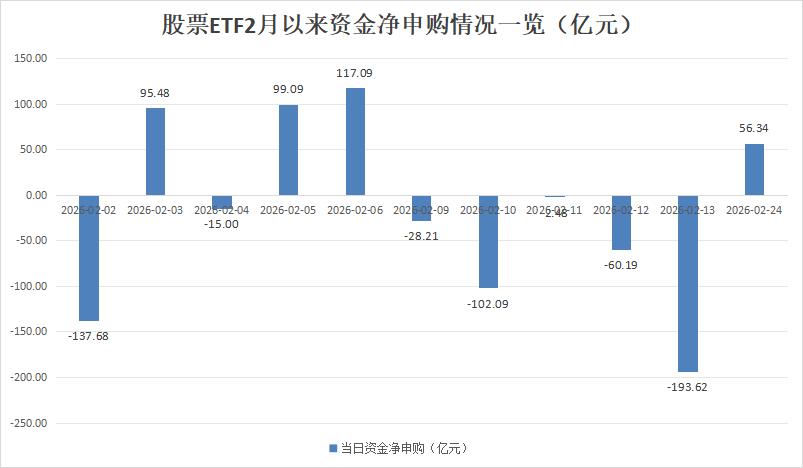
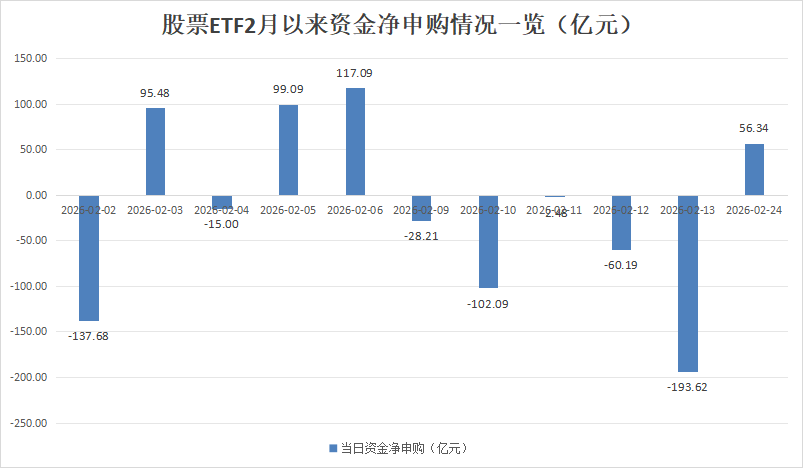
Group 1 - The stock ETF market experienced a significant net inflow of 56.34 billion yuan on February 24, reversing the trend of net outflows observed in the first five trading days of the year [1][2] - The A-share market opened higher and closed with the Shanghai Composite Index up by 0.87%, while the ChiNext Index saw a peak increase of over 2% [2] - The total scale of all stock ETFs reached 3.92 trillion yuan, with 1,339 stock ETFs in the market [2] Group 2 - The Hong Kong stock market ETFs led the net inflow, with 84.72 billion yuan, while broad-based ETFs saw a net outflow of 50.11 billion yuan [4] - ETFs tracking the Hang Seng Technology Index had the highest single-day net inflow of 46.59 billion yuan, while those tracking the CSI A500 Index faced a net outflow of 17.18 billion yuan [4] - Major fund companies like E Fund and Huaxia Fund reported significant net inflows in their ETFs, with E Fund's total ETF scale reaching 659.7 billion yuan [4][5] Group 3 - Specific ETFs such as the Hang Seng Technology Index ETF and the China Internet ETF saw net inflows of 16.53 billion yuan and 13.41 billion yuan, respectively [5][6] - The performance of the robotics and power grid equipment ETFs also attracted over 4 billion yuan in net inflows, indicating growing interest in these sectors [8] Group 4 - The market saw notable net outflows from broad-based ETFs, including the CSI 500 ETF and the media ETF, with the latter experiencing a net outflow of 4.46 billion yuan [9] - The short-term bond ETF faced the largest single-day net outflow of 11.54 billion yuan, reflecting a shift in investor sentiment towards riskier assets [9]
资金回归理性定价?MiniMax、智谱股价回调,关注港股大型科技公司补涨机会
Mei Ri Jing Ji Xin Wen· 2026-02-25 06:50
Group 1 - The core viewpoint of the articles highlights a contrasting performance between large tech companies like Alibaba and Tencent, which are experiencing a stock price recovery, and AI startups MiniMax and Zhiyu, which have seen significant stock price declines after their initial public offerings [1] - The market appears to be returning to rational pricing after a brief speculative surge in small-cap model companies, indicating that large Chinese tech giants are severely undervalued and may represent a bottoming opportunity for investors [1] - The Hang Seng Technology Index shows a significant discount compared to the A-share technology indices, reaching historical highs, suggesting a potential for recovery similar to past instances in 2022 [1] Group 2 - There has been a notable inflow of funds into Hong Kong tech-related ETFs, such as the Hang Seng Technology Index ETF and the Hang Seng Internet ETF, indicating a strategic accumulation of shares in major tech companies like Alibaba and Tencent [2] - These ETFs are listed on mainland stock exchanges and cover a basket of Hong Kong tech giants, reflecting investor confidence in the sector despite recent volatility [2] - The focus of the Hong Kong Stock Connect ETFs is on eligible stocks, excluding non-Hong Kong Stock Connect companies, which may influence investment strategies [2]
56亿,加仓!
Zhong Guo Ji Jin Bao· 2026-02-25 05:48
Group 1 - The stock ETF market experienced a significant inflow of 56.34 billion yuan on the first trading day of the Year of the Horse, reversing the trend of outflows seen in the previous five trading days [1][2] - The A-share market opened higher and closed with the Shanghai Composite Index up 0.87%, stabilizing above 4100 points, while the market turnover slightly increased to 2.18 trillion yuan [2] - The inflow was primarily driven by strong performance in the Hong Kong stock sector, with several ETFs tracking the Hong Kong market seeing substantial inflows [1][4] Group 2 - The largest inflows were observed in Hong Kong market ETFs, totaling 84.72 billion yuan, and thematic industry ETFs, which saw inflows of 25.79 billion yuan, while broad-based ETFs experienced outflows of 50.11 billion yuan [4] - ETFs tracking the Hang Seng Technology Index led the inflows with 46.59 billion yuan, while those tracking the CSI A500 Index saw outflows of 17.18 billion yuan [4] - Major fund companies like E Fund and Huaxia Fund reported significant inflows in their ETFs, with E Fund's total ETF scale reaching 659.7 billion yuan, increasing by 4.88 billion yuan on February 24 [4][5] Group 3 - Specific ETFs such as the Huaxia Hang Seng Technology Index ETF and the E Fund's China Internet ETF saw inflows of 16.53 billion yuan and 13.75 billion yuan, respectively [5][6] - The performance of the robotics sector was highlighted, with the Huaxia Robotics ETF also receiving over 4 billion yuan in inflows, reflecting a growing interest in the domestic robotics industry [7] - The market sentiment around the Hang Seng Technology Index is optimistic, with analysts noting the potential for growth driven by advancements in AI and technology [6][7]
南向资金尾盘半小时净流入31亿,恒生科技指数ETF、恒生互联网ETF出现大买单
Mei Ri Jing Ji Xin Wen· 2026-02-24 11:44
Group 1 - The Hong Kong stock market experienced a decline in major tech stocks, with Tencent Holdings and Meituan dropping over 3%, while Alibaba, Baidu Group, and Xiaomi Group fell by 2% [1] - Southbound capital saw a reversal from net outflow to net inflow, with a rapid net inflow of HKD 3.1 billion in the last half hour before the market closed [1] - Significant buying activity was observed in the Hang Seng Technology Index ETF (513180.SH) and the Hang Seng Internet ETF (513330.SH), with over HKD 1 billion in large orders during a sharp intraday drop, indicating potential bullish sentiment towards Hong Kong tech assets [1] Group 2 - Investment opportunities are identified in Hong Kong tech-related ETFs, including the Hang Seng Technology Index ETF (513180.SH), Hang Seng Internet ETF (513330.SH), and the Hong Kong Stock Connect Technology ETF (159101.SZ) [2] - The Hang Seng Internet ETF (513330.SH) focuses on major Hong Kong internet giants such as Alibaba, Baidu Group, Tencent Holdings, and NetEase, while the Hong Kong Stock Connect Technology ETF (159101.SZ) also includes leading innovative pharmaceutical companies [2] - These ETFs are listed on the Shanghai and Shenzhen stock exchanges, allowing A-share investors to trade flexibly with low entry barriers and without the need for cross-border accounts or currency exchange [2]
美联储降息预期下修,恒生科技指数ETF、恒生互联网ETF开年走低
Sou Hu Cai Jing· 2026-02-24 06:41
Group 1 - The Hang Seng Technology Index ETF (513180.SH) and the Hang Seng Internet ETF (513330.SH) have started the year on a downward trend, with major stocks like Alibaba, Tencent, and Xiaomi facing adjustments [1] - Following the Chinese New Year holiday, the market has shown weak performance due to revised expectations for interest rate cuts by the Federal Reserve, which is particularly impactful for the Hong Kong stock market sensitive to external liquidity [1] - The Federal Reserve's January meeting minutes revealed significant divergence among officials regarding future policy outlook, leading to a market perception that the pace of interest rate cuts may slow down in the short term [1] Group 2 - The initial jobless claims in the U.S. indicate that the employment market remains resilient, which is a key focus for the Federal Reserve during the interest rate cut cycle, resulting in reduced expectations for rate cuts [1] - The December PCE data released on February 20 exceeded expectations, reinforcing the view that the Federal Reserve may pause interest rate cuts, with market expectations for a June rate cut dropping to 45.6% and postponing the cut to July [1] - The Zhang Xia team from China Merchants Securities commented that while short-term expectations for Federal Reserve policy may fluctuate, the most significant phase of liquidity shock has passed, and once rate cut expectations stabilize, the Hong Kong market will benefit significantly [1] Group 3 - Investment tools focusing on Hong Kong technology-related ETFs include the Hang Seng Technology Index ETF (513180.SH), the Hang Seng Internet ETF (513330.SH), and the Hong Kong Stock Connect Technology ETF (159101.SZ) [2] - The Hang Seng Internet ETF (513330.SH) targets major internet companies in Hong Kong such as Alibaba, Baidu, Tencent, and NetEase, while the Hong Kong Stock Connect Technology ETF (159101.SZ) also includes leading innovative pharmaceutical companies [2] - These ETFs are listed on mainland stock exchanges and support T+0 intra-day trading, providing A-share investors with low-threshold access without the need for cross-border accounts or currency exchange [2]


