
BeiGene(688235)

Search documents
科创医药ETF工银(588860)开盘涨0.48%,重仓股联影医疗涨0.89%,百济神州涨1.90%
Xin Lang Cai Jing· 2026-03-24 01:39
Group 1 - The core point of the news is the performance of the Science and Technology Innovation Pharmaceutical ETF (工银, 588860), which opened with a gain of 0.48% at 0.626 yuan on March 24 [1][2] - The ETF's major holdings showed positive movements, with notable increases including Zai Lab (泽璟制药) up 2.81%, BeiGene (百济神州) up 1.90%, and Honor Bio (荣昌生物) up 2.70% [1] - The ETF's performance benchmark is the Shanghai Stock Exchange Science and Technology Innovation Board Biopharmaceutical Index, managed by ICBC Credit Suisse Asset Management Company, with a return of 24.70% since its inception on August 8, 2024, and a recent one-month return of -10.90% [2] Group 2 - The MACD golden cross signal has formed, indicating a positive trend for the stocks mentioned [3]



医药生物行业跟踪周报:BD放量及再融资,创新药龙头现金流充裕-20260322
Soochow Securities· 2026-03-22 11:19
Investment Rating - The report maintains an "Accumulate" rating for the pharmaceutical and biotechnology industry [1] Core Insights - The innovative drug sector is experiencing significant funding support, with a total of approximately 700 billion RMB raised in the A-share and Hong Kong markets from January 1, 2024, to March 21, 2026, to support R&D investments [15] - The BD (Business Development) income has become a crucial funding source for innovative drug research, with total contracts reaching 57.1 billion USD as of March 21, 2026, indicating a strong trend in the Chinese innovative drug market [18] - The report highlights a positive outlook for the innovative drug sector, particularly in small nucleic acid therapies, and suggests a ranking of preferred sub-sectors: innovative drugs > research services > CXO > traditional Chinese medicine > medical devices > pharmacies [8][11] Summary by Sections Industry Performance - The A-share pharmaceutical index has seen a decline of 2.77% this week and 2.90% year-to-date, underperforming the CSI 300 by 0.59% and 1.54% respectively [8] - The Hong Kong biotechnology index has increased by 0.48% this week and decreased by 0.97% year-to-date, outperforming the Hang Seng Technology Index by 2.60% and 10.63% respectively [8] Funding and Investment - From January 1, 2024, to March 21, 2026, the A-share pharmaceutical sector raised 11.8 billion RMB through equity financing and 2.5 billion RMB through convertible bonds [15] - The report emphasizes that the current funding situation in the pharmaceutical sector is robust, with most companies maintaining over one year of R&D funding coverage [18] R&D Progress and Company Developments - Several companies have made significant advancements in their R&D pipelines, including KX-826 for hair loss treatment and ABSK061 for achondroplasia, which received orphan drug designation from the FDA [8] - The report suggests specific companies to watch based on various therapeutic areas, including innovative drugs, ADCs, and small nucleic acids [11] Market Insights - The report notes that the overall market for pharmaceuticals is currently undervalued, with the pharmaceutical index trading at a P/E ratio of 35.19, which is 3.22 times lower than its historical average [8]

医药生物行业跟踪周报:BD放量及再融资,创新药龙头现金流充裕
Soochow Securities· 2026-03-22 10:24
Investment Rating - The report maintains a rating of "Buy" for the pharmaceutical and biotechnology industry [1] Core Insights - The innovative drug sector is experiencing significant funding support, with a total of approximately 700 billion RMB raised in the A-share and Hong Kong markets from January 1, 2024, to March 21, 2026, to support R&D investments [15] - The BD (Business Development) income has become a crucial funding source for innovative drug research, with total contracts reaching 57.1 billion USD as of March 21, 2026, indicating a strong trend in the Chinese innovative drug market [18] - The report highlights a positive outlook for the innovative drug sector, particularly in small nucleic acid therapies, and suggests a ranking of preferred sub-sectors: innovative drugs > research services > CXO > traditional Chinese medicine > medical devices > pharmacies [8] Summary by Sections Industry Performance - The A-share pharmaceutical index has seen a decline of 2.77% this week and 2.90% year-to-date, underperforming the CSI 300 by 0.59% and 1.54% respectively [8] - The Hong Kong biotechnology index has increased by 0.48% this week and decreased by 0.97% year-to-date, outperforming the Hang Seng Technology Index by 2.60% and 10.63% respectively [8] Funding and Investment - From January 1, 2024, to March 21, 2026, the A-share pharmaceutical sector raised 11.8 billion RMB through equity financing and 2.5 billion RMB through convertible bonds [15] - The Hong Kong pharmaceutical sector raised a total of 63.2 billion HKD during the same period [15] R&D Progress and Company Developments - Several companies have made significant advancements in their R&D, including KX-826 for hair loss treatment and ABSK061 for achondroplasia, which received orphan drug designation from the FDA [8] - The report emphasizes the importance of maintaining a robust financial foundation for ongoing clinical trials and pipeline expansion, with most companies having over one year of R&D funding coverage [18] Stock Recommendations - The report suggests focusing on specific companies based on various therapeutic areas, including innovative drugs, ADCs, small nucleic acids, and traditional Chinese medicine [11]
医药健康行业研究:受上游原材料成本提升影响,原料药产品迎来提价契机
SINOLINK SECURITIES· 2026-03-22 08:54
Investment Rating - The report suggests a positive investment outlook for the innovative drug sector, highlighting potential opportunities due to upcoming clinical data and successful overseas clinical progress of pipelines [2][4]. Core Insights - The chemical products sector is experiencing significant price increases due to rising international oil prices and high overseas energy costs, particularly affecting solvent products which are difficult to stockpile [1][10]. - The raw material pharmaceutical products are expected to see price increases as upstream raw material costs rise, with downstream clients maintaining low inventory levels since April 2023, indicating a potential for sustained price increases and profit elasticity [1][10]. - The report emphasizes the importance of the PI3K/AKT/mTOR signaling pathway in cancer treatment, with renewed focus on PI3K inhibitors, particularly following Novartis's acquisition of Synnovation Therapeutics' PI3Kα inhibitor SNV4818 [34][35][36]. Summary by Sections Raw Materials - The report notes that the pharmaceutical raw material sector is poised for price increases due to rising upstream costs and low inventory levels among clients, which could lead to sustained profitability [1][10]. Pharmaceuticals - Novartis announced a $2 billion upfront payment and up to $1 billion in milestone payments to acquire Synnovation Therapeutics' PI3Kα inhibitor SNV4818, indicating a strategic focus on differentiated therapies in the HR+/HER2- breast cancer market [2][34]. Medical Devices - Innovative products in the medical device sector are expanding into international markets, with companies like MicroPort receiving CE certification for pediatric applications of their surgical robots, enhancing their global brand presence [3][11]. Biologics - The report highlights the promising results of the oral GLP-1 Aleniglipron, which showed significant weight loss in clinical trials, suggesting a shift towards oral formulations that improve patient compliance and reduce logistics costs [3][12]. Traditional Chinese Medicine - The report suggests monitoring undervalued high-dividend assets within the traditional Chinese medicine sector as companies begin to release their performance results [3][12]. Healthcare Services and Consumer Healthcare - The report discusses the upcoming release of the DRG/DIP 3.0 version by the National Healthcare Security Administration, expected to be published around July 2023, which will provide insights into the evolving healthcare payment landscape [3][12]. Investment Recommendations - The report recommends focusing on core sectors such as small nucleic acids, bispecific antibodies, and ADCs, while also identifying opportunities during earnings forecast windows and major clinical data release events [2][4].

靶蛋白降解行业深度报告-下一代颠覆性治疗范式迎来商业化元年
2026-03-19 02:39
Summary of Key Points from the Conference Call Records Industry Overview - The protein degradation industry is entering a commercialization phase with technologies like PROTAC and molecular glue expected to gain regulatory approval in 2026, marking a shift from concept to product realization [1][2][20]. Core Insights and Arguments - **Technological Advancements**: AI-driven drug development is transitioning from serendipitous discovery to rational design, significantly enhancing the prediction accuracy of ternary complexes and accelerating the output of drug candidates [1][3][4]. - **Efficacy Improvements**: New generation degraders have surpassed a 95% efficiency threshold, with products like KT-621 demonstrating potential as "oral small nucleic acid" alternatives in autoimmune diseases [1][4]. - **Clinical Data**: BeiGene's BTK PROTAC achieved an overall response rate (ORR) of 94% in fourth-line treatment, outperforming similar products from Nurix, with safety risks to be monitored in upcoming data releases [1][12]. - **Market Trends**: The focus is shifting from tumor resistance targets to "undruggable" and autoimmune areas, with new platforms like LyTACs targeting extracellular and membrane proteins [1][7][8]. Milestones and Unique Advantages - **Upcoming Approvals**: Arvinas' ARV-471 and BMS' Abudomide are set for approval in mid-2026, representing significant milestones in the protein degradation field [2][20]. - **Mechanism of Action**: Protein degradation technologies offer advantages over traditional drugs by directly degrading target proteins, potentially overcoming resistance issues and expanding the range of druggable targets [2][3]. - **Patient Compliance**: Oral formulations of these drugs improve patient adherence compared to injectable therapies [2]. Key Players and Pipeline Progress - **Arvinas**: Leading in the PROTAC space with ARV-471 expected to be the first commercialized PROTAC drug, despite not showing a disruptive advantage over existing oral SERD drugs [9][20]. - **BMS**: Dominating the molecular glue sector with Abudomide and Iberdomide, both expected to show improved efficacy and safety profiles compared to older products [10][14]. - **Kymera Therapeutics**: Notable for its STAT6 PROTAC (KT-621), which has shown promising clinical data compared to Dupixent, with key data releases anticipated in 2027 [10][19]. - **BeiGene**: Fastest progress in the BTK PROTAC space, with significant clinical data expected by the end of 2026 [9][19]. Emerging Technologies and Future Directions - **LyTACs and DACs**: New platforms are in early stages, with LyTACs being the most mature for extracellular protein targeting, while DACs are still exploratory [6]. - **Monte Rosa Therapeutics**: Utilizing an AI platform for systematic drug discovery, with unique products targeting a wide range of autoimmune diseases [19][21]. - **C4 Therapeutics**: Developing IKZF1/3 molecular glue with promising safety profiles, aiming for rapid approval in the near future [17][18]. Investment Opportunities - **Key Companies to Watch**: - Revolution Medicines for its potential in pancreatic cancer treatment [21]. - Monte Rosa Therapeutics for its innovative AI platform [21]. - BeiGene for its leading position in the BTK PROTAC market [21]. - Kymera Therapeutics for its high ORR in clinical trials [21]. This summary encapsulates the critical developments and insights from the conference call records, highlighting the advancements and future potential within the protein degradation industry.


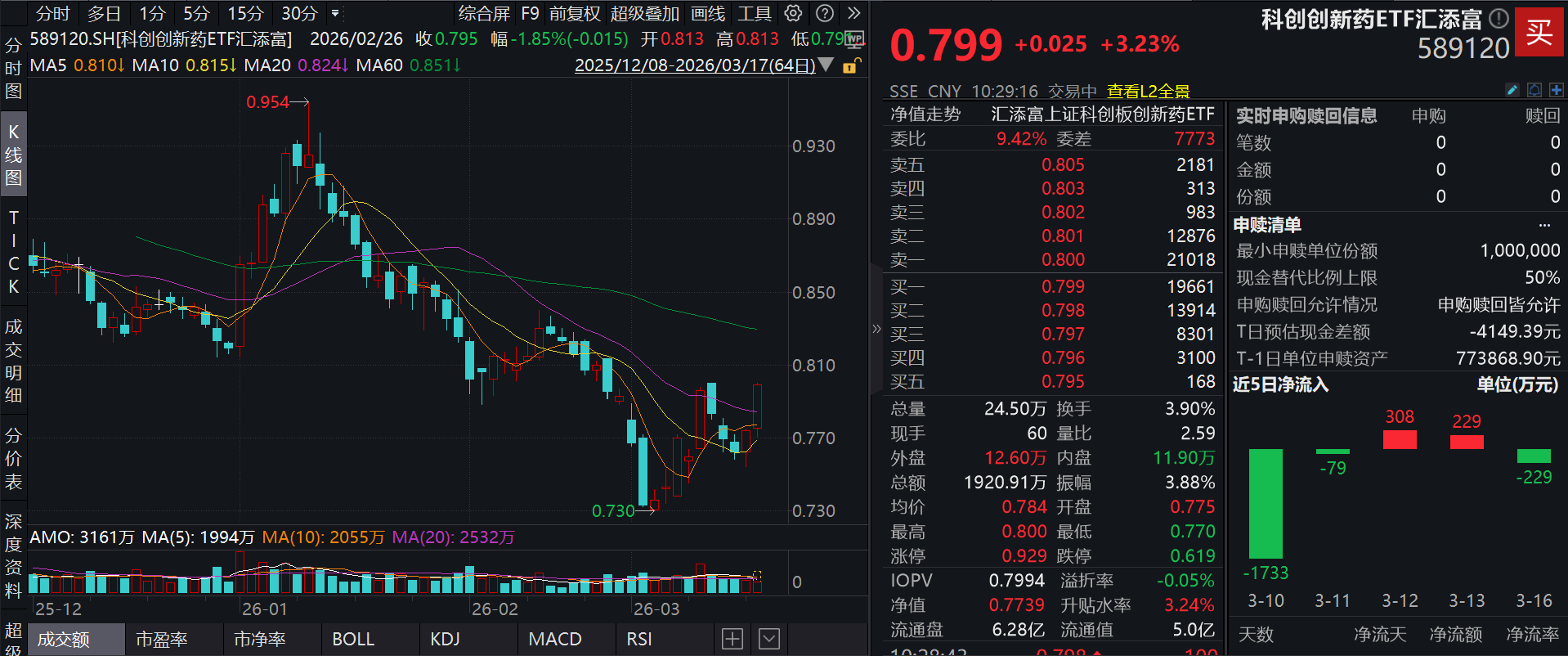
科创创新药连续反弹,百济神州涨超4%,荣昌生物涨近7%,多项重磅新药、专利来了!科创创新药ETF汇添富(589120)量价齐升涨超3%
Xin Lang Cai Jing· 2026-03-17 03:09
Core Viewpoint - The innovation drug sector in China is experiencing significant growth, driven by new drug approvals and favorable policy changes, with a focus on the performance of the ChiNext Innovation Drug ETF. Group 1: Market Performance - The ChiNext Innovation Drug Index rose by 3.42% as of March 17, 2026, with notable increases in constituent stocks such as Sangfor Biopharma (up 9.72%) and Yuandong Biotech (up 7.96%) [1] - The ChiNext Innovation Drug ETF (Huitianfu) increased by 3.23%, reaching a latest price of 0.8 yuan, and has seen a cumulative increase of 1.84% over the past week [1] - The ETF recorded a turnover rate of 3.90% with a trading volume of 19.21 million yuan, and an average daily trading volume of 33.78 million yuan over the past year [1] Group 2: Fund Growth and Inflows - The ChiNext Innovation Drug ETF saw a significant scale increase of 10.69 million yuan over the past two weeks, ranking in the top half among comparable funds [3] - The ETF's share count grew by 39 million shares in the past month, also placing it in the top half of comparable funds [3] - Despite a recent net outflow of 2.30 million yuan, the ETF experienced net inflows on 10 out of the last 15 trading days, totaling 30.51 million yuan [3] Group 3: Company Developments - Rongchang Biopharma's RC288 injection has received acceptance from the NMPA, showcasing promising anti-tumor activity and safety in preclinical studies [3] - Rongchang Biopharma is expected to enter a new growth phase starting in 2026, benefiting from new indications for RC18, RC48, and RC28, along with international sales starting in 2027 [4] - The company anticipates revenue from multiple asset authorizations beginning in 2025, which will enhance its financial statements [4] Group 4: Industry Trends - The new National Basic Medical Insurance Drug List has added 114 new drugs, including 50 innovative drugs, with a negotiation success rate of 88%, indicating a robust market for innovative drugs [5] - The commercialization of innovative drugs is accelerating, supported by improved payment systems and a green channel for insurance access [5] - The CXO industry is highlighted as a strong investment opportunity, with ongoing improvements in global pharmaceutical R&D and increasing collaboration between Chinese companies and multinational corporations [6]

百济神州:公司增值税计税方式未发生根本性变化
Zheng Quan Ri Bao· 2026-03-16 14:12
Core Viewpoint - The company, BeiGene, stated that the recent changes in the value-added tax (VAT) policy will not significantly impact its profits, as it does not fall under the adjustment from a 3% simplified tax to a 13% general tax rate, and its VAT calculation method remains fundamentally unchanged [1] Group 1 - The company confirmed that it is not affected by the VAT policy change set to take effect on January 1, 2026 [1] - The company anticipates that the tax policy change will not have a major adverse effect on its profitability [1]
百悦泽砍下全球销冠!百济神州:开启跨国药企之路?
市值风云· 2026-03-13 12:25
Group 1 - The core viewpoint of the article highlights that BeiGene has transitioned from continuous losses to sustained profitability, with clear performance guidance for 2025 and 2026 [1][3][7] - For the fiscal year 2025, the company expects total revenue of 38.205 billion, representing a year-on-year growth of 40.4%, achieving the upper end of its previous revenue guidance of 5.1-5.3 billion USD [4][6] - The projected net profit attributable to the parent company for 2025 is 1.422 billion, marking the company's first anticipated profit for the year [5][6] Group 2 - The company maintains an optimistic outlook for 2026, forecasting total revenue between 6.2-6.4 billion USD, which corresponds to a year-on-year growth of approximately 14-18% [6] - Operating profit for 2026 is expected to be between 700-800 million USD, indicating a significant year-on-year increase of 57%-79% [6]

百济神州(06160) - 公司资料表
2026-03-13 09:30
公司資料表 香港交易及結算所有限公司及香港聯合交易所有限公司對本資料表的內容概不負 責,對其準確性或完整性亦不發表任何聲明,並明確表示概不就因本資料表全部 或任何部分內容而產生或因依賴該等內容而引致的任何損失承擔任何責任。 公司名稱(股份代號):百濟神州有限公司(06160)(「本公司」) 股份簡稱:百濟神州 本資料表旨在向公眾提供有關本公司於指定日期的資料。該等資料無意作為本公 司及╱或其證券之完整資料摘要。 摘要內容 文件類型 日期 | A.豁免 | 於2026年3月13日的最新版本 | | --- | --- | | B.存託協議 | 於2025年5月27日的最新版本 | | C.稅項 | 於2025年5月27日的最新版本 | | D.法律及規例 | 於2025年5月27日的最新版本 | 責任聲明 於本公告日期,本公司董事謹此共同及個別對本資料表所載資料的準確性承擔全 部責任,並在作出一切合理查詢後確認,據彼等所深知及所確信,資料在所有重 大方面均屬準確及完整,並無誤導或欺詐成分,亦無遺漏任何其他事項而導致任 何資料不準確或產生誤導。 董事亦共同及個別承諾,於上次刊發後資料有重大變動時公佈經修訂的公司資 ...
百济神州:合共5.7万股美国存托股份获购买
Zhi Tong Cai Jing· 2026-03-12 15:35
Group 1 - The company BeiGene (06160) announced that a total of 57,000 American Depositary Shares (ADS) will be purchased by 4,431 participants under the 2018 Employee Stock Purchase Plan during the subscription period from September 2, 2025, to February 27, 2026 [1] - The total number of shares involved in the purchase is 741,300, which represents approximately 0.05% of the total issued shares of the company as of the date of the announcement [1]