BeiGene(688235)

Search documents
年薪超400万董事长不满薪酬反对连任,A股高薪董事长还有谁
Bei Jing Shang Bao· 2025-12-03 13:56
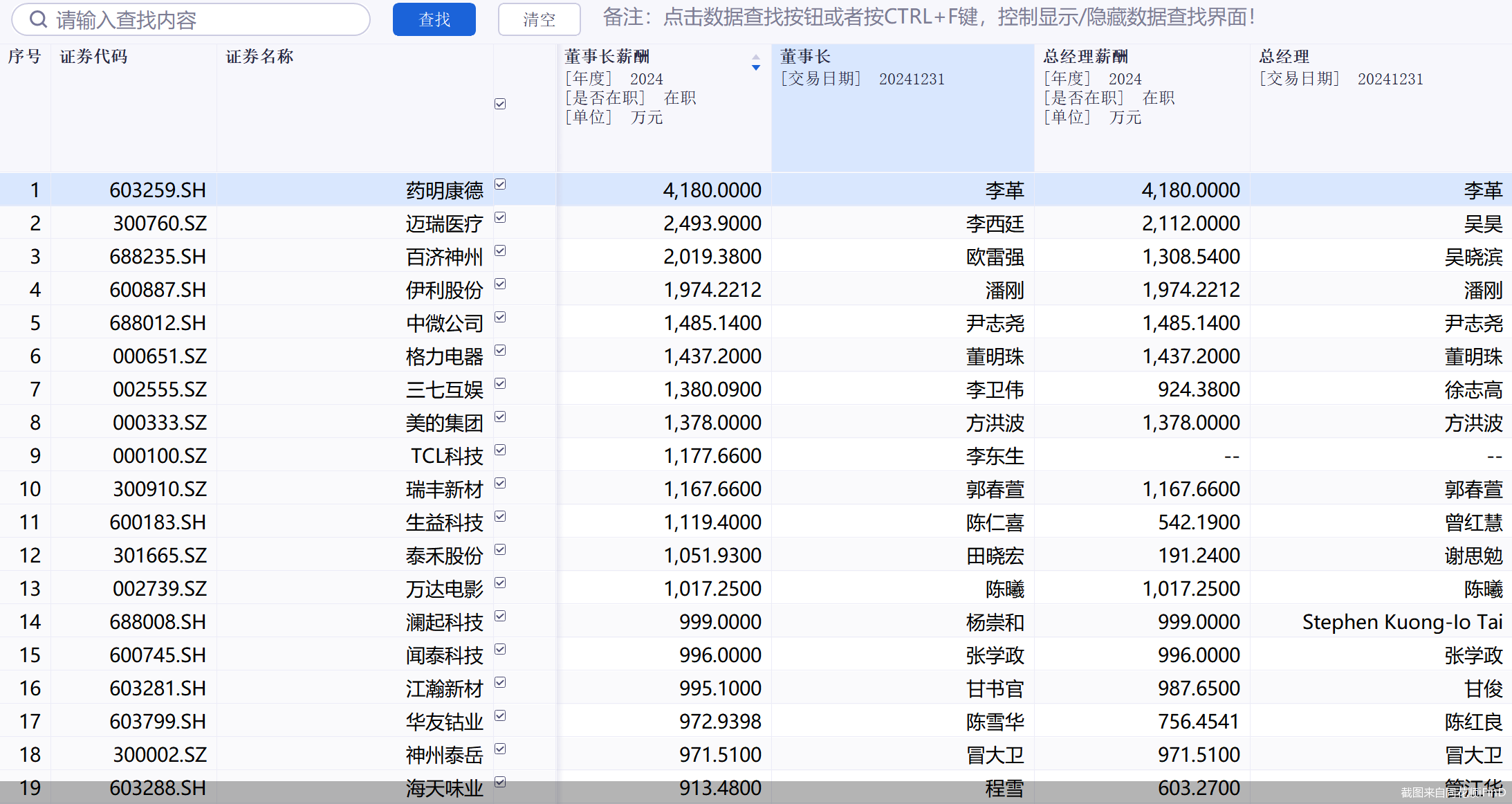
Core Viewpoint - The chairman of Absen, Ding Yanhui, opposed his re-election due to dissatisfaction with his salary, which increased significantly despite the company's declining profits [1][3][5]. Group 1: Salary and Performance - Ding Yanhui's salary for 2024 is 4.3556 million yuan, ranking 135th among approximately 4,500 A-share companies [1][8]. - In 2024, Ding's salary increased by nearly 1.5 million yuan compared to 2023, where he earned 2.8845 million yuan [3]. - Absen's revenue for 2024 is approximately 3.663 billion yuan, a decrease of 8.58% year-on-year, while the net profit dropped by 62.98% to about 117 million yuan [3]. Group 2: Shareholding Structure - Ding Yanhui, along with co-founders Ren Yonghong and Deng Jiangbo, holds a combined 66.32% of Absen's shares, indicating a highly concentrated ownership structure [6]. - Ding Yanhui holds 33.78% of the shares, while Ren Yonghong and Deng Jiangbo hold 16.61% and 14.23%, respectively [6]. Group 3: Industry Context - In the A-share market, 13 chairpersons have salaries exceeding 10 million yuan, with WuXi AppTec's chairman earning the highest at 41.8 million yuan [8][9]. - The high salaries in the pharmaceutical sector reflect the industry's characteristics of high investment, high returns, and intense competition [9].





鼓励创新药出海,中国药品价格登记系统上线:我国药企授权出海交易超920亿美元
Mei Ri Jing Ji Xin Wen· 2025-12-03 13:24
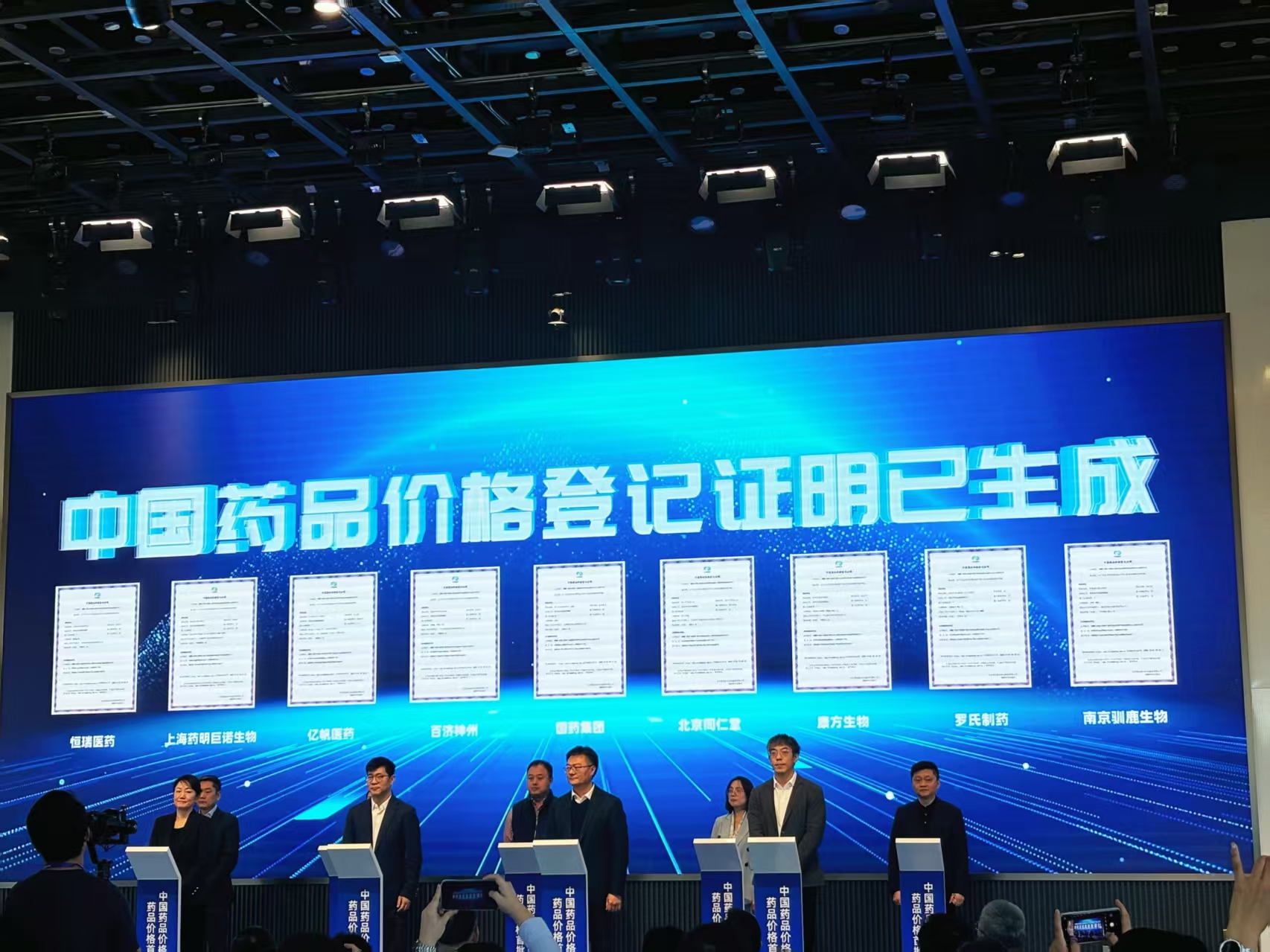
Core Insights - The launch of the Chinese Drug Price Registration System on December 2 is seen as a significant positive development for the innovative drug sector, facilitating the international expansion of domestic innovative drugs [1][4]. Group 1: Drug Price Registration System - The Chinese Drug Price Registration System was launched on December 2, with nine pharmaceutical companies participating in the initial registration, including both multinational and traditional Chinese medicine firms [2]. - The system currently includes limited information, with only 10 drug entries available, indicating a nascent stage of development [2]. - The system allows for independent pricing by companies outside of the National Medical Insurance (NMI) framework, which is a notable shift in policy [1][5]. Group 2: Innovative Drugs Highlighted - Four drugs showcased on the system are recognized as either the first of their kind in China or globally, including innovative treatments like Toripalimab and Icaritin [3]. - For instance, Toripalimab is the first Chinese PD-1 monoclonal antibody approved in both Europe and the U.S., while Icaritin is the first CAR-T therapy targeting BCMA approved in China [3]. Group 3: Market Implications - The establishment of the registration system is expected to enhance the global pricing framework for Chinese innovative drugs and attract high-quality foreign drugs to the Chinese market [4][5]. - Data indicates that in the first three quarters of 2025, Chinese pharmaceutical companies completed 103 license-out transactions totaling $92.03 billion, highlighting the growing importance of the Chinese market in the global pharmaceutical industry [4]. - The NMI's non-interference in pricing for the non-NMI market is seen as a positive step towards respecting market dynamics and enhancing the pricing power of domestic companies in international markets [5].



创新药龙头公司三季报验证景气度,前瞻布局构建全球竞争力
Xin Lang Cai Jing· 2025-12-03 13:20
Core Insights - The Chinese innovative drug sector is experiencing strong growth driven by accelerated new drug approvals and increased business development (BD) activities [1][13] - In the first half of 2025, the total transaction amount in China reached $60.8 billion, a significant year-on-year increase of 129%, while the cumulative transaction amount for the first three quarters reached $93.7 billion, up 64% year-on-year [1][13] - The commercialization of innovative drugs is boosting overall revenue recovery and improving corporate profitability, indicating a transition to a new phase of high-quality development in the industry [1][13] Company Performance Highlights 1. BeiGene - In Q3 2025, BeiGene's revenue exceeded 10 billion yuan for the first time, with a year-on-year growth of 41.1%, and adjusted net profit increased by 489% [2][14] - The gross margin for global product revenue under GAAP was 85.9%, up 3.1 percentage points from the same period in 2024, primarily due to increased sales of Zanubrutinib [2][14] 2. HengRui Medicine - HengRui Medicine achieved revenue of 7.427 billion yuan in Q3 2025, a year-on-year increase of 12.72%, with net profit growing by 9.53% [4][15] - The company has made significant strides in international BD transactions, with over $800 million in upfront payments from innovative drug licensing agreements in the first three quarters of the year [5][15] 3. WuXi AppTec - WuXi AppTec reported total revenue of 12.057 billion yuan in Q3 2025, a year-on-year increase of 15.26%, with net profit rising by 53.27% [6][17] - The company has adjusted its full-year revenue guidance upward, expecting sustained double-digit growth in its core business [7][17] Industry Future Trends - The Chinese innovative drug industry is undergoing a paradigm shift from "domestic substitution" to "global value creation" and "international ecological collaboration," marking the entry into an international 2.0 era [8][18] - The focus on internationalization is becoming more pronounced, with strategic collaborations extending beyond late-stage assets to include early-stage technology platforms [8][18] Strategic Recommendations for Companies - Companies should build globally-oriented differentiated R&D pipelines, shifting focus from filling domestic gaps to addressing unmet clinical needs globally [9][19] - Developing dual-capacity international BD capabilities is essential, treating international expansion as a core strategic capability rather than a one-time transaction [10][20] - Establishing a lean and efficient global operational system is crucial for maintaining cost and efficiency advantages in the competitive international market [10][20]

我国药企授权出海交易超920亿美元
Mei Ri Jing Ji Xin Wen· 2025-12-03 12:49
Core Insights - The launch of the Chinese Drug Price Registration System on December 2 is seen as a significant positive development for the innovative drug sector, facilitating the international expansion of domestic innovative drugs [1][4] - The system allows for independent pricing by companies outside of the National Medical Insurance (NMI) market, which is expected to foster a more competitive environment [1][5] Group 1: Drug Price Registration System - The Chinese Drug Price Registration System was launched on December 2, with nine pharmaceutical companies participating in the initial registration, including both multinational and domestic firms [2] - The system currently includes limited data, with only 10 drug entries available, indicating a nascent stage of development [2] - The system is designed to respect the pricing autonomy of companies in the non-NMI market, which is a shift from previous perceptions that equated the NMI market with the entire Chinese pharmaceutical market [5] Group 2: Innovative Drugs Highlighted - Four drugs showcased on the system's homepage hold either domestic or global "first" status, including innovative treatments like the first Chinese PD-1 monoclonal antibody approved in Europe and the U.S. [3] - Specific pricing examples illustrate the disparity between NMI reimbursement prices and companies' self-reported prices, such as the self-reported price of 10,688 yuan for a PD-1 monoclonal antibody compared to the NMI price of 1,253.53 yuan [3] Group 3: Market Implications - The establishment of the drug price registration system is expected to enhance the global pricing framework for Chinese innovative drugs and attract high-quality foreign drugs to the Chinese market [4] - Data indicates that Chinese pharmaceutical companies completed 103 license-out transactions worth 9.203 billion USD in the first three quarters of 2025, highlighting the growing importance of the Chinese market in the global pharmaceutical industry [4] - The NMI's non-interference in pricing for the non-NMI market is viewed as a positive step towards empowering companies to set prices that reflect market conditions, potentially increasing their influence in international markets [5]
医药跌势未止,抄底资金再出动!医疗ETF再创4个月新低,单日逾亿元增仓,港股创新药四连跌,520880放量溢价
Xin Lang Cai Jing· 2025-12-03 12:03
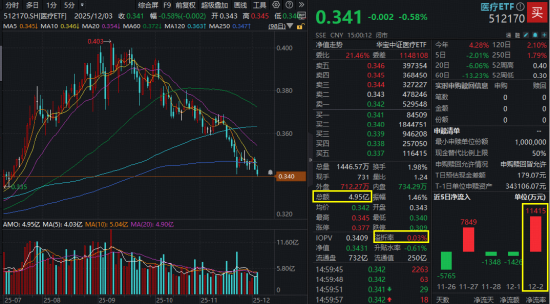
Core Viewpoint - The A+H pharmaceutical sector continues to adjust, with significant fluctuations in the market, particularly in innovative drugs, indicating potential investment opportunities as bottom-fishing capital emerges [1][5][16]. Group 1: Market Performance - The largest medical ETF in the market (512170) and the only drug ETF (562050) fell by 0.58% and 0.19% respectively, while the Hong Kong innovative drug ETF (520880) dropped by 1.43% [1][5]. - A-share medical leaders mostly declined, with WuXi AppTec down 2.01%, and both Aier Eye Hospital and Tigermed down over 1%, while some stocks like Yingke Medical and New Industry saw gains [1][12]. - The medical ETF (512170) hit a four-month low during intraday trading, closing below all moving averages, but saw over 1.14 billion yuan in net subscriptions as investors sought to buy the dip [1][16]. Group 2: Sector Analysis - The pharmaceutical sector in A-shares showed relative resilience, with the drug ETF (562050) outperforming the market, primarily due to gains from traditional Chinese medicine leaders like Pian Zai Huang and Yunnan Baiyao [3][12]. - The innovative drug sector displayed divergence, with Yifan Pharmaceutical surging by 6.11%, while major stocks like BeiGene fell by 1.59% [3][12]. - The drug ETF (562050) has about 25% weight in traditional Chinese medicine, which helps mitigate the high volatility of innovative drugs, thus reducing the overall volatility and drawdown of the pharmaceutical index [3][12]. Group 3: Future Outlook - The innovative drug sector is expected to be a major upward trend heading into 2026, as the industry continues to experience strong demand and unmet needs, with increased R&D investments from pharmaceutical companies [7][16]. - Analysts suggest that the current adjustment phase may present a favorable long-term investment opportunity in pharmaceutical assets, particularly as the sector shows signs of recovery [16]. - The Hong Kong innovative drug ETF (520880) is recommended for balanced internal allocation strategies, with a focus on improving fundamentals in the innovative drug supply chain [7][16].
12月3日医疗健康R(480016)指数跌0.42%,成份股人福医药(600079)领跌
Sou Hu Cai Jing· 2025-12-03 10:05
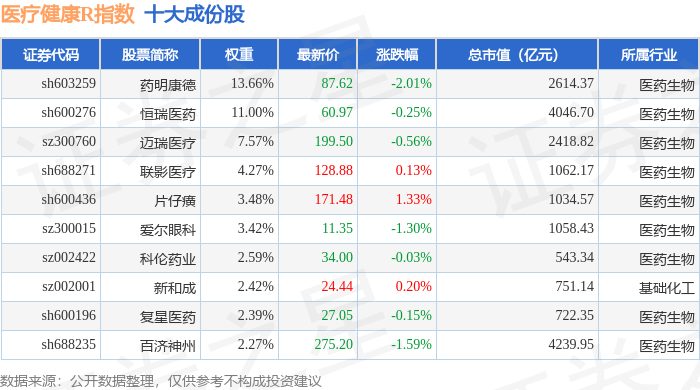
Core Points - The Medical Health R Index (480016) closed at 7284.72 points, down 0.42%, with a trading volume of 17.046 billion yuan and a turnover rate of 0.61% [1] - Among the index constituents, 23 stocks rose while 26 fell, with TeBao Bio leading the gainers at 2.85% and Renfu Pharmaceutical leading the decliners at 3.33% [1] Index Constituents Summary - The top ten constituents of the Medical Health R Index include: - WuXi AppTec (sh603259) with a weight of 13.66%, latest price at 87.62, down 2.01%, and a market cap of 261.437 billion yuan [1] - Hengrui Medicine (sh600276) with a weight of 11.00%, latest price at 60.97, down 0.25%, and a market cap of 404.670 billion yuan [1] - Mindray Medical (sz300760) with a weight of 7.57%, latest price at 199.50, down 0.56%, and a market cap of 241.882 billion yuan [1] - United Imaging Healthcare (sh688271) with a weight of 4.27%, latest price at 128.88, up 0.13%, and a market cap of 106.217 billion yuan [1] - Pianzai Shou (sh600436) with a weight of 3.48%, latest price at 171.48, up 1.33%, and a market cap of 103.457 billion yuan [1] - Aier Eye Hospital (sz300015) with a weight of 3.42%, latest price at 11.35, down 1.30%, and a market cap of 105.843 billion yuan [1] - Kelun Pharmaceutical (sz002422) with a weight of 2.59%, latest price at 34.00, down 0.03%, and a market cap of 54.334 billion yuan [1] - Xinhecheng (sz002001) with a weight of 2.42%, latest price at 24.44, up 0.20%, and a market cap of 75.114 billion yuan [1] - Fosun Pharma (sh600196) with a weight of 2.39%, latest price at 27.05, down 0.15%, and a market cap of 72.235 billion yuan [1] - Ziji Shenzhou (sh688235) with a weight of 2.27%, latest price at 275.20, down 1.59%, and a market cap of 423.995 billion yuan [1] Capital Flow Analysis - The Medical Health R Index constituents experienced a net outflow of 1.159 billion yuan from institutional investors, while retail investors saw a net inflow of 999 million yuan [1] - Detailed capital flow for specific stocks shows: - Health元 (600380) had a net inflow of 34.2431 million yuan from institutional investors [2] - Hengrui Medicine (600276) had a net inflow of 29.9909 million yuan from institutional investors [2] - Long Spring High-tech (000661) had a net inflow of 19.8154 million yuan from institutional investors [2] - The index constituents underwent adjustments, adding four new stocks and removing one [2]




创新药行情有望持续,PROTAC专题:蛋白降解东风起,国内产业链迎新机
2025-12-03 02:12
Summary of Key Points from Conference Call Records Industry Overview - The pharmaceutical sector experienced a correction in 2025 but rebounded towards the end of the year, with the innovative drug market expected to continue its momentum into 2026, presenting investment opportunities [1][6][10]. - Current industry hotspots include the flu epidemic, policy support, and breakthroughs in innovative fields such as small nucleic acid drugs, GLP-1, and BCL-2 inhibitors [1][7][8]. Core Insights and Arguments - The overall performance of the pharmaceutical sector in November 2025 was weak, with a decline of 3.6%, underperforming the CSI 300 index by approximately 1.16 percentage points [3]. - The application of AI technology in healthcare, including AI medicine and brain-computer interfaces, is gaining attention and is expected to present opportunities in 2026 [4][12]. - The release of the medical insurance negotiation directory and commercial insurance innovation directory will significantly impact the sales of related products once they enter the insurance system [10]. - Investment recommendations for 2026 include focusing on cutting-edge technologies such as dual antibodies, multi-antibodies, ADC, PROTAC, small nucleic acids, and GLP-1, as well as large companies with strong R&D capabilities and biotech firms with best/first-in-class potential [9][11]. Notable Developments - The flu data has reached new highs, driving up the stock prices of related testing drugs and vaccines [7]. - The third-party laboratory sector is expected to see performance bottoming out in Q4 2025, with a recovery starting in Q1 2026, aided by accelerated payment collection from companies like KingMed and Dian Diagnostics [4][19]. - The PROTAC technology is highlighted for its ability to degrade target proteins, addressing issues of drug resistance, with leading companies like Pfizer, BMS, and BeiGene making significant progress [4][16][17]. Investment Opportunities - Companies such as KingMed and Dian Diagnostics are recommended for investment due to their improving cash flow and potential recovery in the IVD industry [19][20]. - Jichuan Pharmaceutical is included in the December portfolio due to its expected performance rebound driven by flu season demand and low inventory levels [21]. - The CRO industry is poised for growth, with expectations of increased outsourcing rates and improved margins due to a decrease in new entrants [22][23]. Future Trends - The medical device sector is showing positive trends, with expectations for improvement in the consumer healthcare segment in 2026 [2][11]. - The potential for significant growth in the insulin business of companies like Lianbang Pharmaceutical is anticipated, with a projected revenue of 20 billion yuan in 2025 [32][35]. - The upcoming KMR data in December is expected to act as a catalyst for the global PROTAC market, with a focus on companies with substantial technology platforms [18]. Conclusion - The pharmaceutical and healthcare sectors are navigating through a period of adjustment, with various innovative technologies and market dynamics presenting both opportunities and challenges. Investors are advised to keep a close watch on regulatory developments, clinical trial outcomes, and emerging technologies that could shape the future landscape of the industry [1][6][10].


11月公募扎堆调研,都在看哪些股?
3 6 Ke· 2025-12-03 01:32
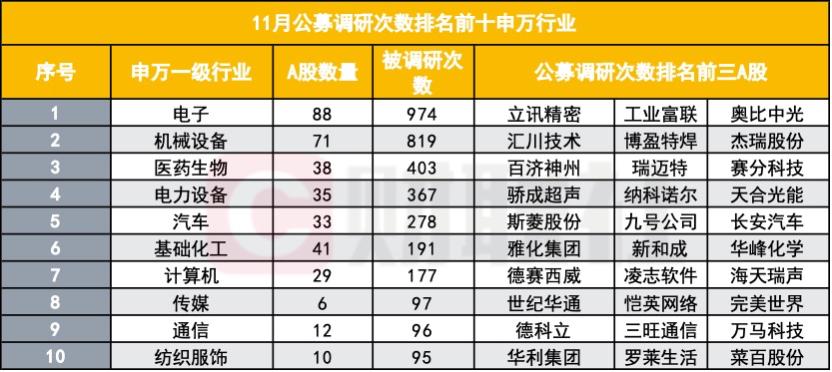
Core Insights - Despite a cautious market sentiment in November, public fund research enthusiasm remains strong, with 154 public funds participating in 4,298 research instances covering 506 stocks across 30 industries [1][2] - The stocks under research showed significant resilience, outperforming the CSI 300 index by 1.89 percentage points, with 186 stocks achieving positive returns, and 66 stocks rising over 10% [1][2] - Leading the gains was Huasheng Lithium with a monthly increase of 132.48%, while the electric equipment sector performed strongly, with Hai Lu Heavy Industry and Fengyuan Co. also making the top gainers list [1][4] Industry Focus - The electronic industry led the research activities with 974 instances covering 88 stocks, with Luxshare Precision, Industrial Fulian, and Aobi Zhongguang being the most researched [2][3] - The mechanical equipment sector followed closely with 819 research instances covering 71 stocks, focusing on companies like Huichuan Technology and Bo Ying Special Welding [2][3] - The pharmaceutical and biological sector ranked third with 403 research instances covering 38 stocks, highlighting companies like BeiGene and Ruimai Technology [2][3] Research Frequency and Performance - The top researched stocks included Luxshare Precision (142 instances), Huichuan Technology (81 instances), and Bo Ying Special Welding (71 instances) [4][7] - Notably, the stocks with the highest price increases also included multiple companies from the electronic and electric equipment sectors, indicating a correlation between research frequency and stock performance [5][6] - The research data reflects a trend where public funds are increasingly focusing on companies with potential technological breakthroughs and favorable market conditions [8][9] Institutional Activity - A total of 85 public funds conducted at least 20 research instances, with 25 funds exceeding 50 instances, indicating strong interest from leading institutions [6][7] - The top three funds by research frequency were Bosera Fund (111 instances), Huaxia Fund (101 instances), and Guotai Fund (93 instances) [6][7] - The research paths of these leading institutions showed a high degree of overlap, particularly focusing on Luxshare Precision, Huichuan Technology, and Bo Ying Special Welding [7][8] Trends and Insights - The research data reveals two key trends: a strong interest from top public funds in the electronic and mechanical equipment sectors, and an increasing resonance between research activities and market performance [9] - The focus of research is shifting towards more detailed and refined insights, emphasizing industry dynamics and technological innovations [9]



中国药品价格登记系统上线!创新药出海传来利好
Guo Ji Jin Rong Bao· 2025-12-02 13:41
Core Viewpoint - The launch of the drug price registration system in China is a significant step towards establishing a global pricing framework for innovative drugs, enhancing the international competitiveness of Chinese pharmaceutical companies [1][3][6]. Group 1: Drug Price Registration System - The drug price registration system, initiated by the National Healthcare Security Administration, allows domestic and foreign pharmaceutical companies to independently declare drug prices, creating a comprehensive pricing archive [1][3]. - The system operates independently from provincial procurement platforms and follows principles of "one location acceptance, nationwide sharing, and global openness," which aids in building a globalized drug pricing system [1][3]. - The registration of prices does not alter the medication costs for insured and uninsured individuals [1]. Group 2: Support for Chinese Pharmaceutical Companies - The new system addresses the shortcomings in the pricing mechanism for innovative drugs, facilitating their entry into international markets and allowing for pricing that aligns with local payment systems [3][4]. - Companies like Yifan Pharmaceutical highlight that the system will provide substantial support for overseas expansion, allowing for a more accurate reflection of the true value of innovative drugs [4]. - The system enables companies to register prices according to international practices, providing verifiable pricing information to regulatory bodies and partners [4]. Group 3: Attracting Foreign Innovative Drugs - The establishment of the drug price registration system is expected to attract more high-quality foreign innovative drugs into the Chinese market, as multinational companies will be encouraged to participate in national healthcare negotiations [6][7]. - The system allows multinational companies to register prices independently in China, creating a clear distinction between market supply prices and negotiated healthcare prices, which enhances the certainty of market entry for innovative drugs [7].

企业自主登记真实药价,非医保价!中国药品价格登记系统上线
Di Yi Cai Jing· 2025-12-02 11:35
Core Points - The launch of the China Drug Price Registration System aims to facilitate the globalization of Chinese innovative drugs and attract high-quality foreign drugs to the Chinese market, benefiting patients in China [1][4] - The system operates under a "one location acceptance, nationwide sharing, global openness" service mechanism, allowing pharmaceutical companies to independently declare and register drug prices [1][4] - The establishment of this system fills a gap in the national-level drug pricing disclosure framework in China, enhancing the credibility of registered prices compared to provincial systems [5] Group 1: System Overview - The China Drug Price Registration System (China Drug Registration) was officially launched on December 2, providing a platform for drug price registration and inquiry [1] - The system is a collaboration between the National Healthcare Security Administration and the Beijing Municipal Government, operated by a state-owned enterprise under a socialized operation model [1][4] - The registration process allows drug market authorization holders to voluntarily declare prices and is open for public inquiry, ensuring transparency [5] Group 2: Industry Impact - The system is expected to significantly impact the high-quality development of the pharmaceutical industry in China, aligning with the country's goal of building a healthy China and supporting the development of innovative drugs and medical devices [3][4] - By providing a platform for global price registration, the system helps Chinese pharmaceutical companies establish a comprehensive global pricing framework, enhancing the modernization of drug price governance [4][5] - The system's independent operation from provincial procurement platforms allows for a clearer distinction between market prices and negotiated prices under healthcare insurance [4][5]