BeiGene(688235)

Search documents
百济神州股价跌5.17%,红土创新基金旗下1只基金重仓,持有3.74万股浮亏损失48.53万元
Xin Lang Ji Jin· 2026-03-03 05:36
Group 1 - The core point of the news is that BeiGene's stock has experienced a decline of 10.47% over the past four days, with a current price of 237.87 CNY per share and a market capitalization of 366.48 billion CNY [1] - BeiGene was founded on October 28, 2010, and went public on December 15, 2021. The company focuses on the research, development, production, and commercialization of innovative drugs [1] - The main revenue composition of BeiGene is derived from drug sales, accounting for 99.10%, while collaboration revenue constitutes 0.90% [1] Group 2 - Red土 Innovation Fund has a significant holding in BeiGene, with 37,400 shares in its Red土 Innovation Healthcare Stock A fund, representing 3.79% of the fund's net value [2] - The fund has incurred a floating loss of approximately 48,530 CNY today and a total floating loss of 109,770 CNY during the four-day decline [2] - The Red土 Innovation Healthcare Stock A fund was established on October 20, 2020, with a current size of 234 million CNY and a year-to-date return of 5.66% [2]

BeOne Medicines (NasdaqGS:BGNE) FY Conference Transcript
2026-03-02 15:12
Summary of BeOne Medicines FY Conference Call Company Overview - **Company**: BeOne Medicines (NasdaqGS:BGNE) - **Event**: 46th Annual Healthcare Conference from TD Cowen - **Date**: March 02, 2026 Key Points Financial Guidance and Revenue - **Revenue Guidance**: BeOne Medicines provided a revenue guidance of **$6.2 billion to $6.4 billion** for FY 2026, reflecting a **$1 billion year-over-year growth** [6][9] - **Q4 Performance**: The company reported a strong exit from Q4, with significant growth across all geographies, particularly in the US and China markets [7][13] - **Market Dynamics**: The guidance considers competitive dynamics, including stable net pricing in the US market [8][12] Competitive Landscape - **Competitors**: The company acknowledged competition from AVEO and Jaypirca, noting that AVEO was not approved, which positively impacts BeOne's market position [11] - **Market Leadership**: BRUKINSA was established as the **number 1 BTK globally** in 2025, with a **14% sequential growth** in Q4 compared to Q3, while competitors grew by only **4%** [13][14] Regional Growth - **US and China**: Strong growth was noted in both the US and China, with BRUKINSA leading in these markets [13] - **Europe and Rest of World**: The European business nearly tripled in 2024 and grew over **70%** in 2025, while the rest of the world markets grew by more than **100%** [14] Research and Development (R&D) - **Pipeline Expansion**: The company is expanding its pipeline with multiple programs in various phases, including BCL-2 and BTK degrader [20][24] - **Investment Strategy**: BeOne Medicines is committed to both growth and margin expansion, having generated over **$940 million in free cash** in 2025 [24] - **Partnership Considerations**: The company is evaluating potential partnerships for certain assets but has the capability to develop most of its programs independently [26] Clinical Trials and Drug Development - **CDK4 Program**: The CDK4 program is set to start trials, with a focus on operational excellence and rapid enrollment [35][38] - **GPC3 and CEA-ADC**: The GPC3 ADC has shown promising results, with FDA granting Fast Track designation, and plans for registrational studies are underway [51][55] - **B7H4 ADC**: The B7H4 ADC is in development, with initial studies planned for breast or gynecologic cancers [57][62] Market Potential and Strategy - **BCL-2 Class**: The BCL-2 class, particularly with sonrotoclax, is expected to unlock significant market potential due to its usability and safety profile compared to existing treatments like Venetoclax [73][74] - **Multiple Myeloma Opportunity**: Plans to initiate a phase 3 study in multiple myeloma are in place, targeting patients with specific genetic translocations [76] Future Outlook - **Regulatory Engagement**: The company is actively engaging with regulatory authorities to expedite the development of its promising candidates [51] - **Data Disclosures**: BeOne Medicines plans to share data from various programs at major medical congresses throughout the year, indicating a robust pipeline and ongoing commitment to transparency [43][55] Additional Insights - **Operational Efficiency**: The company has demonstrated a high success rate in moving molecules from early to late-stage development, with a focus on stopping underperforming programs [31] - **Innovative Approaches**: BeOne Medicines is leveraging its unique clinical development model to enhance efficiency and reduce costs in drug development [23] This summary encapsulates the key insights and strategic directions discussed during the conference call, highlighting BeOne Medicines' strong market position, growth potential, and commitment to innovation in oncology.

百济神州(06160):业绩符合预期,早研管线步入收获期
SINOLINK SECURITIES· 2026-03-02 13:35
Investment Rating - The report maintains a "Buy" rating for the company, indicating an expected price increase of over 15% in the next 6-12 months [5]. Core Insights - The company reported total revenue of $5.3 billion for 2025, a year-on-year increase of 40%, and achieved a GAAP net profit of $287 million, marking a return to profitability [2]. - The sales of the core product, Zebutinib, continued to grow rapidly, with Q4 2025 sales reaching $1.15 billion, a 39% increase year-on-year [3]. - The company provided guidance for 2026, projecting total revenue between $6.2 billion and $6.4 billion, with GAAP operating expenses of $4.7 billion to $4.9 billion and a gross margin in the high 80% range [3]. Financial Performance - The company’s revenue is expected to grow from $5.34 billion in 2025 to $6.43 billion in 2026, reflecting a growth rate of 20.27% [10]. - The net profit forecast for 2026 is adjusted to $685 million, with a significant growth rate of 138.6% compared to 2025 [10]. - The diluted earnings per share (EPS) is projected to be $0.44 in 2026, up from $0.19 in 2025 [10]. Research and Development Pipeline - The company is advancing its R&D pipeline, with several key milestones expected in 2026, including interim analysis for Zebutinib in MCL and potential approvals for other products [4]. - The company anticipates data releases for various clinical trials in the first half of 2026, which could serve as catalysts for future growth [4].
百济神州全年首次盈利!多家创新药企经营报喜,A股逾七成概念股实现营收增长
Bei Jing Shang Bao· 2026-03-02 12:18
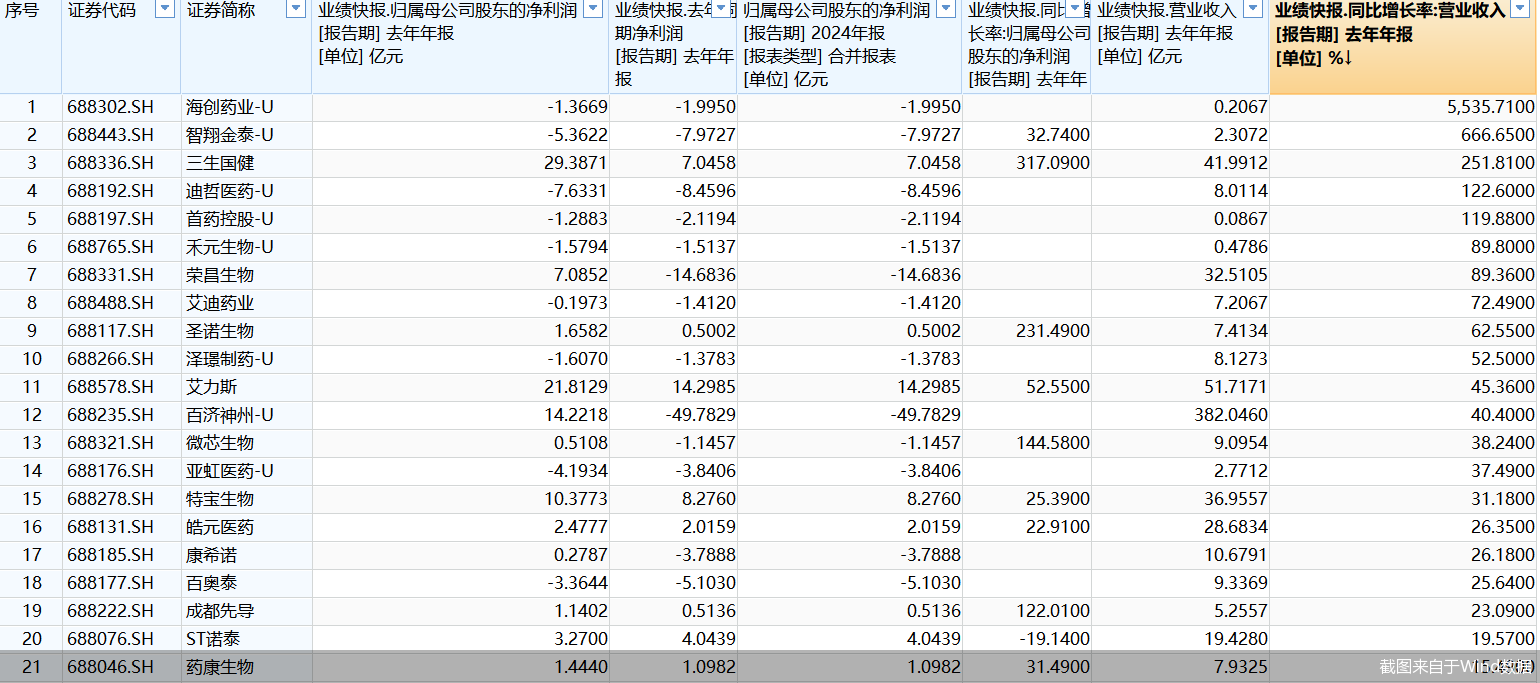
Core Viewpoint - The innovative drug sector in the A-share market has shown significant recovery in 2025, with many companies reporting revenue and profit growth, driven by new drug launches and business development (BD) authorization income [1][8]. Group 1: Performance Highlights - Among the 39 innovative drug concept stocks that disclosed their 2025 performance reports, 29 companies achieved year-on-year revenue growth, and 25 companies reported profit growth or reduced losses [1][7]. - Notable companies like BeiGene (百济神州) and Rongchang Bio (荣昌生物) have turned losses into profits, indicating an expanding profitability landscape in the innovative drug sector [6][1]. - BeiGene reported a revenue of 38.205 billion yuan in 2025, a 40.4% increase year-on-year, and a net profit of approximately 1.422 billion yuan, marking its first annual profit [4][3]. Group 2: Growth Drivers - The primary drivers for revenue growth among these companies include the rapid market release of new drugs and significant income from BD authorizations [8][10]. - For instance, Haichuang Pharmaceutical (海创药业) saw its revenue surge by over 55 times, primarily due to the launch of its first Class 1 new drug, which was approved for sale in May 2025 [8][9]. - Companies like Zhixiang Jintai (智翔金泰) also benefited from expanding sales of their commercialized products and substantial licensing income from BD agreements [8][10]. Group 3: Financial Performance - Zhixiang Jintai achieved a revenue of 231 million yuan in 2025, a 666.65% increase year-on-year, while its net loss decreased from 799.27 million yuan to 536.22 million yuan [9]. - Sanofi (三生国健) reported the highest net profit among the 39 stocks, with a revenue of 4.199 billion yuan, a 251.81% increase, and a net profit of 2.939 billion yuan, a 317.09% increase [9][10]. Group 4: Challenges and Market Dynamics - Despite the positive trends, 9 companies reported revenue declines, with Yifang Bio (益方生物) experiencing the largest drop at 77.89%, leading to an increased net loss [11][12]. - The commercial path for innovative drugs remains challenging, as evidenced by companies like Baili Tianheng (百利天恒) and Shenzhou Cell (神州细胞), which also reported declines in revenue and net profit [12].

合成生物学周报:华熙生物在天津建成全球最大中试转化平台,北京昌平合成生物企业数量激增近七成
Huaan Securities· 2026-03-02 10:50
Investment Rating - The industry investment rating is "Buy" [1] Core Insights - The report highlights the rapid growth of synthetic biology, with a significant increase in the number of synthetic biology companies in Beijing's Changping District, which has surged nearly 70% compared to the same period last year, reaching a total of 146 companies [9] - The establishment of the world's largest pilot transformation platform by Huaxi Biological in Tianjin, which has a total investment of several billion yuan and spans 40,000 square meters, is a key development in the industry [10] - The National Development and Reform Commission has issued the "14th Five-Year Plan for the Development of the Bioeconomy," indicating a trillion-yuan market potential in the bioeconomy sector [4] Market Dynamics - The Huaxi Synthetic Biology Index decreased by 0.49% to 1271.82 during the week of February 24-27, 2026, underperforming compared to the Shanghai Composite Index, which rose by 1.98% [5] - The report notes that the synthetic biology sector is experiencing a wave of technological advancements and increased investment, with nearly 100 companies completing new financing rounds since 2025 [33] Company Developments - Huaxi Biological's pilot platform has already undertaken over 30 biological manufacturing projects, facilitating the transition from laboratory-scale to commercial-scale production [10] - The report mentions that Lif Biological's PEF (polyethylene furanoate) has received approval for food contact use, marking a significant step for bio-based materials in the food packaging sector [24] - Watson Biological has announced a 450 million yuan investment to establish a fund focused on synthetic biology, with a target size of 1 billion yuan [25] Industry Financing - The report indicates that financing in the synthetic biology sector is accelerating, with companies like Rhein Biological and EcoviaBio completing multiple rounds of financing to expand their production capabilities [33][34] - Rhein Biological is focusing on two main development directions: enhancing its core business and providing industrialization services for external synthetic biology products [34]




合成生物学周报:华熙生物在天津建成全球最大中试转化平台,北京昌平合成生物企业数量激增近七成-20260302
Huaan Securities· 2026-03-02 08:43
Investment Rating - The industry investment rating is "Buy" [1] Core Insights - The report highlights the rapid growth of synthetic biology, with a significant increase in the number of synthetic biology companies in Beijing's Changping District, which has surged nearly 70% compared to the same period last year, reaching a total of 146 companies [9] - The establishment of the world's largest pilot transformation platform by Huaxi Biological in Tianjin, which has a total investment of several billion yuan and spans 40,000 square meters, is a key development in the industry [10] - The "14th Five-Year Plan" for the development of the bio-economy has been issued by the National Development and Reform Commission, indicating a trillion-yuan market potential in the bio-economy sector [4] Market Dynamics - The Huaxi Synthetic Biology Index decreased by 0.49% to 1271.82 during the week of February 24-27, 2026, underperforming compared to the Shanghai Composite Index, which rose by 1.98% [5] - The report notes that the synthetic biology sector is experiencing a biotechnology revolution, providing innovative solutions to major challenges such as health, climate change, and food security [4] Company Developments - The report mentions that Watson Bio has established a 450 million yuan industry fund focused on synthetic biology, with a target size of 1 billion yuan [25] - Jin Dan Technology announced an additional investment of approximately 148 million yuan in its 75,000-ton annual production project for polylactic acid, bringing the total investment to 1.03 billion yuan [26] - The report also highlights the successful commercialization of products such as mannitol and alonose by companies like Weiyuan Synthetic [9] Industry Financing - The report indicates that financing in the synthetic biology sector is accelerating, with nearly 100 companies completing new financing rounds since 2025 [33] - EcoviaBio completed a Series B financing round to expand its production capacity for gamma-polyglutamic acid, a biodegradable material [34] - Verley, a precision fermentation company, successfully completed a $38 million Series A financing, marking a significant step towards commercializing precision fermentation [34]


百济神州接待196家机构调研,包括淡水泉、APS Asset、AJ Asset Management、BOCOM International等
Jin Rong Jie· 2026-03-02 08:36
Core Viewpoint - BeiGene has demonstrated strong execution in Q4 2025, achieving significant product revenue growth and solid cash flow, with its lead product, Brukinsa (Zebutinib), becoming the top BTK inhibitor globally [1][4][17]. Financial Performance - Q4 2025 product revenue reached $1.5 billion, a 33% year-over-year increase, with Brukinsa global revenue of $1.1 billion, up 38% [3][17]. - For the full year 2025, Brukinsa generated $3.9 billion in global revenue, reflecting a 49% increase [3][17]. - Gross margin improved to 87%, with operating profit of $447 million and GAAP net profit of $287 million for Q4 2025 [3][19]. - The company expects total revenue for 2026 to be between $6.2 billion and $6.4 billion, with GAAP operating expenses projected at $4.7 billion to $4.9 billion [3][21]. Product Development and Pipeline - In 2025, BeiGene made significant progress in R&D, with the approval of ZS in China for relapsed/refractory MCL and CLL, and ongoing regulatory reviews in the US and EU [2][8]. - The company is advancing multiple clinical trials, including three Phase 3 trials for BTK degraders and a combination therapy for HER2-positive gastric cancer [2][8][14]. - BeiGene aims to establish Brukinsa as a foundational treatment in CLL, with plans to expand its use in fixed-duration treatment regimens [10][11]. Market Position and Strategy - Brukinsa has established itself as the leading BTK inhibitor, with a market share of approximately 50% in the CLL treatment space [7][27]. - The company is targeting three ambitious goals for CLL innovation, focusing on improving patient outcomes and treatment options [6][10]. - BeiGene is also expanding its pipeline beyond CLL, with ongoing research in various hematologic malignancies and solid tumors [11][12][13]. Future Catalysts - Key upcoming milestones include the initiation of a global Phase 3 study comparing ZS with another oral fixed-duration treatment in newly diagnosed CLL patients [16][21]. - The company plans to submit a marketing application for ZS in combination with chemotherapy for HER2-positive gastric cancer in mid-2026 [16][21]. - BeiGene is also set to report on several concept validation studies in immunology throughout 2026 [16].
百济神州:4Q25产品销售强势、利润端略有波动,2026研发多点开花;维持买入-20260302
BOCOM International· 2026-03-02 06:24
Investment Rating - The report maintains a "Buy" rating for the company, 百济神州 (6160 HK) [2][11]. Core Insights - The company demonstrated strong product sales in Q4 2025, with revenue reaching USD 1.476 billion, a year-on-year increase of 32%. The sales of the drug, Zejula, amounted to USD 1.1 billion, with a significant market share in the US [6]. - The company is increasing its R&D investments in 2026, focusing on pipeline development and prioritizing management, which is expected to yield multiple catalysts [2][6]. - The revenue guidance for 2026 is set between RMB 62-64 billion, with a projected non-GAAP net profit of RMB 14-15 billion [6]. Financial Performance - The company’s revenue for 2026 is forecasted at RMB 6,317 million, a decrease of 3% from previous estimates. The gross profit is expected to be RMB 5,564 million, down by 1% [5]. - The gross profit margin is projected to be 88.0%, an increase of 0.9 percentage points compared to previous estimates [5]. - The GAAP net profit for 2026 is estimated at RMB 750 million, reflecting a 15% decrease from prior forecasts [5]. Stock Performance - The stock price closed at HKD 194.40, with a target price adjusted to HKD 229.20, indicating a potential upside of 17.9% [1][11]. - The stock has shown a year-to-date change of 8.42% [4]. Pipeline Development - The company is focusing on four core strategic areas for pipeline development: chronic lymphocytic leukemia (CLL), other hematological malignancies, solid tumors, and inflammation/immune diseases [6]. - Key upcoming milestones include the potential approval of Sotigalimab in the US and Europe, and the initiation of several clinical trials for new therapies [6].
百济神州(06160):4Q25 产品销售强势、利润端略有波动,2026 研发多点开花;维持买入
BOCOM International· 2026-03-02 06:11
Investment Rating - The investment rating for the company is "Buy" with a target price of HKD 229.20, indicating a potential upside of 17.9% from the current price of HKD 194.40 [1][11]. Core Insights - The company has shown strong sales performance in Q4 2025, particularly with the drug Zebutinib, which achieved sales of USD 1.1 billion, reflecting a year-on-year increase of 38% [6]. - The company is focusing on enhancing its research and development efforts in 2026, with a revenue guidance of USD 6.2 to 6.4 billion and a non-GAAP net profit forecast of USD 1.4 to 1.5 billion [6]. - The company is strategically prioritizing its pipeline development in four key areas: chronic lymphocytic leukemia (CLL), other hematological malignancies, solid tumors, and inflammation/immunology [6]. Financial Performance - For 2026, the company is projected to generate revenue of RMB 6,317 million, with a gross profit of RMB 5,564 million, resulting in a gross margin of 88.0% [5][12]. - The GAAP net profit for 2026 is estimated at RMB 750 million, with a net profit margin of 11.9% [5][12]. - The company’s stock price has shown a year-to-date increase of 8.42% [4]. Market Position - Zebutinib holds approximately 50% market share among BTK inhibitors and about 25% among all treatment options for 1L CLL patients in the U.S. market [6]. - The company is expected to maintain its leading position in the slow-growing lymphoma market, with new drug approvals anticipated in 2026 [6]. Valuation - The DCF valuation model estimates the equity value of the company at approximately USD 45.27 billion, translating to a per-share value of HKD 229.20 [7].
百济神州归母净利14.2亿扭亏 近四年研发费492.6亿占营收60%
Chang Jiang Shang Bao· 2026-03-02 00:34
Core Insights - After turning profitable, BeiGene (688235.SH, 06160.HK, NASDAQ: BGNE) has demonstrated significant growth momentum, with 2025 revenue reaching 38.205 billion yuan, a year-on-year increase of 40.4%, and a net profit of 1.422 billion yuan, recovering from a loss of 4.978 billion yuan in the previous year [2][3] Financial Performance - In 2025, BeiGene's product revenue was 37.77 billion yuan, up 39.9% year-on-year [2] - The company reported a net profit of 1.422 billion yuan for 2025, compared to a loss of 4.978 billion yuan in the same period last year [2] - The company had a cumulative net loss of approximately 59.1 billion yuan from 2017 to 2024, averaging over 20 million yuan in daily losses [2] Revenue Drivers - The growth in product revenue for 2025 was primarily driven by the sales of Baiyueze (Zebutinib), licensed products from Amgen, and Baizean (Tislelizumab) [3][4] - Baiyueze's global sales reached 28.067 billion yuan in 2025, marking a 48.8% increase, solidifying its position as a global leader in the BTK inhibitor market [3] - Sales in the U.S. totaled 20.206 billion yuan, up 45.5%, while Europe and China saw increases of 66.4% and 33.1%, respectively [3] R&D Investment - BeiGene has consistently invested over 10 billion yuan in R&D for four consecutive years, with cumulative R&D expenses reaching 49.264 billion yuan, accounting for approximately 60% of total revenue during this period [6][7] - R&D expenses for 2025's first three quarters were 11.159 billion yuan, a 9.77% increase year-on-year, representing about 40% of the revenue for that period [6] Product Development - Baiyueze is noted for having the broadest range of approved indications among BTK inhibitors globally, with over 45 clinical trials conducted across more than 30 countries [7] - Baizean is positioned as a cornerstone product in BeiGene's solid tumor portfolio, with ongoing clinical development in over 33 countries and more than 15,800 participants enrolled [8] - The company plans to submit new indication applications for Baizean in the U.S. and China in the first half of 2026 [8] Future Outlook - BeiGene anticipates strong financial performance in Q4 2025 and throughout the year, highlighting its competitive advantages in clinical development and a differentiated R&D pipeline [9]