
UIH(688271)

Search documents
联影医疗(688271) - 联影医疗关于召开2025年第一次临时股东会的公告
2025-12-12 13:30
证券代码:688271 证券简称:联影医疗 公告编号:2025-050 上海联影医疗科技股份有限公司 关于召开2025年第一次临时股东会的通知 本公司董事会及全体董事保证公告内容不存在任何虚假记载、误导性陈述或 者重大遗漏,并对其内容的真实性、准确性和完整性依法承担法律责任。 重要内容提示: 召开日期时间:2025 年 12 月 30 日 14 点 00 分 网络投票系统:上海证券交易所股东大会网络投票系统 网络投票起止时间:自2025 年 12 月 30 日至2025 年 12 月 30 日采用上海证 券交易所网络投票系统,通过交易系统投票平台的投票时间为股东会召开当日的 交易时间段,即 9:15-9:25,9:30-11:30,13:00-15:00;通过互联网投票平台的 投票时间为股东会召开当日的 9:15-15:00。 股东会召开日期:2025年12月30日 本次股东会采用的网络投票系统:上海证券交易所股东大会网络投票系 统 召开地点:上海市嘉定区城北路 2258 号一楼 (五) 网络投票的系统、起止日期和投票时间。 一、 召开会议的基本情况 (一) 股东会类型和届次 2025年第一次临时股东会 (二 ...

联影医疗(688271) - 联影医疗第二届董事会独立董事第七次专门会议决议
2025-12-12 13:30
表决结果:3 票同意、0 票反对、0 票弃权。 上海联影医疗科技股份有限公司 独立董事:王少飞、盛雷鸣、JIA HONG GAO 2025 年 12 月 12 日 一、审议通过《关于 2026 年度日常关联交易预计的议案》 上海联影医疗科技股份有限公司 经全体与会独立董事审议:公司预计 2026 年度与关联人发生的关联交易系 公司生产经营中正常业务行为,双方交易遵循了客观、公平、公允的原则,交易 价格根据市场价格确定,不存在损害公司和其他非关联方股东的利益。公司审议 该关联交易议案的表决程序符合有关规定,关联董事进行了回避表决,符合《上 海证券交易所科创板股票上市规则》《上海证券交易所科创板上市公司自律监管 指引第 1 号——规范运作》等相关规定。综上,我们同意本次 2026 年度日常关 联交易预计的事项。 第二届董事会独立董事第七次专门会议决议 上海联影医疗科技股份有限公司(以下简称"公司")第二届董事会独立董 事第七次专门会议于2025年12月12日以通讯方式召开,本次会议的通知于2025 年 12 月 8 日通过书面方式送达各位独立董事,会议通知中包括会议的相关材料, 同时列明了会议召开的时间、地点、内 ...
医疗设备招投标数据跟踪:设备招投标景气度持续,高端化+反内卷趋势利好头部企业
Ping An Securities· 2025-12-12 12:48
Investment Rating - Industry investment rating is "Outperform" compared to the market, expecting the industry index to perform better than the CSI 300 index by more than 5% in the next six months [22]. Core Insights - The medical device bidding environment remains robust, with a significant trend towards high-end products. Since 2025, the release of equipment update policy dividends has led to sustained market demand growth, keeping bidding activities at a high level. Monthly procurement scales from July to November 2025 were 13.4 billion, 14.6 billion, 16.4 billion, 16.4 billion, and 20.9 billion respectively, with year-on-year growth rates of +24%, +31%, +2%, +14%, and +0% [3][11]. - The bidding environment is benefiting leading companies in the industry, with procurement scales for ultrasound, CT, MRI, DR, DSA, and gastrointestinal endoscopes showing significant year-on-year growth in November 2025 [4][12][14]. - The report emphasizes the importance of high-end and intelligent medical devices, suggesting that leading domestic companies like Mindray, United Imaging, Kaili Medical, and Aohua Endoscopy should be closely monitored for their strategic positioning in the market [5][20]. Summary by Sections Market Trends - The medical device market is experiencing a strong revival, with a notable focus on high-end imaging equipment such as CT, MRI, and ultrasound, which together account for nearly 62% of the total bidding amount [3][11]. - In November 2025, the procurement scale for ultrasound was 2.301 billion (yoy +17%), CT was 2.605 billion (yoy +26%), MRI was 2.394 billion (yoy +6%), DR was 460 million (yoy +50%), and DSA was 1.016 billion (yoy +4%) [12][14]. Company Performance - Domestic companies are aligning with industry trends, with Mindray achieving 1.318 billion (yoy +12%), United Imaging at 1.433 billion (yoy +30%), Kaili Medical at 247 million (yoy +62%), and Aohua at 109 million (yoy +60%) in November 2025 [17]. Investment Recommendations - The report recommends focusing on domestic leading enterprises that are enhancing their high-end and intelligent product offerings, as the bidding environment is expected to remain favorable due to ongoing policy support for equipment updates [5][20].


12月12日联影医疗现1笔大宗交易 机构净卖出299.71万元
Sou Hu Cai Jing· 2025-12-12 10:08
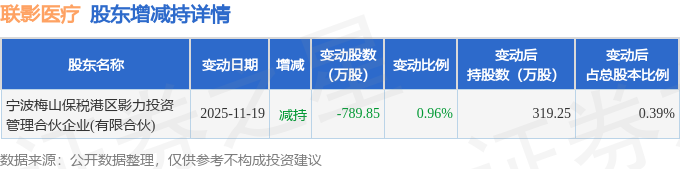
该股最近90天内共有25家机构给出评级,买入评级18家,增持评级7家;过去90天内机构目标均价为 173.12。 以上内容为证券之星据公开信息整理,由AI算法生成(网信算备310104345710301240019号),不构成 投资建议。 该股近半年内有股东持股变动,合计净减持789.85万股,股东增减持明细如下表: | 股东名称 | 变动日期 增减 | 变动股数 | 变动比例 | 变动后 | 变动后 | | | --- | --- | --- | --- | --- | --- | --- | | | | (万股) | | 持股数 (万股) | 占总股本比例 | | | 宁波梅山保税港区影力投资 管理合伙企业(有限合伙) | 2025-11-19 减持 | -789.85 | 0.96% | | 319.25 | 0.39% | 证券之星消息,12月12日联影医疗发生大宗交易,交易数据如下: 大宗交易成交价格128.63元,成交2.33万股,成交金额299.71万元,买方营业部为中信证券股份有限公 司总部(非营业场所),卖方营业部为机构专用。 近三个月该股共发生5笔大宗交易,合计成交7.99万手,折价成交2 ...

股票行情快报:联影医疗(688271)12月11日主力资金净卖出2605.05万元
Sou Hu Cai Jing· 2025-12-11 12:41
Core Viewpoint - The financial performance of United Imaging Healthcare (688271) shows significant growth in revenue and net profit for the first three quarters of 2025, indicating strong operational efficiency and market demand for its medical imaging and treatment solutions [2]. Financial Performance - For the first three quarters of 2025, the company's main revenue reached 8.859 billion yuan, a year-on-year increase of 27.39% [2]. - The net profit attributable to shareholders was 1.12 billion yuan, up 66.91% year-on-year [2]. - The net profit excluding non-recurring items was 1.053 billion yuan, reflecting a substantial increase of 126.94% year-on-year [2]. - In Q3 2025 alone, the company reported a single-quarter main revenue of 2.843 billion yuan, a remarkable increase of 75.41% year-on-year [2]. - The single-quarter net profit attributable to shareholders was 122 million yuan, showing a year-on-year growth of 143.8% [2]. - The single-quarter net profit excluding non-recurring items was 87.6141 million yuan, up 126.24% year-on-year [2]. - The company's debt ratio stands at 30.08%, with investment income of 606.847 million yuan and financial expenses of -438.233 million yuan, while the gross profit margin is 47.02% [2]. Market Activity - As of December 11, 2025, the stock price of United Imaging Healthcare closed at 128.7 yuan, down 0.84% with a turnover rate of 0.31% [1]. - The trading volume was 25,700 hands, with a total transaction value of 332 million yuan [1]. - On December 11, the net outflow of main funds was 26.0505 million yuan, accounting for 7.85% of the total transaction value, while retail investors saw a net inflow of 13.9798 million yuan, representing 4.21% of the total transaction value [1]. Analyst Ratings - In the last 90 days, 25 institutions have provided ratings for the stock, with 18 giving a buy rating and 7 an overweight rating [2]. - The average target price set by institutions over the past 90 days is 17.312 billion yuan [2].

中国医疗健康-2025 年 11 月中国医疗设备招标:同比增速超预期,上调基准假设-China Healthcare_ Nov 2025 China hospital equipment bidding_ Higher-than-expected yoy growth; lifting base case assumption
2025-12-11 02:23
Summary of Conference Call on China Healthcare Industry and Companies Industry Overview - **Sector**: China Healthcare, specifically focusing on hospital equipment bidding - **Key Data**: November 2025 public hospital medical equipment bidding value increased by **15% YoY**, surpassing previous expectations of flat-to-low single-digit growth [1] Core Insights - **Bidding Activity**: - The increase in bidding value was unexpected, as leading indicators suggested weaker dynamics for 2025 compared to 2024 [1] - United Imaging indicated that while trade-in program execution is faster than last year, some procurement may be deferred to 2026, suggesting a recovery in non-trade-in demand [1] - **Future Outlook**: - A cautious stance is maintained for bidding activity into December 2025 and the first half of 2026 due to tougher base effects and uneven trade-in execution across regions [2] - The base-case assumption for bidding value has been revised from a flat-to-single-digit decline to flat-to-modest YoY growth for December 2025 and 1H26 [2] Company-Specific Insights United Imaging - **Performance**: - Domestic revenue grew **73% YoY** in 3Q25, driven by previous hospital bidding revenue recognition; overseas revenue increased by **81% YoY** [14] - Service revenue grew **22% YoY**, indicating resilience to economic cycles [14] - November growth was **30% YoY**, significantly higher than the industry average of **15%** [14] - **Valuation**: - Currently trading near its median P/E multiple since listing, with significant long-term net profit growth potential anticipated [14] Mindray - **Performance**: - Core businesses showed mixed results: PMLS grew **2.6%**, MI grew **1%**, while IVD declined **2.8%** in 3Q25 [16] - Domestic PMLS revenue decline narrowed to **-25%** from **-57%** in 1H25, with overseas sales up **14% YoY** [16] - Management expects destocking to complete by 4Q25, with revenue recovery anticipated in 2026 [16] - **Growth Drivers**: - Long-term double-digit growth supported by recurring business in China and market share gains in emerging markets [16] - High-potential products expected to drive significant revenue growth in China from 2024 to 2035 [16] Risks and Challenges - **Mindray**: - Risks include potential impacts from VBP on product pricing, challenges in penetrating top-tier hospitals, and difficulties in entering North American and European markets [77] - **United Imaging**: - Risks include chip supply chain issues, raw material risks, macroeconomic downturns in China, and potential VBP risks [78] Investment Ratings - **Mindray**: Rated as "Buy" with a 12-month target price of **Rmb285**, indicating an upside of **43.4%** [79] - **United Imaging**: Rated as "Buy" with a 12-month target price of **Rmb174**, indicating an upside of **34.9%** [82] Conclusion - The China healthcare equipment sector is showing signs of recovery with better-than-expected bidding activity, particularly for United Imaging. Mindray is facing challenges but has potential growth drivers in emerging markets and high-potential products. Both companies are rated as "Buy" with significant upside potential.
2025年中国医疗AI解决方案行业政策、产业链、市场规模、细分产品结构、竞争格局、代表企业经营现状及发展趋势分析研判:应用广泛且持续深入,市场格局愈加多元化[图]
Chan Ye Xin Xi Wang· 2025-12-11 01:34
Core Insights - China is a significant market for global medical AI solutions, benefiting from technological advancements, high-quality medical data accumulation, supportive national policies, and growing market demand, leading to rapid growth in AI applications in healthcare [1][4]. Market Size and Growth - The market size for medical AI solutions in China is projected to grow from 9.1 billion yuan in 2021 to 16.4 billion yuan in 2024, with L1 solutions increasing from 5.8 billion yuan to 9.4 billion yuan, L2 solutions from 3.3 billion yuan to 6.9 billion yuan, and L3 solutions at 0.1 billion yuan [1][4]. - By 2025, the market size is expected to reach 18.2 billion yuan, with L1 solutions at 9.8 billion yuan, L2 solutions at 7.8 billion yuan, and L3 solutions at 0.6 billion yuan [1][4]. Industry Definition and Applications - Medical AI solutions utilize AI technologies such as machine learning, deep learning, natural language processing, and big data analysis to enhance various medical processes, including diagnosis, treatment, drug development, and hospital management [2][3]. - The industry is evolving from L1 and L2 solutions, which provide supportive insights, to L3 and L4 autonomous agents capable of executing tasks independently [2][3]. Industry Development Status - The integration of general large model capabilities with medical knowledge bases is driving the transition of medical AI solutions towards higher levels of autonomy [3][4]. - The global market for medical AI solutions is expected to grow from 23.2 billion yuan in 2021 to 40 billion yuan in 2024, with L1 solutions increasing from 13.9 billion yuan to 21.1 billion yuan, L2 solutions from 9.3 billion yuan to 18.7 billion yuan, and L3 solutions at 0.2 billion yuan [4]. Industry Chain - The medical AI solutions industry chain includes upstream data supply, hardware providers (chips, servers), cloud services, operating systems, and algorithms, with midstream companies providing AI solutions and downstream applications in healthcare institutions, pharmaceutical companies, and individual patients [5]. Policy Environment - The Chinese government has prioritized the application of AI in healthcare, implementing policies to support AI in medical diagnosis, health management, and insurance regulation, which are expected to accelerate the development of AI in healthcare [5]. Competitive Landscape - The industry features a competitive landscape with local giants, vertical startups, and multinational companies. Key players include iFlytek Medical, Baidu, United Imaging, CloudWalk, Weining Health, and Mindray Medical [7]. - iFlytek Medical is a leading company in the AI healthcare sector, leveraging its large model to empower various healthcare stakeholders and has developed comprehensive AI solutions for hospitals and primary care institutions [9][11]. Revenue Structure of Key Players - iFlytek Medical reported a revenue of 299 million yuan in the first half of 2025, with contributions from various solutions: 84 million yuan from primary care solutions, 58 million yuan from regional solutions, 53 million yuan from hospital solutions, and 104 million yuan from patient management services [11]. - The company aims to build a robust B-end ecosystem to strengthen its commercial channels [9]. Future Trends - The development of the medical AI industry will be driven by a combination of technology, data, scenarios, and regulation, leading to a more mature, deeper, and broader market landscape [12].


政策拉动国内市场有效复苏,医疗设备招采保持快速增长
GUOTAI HAITONG SECURITIES· 2025-12-10 15:07
Investment Rating - The report maintains an "Overweight" rating for the industry [1][5]. Core Insights - The medical device procurement scale continues to grow, driven by ongoing equipment update policies, which are expected to lead to a long-term increase in procurement levels. The report recommends medical device companies that are likely to benefit from these policies, including Mindray Medical, United Imaging, Kaili Medical, and Aohua Endoscopy [3][5]. - In November 2025, the new equipment procurement scale showed significant year-on-year growth: MRI increased by 11.1%, CT by 26.4%, DR by 47.2%, ultrasound by 17.0%, while endoscopes declined by 4.9%, and surgical robots grew by 8.6%. Cumulatively, from January to November 2025, MRI grew by 50.4%, CT by 72.7%, DR by 74.0%, ultrasound by 56.1%, endoscopes by 19.7%, and surgical robots by 32.8% [5]. - The equipment update policy is expected to drive procurement levels significantly, with a target of over 25% growth in medical equipment investment by 2027 compared to 2023. This policy is expected to enhance the configuration of high-end equipment to levels comparable to middle-income countries [5]. - The domestic market is showing signs of recovery, with a notable increase in procurement demand from medical institutions, reflecting a positive trend in the medical equipment industry. For instance, United Imaging reported a revenue of 6.866 billion yuan in the domestic market for the first three quarters of 2025, representing a year-on-year growth of 23.7% [5]. Summary by Sections - **Investment Recommendations**: The report suggests maintaining an "Overweight" rating and recommends companies likely to benefit from the equipment update policies [5]. - **Market Trends**: The report highlights the growth in procurement scale for various medical devices, indicating a robust market environment [5]. - **Policy Impact**: The ongoing implementation of equipment update policies is expected to significantly enhance procurement levels in the medical sector [5].
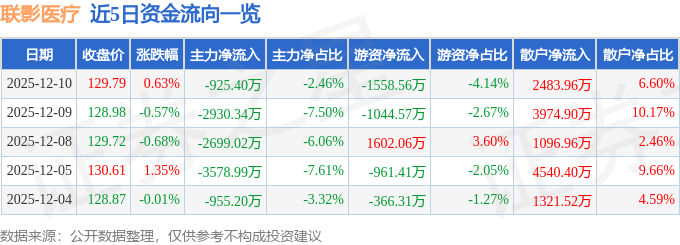
股票行情快报:联影医疗(688271)12月10日主力资金净卖出925.40万元
Sou Hu Cai Jing· 2025-12-10 12:32
Group 1 - The core stock price of United Imaging Healthcare (688271) closed at 129.79 yuan on December 10, 2025, with a slight increase of 0.63% and a trading volume of 29,100 hands, resulting in a total transaction amount of 376 million yuan [1] - The net outflow of main funds on December 10 was 9.254 million yuan, accounting for 2.46% of the total transaction amount, while retail investors saw a net inflow of 24.8396 million yuan, representing 6.6% of the total transaction amount [1][2] Group 2 - Over the past five days, the stock has experienced fluctuations, with the highest closing price being 130.61 yuan and the lowest at 128.87 yuan, alongside varying net inflows and outflows from different investor categories [2] - The company reported a total market value of 106.967 billion yuan, with a net asset value of 20.805 billion yuan and a net profit of 1.12 billion yuan, ranking 2nd, 3rd, and 5th respectively in the medical device industry [3] - The company's revenue for the first three quarters of 2025 was 8.859 billion yuan, a year-on-year increase of 27.39%, with a net profit increase of 66.91% to 1.12 billion yuan [3] Group 3 - The average target price set by 25 institutions over the last 90 days is 173.12 yuan, with 18 institutions giving a buy rating and 7 an increase rating [4]
联影医疗中标:[正在公示]寿县人民医院医学影像科大型医疗设备维保服务采购(二包,二次)成交结果公告
Sou Hu Cai Jing· 2025-12-10 04:36
Group 1 - The core point of the article is that Shanghai United Imaging Healthcare Co., Ltd. has won a bid for the maintenance service procurement of large medical equipment at Shouxian People's Hospital, with a bid amount of 685,000.00 [1][2] - The procurement was officially announced on December 7, 2025, indicating the ongoing investment in healthcare infrastructure in Anhui Province [2] - Shanghai United Imaging Healthcare Co., Ltd. has a significant presence in the market, having participated in 8,516 bidding projects and invested in 21 companies [1] Group 2 - The company holds a substantial amount of intellectual property, including 894 trademark registrations, 5,562 patents, and 109 copyrights, which reflects its innovation capabilities [1] - Additionally, the company has obtained 457 administrative licenses, indicating compliance with regulatory requirements in the healthcare sector [1]