
UIH(688271)

Search documents
2026年中国医疗器械物流配送行业发展历程、政策、运力情况、竞争格局及趋势研判:医疗器械物流基础建设不断完善,物流运输自有车辆突破4万台[图]
Chan Ye Xin Xi Wang· 2026-01-24 02:30
Core Viewpoint - The strategic importance of medical device logistics and distribution is increasingly recognized as the market for medical devices continues to expand, leading to a strong demand for specialized and efficient logistics services [1][8]. Industry Overview - Medical device logistics and distribution involves the effective transfer of medical device products from suppliers or manufacturers to medical institutions, pharmacies, or other relevant endpoints, ensuring safety, timeliness, and accuracy [2][3]. - The industry has evolved through four stages, from minimal focus during the early marketization phase to a rapid development period from 2010 to 2020, driven by increasing demand and regulatory policies [3]. Industry Policies - Recent government policies have provided strong support for the development of the medical device logistics industry, promoting standardization, efficiency, and scale [4]. - Key policies include the establishment of a risk-sharing alliance for online sales of medical devices and encouragement for wholesale companies to integrate storage and transportation resources [4]. Industry Chain - The upstream of the medical device logistics chain includes suppliers of logistics vehicles, software, medical devices, storage equipment, and packaging materials [4]. - The midstream consists of logistics service providers, which are crucial for the entire supply chain, while the downstream includes medical institutions and patients as the primary demand side [4]. Current Industry Status - The logistics total cost for medical devices in China is projected to reach 26.78 billion yuan in 2024, with a year-on-year growth of 1.88% [8]. - The logistics warehousing area is expected to be 23.58 million square meters in 2024, reflecting a 0.8% increase [8]. Market Trends - The medical device logistics industry is expected to accelerate its digital transformation and integration of intelligent technologies, utilizing IoT for real-time monitoring and big data for demand forecasting [12][14]. - Service models are evolving towards highly specialized and integrated solutions, addressing specific requirements for different categories of medical devices [14]. - The logistics network is anticipated to deepen into lower-tier cities, establishing regional distribution centers to enhance efficiency and reduce costs [15].






今日视点:中国药械“出海”迈入体系化新征途
Xin Lang Cai Jing· 2026-01-23 23:26
Core Viewpoint - The Chinese pharmaceutical and medical device industry is entering a new phase of "systematic going global," supported by national platforms and multi-dimensional efforts from enterprises [1] Policy Support - The "systematic going global" initiative is receiving unprecedented systematic support, with the issuance of the first "overseas drug price certificate" in January 2026, bolstering the global pricing of China's pharmaceutical industry [2] - A multi-layered market connection network is being formed, with the National Healthcare Security Administration promoting differentiated development in regions like Guangxi, Xinjiang, Tianjin, and Ningbo, targeting Southeast Asia, Central Asia, and Central and Eastern Europe [2] - Multiple government departments, including the Ministry of Commerce and the National Medical Products Administration, are collaborating to reduce institutional costs and information barriers for enterprises going global [2] Industry Transformation - The export structure of China's pharmaceutical and medical device industry is shifting from low-value consumables to high-value innovative products, with a significant increase in the licensing-out transactions of innovative drugs expected to exceed $130 billion by 2025 [3] - Leading companies like United Imaging Healthcare and Mindray Medical are seeing a continuous increase in overseas revenue, successfully entering high-end hospital markets in Europe and the U.S. [3] Strategic Recommendations - Companies need to solidify their innovation foundation by focusing on unmet clinical needs and building proprietary technology platforms in advanced fields like ADCs, bispecific antibodies, and gene therapy [3] - Utilizing capital tools for overseas strategic layout is essential, such as raising funds through targeted placements for overseas clinical research and acquisitions of quality overseas targets [4] - Implementing differentiated market strategies is crucial, with companies needing to adopt localized thinking in different markets, maximizing product value through partnerships in mature markets and engaging in local production in emerging markets [4]

医疗设备以旧换新专题系列六:12月数据同比-8%,25年全年同比+25%
Southwest Securities· 2026-01-23 10:36
Investment Rating - The report indicates a positive outlook for the medical equipment industry, with an expected year-on-year growth of 25% for the year 2025 [22]. Core Insights - The medical equipment industry is experiencing a slight decline in December data year-on-year, attributed to a high base effect from the previous year. However, there is a significant month-on-month increase of 38% due to accelerated budget spending at year-end [3]. - The report highlights that the current round of medical equipment upgrades is nearing its end, with expectations for a new round of equipment replacement in 2025, which is projected to be no less than the previous round [4]. - The report emphasizes the importance of government policies, including the issuance of long-term special bonds to support large-scale equipment upgrades and consumer replacement programs [15]. Summary by Relevant Sections Medical Imaging - December figures for medical imaging reached 9.8 billion yuan, a decrease of 11%, while the forecast for 2025 is 69.3 billion yuan, reflecting a growth of 37% [5]. Life Information and Support - In December, life information and support equipment generated 2.6 billion yuan, an increase of 8%, with a projected total of 16.7 billion yuan for 2025, marking a 28% growth [5]. Endoscopes - Soft endoscopes reported 1.1 billion yuan in December, down 9%, while hard endoscopes reached 1.2 billion yuan, down 7%. The 2025 projections for both are 7.8 billion yuan for soft endoscopes (+12%) and 7.8 billion yuan for hard endoscopes (+3%) [5]. Radiation Therapy - December figures for radiation therapy stood at 1.6 billion yuan, a slight increase of 1%, with a forecast of 9.6 billion yuan for 2025, indicating a growth of 32% [48]. Surgical Robots - Surgical robots saw a significant decline in December, with figures at 600 million yuan, down 24%, but are expected to reach 5.2 billion yuan in 2025, reflecting a robust growth of 54% [51]. Key Companies - Major companies in the sector include Mindray, which reported 1.9 billion yuan in December (+20%) and is projected to reach 11.2 billion yuan in 2025 (+35%), and United Imaging, with December figures of 2.2 billion yuan (0% change) and a forecast of 12.6 billion yuan (+37%) for 2025 [55][58].


中国医疗-中国医院调研:2026年保持谨慎乐观
2026-01-22 02:44
Summary of China Healthcare Industry Conference Call Industry Overview - **Industry**: China Healthcare Industry - **Report Date**: January 21, 2026 - **Sentiment**: Cautiously optimistic outlook for 2026 regarding hospital capital expenditures and market dynamics [1][2] Key Insights Capital Expenditure Trends - **Stable to Moderate Growth**: Hospital capital expenditures are expected to remain stable with moderate growth in 2026 [2] - **Survey Results**: 59% of surveyed hospital managers anticipate capital expenditure growth in 2026, up from 43% in late 2024, but still below 85% in late 2023 [3] - **Projected Growth Rate**: Expected capital expenditure growth of 4.7% in 2026, compared to 3.0% growth anticipated for 2025 [3] - **Actual Growth Expectations**: Respondents expect actual capital expenditure growth of 5.8% for 2025, indicating limited visibility on actual demand [3] Key Drivers of Expenditure - **Primary Drivers**: 1. Hospital Surplus (69%) 2. Patient Demand (50%) 3. Local Fiscal Budgets (44%) [3] - **Service Volume Constraints**: Factors such as Diagnosis-Related Group (DRG) payment limits and medical insurance settlements are seen as major constraints on service volume [3] Equipment and Technology Focus - **Investment Priorities**: Hospitals are prioritizing investments in AI, endoscopy, and imaging equipment, with a focus on surgical and flexible endoscopes, followed by CT and ultrasound [3] - **Weak Demand**: In vitro diagnostics are expected to remain weak [3] Company-Specific Insights Beneficiaries of Capital Expenditure Growth - **Mindray Medical (300760.SZ)**: Expected to benefit from a stable capital expenditure environment, with anticipated single-digit revenue growth in 2026. The company is expected to maintain a 16% share of planned capital expenditures [4][10] - **United Imaging (688271.SS)**: Anticipated to benefit from strong demand in high-end imaging, with projected revenue growth of approximately 21% in 2026 [4][11] - **New Industries (300832.SZ)**: Expected to face continued pricing pressure in in vitro diagnostics but may achieve above-industry growth due to healthy demand for chemical luminescence analyzers [4][12] - **Huatai Medical (688617.SS)**: Positioned to capitalize on the growing adoption of pulse field ablation technology, with projected revenue growth of 30% in 2026 [4][13] - **Guichuang Tongqiao (2190.HK)**: Expected to see revenue growth of around 30% driven by increased demand for neurointerventional and peripheral interventional procedures [4][15] Challenges for Global Players - **GE Healthcare**: Faces mixed impacts from increased capital expenditure and growing preference for local brands, which may offset some growth [4][16] - **Siemens Healthineers (SHL)**: Cautious outlook due to slow recovery in utilization rates and increased pricing pressure from procurement policies [4][17] - **Philips (PHIA)**: Similar cautious outlook with potential declines in market share for CT and ultrasound equipment [4][18] - **Olympus (7733.T)**: Expected to face challenges in maintaining market share in the digestive endoscopy market [4][19] - **Hologic (6869.T)**: Anticipated slowdown in clinical testing volumes and potential market share decline in hematology [4][20] Additional Observations - **Market Dynamics**: The report highlights a complex landscape for global medical technology companies in China, with both opportunities and pressures from local competition and procurement policies [4][16][17][18][19][20] - **Emerging Trends**: The shift towards local brands and the impact of procurement policies are significant trends that may reshape the competitive landscape in the healthcare sector [4][16][17][18][19][20]



招商中证全指医疗器械ETF投资价值分析:如何一键布局“脑机接口”赛道
CMS· 2026-01-21 14:00
- The report does not contain any quantitative models or factors related to financial engineering or quantitative analysis[1][3][4]
股票行情快报:联影医疗(688271)1月21日主力资金净买入1217.27万元
Sou Hu Cai Jing· 2026-01-21 11:50
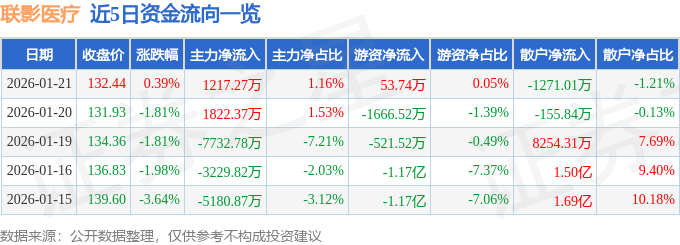
证券之星消息,截至2026年1月21日收盘,联影医疗(688271)报收于132.44元,上涨0.39%,换手率 0.96%,成交量7.92万手,成交额10.52亿元。 1月21日的资金流向数据方面,主力资金净流入1217.27万元,占总成交额1.16%,游资资金净流入53.74 万元,占总成交额0.05%,散户资金净流出1271.01万元,占总成交额1.21%。 近5日资金流向一览见下表: | 指标 | 联影医疗 | 医疗器械行业均值 | 行业排名 | | --- | --- | --- | --- | | 总市值 | 1091.51亿元 | 113.47亿元 | 2 127 | | 净资产 | 208.05亿元 | 38.34亿元 | 3 127 | | 净利润 | 11.2亿元 | 2.08亿元 | 5 127 | | 市盈率(动) | 73.08 | 99.95 | 65 127 | | 市净率 | 5.25 | 4.06 | 103 127 | | 毛利率 | 47.02% | 50.94% | 78 127 | | 净利率 | 12.44% | 9.66% | 57 127 | | ROE | 5 ...
71只科创板股融资余额增加超1000万元
Xin Lang Cai Jing· 2026-01-21 07:09
Summary of Key Points Core Viewpoint - The financing balance of the Sci-Tech Innovation Board decreased by 2.251 billion yuan compared to the previous day, with 71 stocks seeing an increase of over 10 million yuan in financing balance, led by Tianyue Advanced, Yuanjie Technology, and Aters [1][5]. Financing Balance Overview - As of January 20, the total margin financing balance of the Sci-Tech Innovation Board was 294.585 billion yuan, a decrease of 2.270 billion yuan from the previous trading day [5]. - There are 504 stocks with a financing balance exceeding 100 million yuan, including 62 stocks with balances over 1 billion yuan [5]. - 267 stocks saw an increase in financing balance compared to the previous day, with 71 stocks having net purchases exceeding 10 million yuan [5]. Stocks with Significant Financing Changes - The stocks with the highest net purchases include Tianyue Advanced (1.255 billion yuan, up 98.0536 million yuan), Yuanjie Technology (1.598 billion yuan, up 96.1215 million yuan), and Aters (1.286 billion yuan, up 88.0648 million yuan) [2][6]. - The average decrease in financing balance for stocks that saw a reduction was significant, with 112 stocks decreasing by over 10 million yuan, led by Lanke Technology, Han's Laser, and Haiguang Information [5]. Sector Performance - Among the stocks with net purchases exceeding 10 million yuan, the average decline was 0.50%, with notable increases in stocks like Qizhong Technology (up 16.32%), Yingjixin (up 12.24%), and Hangya Technology (up 10.37%) [6]. - The sectors attracting the most interest from financing clients include electronics, machinery, and power equipment, with 23, 11, and 10 stocks respectively [6]. Financing Balance to Market Value Ratio - The average ratio of financing balance to market value for the stocks with significant net purchases is 4.34%, with Aisen Co. having the highest ratio at 9.51% [6].



医保局规定手术机器人定价!器械出海空间广阔,医疗器械 ETF(562600)涨近1%
Sou Hu Cai Jing· 2026-01-21 06:02
Group 1 - The core viewpoint of the news highlights the positive performance of the medical device sector, with significant stock price increases for various companies and a favorable market outlook driven by new pricing policies and international trade initiatives [1][2][3] Group 2 - As of January 21, the Shanghai Composite Index rose by 0.22%, while the medical device index increased by 0.69%, with notable stock performances from Tianzhihang-U (+13%), Sanyou Medical (+7%), and others [1] - The medical device ETF (562600) saw a 0.77% increase, with a trading volume of 254.268 billion yuan and a turnover rate of 4.15%. Over the past six months, the fund has gained 4.80%, and 11.30% over the past year [1] Group 3 - On January 20, the National Healthcare Security Administration issued guidelines for pricing medical services related to surgical robots and remote surgeries, establishing a structured pricing system to enhance innovation returns and improve accessibility to precision medicine [2] - A special seminar was held on January 17 to discuss how to leverage the medical device procurement and pricing platform to support the international expansion of Chinese medical devices, with plans for a cross-border channel based on procurement platforms in Guangxi and Tianjin [2] Group 4 - Multiple authoritative institutions have expressed optimism about the medical device sector, with expectations for a turning point in operations by 2026 due to optimized procurement rules and significant growth potential in domestic and international markets for surgical robots and AI medical technologies [3] - The medical device ETF (562600) tracks the CSI All Index for medical devices, with the top ten weighted stocks accounting for 45.04% of the total, including major players like Mindray Medical and United Imaging [3]



中国 医疗器械:2025 年业绩前瞻及 2026 年初步展望-China Healthcare-Medical Devices – 2025 Results Preview and Initial 2026 Outlook
2026-01-21 02:58
Summary of Conference Call Notes Industry Overview - The medical devices industry in China is expected to face ongoing pricing pressures in 2026, particularly for in vitro diagnostics (IVD) players, although some recovery in medical equipment sales is anticipated. Niche consumable segments may benefit from value-based pricing (VBP) and globalization trends [1][2][3]. Company-Specific Insights Imeik Technology Development Co Ltd (300896.SZ) - **Rating Downgrade**: Imeik has been downgraded from Equal-weight (EW) to Underweight (UW) with a price target (PT) maintained at Rmb130. The downgrade is attributed to intensifying competition, soft domestic demand, and weakening bargaining power, leading to persistent pricing and margin pressures on its core products, Hearty and CureWhite [3][4][32]. - **Sales Forecast**: A projected 20% year-over-year (YoY) sales decline for 2025 is expected, with 4Q results likely flat quarter-over-quarter (QoQ) due to higher selling, general, and administrative expenses (SG&A). A recovery to high single-digit growth is anticipated in 2026, supported by stable legacy products and contributions from new products like Hutox [3][33][34]. - **Valuation Concerns**: The stock is trading at approximately 29 times the estimated earnings per share (EPS) for 2026, which is considered full given the low-teens growth outlook and limited visibility due to macroeconomic and competitive challenges [3][34][37]. Mindray Bio-Medical Electronics Co Ltd (300760.SZ) - **Revenue Decline**: Expected to post a 9% YoY revenue decline for 2025, with a modest recovery anticipated in 2026. The net profit is also projected to decline by double digits in 2025 [8][10]. United Imaging Healthcare Co (688271.SS) - **Sales Growth**: Anticipated to achieve over 20% sales growth in 2025, with net profit growth expected to exceed 40-50% due to a low profit base in 2024 [8][10]. APT Medical Inc (688617.SS) - **Growth Projections**: Expected to see approximately 24% overall sales growth and 28% net profit growth in 2025, with strong performance in 4Q [11][19]. Zylox-Tonbridge Medical Technology Co (2190.HK) - **Market Position**: Likely to benefit from VBP tailwinds in neuro and peripheral intervention devices, with potential upside surprises in sales growth [12][19]. Peijia Medical Ltd (9996.HK) - **Revenue Expectations**: Projected TAVR revenue for 2025 is estimated to be below Rmb300 million due to a voluntary product shipment delay [13][19]. Angelalign Technology Inc (6699.HK) - **Performance Outlook**: Expected to outperform targets due to resilient growth in China and lower costs [8][19]. Key Trends and Risks - **Market Dynamics**: The medical device tender value rebounded by 30.1% YoY in 2025, approaching 2022 levels, indicating a recovery in various categories despite challenges in IVD analyzers [25][26]. - **Competitive Landscape**: Increasing competition in the dermal filler market is noted, with Imeik facing challenges from new product launches and changing market dynamics [32][37]. - **Regulatory Environment**: Updates on VBP implementation and pricing strategies are critical for future performance, particularly for companies like Imeik and Peijia [15][34]. Conclusion The medical devices industry in China is navigating a complex landscape characterized by pricing pressures, competitive challenges, and varying growth prospects across companies. Imeik Technology's downgrade reflects broader concerns about market dynamics and profitability, while other companies like United Imaging and APT Medical show potential for growth amidst these challenges.
上海嘉定深化“医研产用”联动 打造产医融合发展新生态
Xin Hua Cai Jing· 2026-01-20 16:58
Group 1 - Shanghai Jiading is establishing a high-end medical device industry cluster, promoting a dual empowerment of medical services and industrial development [1] - The "Shanghai Medical Valley" industrial park has attracted over 60 biopharmaceutical companies, with a projected total output value of 700 million yuan in 2024 [1] - A new model of industry-medical integration has been created, involving collaboration with Shanghai Jiao Tong University to support the transformation of medical and engineering innovations [1] Group 2 - The first domestically produced proton therapy system has been put into clinical use, treating over 1,000 patients with a maximum treatment cost of 170,000 yuan, which is 15% to 20% lower than imported equipment [2] - The "Union Medical-Jiading Regional Imaging Center" has been established to enhance grassroots medical imaging capabilities, addressing shortages in diagnostic physicians and improving service quality [2] - A digital twin management platform for high-value medical imaging equipment has been created, optimizing workflows and improving patient experience through real-time data monitoring [2] Group 3 - The "Jiading Model" is a practical implementation of the national hierarchical diagnosis and treatment system, promoting high-quality development of public hospitals and the entire chain of high-end medical equipment [3] - This model has been successfully implemented in nearly 400 projects across 31 provinces and cities, covering over 3,000 hospitals and serving nearly 200 million people [3] - The model is being promoted to countries and regions involved in the Belt and Road Initiative, including Indonesia, Brazil, and Africa [3]