Daqo Energy(688303)

Search documents
大全能源(688303) - 上海市方达律师事务所关于新疆大全新能源股份有限公司2025年第一次临时股东大会的法律意见书
2025-11-12 10:19
上海市方达律师事务所(以下简称"本所")是具有中华人民共和国境内法 律执业资格的律师事务所。根据相关法律顾问协议,本所指派律师出席新疆大全 新能源股份有限公司(以下简称"公司")2025 年第一次临时股东大会(以下简 称"本次股东大会"),并就本次股东大会的召集和召开程序、参与表决和召集 会议人员的资格、表决程序和表决结果等有关事宜出具本法律意见书。 FANGDA PARTNERS http://www.fangdalaw.com 中国上海市石门一路 288 号 电子邮件 E-mail: email@fangdalaw.com 兴业太古汇香港兴业中心二座 24 楼 电 话 Tel.: 86-21-2208-1166 邮政编码:200041 传 真 Fax: 86-21-5298-5599 24/F, HKRI Centre Two HKRI Taikoo Hui 288 Shi Men Yi Road Shanghai 200041, PRC 上海市方达律师事务所 关于新疆大全新能源股份有限公司 2025 年第一次临时股东大会的法律意见书 致:新疆大全新能源股份有限公司 本法律意见书依据《中华人民共和国公司法 ...
大全能源跌5.23% 中原证券年内高位维持增持评级

Zhong Guo Jing Ji Wang· 2025-11-12 08:57
Group 1 - The stock price of Daqian Energy (688303.SH) closed at 30.60 yuan, with a decline of 5.23% [1] - The highest point of Daqian Energy's stock price this year was 35.74 yuan, reached on September 5 [1] - Research analyst Tang Jun-nan from Zhongyuan Securities published a report on September 9, stating that the company experienced a loss in the first half of the year but maintains a strong operational position and solid financial backing, thus reaffirming an "overweight" investment rating for the company [1]
A股冲高回落,创业板指再度跌超1%!光伏设备持续下探,阿特斯跌近16%,艾罗能源、天河光能、通威股份、大全能源、隆基绿能跌超6%
Ge Long Hui· 2025-11-12 04:01
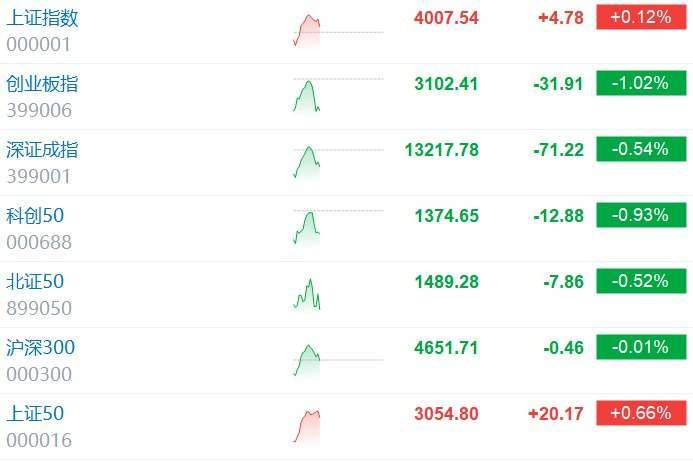
Market Performance - The A-share major indices experienced a pullback after reaching highs, with the ChiNext Index dropping over 1% [1] - The Shanghai Composite Index closed at 4007.54, up by 4.78 points or 0.12% [2] - The ChiNext Index ended at 3102.41, down by 31.91 points or 1.02% [2] - The Shenzhen Component Index fell to 13217.78, down by 71.22 points or 0.54% [2] - The STAR 50 Index decreased to 1374.65, down by 12.88 points or 0.93% [2] - The North Exchange 50 Index dropped to 1489.28, down by 7.86 points or 0.52% [2] - The CSI 300 Index slightly decreased to 4651.71, down by 0.46 points or 0.01% [2] - The SSE 50 Index rose to 3054.80, up by 20.17 points or 0.66% [2] Industry Performance - The photovoltaic equipment sector continued to decline, with notable stocks such as Aiko Solar falling nearly 16% [1] - Other companies in the photovoltaic sector, including Aier Energy, Tianhe Energy, Tongwei Co., Daqo New Energy, and LONGi Green Energy, saw declines exceeding 6% [1]



光伏设备板块盘初下探,阿特斯跌超10%


Xin Lang Cai Jing· 2025-11-12 01:36
Group 1 - The photovoltaic equipment sector experienced a decline at the beginning of trading, with notable drops in stock prices [1] - Canadian Solar (阿特斯) saw a decline of over 10% in its stock price [1] - Other companies such as Yichin Photovoltaic (亿晶光电), Tongrun Equipment (通润装备), GoodWe (固德威), and Daqo Energy (大全能源) also faced significant declines [1]
光伏三季报全景:亏损收窄现曙光 “反内卷”远未到终局
Di Yi Cai Jing· 2025-11-09 02:06
Core Insights - The photovoltaic industry has shown signs of improvement in Q3 2025, with a significant reduction in net losses across the main industry chain, attributed to price stabilization and cost-cutting measures by companies [1][2][6] - Despite the reduction in losses, overall revenue for the industry remains under pressure due to weak installation demand, with a year-on-year revenue decline of 17.05% for the 21 listed companies in the sector [4][6] Group 1: Financial Performance - In Q3 2025, 14 out of 21 photovoltaic companies reported a quarter-on-quarter increase in net profit, with major players like Daqo Energy and Shuangliang Energy turning losses into profits [1][2] - Daqo Energy reported Q3 revenue of 1.773 billion yuan, a year-on-year increase of 24.75% and a quarter-on-quarter increase of 214.93%, while Shuangliang Energy achieved a revenue of 1.688 billion yuan with a net profit of 83 million yuan [3] - The overall revenue for the 21 companies totaled 381.67 billion yuan in the first three quarters, reflecting a decrease of 78.47 billion yuan compared to the previous year [4] Group 2: Market Dynamics - The price stabilization in the photovoltaic supply chain, particularly in the silicon material and silicon wafer segments, has contributed to the recovery of gross margins for manufacturers [2][3] - The average price of monocrystalline silicon wafers increased by at least 40% from the beginning to the end of Q3, while the average price of polysilicon rose by 8.6% [3] - Despite the positive price trends, the overall market remains characterized by an oversupply situation, with inventory pressures still present, particularly in polysilicon [6] Group 3: Demand and Future Outlook - The demand for photovoltaic installations has been weak, with domestic new installations dropping significantly, leading to a decline in revenue for many companies [4][6] - The market is shifting focus to Q4, traditionally a slow season for photovoltaic installations, with expectations of limited order growth for battery components [6] - Companies like Trina Solar have reported a quarter-on-quarter revenue increase of 13.11%, supported by growth in energy storage business and increased overseas shipments [5]


大全能源(688303) - 大全能源2025年第一次临时股东大会会议资料
2025-11-07 15:30
新疆大全新能源股份有限公司 2025 年第一次临时股东大会会议资料 证券代码:688303 证券简称:大全能源 新疆大全新能源股份有限公司 2025 年第一次临时股东大会 会议资料 2025 年 11 月 新疆大全新能源股份有限公司 2025 年第一次临时股东大会会议资料 | | | | 2025 | 年第一次临时股东大会会议须知 1 | | | --- | --- | --- | | 2025 | 年第一次临时股东大会会议议程 3 | | | 2025 | 年第一次临时股东大会会议议案 5 | | | | 议案一 | 5 | | | 关于取消公司监事会及修订《公司章程》并办理相应工商变更登记的议案 | 5 | | | 议案二 | 6 | | | 关于制定、修订公司部分内部治理制度的议案 | 6 | 新疆大全新能源股份有限公司 2025 年第一次临时股东大会会议资料 新疆大全新能源股份有限公司 2025 年第一次临时股东大会会议须知 为维护广大投资者的合法权益,确保股东在本次股东大会期间依法行使权 利,根据《中华人民共和国公司法》、中国证券监督管理委员会颁布的《上市 公司股东会规则》和公司制定的《股东大会议事 ...
5分钟,直线拉升!
证券时报· 2025-11-07 09:09
Market Overview - A-shares maintained a volatile consolidation trend with total trading volume above 2 trillion yuan, while Hong Kong stocks showed weakness, with the Hang Seng Index down nearly 1% and the Hang Seng Tech Index dropping over 2% [1] - The Shanghai Composite Index closed down 0.25% at 3997.56 points, the Shenzhen Component Index fell 0.36% to 13404.06 points, and the ChiNext Index decreased by 0.51% to 3208.21 points [1] Chemical Sector - The organic silicon sector saw significant gains, with Dongyue Silicon Materials hitting a 20% limit up, and other companies like Jiangsu Guotai and Hesheng Silicon Industry also reaching their limits [3][5] - The phosphorus concept stocks strengthened, with companies like Qing Shui Yuan and Chengxing Co. achieving consecutive 20% limit ups, driven by the increasing demand for phosphorus in new energy materials and the tightening supply of phosphate rock [6] Lithium Battery and Photovoltaic Concepts - The lithium battery sector experienced a surge, with Huasheng Lithium Battery hitting a limit up, and other companies like Tianhua New Energy and Wanrun New Energy rising over 15% [8][10] - The photovoltaic industry also saw gains, with companies like Qianzhao Optoelectronics and Hongyuan Green Energy reaching their limits, supported by industry consolidation efforts to eliminate excess capacity [12] Company Highlights - Wentai Technology experienced a sharp rise towards the end of trading, nearing the limit up, with a total transaction volume of 3.77 billion yuan [14] - The company announced significant contracts for the supply of electrolyte products, indicating strong demand and price recovery in the lithium battery supply chain [10][11] - Recent statements from the Dutch government regarding semiconductor supply stability have positioned Wentai Technology and its subsidiary, Anshi Semiconductor, in a favorable light for future operations [16][17]


大全能源(688303) - 大全能源2025年第一次临时股东大会会议资料
2025-11-07 09:00
新疆大全新能源股份有限公司 2025 年第一次临时股东大会会议资料 证券代码:688303 证券简称:大全能源 新疆大全新能源股份有限公司 2025 年第一次临时股东大会 会议资料 2025 年 11 月 新疆大全新能源股份有限公司 2025 年第一次临时股东大会会议资料 | | | | 2025 | 年第一次临时股东大会会议须知 1 | | | --- | --- | --- | | 2025 | 年第一次临时股东大会会议议程 3 | | | 2025 | 年第一次临时股东大会会议议案 5 | | | | 议案一 | 5 | | | 关于取消公司监事会及修订《公司章程》并办理相应工商变更登记的议案 | 5 | | | 议案二 | 6 | | | 关于制定、修订公司部分内部治理制度的议案 | 6 | 新疆大全新能源股份有限公司 2025 年第一次临时股东大会会议资料 新疆大全新能源股份有限公司 2025 年第一次临时股东大会会议须知 为维护广大投资者的合法权益,确保股东在本次股东大会期间依法行使权 利,根据《中华人民共和国公司法》、中国证券监督管理委员会颁布的《上市 公司股东会规则》和公司制定的《股东大会议事 ...
光伏设备板块11月7日涨1.6%,弘元绿能领涨,主力资金净流入19.1亿元
Zheng Xing Xing Ye Ri Bao· 2025-11-07 08:37
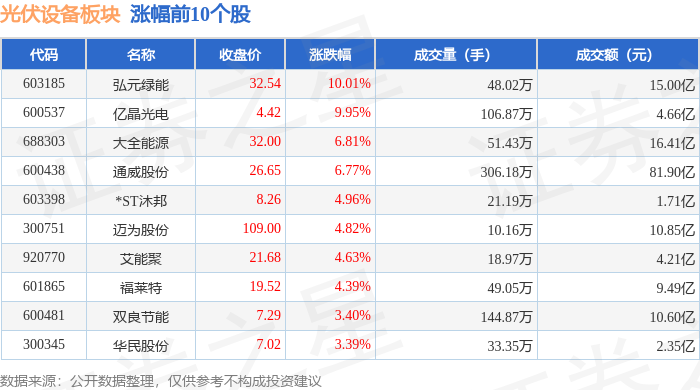
Core Insights - The photovoltaic equipment sector experienced a 1.6% increase on November 7, with Hongyuan Green Energy leading the gains [1] - The Shanghai Composite Index closed at 3997.56, down 0.25%, while the Shenzhen Component Index closed at 13404.06, down 0.36% [1] Stock Performance - Hongyuan Green Energy (603185) closed at 32.54, up 10.01% with a trading volume of 480,200 shares and a transaction value of 1.5 billion [1] - Yijing Photovoltaics (600537) closed at 4.42, up 9.95% with a trading volume of 1,068,700 shares [1] - Daqian Energy (688303) closed at 32.00, up 6.81% with a trading volume of 514,300 shares [1] - Tongwei Co., Ltd. (600438) closed at 26.65, up 6.77% with a trading volume of 3,061,800 shares [1] - Other notable performers include ST Muban (603398) up 4.96%, Maiwei Co. (300751) up 4.82%, and Wenenan (920770) up 4.63% [1] Fund Flow Analysis - The photovoltaic equipment sector saw a net inflow of 1.91 billion in main funds, while retail investors experienced a net outflow of 1.48 billion [2][3] - Tongwei Co., Ltd. (600438) had a main fund net inflow of 859 million, while retail investors had a net outflow of 522 million [3] - Yijing Photovoltaics (600537) experienced a main fund net inflow of 256 million, with a significant retail outflow of 1.53 billion [3]

光伏板块早盘拉升
Di Yi Cai Jing· 2025-11-07 06:49
Core Viewpoint - The stock prices of Yicheng Optoelectronics and Yihua Co., Ltd. have both reached the daily limit, indicating strong market interest and positive sentiment in the sector [1] Company Performance - Yicheng Optoelectronics and Yihua Co., Ltd. experienced a significant increase in stock prices, reaching the daily limit [1] - Other companies such as Daqo New Energy, Tongwei Co., Ltd., Ailuo Energy, TCL Zhonghuan, and Shuangliang Energy also saw their stock prices rise, reflecting a broader positive trend in the industry [1]