
Daqo Energy(688303)

Search documents
连年巨亏 光伏业如何逃出“血海”
经济观察报· 2026-01-25 10:54
Core Viewpoint - The photovoltaic industry is undergoing a brutal survival elimination race and a deep restructuring of the industrial pattern, with the next phase expected to be redefined after this intense reshuffle [2][4]. Group 1: Industry Performance and Losses - In 2025, major companies in the photovoltaic sector are expected to report significant losses, with JinkoSolar forecasting a net loss of 5.9 billion to 6.9 billion yuan, Trina Solar predicting a loss of 6.5 billion to 7.5 billion yuan, and Tongwei expecting a loss of 9 billion to 10 billion yuan [2][6]. - The total expected losses from leading companies amount to hundreds of billions, indicating that the photovoltaic industry is still mired in a loss-making situation [2][5]. - The industry has shifted from a phase of rapid expansion to a deep adjustment period, with companies generally operating at a loss to maintain operations, severely squeezing overall profitability [7][12]. Group 2: Causes of the Crisis - The root cause of the current industry crisis is attributed to aggressive expansion in the past, leading to severe structural oversupply and intense price competition [3][6]. - The prices of key materials such as silicon have plummeted from 300,000 yuan per ton in 2022 to around 55,000 yuan per ton, while silver prices have nearly doubled in recent months, further exacerbating the challenges faced by companies [4][10]. Group 3: Strategic Responses and Industry Restructuring - In response to the crisis, leading companies are turning to mergers and acquisitions to strengthen competitiveness or are extending into related fields such as energy storage and hydrogen energy to seek strategic breakthroughs [4][12]. - TCL Zhonghuan announced plans to invest in a new energy technology company to enhance its integrated strategy and expand battery and module production capacity [12]. - The industry is experiencing a "淘汰赛" (elimination race), with smaller companies likely to exit the market or seek mergers as the competitive landscape narrows [13][14]. Group 4: Future Outlook and Recovery Potential - Companies like Tongwei have seen some operational profitability in the latter half of 2025, but overall losses are expected to continue due to declining sales prices and rising raw material costs [9][10]. - The recovery of profitability is contingent on the overall price recovery across the supply chain and the expansion of photovoltaic application scenarios, which could provide significant growth opportunities [9][10]. - The photovoltaic industry is witnessing a recent increase in component prices, with some manufacturers raising prices by 0.04 to 0.15 yuan per watt, indicating a potential shift in market dynamics [18][19].






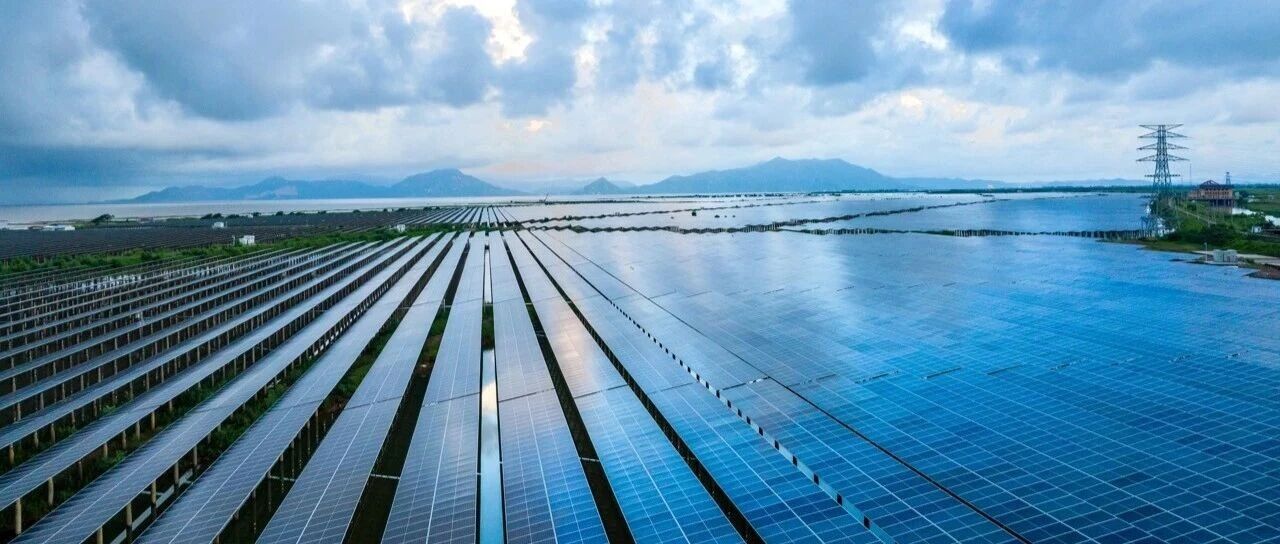
“太空光伏”引爆涨停潮,概念炒作难掩行业供需双弱
Di Yi Cai Jing· 2026-01-25 09:44
Core Viewpoint - The A-share photovoltaic sector has experienced a significant surge, with multiple stocks hitting a 20% limit-up, driven by Elon Musk's endorsement of space photovoltaics at the Davos Forum. However, the industry faces a harsh reality of prolonged losses, overcapacity, and persistent price pressure, with major companies expected to report substantial losses in 2025 [1][2]. Group 1: Industry Performance - The photovoltaic industry has seen widespread losses, with 23 out of 32 listed companies expected to report losses in 2025, accounting for over 70% of the sample [2]. - Major players like Tongwei Co. anticipate a net loss of 90 to 100 billion yuan in 2025, up from a loss of 70.39 billion yuan the previous year, marking it as the only company with a projected loss exceeding 100 billion yuan [2]. - Trina Solar and JinkoSolar are also expected to report significant losses, with Trina Solar projecting a loss of 65 to 75 billion yuan, and JinkoSolar estimating a loss of 59 to 69 billion yuan [2][3]. Group 2: Market Dynamics - The photovoltaic supply chain is experiencing intensified losses due to weak terminal demand, overcapacity, and stagnant product prices, which are the main contributors to the industry's financial struggles [2][3]. - Despite some companies like Daqo Energy and Longi Green Energy reducing their losses, the overall trend remains negative, with Daqo Energy expecting a loss of 14.18 to 17.18 billion yuan, a reduction of 52.17% to 63.21% year-on-year [3]. - The industry is facing a dual challenge of weak supply and demand, with overcapacity leading to low prices, which is the primary cause of losses [4][5]. Group 3: Cost Pressures - The rapid increase in raw material prices, particularly silver, has significantly impacted production costs, with silver prices rising over 118% since October of the previous year [6][7]. - The cost of silver paste, a critical material in photovoltaic technology, has surged, further straining the profitability of companies in the sector [6][7]. - Companies are exploring cost-reduction strategies, including substituting silver with copper and aluminum, but the impact of these innovations on profitability remains limited [7]. Group 4: Future Outlook - The industry is expected to undergo structural reforms characterized by capacity utilization improvements, elimination of outdated capacity, and potential mergers and acquisitions, which are essential for recovery [7]. - A return to a healthy supply-demand balance and a restoration of product prices to reasonable levels are crucial for the fundamental improvement of companies' profitability [7].

商业航天引爆太空光伏需求!科创50ETF(588000)午后翻红,光伏股集体大涨,晶科能源涨停,天合光能涨超14%!
Mei Ri Jing Ji Xin Wen· 2026-01-23 06:50
Group 1 - The A-share market experienced fluctuations on January 23, with the Sci-Tech 50 ETF (588000) rebounding in the afternoon, showing a gain of 0.43% and a trading volume exceeding 3.5 billion yuan, indicating a significant increase in trading activity [1] - Solar energy stocks surged, with JinkoSolar hitting the daily limit, Trina Solar rising by 14.92%, GuoBo Electronics increasing by 13.83%, and Canadian Solar up by 10.51%. Other companies like ZhongKong Technology and Daqo New Energy also saw gains exceeding 7% [1] - Trina Solar announced a price increase for its distributed photovoltaic standard components by 0.03 yuan/W, with the new price range set at 0.88-0.92 yuan/W. This marks the third price adjustment since 2026, with an overall increase of 0.06 yuan/W in less than a month [1] Group 2 - The outlook for the solar industry is optimistic, with brokerage reports indicating that the application for 200,000 satellites in China is accelerating the entire commercial space industry chain, leading to a surge in demand for space-based photovoltaics [1] - The planned constellation of thousands of satellites is expected to exponentially increase the demand for photovoltaic cells, while the complexity of satellite equipment is driving up the energy supply requirements per satellite [1] - Technological advancements are pushing the photovoltaic cell industry towards low-cost HJT and perovskite tandem routes, driven by commercialization [1] Group 3 - The Sci-Tech 50 ETF (588000) tracks the Sci-Tech 50 Index, with over 70% of its holdings in the electronics sector, aligning well with the current development trends in artificial intelligence and robotics [2] - The ETF also covers multiple sub-sectors, including medical devices, software development, and photovoltaic equipment, indicating a high content of hard technology [2] - Investors optimistic about the long-term development prospects of China's hard technology are encouraged to continue monitoring this ETF [2]


光伏龙头企业“亏损潮”延续,专家:2026年三四月份有望迎来拐点
Hua Xia Shi Bao· 2026-01-22 09:35
Core Viewpoint - The photovoltaic industry is experiencing significant losses across all major segments, with a call for recovery and improvement in profitability by 2026, focusing on asset management and pricing power [2][11]. Group 1: Industry Performance - The photovoltaic sector is in a "dark moment," with all major segments, including silicon materials, wafers, cells, and modules, reporting losses [2]. - The overall performance of the industry is characterized by high inventory and weak demand, despite some signs of recovery in silicon material prices [3]. - The integrated companies face significant pressure, with a notable decline in profitability due to rising costs of key materials like silver paste [3][6]. Group 2: Company-Specific Insights - Daqo New Energy forecasts a net loss of 1 to 1.3 billion yuan for 2025, but with a reduced loss margin of 52.17% to 63.21% year-on-year due to improved operational efficiency [3]. - Longi Green Energy expects a net loss of 6 to 6.5 billion yuan, a reduction of over 2 billion yuan compared to the previous year, driven by increased production efficiency [5]. - Junda Co. anticipates a net loss of 1.5 to 1.2 billion yuan, significantly higher than the previous year's loss of 590 million yuan, citing supply-demand imbalance and price transmission issues [4]. Group 3: Component and Equipment Sector - Companies focusing on Bifacial (BC) modules, such as Aiko Solar, are seeing a significant reduction in losses, with expected losses narrowing from 5.319 billion yuan to between 1.9 billion and 1.2 billion yuan [5]. - The equipment sector, represented by Aotai Technology, is also facing declines, with expected revenue dropping by 26.71% to 30.50% year-on-year [8]. - Silver paste manufacturer Dike Co. is projected to shift from profit to loss, with expected losses of 200 to 300 million yuan due to rising silver prices [9]. Group 4: Future Outlook - The industry is still in a phase of "deleveraging and capacity reduction," but there are signs of recovery in upstream segments, with discussions about potential profitability improvements in 2026 [11][12]. - Aiko Solar reports that its ABC module sales volume is expected to double, indicating a positive trend despite overall losses [12]. - Analysts predict that the industry may see a shift from supply-demand pricing to cost-based pricing by early 2026, potentially improving profit margins significantly [12].




行业寒冬叠加银价暴击,12家光伏龙头集体“失血”超500亿
Xin Lang Cai Jing· 2026-01-22 08:03
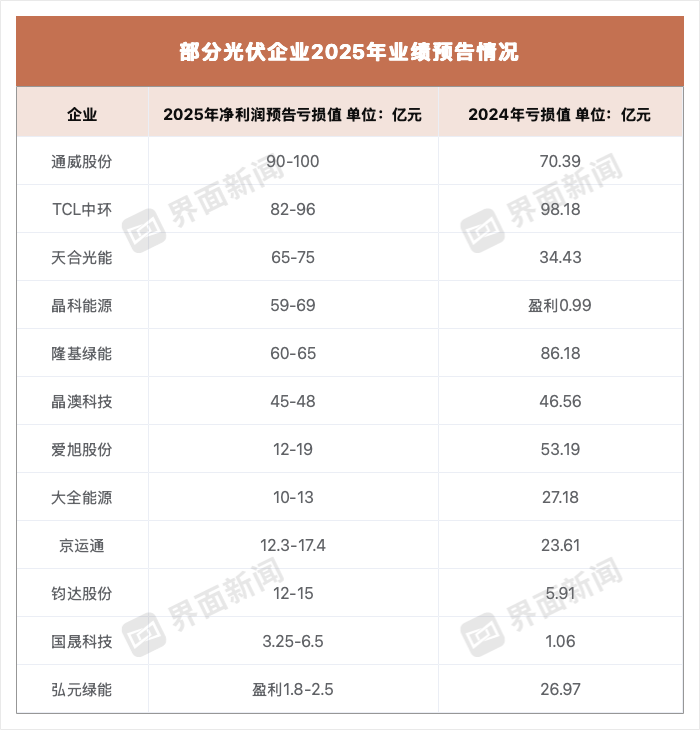
Core Viewpoint - The photovoltaic industry continues to face significant challenges, with major companies reporting substantial losses, totaling over 500 billion yuan, except for Hongyuan Green Energy, which is the only profitable entity among the analyzed firms [1][2]. Group 1: Financial Performance - Among 12 major photovoltaic companies, only Hongyuan Green Energy reported a profit, while the others collectively faced losses exceeding 500 billion yuan [1]. - Tongwei Co. is projected to incur the largest loss in 2025, estimated between 90-100 billion yuan, followed by TCL Zhonghuan and Trina Solar, with losses of 82-96 billion yuan and 65-75 billion yuan, respectively [2]. - JinkoSolar is expected to report a loss of 59-69 billion yuan for the previous year, while it anticipates a slight profit in 2024 [6][8]. Group 2: Cost Pressures - The rising prices of silver and silicon materials have significantly increased production costs for photovoltaic companies, with silver paste becoming a major cost component, accounting for approximately 17% of module costs [3][5]. - Silver prices have surged over 230% since the beginning of 2025, contributing to the financial strain on companies like Longi Green Energy and Trina Solar [5]. Group 3: Company Strategies and Developments - Longi Green Energy and TCL Zhonghuan have shown the most significant reduction in losses among leading firms, with Longi reducing its losses by nearly 20 billion yuan due to improved production yields and the development of alternative materials [10]. - Hongyuan Green Energy has successfully turned a profit, projecting a net profit of 1.8-2.5 billion yuan for 2025, attributed to its vertically integrated supply chain strategy [14][15]. - JinkoSolar and Trina Solar have both highlighted advancements in their energy storage businesses, indicating a potential area for growth despite current losses [8].

今日120只个股跨越牛熊分界线
Zheng Quan Shi Bao Wang· 2026-01-22 07:41
Core Viewpoint - The A-share market shows positive momentum with the Shanghai Composite Index closing at 4122.58 points, above the annual line, reflecting a slight increase of 0.14% [1] Group 1: Market Performance - The total trading volume of A-shares reached 27,165.07 billion yuan [1] - 120 A-shares have surpassed the annual line, indicating a bullish trend in the market [1] Group 2: Notable Stocks - Stocks with significant deviation rates include: - Teruisi (特瑞斯) with a deviation rate of 22.45% and a daily increase of 29.98% [1] - Qingyun Technology (青云科技) with a deviation rate of 17.76% and a daily increase of 20.00% [1] - Zhongbei Communication (中贝通信) with a deviation rate of 9.06% and a daily increase of 10.00% [1] - Other stocks with smaller deviation rates that have just crossed the annual line include: - Meiansen (梅安森) and Founder Securities (方正证券) [1]



“印钞机”变“碎钞机”,光伏集体巨亏
投中网· 2026-01-22 06:06
Core Viewpoint - The photovoltaic industry is undergoing a significant restructuring, with major companies expected to report substantial losses in 2025 due to overcapacity, price wars, and rising raw material costs [5][10][12]. Group 1: Industry Overview - Trina Solar forecasts a loss of 65-75 billion yuan for 2025, contributing to a total expected loss of over 600 billion yuan across the photovoltaic sector [5][10]. - The entire industry chain, from upstream silicon materials to downstream components, is experiencing collective losses, with the gross profit margin for polysilicon dropping to -6.30% in the first half of 2025, compared to 73% in 2022 [12][13]. - The price of silver has surged by 140% over two years, further compressing profits as component prices have fallen below cash cost levels [6][14][16]. Group 2: Key Indicators for Industry Restructuring - Analysts suggest monitoring three key indicators for the industry's clearing process: energy consumption, conversion efficiency, and profit margins [7][19]. - The industry is expected to enter a brutal elimination phase in 2026, focusing on energy efficiency, technology, and cost [8][18]. Group 3: Company Performance and Differentiation - Major companies like LONGi Green Energy and Tongwei Co. are projected to incur significant losses, but some are showing signs of reduced losses compared to previous years [21]. - TCL Zhonghuan is facing challenges due to high energy consumption and outdated production processes, leading to a decline in competitiveness [21][23]. - Companies are investing in new technologies, such as LONGi's focus on BC cell technology and Tongwei's optimization of silicon material costs, to prepare for the upcoming technological competition in 2026 [25].


大全能源跌3.54% 某券商在其历史大顶给跑赢行业评级
Zhong Guo Jing Ji Wang· 2026-01-20 08:45
Group 1 - Daqo Energy (688303.SH) closed at 24.50 yuan, with a decline of 3.54% [1] - The stock price of Daqo Energy reached a historical high of 96.00 yuan on August 30, 2021 [1] - A brokerage firm issued a report on September 1, 2021, rating Daqo Energy as outperforming the industry [1]
去年中国GDP增长5%,多家手机厂商下调出货预期 | 财经日日评
吴晓波频道· 2026-01-20 00:30
Economic Overview - In 2025, China's GDP reached 1401879 billion yuan, growing by 5% year-on-year, with quarterly growth rates of 5.4%, 5.2%, 4.8%, and 4.5% respectively [2] - The industrial added value increased by 5.9%, while the service sector grew by 5.4%. Retail sales totaled 501202 billion yuan, up by 3.7% [2] - Fixed asset investment decreased by 3.8%, with a notable decline in real estate investment [3] Trade and Investment - Canada has reduced the import tax on Chinese electric vehicles to 6.1%, allowing an annual quota of 49,000 vehicles, which is a significant policy shift aimed at filling market gaps [4][5] - The adjustment in tariffs is expected to enhance the competitiveness of Chinese electric vehicles in the Canadian market, which has seen a decline in sales due to high costs and tariffs [5] Real Estate Market - In December 2025, new home prices in first-tier cities fell by 0.3%, with a notable increase in Shanghai, while overall new home sales area decreased by 8.7% year-on-year [6] - The real estate market is still in a bottoming phase, with a significant reduction in new supply and ongoing inventory pressure [7] Mobile Phone Industry - Several smartphone manufacturers, including Xiaomi and OPPO, have lowered their annual shipment forecasts due to rising storage costs, with reductions exceeding 20% for some brands [8] - The impact of rising storage prices is uneven across manufacturers, with larger firms like Apple and Samsung less affected [9] Solar Industry - Nine leading solar companies, including LONGi Green Energy and Tongwei Co., have announced expected losses for 2025, with Tongwei projecting a loss of 90 to 100 billion yuan [10] - The solar industry is facing significant challenges, including high inventory levels and price competition, leading to a prolonged period of losses [11] Wealth Disparity - The global wealth of billionaires reached a record 18.3 trillion USD in 2025, with a 16% increase in total wealth, highlighting a growing wealth gap amid stagnant poverty reduction efforts [12][13] - The AI sector's growth has significantly contributed to the increase in billionaire wealth, while ordinary residents face declining purchasing power due to inflation [13] Space Tourism - A startup has announced the opening of reservations for the world's first lunar hotel, aiming to begin operations by 2032, although the feasibility of such a project remains uncertain [14][15]


超300份预告折射产业冷暖,业绩驱动取代概念博弈成市场主线
第一财经网· 2026-01-19 10:13
Core Viewpoint - The A-share market is experiencing a clear divergence in industry performance as over 350 companies have released their 2025 earnings forecasts, highlighting strong growth in the semiconductor and non-ferrous metals sectors, while the photovoltaic industry faces significant losses due to overcapacity and price competition [1] Semiconductor Industry - The semiconductor sector is benefiting from the global AI infrastructure wave and rising storage chip prices, with leading companies like 澜起科技 (Lianqi Technology) forecasting a net profit of 2.15 billion to 2.35 billion yuan for 2025, representing a year-on-year growth of 52.29% to 66.46% [2] - 佰维存储 (Baiwei Storage) expects to achieve record revenue of 10 billion to 12 billion yuan, with a net profit forecast of 850 million to 1 billion yuan, reflecting a staggering year-on-year growth of 427.19% to 520.22% [2] Photovoltaic Industry - The photovoltaic sector is struggling with overcapacity, low prices, and rising raw material costs, leading to significant losses among leading companies. 通威股份 (Tongwei Co.) anticipates a net loss of 9 billion to 10 billion yuan, while TCL中环 (TCL Zhonghuan) expects a loss of 8.2 billion to 9.6 billion yuan [3] - The total projected losses for major photovoltaic companies have exceeded 32 billion yuan, with several firms reporting substantial deficits [3] Real Estate Industry - The real estate sector is also under pressure, with companies like 华夏幸福 (China Fortune Land Development) forecasting a net loss of 16 billion to 24 billion yuan, attributed to insufficient market demand and weak social expectations [4] Non-Ferrous Metals Industry - The non-ferrous metals sector has seen significant price increases, benefiting from global monetary easing and fiscal expansion, with companies reporting strong earnings growth. For instance, 紫金矿业 (Zijin Mining) expects a net profit of 51 billion to 52 billion yuan, a year-on-year increase of 59% to 62% [5][6] - The performance of the rare earth sector is also notable, with 北方稀土 (Northern Rare Earth) projecting a net profit of 2.176 billion to 2.356 billion yuan, reflecting a year-on-year growth of 116.67% to 134.60% [7] Concept Stocks and Emerging Industries - Emerging sectors like commercial aerospace and AI applications are facing challenges, with many companies reporting losses despite previous market enthusiasm. For example, 上海瀚讯 (Shanghai Hanxun) and 三维通信 (Sanwei Communication) are expected to incur losses in 2025 [8][9] - 中文在线 (Zhongwen Online) anticipates a net loss of 580 million to 700 million yuan, driven by high promotional costs in its overseas short drama business [9]