
Daqo Energy(688303)

Search documents
昨夜!黄金大跌,中概股下挫!美降息预期,悬了?
Zheng Quan Shi Bao· 2025-11-15 00:20
Market Overview - The majority of European and American stock markets closed lower on November 14, with the Dow Jones Industrial Average down 0.65% at 47147.48 points, the S&P 500 down 0.05% at 6734.11 points, and the Nasdaq up 0.13% at 22900.59 points [1][2] - For the week, the Dow Jones increased by 0.34%, the S&P 500 by 0.08%, while the Nasdaq decreased by 0.45% [1] Chinese Concept Stocks - The Nasdaq China Golden Dragon Index fell by 1.61%, while the Wind Chinese Concept Technology Leaders Index dropped by 2.28% [2] - Popular Chinese concept stocks mostly declined, with notable drops including Futu Holdings down over 7%, Gaotu Group down over 5%, and Xpeng Motors down over 5% [4] Oracle Corporation - Oracle's stock fell nearly 7% this week, reflecting growing concerns over AI themes and high valuations in tech stocks [5] - The company has committed to investing thousands of billions in chip purchases and data center construction to fulfill agreements with OpenAI, leading to a nearly 30% drop in stock price over the past month [5][6] - Barclays downgraded Oracle's debt rating to "underweight," warning that its credit rating could fall to BBB-, just above junk status, and highlighted the risk of exhausting cash reserves by November 2026 [6][7] Federal Reserve and Interest Rates - Market expectations for a rate cut by the Federal Reserve in December have decreased significantly, with the probability dropping from 67% to below 50% [8] - Kansas City Fed President Jeff Schmieding expressed concerns that further rate cuts could entrench high inflation rather than support the labor market [8] Commodity Prices - International gold prices fell over 2%, with COMEX gold futures down 2.62% to $4084.4 per ounce, while silver futures dropped 5.21% to $50.4 per ounce [9] - The decline in gold prices is attributed to reduced optimism regarding Fed rate cuts, as rising interest rates diminish the appeal of non-yielding assets like gold [9] - Crude oil prices saw an increase, with West Texas Intermediate rising 2.15% to $59.95 per barrel, influenced by geopolitical tensions [9]







新能源行业25Q1-3财务费用总结:光伏反内卷稍见成效,风电毛利率已企稳回升
Soochow Securities· 2025-11-14 10:22
Investment Rating - The report indicates a positive outlook for the photovoltaic sector, with signs of recovery in profitability and stable growth in the wind power sector [1][5]. Core Insights - The renewable energy sector reported a revenue of 11,722 billion yuan for Q1-3 2025, a year-on-year decrease of 1%, and a net profit of 242 billion yuan, down 19% year-on-year. In Q3 2025, revenue was 4,138 billion yuan, up 2% year-on-year, and net profit was 118 billion yuan, up 41% year-on-year [2][7]. - The photovoltaic segment experienced a significant reduction in losses, with Q3 2025 revenue at 2,315 billion yuan, down 8% year-on-year, but net profit surged to 28.4 billion yuan, a year-on-year increase of 1,495% [2][37]. - The wind power segment showed robust growth, with Q3 2025 revenue of 1,135 billion yuan, up 22% year-on-year, and net profit of 50 billion yuan, up 33% year-on-year [2][16]. Summary by Sections Revenue and Profitability - The renewable energy sector's revenue for Q1-3 2025 was 11,722 billion yuan, with a net profit of 242 billion yuan. Q3 2025 saw a revenue of 4,138 billion yuan and a net profit of 118 billion yuan, marking a significant recovery [2][15]. - The photovoltaic sector's revenue for Q1-3 2025 was 6,640 billion yuan, with a net loss of 43 billion yuan. In Q3 2025, revenue was 2,315 billion yuan, and net profit was 28.4 billion yuan, indicating a strong recovery [2][37]. Segment Performance - The photovoltaic segment's Q3 2025 performance showed a revenue decline of 8% year-on-year but a remarkable net profit increase of 1,495%. The wind power segment continued to grow, with a 22% revenue increase year-on-year [2][16][37]. - The report highlights that the profitability of the wind power segment is improving, with a notable increase in gross margins due to price adjustments and operational efficiencies [2][16]. Market Trends - The report notes a gradual recovery in demand for household energy storage, with significant growth expected in commercial and large-scale storage solutions. The anticipated installation capacity for 2025 is around 150 GWh, representing a year-on-year increase of over 40% [2][6]. - The photovoltaic industry is undergoing a restructuring process, with upstream profitability recovering as prices for silicon materials rise. This trend is expected to continue into 2026, leading to a reshaped industry ecosystem [2][6]. Recommendations - The report recommends focusing on high-growth areas such as inverters and mounting systems, as well as leading photovoltaic companies with cost advantages and strong distribution channels [2][6].




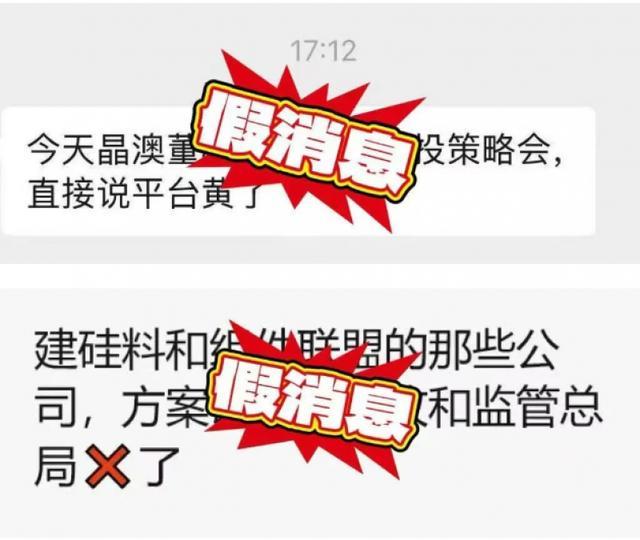
“平台黄了”传言震动光伏板块 晶澳科技、光伏协会紧急发文辟谣
Zhong Guo Jing Ying Bao· 2025-11-13 03:23
Group 1 - The core viewpoint of the articles revolves around the recent rumors regarding the photovoltaic industry, which led to a significant decline in stock prices of major companies in the sector, with some experiencing a drop of over 5% in a single day [1] - The rumors included claims about a company secretary stating that certain industry self-regulation initiatives were failing, raising concerns about the progress of self-regulatory mechanisms within the photovoltaic industry [1] - In response to the rumors, major companies like JA Solar issued urgent clarifications, denying the statements attributed to them and emphasizing the importance of relying on official channels for accurate information [1] Group 2 - The photovoltaic industry has faced significant losses over the past two years due to supply-demand mismatches and low-price competition, prompting a "anti-involution" initiative that began in the second half of 2024 [2] - The initiative includes measures such as production cuts and price controls to ensure that prices do not fall below production costs, with a focus on the upstream polysilicon segment, which is critical for the overall supply-demand balance [2] - Despite some leading polysilicon companies like GCL-Poly and Daqo Energy achieving profitability by Q3 2025, many downstream companies in the silicon wafer, cell, and module sectors continue to report losses [2]






大全能源涨2.06%,成交额3.79亿元,主力资金净流出2141.65万元
Xin Lang Zheng Quan· 2025-11-13 02:45
Core Viewpoint - Daqo Energy's stock price has shown significant growth this year, with a year-to-date increase of 29.37%, reflecting strong market interest despite recent fluctuations in trading volume and net capital outflow [1][2]. Company Overview - Daqo Energy, established on February 22, 2011, and listed on July 22, 2021, is located in Shihezi City, Xinjiang, and specializes in the research, manufacturing, and sales of high-purity polysilicon [1]. - The company's main business revenue composition is 97.95% from high-purity polysilicon and 2.05% from by-products and others [1]. Financial Performance - For the period from January to September 2025, Daqo Energy reported an operating income of 3.243 billion yuan, a year-on-year decrease of 46.00%, and a net profit attributable to shareholders of -1.073 billion yuan, an increase of 2.36% year-on-year [2]. - Cumulatively, Daqo Energy has distributed 9.743 billion yuan in dividends since its A-share listing, with 8.588 billion yuan distributed over the past three years [3]. Shareholder Structure - As of September 30, 2025, Daqo Energy had 40,000 shareholders, an increase of 14.07% from the previous period, with an average of 53,635 circulating shares per shareholder, up 240.25% [2]. - The top ten circulating shareholders include major ETFs, with notable reductions in holdings for several funds, indicating potential shifts in institutional investment [3].

光伏“反内卷”遇到了“鬼故事”
虎嗅APP· 2025-11-12 13:33
Core Viewpoint - The article discusses the recent turmoil in the photovoltaic (PV) industry due to rumors about the failure of anti-involution policies, which led to significant stock declines. However, the industry association's clarification has stabilized the market, highlighting the determination to combat unhealthy competition and restore value in the sector [3][4][17]. Group 1: Industry Context - The term "involution" has become synonymous with the PV industry in 2023, characterized by homogenized expansion, price wars, and inefficient competition amid slowing installation demand [7]. - The capital market's reaction is evident, with the PV ETF experiencing a dramatic decline of 68.39%, reflecting the industry's struggles and the negative sentiment surrounding it [8]. - The anti-involution initiative began planning in May 2024, officially launching in October 2024, with policies aimed at curbing unhealthy competition and restoring market balance [9][10]. Group 2: Policy Measures - Current policies focus on "price protection" and "volume control," aiming to eliminate below-cost sales and facilitate the exit of outdated production capacities [10]. - Initial results of the price protection measures show significant price increases in key materials: silicon materials up 33.33%, silicon wafers up 17.39%, batteries up 8.92%, and modules up 2.45% [11]. - The silicon material segment is crucial for reversing the industry's overcapacity, as it has the least production elasticity and is capital-intensive, making it difficult to restart production once halted [12][13]. Group 3: Market Recovery - The anti-involution actions have led to expectations of rapid capacity reduction in the silicon material sector, which is essential for improving the overall PV industry landscape [17]. - The establishment of a joint storage platform for silicon material by multiple companies is anticipated to facilitate the exit of smaller players and further stabilize the market [16]. Group 4: Asset Revaluation - The article posits that the anti-involution policies will drive a revaluation of PV assets, transitioning the industry from scale expansion to quality competition [20]. - Companies like Tongwei, TCL Zhonghuan, and Longi Green Energy are showing signs of recovery, with some reporting improved quarterly performance despite still being in the red [22]. - The focus on technological advancements, such as perovskite solar cells, is seen as a pathway for companies to differentiate themselves and enhance their market value [24][25].



光伏“反内卷”遇到了“鬼故事”
Hu Xiu· 2025-11-12 12:49
Core Viewpoint - The recent rumors regarding the failure of the "anti-involution" policy in the photovoltaic industry led to significant stock declines, but subsequent clarifications from industry associations helped stabilize the market, indicating a strong commitment to reversing negative competition in the sector [1][5][18]. Group 1: Market Reaction - Following the spread of rumors, the photovoltaic sector experienced a sharp decline, with companies like Jingao Technology and Tongwei Co. seeing drops of 6.84% and 6.06% respectively [5]. - The China Photovoltaic Industry Association issued a statement to refute the rumors, emphasizing the importance of maintaining industry integrity and combating malicious market manipulation [1][5]. Group 2: Anti-Involution Policy - The term "involution" has become synonymous with the photovoltaic industry since 2023, characterized by homogenized expansion and price wars amid slowing installation demand [7]. - The core of the current policy focuses on "price protection" and "volume control," aiming to eliminate below-cost sales and facilitate the exit of outdated production capacities to restore market balance [9][10]. Group 3: Price Recovery - Initial results from the price protection measures show positive trends, with significant price increases in key materials: silicon materials up 33.33%, silicon wafers up 17.39%, and battery cells up 8.92% [10]. - The recovery of prices is expected to improve profitability for companies, laying a solid foundation for valuation increases [20]. Group 4: Capacity Control - The silicon material segment is crucial for addressing overcapacity issues, as it has the least production flexibility and is capital-intensive [11][12]. - Companies are beginning to implement production and sales controls, with expectations to limit annual output to 1.4 million tons, aligning with earlier targets [14]. Group 5: Asset Revaluation - The anti-involution policies are transitioning from expectation to substantial implementation, driving the revaluation of assets in the photovoltaic sector [18][19]. - Companies like Tongwei Co., GCL-Poly Energy, and Daqo New Energy are expected to attract market attention as they benefit from reduced silicon material production and subsequent price increases [22]. Group 6: Technological Advancements - The Ministry of Industry and Information Technology has initiated efforts to accelerate the development of advanced photovoltaic technologies, such as perovskite solar cells, which have the potential for higher efficiency compared to traditional silicon cells [23]. - Recent announcements from companies like GCL-Poly regarding the commercialization of perovskite technology indicate a shift towards innovative production methods, which could lead to significant market opportunities [24].
小作文传谣,光伏板块突然大跌!官方紧急辟谣
Zheng Quan Shi Bao· 2025-11-12 10:40
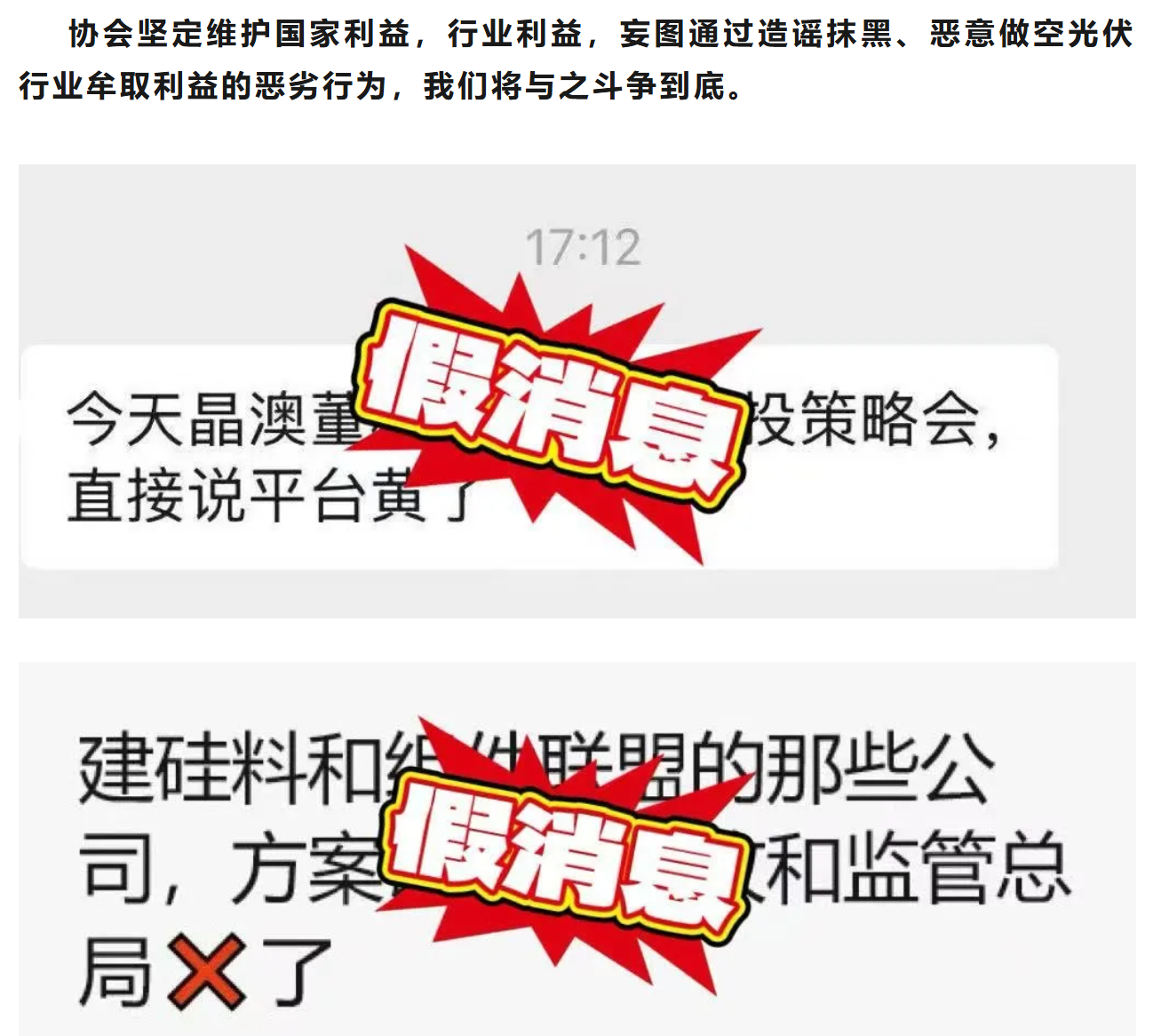
Group 1 - The China Photovoltaic Association issued a statement refuting rumors circulating online, emphasizing that the association and industry players are working steadily to maintain national and industry interests [1] - The association condemned malicious actions aimed at defaming the photovoltaic industry and stated their commitment to combat such behaviors [1] Group 2 - JinkoSolar's staff responded to media inquiries, clarifying that no executives claimed "the storage platform is failing," labeling the rumor as false [3] - The staff noted that JinkoSolar is not a participant in the storage platform and lacks detailed information on its implementation [3] - The photovoltaic sector experienced a significant decline, with leading companies like Longi Green Energy dropping over 7% and Canadian Solar falling over 14% [3]


硅料“收储”黄了?中国光伏行业协会紧急辟谣|快讯
Hua Xia Shi Bao· 2025-11-12 10:32
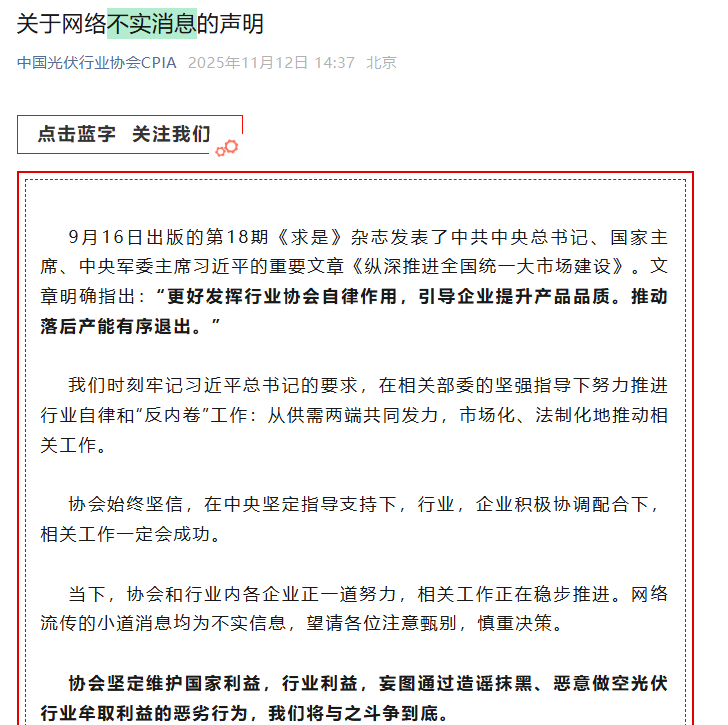
Core Viewpoint - Recent rumors regarding the failure of the silicon material storage platform have caused significant turmoil in the photovoltaic industry, leading to a sharp decline in the stock prices of various solar companies [3][4]. Group 1: Market Reaction - On November 12, stock prices of major photovoltaic companies dropped significantly, with notable declines including: - Aiko Technology down 14.33% - Tongwei Co. down 6.06% - Longi Green Energy down 7.35% - JA Solar down 6.84% - Daqo New Energy down 8.76% [3]. Group 2: Industry Response - The China Photovoltaic Industry Association issued a statement on November 12, refuting the rumors and emphasizing that the industry is working steadily towards its goals, urging caution against misinformation [4]. - JA Solar representatives expressed confidence in the photovoltaic industry's policies against "internal competition" and support for the establishment of the storage platform, while acknowledging the need for collaboration to overcome challenges [4].


大全能源(688303) - 大全能源2025年第一次临时股东大会决议公告
2025-11-12 10:30
证券代码:688303 证券简称:大全能源 公告编号:2025-049 本次会议是否有被否决议案:无 一、 会议召开和出席情况 (一) 股东大会召开的时间:2025 年 11 月 12 日 (二) 股东大会召开的地点:上海市浦东新区张杨路 838 号华都大厦 29 层 AJ 座会议室 (三) 出席会议的普通股股东、特别表决权股东、恢复表决权的优先股股东及 其持有表决权数量的情况: (四) 出席会议的普通股股东、特别表决权股东、恢复表决权的优先股股东及 其持有表决权数量的情况: 新疆大全新能源股份有限公司 2025年第一次临时股东大会决议公告 本公司董事会及全体董事保证公告内容不存在任何虚假记载、误导性陈述或 者重大遗漏,并对其内容的真实性、准确性和完整性依法承担法律责任。 重要内容提示: | 1、出席会议的股东和代理人人数 | 266 | | --- | --- | | 普通股股东人数 | 266 | | 2、出席会议的股东所持有的表决权数量 | 1,647,740,531 | | 普通股股东所持有表决权数量 | 1,647,740,531 | | 3、出席会议的股东所持有表决权数量占公司表决权数量的比 | ...
大全能源(688303) - 上海市方达律师事务所关于新疆大全新能源股份有限公司2025年第一次临时股东大会的法律意见书
2025-11-12 10:19
上海市方达律师事务所(以下简称"本所")是具有中华人民共和国境内法 律执业资格的律师事务所。根据相关法律顾问协议,本所指派律师出席新疆大全 新能源股份有限公司(以下简称"公司")2025 年第一次临时股东大会(以下简 称"本次股东大会"),并就本次股东大会的召集和召开程序、参与表决和召集 会议人员的资格、表决程序和表决结果等有关事宜出具本法律意见书。 FANGDA PARTNERS http://www.fangdalaw.com 中国上海市石门一路 288 号 电子邮件 E-mail: email@fangdalaw.com 兴业太古汇香港兴业中心二座 24 楼 电 话 Tel.: 86-21-2208-1166 邮政编码:200041 传 真 Fax: 86-21-5298-5599 24/F, HKRI Centre Two HKRI Taikoo Hui 288 Shi Men Yi Road Shanghai 200041, PRC 上海市方达律师事务所 关于新疆大全新能源股份有限公司 2025 年第一次临时股东大会的法律意见书 致:新疆大全新能源股份有限公司 本法律意见书依据《中华人民共和国公司法 ...