
MicroPort EP(688351)

Search documents
微电生理2025年业绩快报:营收增长12.43%,净利润微降1.76%
Jing Ji Guan Cha Wang· 2026-02-12 10:29
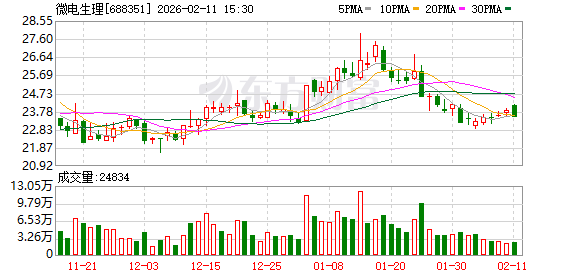
Group 1: Financial Performance - The company reported a total revenue of 464.53 million yuan for 2025, representing a year-on-year increase of 12.43% [1] - The net profit attributable to the parent company was 51.15 million yuan, showing a decline of 1.76% compared to the previous year [1] - The net profit excluding non-recurring gains and losses was 23.66 million yuan, significantly increasing compared to 2024 [1] - The growth in performance was primarily driven by overseas revenue, which increased by over 40% and accounted for more than 30% of total revenue [1] - In domestic operations, the usage of pressure monitoring radiofrequency ablation catheters increased by over 70%, contributing to the upgrade of high-end procedures [1] Group 2: Recent Events - The company announced on February 10, 2026, that its magnetic navigation ablation catheter and star-shaped high-density mapping catheter received EU Medical Device Regulation (MDR) certification, facilitating entry into the European market and enhancing its overseas technology matrix [2] - On February 11, 2026, the company disclosed that approximately 346 million shares of restricted stock will be released for trading on March 2, 2026, representing 73.47% of the total share capital, which may exert liquidity pressure on the stock price [2] Group 3: Stock Performance - The stock price experienced fluctuations, closing at 23.50 yuan on February 12, 2026, with a 7-day price change of 0.95% and a volatility of 4.64% [3] - The stock dropped by 1.43% on February 11, 2026, the day the earnings report was disclosed, with a trading volume of 58.88 million yuan [3] - On February 12, 2026, the net outflow of funds from major investors was 5.11 million yuan, while retail investor activity remained high [3] - The medical device sector declined by 0.83% during the same period, underperforming the broader market [3]

上海微创电生理医疗科技股份有限公司 2025年年度业绩快报
Zheng Quan Ri Bao· 2026-02-11 22:13
Financial Performance - In 2025, the company achieved total revenue of 464.53 million yuan, representing a year-on-year growth of 12.43% [2] - The net profit attributable to the parent company was 51.15 million yuan, a decrease of 1.76% compared to the previous year [2] - The net profit attributable to the parent company after deducting non-recurring gains and losses was 23.66 million yuan, significantly increasing from 5.08 million yuan in 2024 [2] - By the end of 2025, total assets reached 1,993.07 million yuan, an increase of 5.25% from the beginning of the reporting period [2] - The equity attributable to the parent company was 1,802.17 million yuan, up 3.47% from the beginning of the reporting period [2] Business Development - The company has deepened its overseas expansion, with overseas revenue growing by over 40%, accounting for more than 30% of total revenue, validating the effectiveness of its international strategy [3] - The high-end pressure monitoring radiofrequency ablation catheter has been commercialized in over 20 countries, and the cryoablation system has received EU certification, with successful applications in Germany, Turkey, and Greece [3] - The company actively participated in major international academic conferences, showcasing its "electric fire ice" solution, which has garnered significant industry attention and recognition [3] Domestic Market Focus - The company continues to focus on high-end surgical breakthroughs and product innovation, with a steady increase in three-dimensional surgical volumes [4] - The usage of pressure monitoring radiofrequency ablation catheters increased by over 70% year-on-year, accelerating the domestic replacement process of high-end electrophysiology devices [4] - In November 2025, the company launched the PulseMagic? TrueForce? disposable pressure monitoring cardiac pulsed electric field ablation catheter, becoming the first in China to feature saline infusion capabilities [4] Profitability Factors - The net profit attributable to the parent company increased by 365.73% year-on-year, primarily due to revenue growth and cost reduction efforts [5]
今日晚间重要公告抢先看——紫光股份:拟定增募资用于收购新华三6.98%股权等;中微半导:拟在四川资阳建设IPM产线项目
Jin Rong Jie· 2026-02-11 13:57
Group 1: Major Announcements - Unisplendour plans to raise no more than 5.57 billion yuan through a private placement to acquire a 6.98% stake in New H3C and for other projects [2] - Zhongwei Semiconductor intends to establish an IPM production line project in Ziyang, Sichuan, using 1.21 billion yuan of leftover IPO funds [2] - Kaiying Network has signed a settlement agreement with Legend IP, which is expected to positively impact the company's profit by approximately 200 million yuan [2] Group 2: Project Developments - Blue Ocean Huaten plans to invest 8 million yuan in Wanren Technology to support its daily operations and AI project development [4] - Yuedian Power A has successfully put into operation the expansion project of the Huizhou Power Plant, which includes two 1000MW units [7] - Longmag Technology intends to raise up to 760 million yuan for its second phase project in Vietnam and chip inductor manufacturing [8] Group 3: Financial Performance - Top Group expects a net profit of 2.6 billion to 2.9 billion yuan for 2025, a decrease of 3.35% to 13.35% year-on-year due to rising raw material costs and increased market competition [20] - Jingchen Technology reported a net profit of 871 million yuan for 2025, a 6% increase year-on-year, with record high sales of over 174 million chips [21] - Guodian Xintong's net profit for 2025 is projected at 678 million yuan, a decline of 16.91% year-on-year, primarily due to increased credit impairment losses and tax expenses [22] Group 4: Shareholder Actions - Jieshun Technology's actual controller plans to reduce holdings by up to 2.8% of the company's shares [27] - Lihexing's controlling shareholder and concerted actors plan to collectively reduce their holdings by up to 1% [27] - Kory Technology's shareholders plan to reduce their holdings by a total of up to 3.13% [29] Group 5: Stock Buybacks - Quzhou Dongfeng plans to repurchase shares worth between 50 million and 100 million yuan, with a maximum price of 6.48 yuan per share [30]





微电生理2025年净利5115.17万元,同比下降1.76%
Bei Jing Shang Bao· 2026-02-11 13:20
Core Viewpoint - Microelectrophysiology (688351) reported a revenue of 465 million yuan for the year 2025, reflecting a year-on-year growth of 12.43%, while net profit attributable to shareholders decreased by 1.76% to 51.15 million yuan [1] Group 1: Financial Performance - The company achieved an operating income of 465 million yuan in 2025, which is a 12.43% increase compared to the previous year [1] - The net profit attributable to shareholders for 2025 was 51.15 million yuan, showing a decline of 1.76% year-on-year [1] Group 2: International Strategy - The company's overseas revenue grew by over 40% in 2025, indicating successful implementation of its internationalization strategy [1] - International revenue now accounts for more than 30% of total revenue, highlighting the company's competitive advantages in technology, products, and services [1]
微电生理:2025年年度业绩快报
Zheng Quan Ri Bao· 2026-02-11 11:09
Group 1 - The core viewpoint of the article is that Microelectrophysiology announced its projected financial performance for 2025, indicating a positive growth trajectory in revenue and net profit [2] - The company expects to achieve an operating revenue of 464.53 million yuan in 2025, representing a year-on-year growth of 12.43% [2] - The net profit attributable to the parent company is projected to be 51.15 million yuan [2]

晚间公告|2月11日这些公告有看头
Di Yi Cai Jing· 2026-02-11 10:25
Group 1 - Unisplendour Corporation has decided to terminate its plan to issue H-shares and list on the Hong Kong Stock Exchange due to strategic development considerations [2] - Yuandong Biotech is participating in a follow-up procurement for 13 products, with expected sales revenue of approximately 651 million yuan in 2024, accounting for 48.25% of total revenue [3] - Blue Lithium has terminated its participation in the GreenMei Indonesia project due to strategic adjustments by GreenMei, with no significant impact on its operations [4] Group 2 - Jinhaitong plans to invest up to 400 million yuan in the construction of a semiconductor equipment manufacturing center in Shanghai, covering an area of 55,000 square meters [5] - Kaiying Network's subsidiary has signed a settlement agreement with Legend IP, which is expected to positively impact profits by approximately 200 million yuan [6] - Newray plans to acquire 70% of PCB tool company Huilian Electronics for no more than 700 million yuan, enhancing its market position in the PCB tool sector [7] Group 3 - Longbai Group intends to acquire a 5.46% stake in Yunnan Guotai for 234 million yuan [8] - Dawi Technology's Zhangbei data center project is set to be completed by October 2025, primarily providing customized standard data center environments [9] Group 4 - Guobang Electronics reported a net profit of 508 million yuan for 2025, a year-on-year increase of 4.72%, despite a revenue decline of 7.92% [11] - Daotong Technology achieved a net profit of 935 million yuan in 2025, reflecting a significant year-on-year growth of 45.89% [12] - Jingchen Co. reported a net profit of 871 million yuan for 2025, with a growth of 6% year-on-year [13] Group 5 - Qizhou Dongfeng plans to repurchase shares worth between 50 million and 100 million yuan to implement an employee stock ownership plan [17] - Keri Technology's shareholders plan to reduce their holdings by a total of up to 3.13% of the company's shares [19] Group 6 - Roman Co. signed a 260 million yuan contract for a wind power project, with the company’s share of the contract amounting to approximately 190 million yuan [21] - Zhongke Haixun is expected to win projects totaling approximately 288 million yuan [22] - Shan Jian Co. won four construction projects with a total value of 4.834 billion yuan [23]



微电生理2025年度归母净利润5115.17万元 同比下降1.76%
Zhi Tong Cai Jing· 2026-02-11 08:48
Core Viewpoint - The company reported a total revenue of 465 million yuan for the year 2025, marking a year-on-year increase of 12.43%, while the net profit attributable to the parent company decreased by 1.76% to 51.15 million yuan [1] Group 1: International Expansion - The company has deepened its overseas layout, achieving significant results in business development, with overseas revenue growing by over 40% year-on-year, now accounting for more than 30% of total revenue [1] - The high-end pressure monitoring radiofrequency ablation catheter has been commercialized in over 20 countries, and the cryoablation system has successfully obtained EU certification, with commercial applications in Germany, Turkey, and Greece [1] - The company actively participated in major international academic conferences, showcasing its "electric fire ice" comprehensive solution, which has gained widespread attention and recognition in the industry [1] Group 2: Domestic Business and Product Innovation - The company continues to focus on breakthroughs in high-end procedures and product innovation, with the usage of pressure monitoring radiofrequency ablation catheters increasing by over 70% year-on-year [2] - The company remains a leader in industry technology, with the approval of the PulseMagic TrueForce disposable pressure monitoring cardiac pulsed electric field ablation catheter, which is the first in China to feature a saline infusion function [2] - The collaboration with the affiliated company, Shangyang Medical, on the PulseMagic Spiral catheter is expected to create a complete product matrix in the pulsed ablation field, playing a key role in the iteration of cardiac electrophysiology technology and domestic replacement [2]
微电生理(688351.SH)2025年度归母净利润5115.17万元 同比下降1.76%
智通财经网· 2026-02-11 08:45
Core Viewpoint - The company reported a total revenue of 465 million yuan for the fiscal year 2025, marking a year-on-year increase of 12.43%, while the net profit attributable to the parent company decreased by 1.76% to 51.15 million yuan [1] Group 1: International Expansion - The company has deepened its overseas layout, achieving significant results with overseas revenue growing by over 40% year-on-year, now accounting for more than 30% of total revenue, validating the effectiveness of its international strategy [1] - The high-end pressure monitoring radiofrequency ablation catheter has been commercialized in over 20 countries, and the cryoablation system has successfully obtained EU certification, with commercial applications in Germany, Turkey, Greece, and other countries, receiving positive clinical feedback [1] - The company actively participated in major international academic conferences, showcasing its "electric fire ice" comprehensive solution through high-quality live surgeries and discussions, gaining widespread attention and recognition in the industry [1] Group 2: Domestic Business and Product Innovation - The company continues to focus on breakthroughs in high-end procedures and product innovation, with the volume of three-dimensional surgeries steadily increasing, and the usage of pressure monitoring radiofrequency ablation catheters rising by over 70% year-on-year [2] - The company remains a leader in industry technology, with its self-developed PulseMagic™ TrueForce® disposable pressure monitoring cardiac pulsed electric field ablation catheter approved for market launch in November 2025, becoming the first in China equipped with saline infusion functionality [2] - The collaboration with the affiliated company, Shangyang Medical, which previously received approval for the PulseMagic™ Spiral disposable magnetic electric positioning cardiac pulsed electric field ablation catheter, forms a strong synergy, establishing a complete product matrix in the field of pulsed ablation [2]
微电生理:2025年年度净利润5115.17万元
Mei Ri Jing Ji Xin Wen· 2026-02-11 08:26
Group 1 - The core viewpoint of the article highlights the financial performance of Microelectronic Physiology, which reported an operating income of approximately 465 million yuan for the year 2025, representing a year-on-year increase of 12.43% [1] - The net profit attributable to shareholders of the listed company was 51.15 million yuan, showing a slight decrease of 1.76% compared to the previous year [1] - The basic earnings per share were reported at 0.1087 yuan, which is a decrease of 1.72% year-on-year [1] Group 2 - The article also mentions a significant development in the video generation technology sector, where a new Chinese video model is capable of producing 15-second videos for commercial delivery using just a few prompt words, leading to a surge in related film and television stocks [1]
微电生理(688351) - 2025 Q4 - 年度业绩
2026-02-11 08:25
Financial Performance - The total operating revenue for 2025 reached CNY 464.53 million, representing a year-on-year increase of 12.43%[2] - The net profit attributable to the parent company was CNY 51.15 million, a decrease of 1.76% compared to the previous year[2] - The net profit attributable to the parent company after deducting non-recurring gains and losses surged by 365.73% to CNY 23.66 million from CNY 5.08 million in 2024[2][10] - Total assets at the end of 2025 amounted to CNY 1,993.07 million, reflecting a growth of 5.25% from the beginning of the period[6] - The equity attributable to the parent company increased by 3.47% to CNY 1,802.17 million[6] International Expansion - The company achieved over 40% growth in overseas revenue, which now accounts for more than 30% of total revenue, validating its internationalization strategy[7] - The high-end pressure monitoring RF ablation catheter has been commercialized in over 20 countries, and the cryoablation system has received EU certification[7] Product Innovation - The company launched the PulseMagic™ TrueForce® disposable pressure monitoring cardiac pulsed electric field ablation catheter, marking a significant innovation in the domestic market[8] - The usage of pressure monitoring RF ablation catheters increased by over 70% year-on-year, indicating a shift towards more complex procedures[8] - The company emphasizes continuous product innovation and brand building to enhance competitiveness in overseas markets[7]