Bloomage Biotech(688363)

Search documents
2万一支的童颜针,爱美客的新摇钱树?
和讯· 2025-08-22 10:56
Core Viewpoint - The domestic medical beauty industry is undergoing significant changes, with major players experiencing a decline in performance due to market shifts and increased competition from new regenerative materials like collagen and "童颜针" (youthful needle) [4][7][14]. Group 1: Industry Performance - The three major companies in the medical beauty sector, including 华熙生物, 爱美客, and 昊海生科, reported substantial declines in revenue and net profit, with 爱美客's revenue dropping by 21.59% to 12.99 billion yuan and net profit decreasing by 29.57% to 7.89 billion yuan in the first half of 2024 [7][8]. - 爱美客's core products, including "嗨体" and "濡白天使," saw revenue declines of 23.79% and 23.99%, respectively, despite maintaining high gross margins of over 90% [6][7]. Group 2: Market Trends - The introduction of "童颜针," particularly the imported product 艾塑菲, has gained rapid popularity, with sales reaching 20,000 units and contributing over 800 million yuan in revenue within two months of its launch [5][17]. - The shift towards regenerative materials is evident, as "童颜针" offers longer-lasting effects and a different mechanism compared to traditional hyaluronic acid fillers, which are facing price declines due to increased competition [16][17]. Group 3: Strategic Moves - 爱美客's acquisition of REGEN, a Korean medical beauty company, for 1.386 billion yuan marks the largest cross-border acquisition in the domestic medical beauty industry, aiming to enhance its product portfolio and market presence [5][9]. - The ongoing dispute between 江苏吴中 and 爱美客 over the distribution rights of 艾塑菲 highlights the competitive landscape and the challenges of dependency on agency models in the medical beauty sector [19][20]. Group 4: R&D and Innovation - 爱美客 has increased its R&D investment to 1.57 billion yuan, representing 12.05% of its revenue, indicating a focus on enhancing its competitive edge through innovation [8]. - The company holds 182 valid patents, including 53 invention patents, showcasing its commitment to developing proprietary technologies [8].


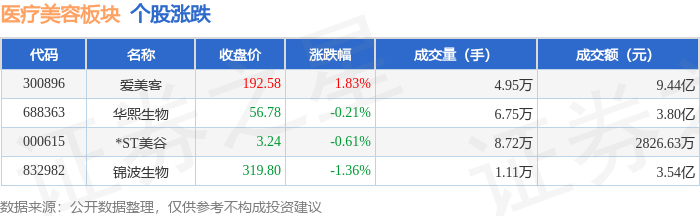
医疗美容板块8月22日涨0.94%,爱美客领涨,主力资金净流出1537.43万元
Zheng Xing Xing Ye Ri Bao· 2025-08-22 08:46
证券之星消息,8月22日医疗美容板块较上一交易日上涨0.94%,爱美客领涨。当日上证指数报收于 3825.76,上涨1.45%。深证成指报收于12166.06,上涨2.07%。医疗美容板块个股涨跌见下表: 从资金流向上来看,当日医疗美容板块主力资金净流出1537.43万元,游资资金净流入1006.26万元,散 户资金净流入531.18万元。医疗美容板块个股资金流向见下表: 以上内容为证券之星据公开信息整理,由AI算法生成(网信算备310104345710301240019号),不构成投资建议。 | 代码 | 名称 | 收盘价 | 涨跌幅 | 成交量(手) | 成交额(元) | | --- | --- | --- | --- | --- | --- | | 300896 | 爱美客 | 192.58 | 1.83% | 4.95万 | 9.44 G | | 688363 | 华熙生物 | 56.78 | -0.21% | 6.75万 | 3.80 Z | | 000615 | *ST美谷 | 3.24 | -0.61% | 8.72万 | 2826.63万 | | 832982 | 锦波生物 | 319.80 ...
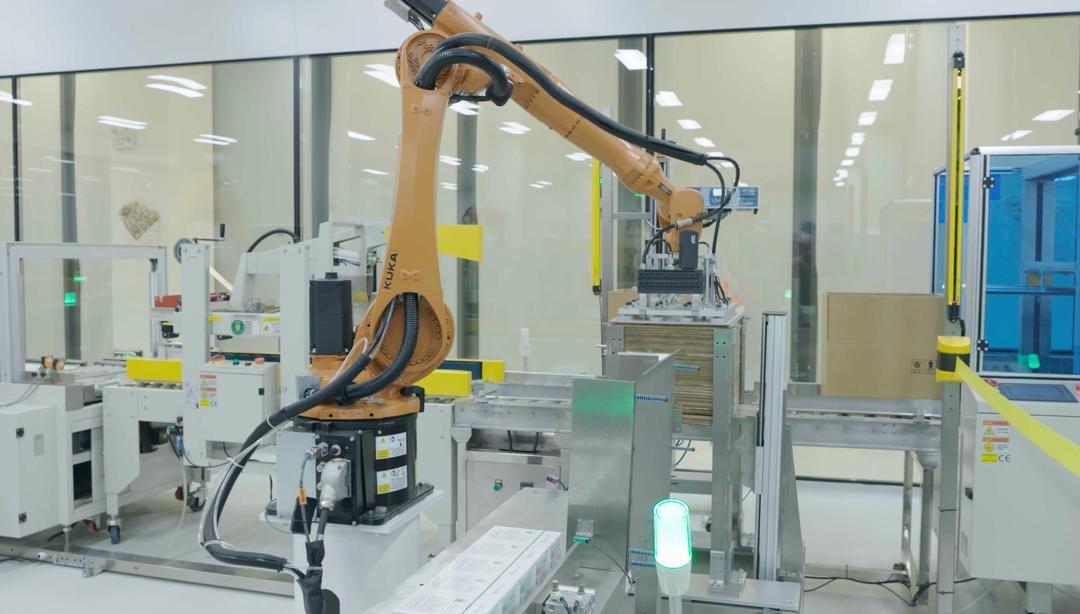
华熙生物:让“液体黄金”走进生活日常
Da Zhong Ri Bao· 2025-08-21 23:34
Core Viewpoint - The article highlights the advancements and innovations in the production and application of hyaluronic acid by Huaxi Biological Technology Co., Ltd., showcasing its transition from a high-cost medical ingredient to a widely used component in various consumer products through technological breakthroughs [1][2][3]. Group 1: Technological Innovations - Huaxi Biological achieved a 90% reduction in production costs of hyaluronic acid through microbial fermentation, breaking international monopolies and enabling industrial-scale production [3]. - The introduction of enzyme cutting technology in 2011 allowed for precise control of molecular weight, leading to the development of products with different functionalities and earning national recognition [3]. - The adoption of synthetic biology technology in 2020 further enhanced production efficiency by three times and enabled zero-carbon production [3][5]. Group 2: Industry Position and Market Demand - Huaxi Biological has established a complete industrial chain from raw material development to end-user applications, positioning itself as a leader in the global hyaluronic acid market [5][7]. - The company has diversified its product offerings across four main business segments: raw materials, pharmaceuticals, skincare products, and functional foods, which collectively support its growth [7]. - The inclusion of sodium hyaluronate in the new food raw material directory by the National Health Commission in 2021 has spurred the development of new products like "Water Muscle Spring" hyaluronic acid drinking water [7]. Group 3: Global Expansion and Brand Development - Huaxi Biological is leveraging its innovative strategies to penetrate international markets, enhancing product competitiveness and brand recognition [7][8]. - The company is not only selling raw materials but also exporting standards and expanding its market presence in regions like Europe, Japan, and the United States [7]. - The growing global demand for health and wellness products, driven by aging populations, is facilitating the expansion of hyaluronic acid applications in everyday life [7][8].
医疗美容板块8月21日涨1.37%,锦波生物领涨,主力资金净流入45.74万元
Zheng Xing Xing Ye Ri Bao· 2025-08-21 08:38
Group 1 - The medical beauty sector increased by 1.37% on August 21, with Jinbo Biological leading the gains [1] - The Shanghai Composite Index closed at 3771.1, up 0.13%, while the Shenzhen Component Index closed at 11919.76, down 0.06% [1] Group 2 - The medical beauty sector saw a net inflow of 457,400 yuan from main funds, while retail investors experienced a net outflow of 859,410 yuan [2] - Specific stock performances included Huaxi Biological with a net inflow of 7,907,300 yuan, while *ST Meigu and Aimeike had net outflows of 3,103,300 yuan and 4,346,600 yuan respectively [2]

美容护理概念股震荡拉升 洁雅股份涨超10%


Xin Lang Cai Jing· 2025-08-21 02:29
Group 1 - The beauty and personal care concept stocks experienced significant fluctuations, with Jieya Co., Ltd. and Shuiyang Co., Ltd. rising over 10% [1] - Huaye Fragrance and Huaxi Biotechnology increased by more than 5% [1] - Lafang Home Products, Jinbo Biotechnology, and Zhongshun Jierou saw gains of over 3% [1]
重组蛋白概念下跌0.85%,主力资金净流出39股
Zheng Quan Shi Bao Wang· 2025-08-20 09:02
Group 1 - The restructuring protein concept declined by 0.85%, ranking among the top declines in the concept sector, with leading decliners including Beida Pharmaceutical, Saiseng Pharmaceutical, and Rejing Bio [1][2] - Among the 39 stocks in the restructuring protein sector, 18 stocks saw price increases, with Zhongyuan Qihua, Huaxi Bio, and *ST Wanfang leading the gains at 3.27%, 2.53%, and 2.23% respectively [1][2] - The restructuring protein sector experienced a net outflow of 789 million yuan from main funds today, with Shenzhou Cell seeing the largest outflow of 75.26 million yuan [2][3] Group 2 - The top gainers in the concept sector included Tonghuashun Fruit Index at 3.70%, AI Mobile at 2.77%, and National Big Fund Holdings at 2.76%, while the monkeypox concept declined by 0.86% [2] - The main funds saw net inflows in stocks such as Huaxi Bio, Guoyao Modern, and Haoyuan Pharmaceutical, with inflows of 47.54 million yuan, 21.85 million yuan, and 20.45 million yuan respectively [2][4] - The restructuring protein concept's outflow list included stocks like Shenzhou Cell, Ruizhi Pharmaceutical, and Kexing Pharmaceutical, with respective outflows of 75.26 million yuan, 70.92 million yuan, and 65.90 million yuan [2][3]


医疗美容板块8月20日涨3.29%,爱美客领涨,主力资金净流入7610.08万元
Zheng Xing Xing Ye Ri Bao· 2025-08-20 08:52
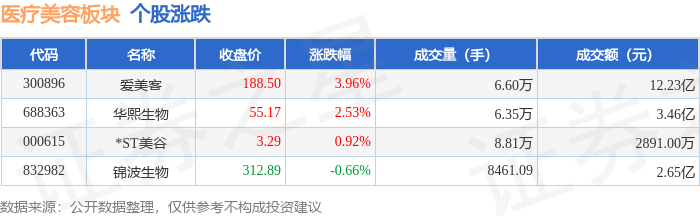
Market Performance - The medical beauty sector increased by 3.29% on August 20, with Ai Meike leading the gains [1] - The Shanghai Composite Index closed at 3766.21, up 1.04%, while the Shenzhen Component Index closed at 11926.74, up 0.89% [1] Individual Stock Performance - Ai Meike (300896) closed at 188.50, with a rise of 3.96% and a trading volume of 66,000 shares [1] - Huaxi Biological (688363) closed at 55.17, increasing by 2.53% with a trading volume of 63,500 shares [1] - ST Meigu (000615) closed at 3.29, up 0.92% with a trading volume of 88,100 shares [1] - Jinbo Biological (832982) closed at 312.89, down 0.66% with a trading volume of 8,461 shares [1] Capital Flow Analysis - The medical beauty sector saw a net inflow of 76.10 million yuan from main funds, while retail investors experienced a net outflow of 95.65 million yuan [1] - Huaxi Biological had a main fund net inflow of 48.03 million yuan, but a retail net outflow of 33.25 million yuan [2] - Ai Meike experienced a main fund net inflow of 24.71 million yuan, with a significant retail net outflow of 61.19 million yuan [2] - ST Meigu had a main fund net inflow of 3.36 million yuan, but also faced a retail net outflow of 1.22 million yuan [2]
华熙生物(688363)8月19日主力资金净流入1079.40万元
Sou Hu Cai Jing· 2025-08-19 11:29
金融界消息 截至2025年8月19日收盘,华熙生物(688363)报收于53.81元,下跌0.06%,换手率 0.69%,成交量3.32万手,成交金额1.79亿元。 资金流向方面,今日主力资金净流入1079.40万元,占比成交额6.04%。其中,超大单净流入674.10万 元、占成交额3.77%,大单净流入405.30万元、占成交额2.27%,中单净流出流出439.07万元、占成交额 2.46%,小单净流出640.33万元、占成交额3.58%。 通过天眼查大数据分析,华熙生物科技股份有限公司共对外投资了31家企业,参与招投标项目414次, 知识产权方面有商标信息3893条,专利信息814条,此外企业还拥有行政许可92个。 来源:金融界 华熙生物最新一期业绩显示,截至2025一季报,公司营业总收入10.78亿元、同比减少20.77%,归属净 利润1.02亿元,同比减少58.13%,扣非净利润8190.76万元,同比减少64.62%,流动比率2.367、速动比 率1.272、资产负债率18.50%。 天眼查商业履历信息显示,华熙生物科技股份有限公司,成立于2000年,位于济南市,是一家以从事医 药制造业为主的企业 ...
医疗美容板块8月19日跌0.76%,爱美客领跌,主力资金净流出762.74万元
Zheng Xing Xing Ye Ri Bao· 2025-08-19 08:37
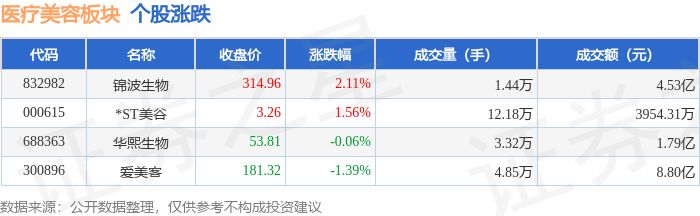
Market Overview - The medical beauty sector experienced a decline of 0.76% on August 19, with Ai Meike leading the drop [1] - The Shanghai Composite Index closed at 3727.29, down 0.02%, while the Shenzhen Component Index closed at 11821.63, down 0.12% [1] Stock Performance - Jinbo Biological (832982) closed at 314.96, up 2.11% with a trading volume of 14,400 shares and a transaction value of 45.3 million yuan [1] - ST Meigu (000615) closed at 3.26, up 1.56% with a trading volume of 121,800 shares and a transaction value of 39.54 million yuan [1] - Huaxi Biological (688363) closed at 53.81, down 0.06% with a trading volume of 33,200 shares and a transaction value of 179 million yuan [1] - Ai Meike (300896) closed at 181.32, down 1.39% with a trading volume of 48,500 shares and a transaction value of 880 million yuan [1] Capital Flow - The medical beauty sector saw a net outflow of 7.63 million yuan from main funds, while retail funds experienced a net outflow of 1.21 million yuan [1] - There was a net inflow of 8.84 million yuan from speculative funds [1] Detailed Capital Flow Analysis - Huaxi Biological (688363) had a main fund net inflow of 10.79 million yuan, but a net outflow of 4.39 million yuan from speculative funds and a net outflow of 6.40 million yuan from retail funds [2] - ST Meigu (000615) recorded a main fund net inflow of 4.16 million yuan, with net outflows of 1.85 million yuan from speculative funds and 2.31 million yuan from retail funds [2] - Ai Meike (300896) experienced a significant main fund net outflow of 22.58 million yuan, while speculative funds had a net inflow of 15.08 million yuan and retail funds saw a net inflow of 7.50 million yuan [2]
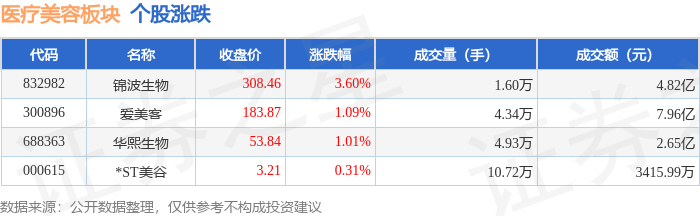
医疗美容板块8月18日涨1.03%,锦波生物领涨,主力资金净流出781.13万元
Zheng Xing Xing Ye Ri Bao· 2025-08-18 08:45
Market Performance - The medical beauty sector increased by 1.03% on August 18, with Jinbo Biological leading the gains [1] - The Shanghai Composite Index closed at 3728.03, up 0.85%, while the Shenzhen Component Index closed at 11835.57, up 1.73% [1] Individual Stock Performance - Jinbo Biological (832982) closed at 308.46, with a rise of 3.60% and a trading volume of 16,000 shares [1] - Aimeike (300896) closed at 183.87, up 1.09% with a trading volume of 43,400 shares [1] - Huaxi Biological (688363) closed at 53.84, increasing by 1.01% with a trading volume of 49,300 shares [1] - *ST Meigu (000615) closed at 3.21, up 0.31% with a trading volume of 107,200 shares [1] Capital Flow Analysis - The medical beauty sector experienced a net outflow of 7.81 million yuan from main funds, while retail funds saw a net outflow of 22.98 million yuan [1] - Speculative funds had a net inflow of 30.79 million yuan [1] Detailed Capital Flow for Individual Stocks - Aimeike (300896) had a main fund net inflow of 15.99 million yuan, with a retail net outflow of 34.19 million yuan [2] - *ST Meigu (000615) saw a main fund net inflow of 0.25 million yuan, with a retail net outflow of 1.13 million yuan [2] - Huaxi Biological (688363) experienced a main fund net outflow of 24.06 million yuan, while retail funds had a net inflow of 1.23 million yuan [2]