InventisBio (688382)

Search documents
创新药企透露行业发展新动向
Zhong Guo Zheng Quan Bao· 2025-11-06 20:15
Core Viewpoint - The Chinese innovative drug market is entering a rapid development phase, with local leading companies like Heng Rui benefiting from policy support and industry expansion opportunities [1] Company Performance - Heng Rui Pharmaceutical reported a revenue of 23.188 billion yuan for the first three quarters of 2025, a year-on-year increase of 14.85%, and a net profit of 5.751 billion yuan, up 24.50% [2] - The company has received a total cash dividend of over 9.3 billion yuan, enhancing investor returns [1] - The company has established a differentiated competitive advantage through over 50 billion yuan in R&D investment and has 24 innovative drugs approved for sale in China [1] Industry Trends - The innovative drug sector is experiencing accelerated commercialization and increased business development (BD) transactions, leading to a sustained trend of rapid growth in performance [1] - Other innovative drug companies, such as Zai Lab and DiZhe Pharmaceutical, are also reporting significant revenue growth, with Zai Lab achieving a 54.49% increase in revenue to 593 million yuan [3] - The industry is expected to continue its growth trajectory, supported by favorable national policies and increasing international collaboration [4][5] R&D Focus - Heng Rui's innovative drugs, including Rivoceranib and Darsylis, are addressing unmet clinical needs, contributing to their revenue growth [2] - Zai Lab emphasizes its differentiated product pipeline focusing on oncology and autoimmune diseases, aiming to fill domestic gaps in treatment options [3] - The industry is witnessing a rise in R&D investments, with companies like Yi Fang Bio reporting a total R&D investment of 190 million yuan for the first three quarters of 2025 [4] Future Outlook - Analysts predict a new round of growth for the pharmaceutical sector, particularly in innovative drugs, as the international standing of Chinese innovative drug companies rises [5] - The innovative drug sector is expected to remain a key investment theme in the pharmaceutical industry through 2026, driven by increased BD transactions and international collaborations [5]



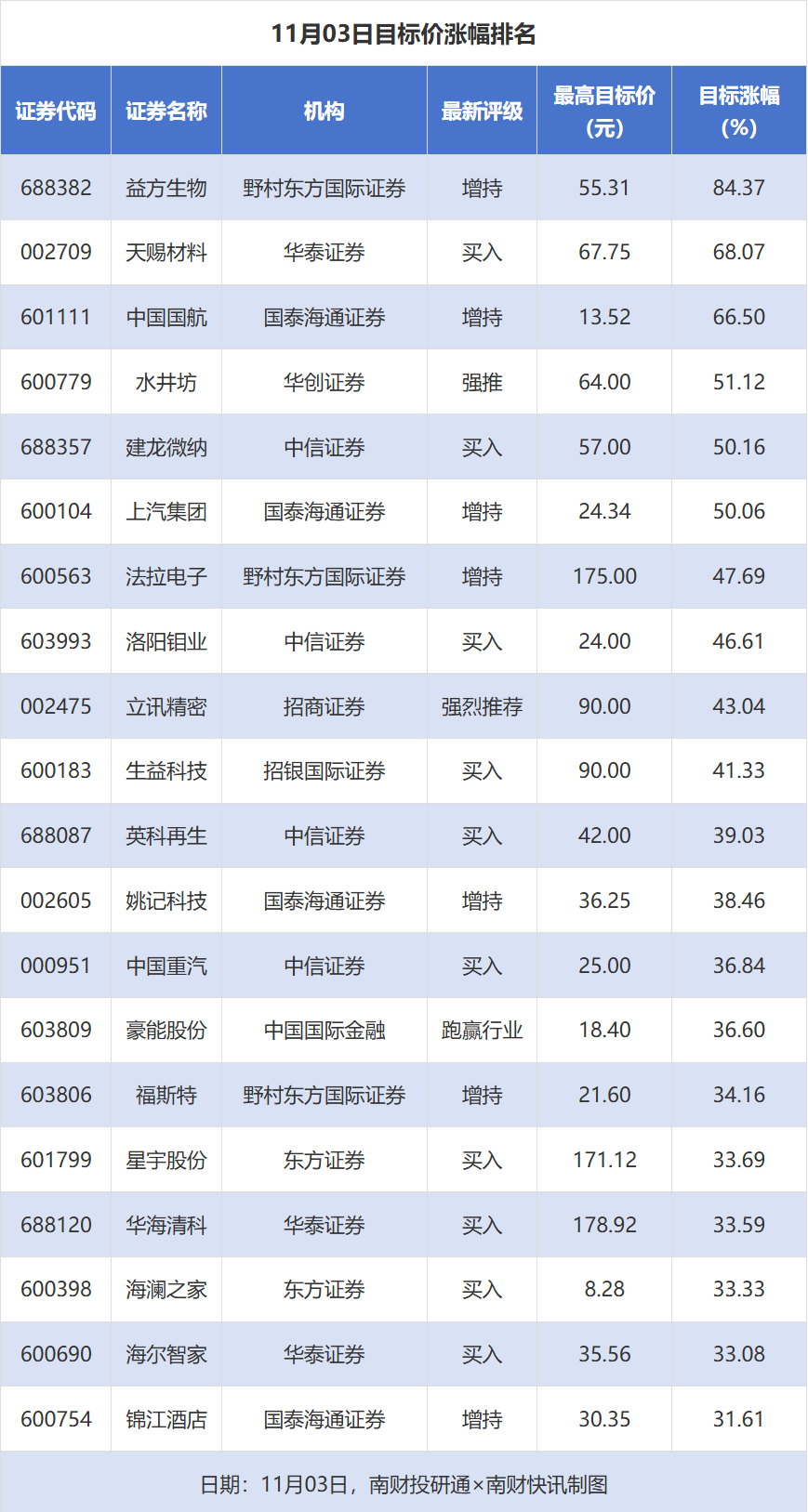
益方生物目标价涨幅超84%,口子窖、舍得酒业评级被调低
2 1 Shi Ji Jing Ji Bao Dao· 2025-11-05 12:10
Core Viewpoint - On November 3, various brokerage firms provided target price recommendations for listed companies, highlighting significant potential price increases for certain stocks, particularly in the chemical, battery, and aviation sectors [2][3]. Group 1: Target Price Increases - Yifang Bio (688382) has a target price increase of 84.37%, rated as "Buy" by Nomura Orient International Securities [2][3]. - Tianci Materials (002709) has a target price increase of 68.07%, rated as "Buy" by Huatai Securities [2][3]. - China National Aviation (601111) has a target price increase of 66.50%, rated as "Buy" by Guotai Haitong Securities [2][3]. Group 2: Brokerage Recommendations - A total of 231 listed companies received brokerage recommendations on November 3, with Zhongji Xuchuang (300308) receiving 4 recommendations, Xugong Machinery (000425) receiving 3, and Zhou Dasheng (002867) also receiving 3 [4][5]. - The companies with the highest number of brokerage recommendations include Zhongji Xuchuang (300308), Xugong Machinery (000425), and Zhou Dasheng (002867) [4][5]. Group 3: Rating Adjustments - Two companies had their ratings upgraded: Guanggang Gas (688548) from "Hold" to "Outperform" by Guosen Securities, and Jianlong Micro-Nano (688357) from "Hold" to "Buy" by CITIC Securities [6][7]. - Four companies had their ratings downgraded, including Kuozi Jiao (603589) and Shede Liquor (600702), both downgraded from "Buy" to "Hold" by CITIC Securities [6][7]. Group 4: First Coverage - On November 3, four companies received initial coverage, including Ocean Electric (002249) rated "Hold" by Industrial Securities, and Asia-Pacific Co. (002284) rated "Hold" by Shanxi Securities [8][9]. - Other companies receiving initial coverage include Baolong Technology (603197) rated "Buy" by Aijian Securities and Rongtai Co. (605133) rated "Buy" by Guosheng Securities [8][9].




大药的诞生,才是医药的未来
Haitong Securities International· 2025-11-05 07:29
Core Insights - The pharmaceutical industry is experiencing a structural change driven by the growth cycles of major products, with significant opportunities emerging in innovative drugs, medical devices, and consumer healthcare [3][6][31] - The demand for pharmaceuticals is expected to improve in 2026, supported by policies encouraging innovation and a recovery in domestic consumption [3][7] - The supply side of the pharmaceutical industry is characterized by high entry barriers due to patent protections and government regulations, which helps maintain a stable competitive environment [4][5] Group 1: Industry Trends - The aging population, urbanization, and changing disease patterns are making the pharmaceutical industry a perpetual growth sector [3] - The global pharmaceutical market has seen rapid expansion from 2009 to 2019, followed by a surge in demand due to COVID-19, and is now entering a phase of recovery and growth [3][6] - The Chinese pharmaceutical industry is expected to gradually produce world-class companies, with increasing recognition of Chinese innovative drug assets by multinational corporations (MNCs) [4][5] Group 2: Investment Opportunities - Opportunities in innovative drugs are highlighted, particularly in oncology, metabolic diseases, and autoimmune diseases, with a focus on next-generation therapies and precision medicine [6][31] - The demand for innovative drugs is expected to remain strong, with policies improving medical insurance payments and the upcoming launch of commercial insurance drug catalogs [7][31] - The medical device sector is anticipated to recover, with a focus on domestic demand and international expansion, particularly in areas with low domestic production rates [7][8] Group 3: Company Performance - Major pharmaceutical companies like Eli Lilly, AbbVie, and AstraZeneca are experiencing significant growth driven by key products, with Eli Lilly's Tirzepatide generating $24.8 billion in sales [12][15] - The report identifies specific companies such as Hengrui Medicine, Hansoh Pharmaceutical, and BeiGene as outperformers in the market, with strong pipelines and global competitiveness [7][8] - The report emphasizes the importance of mergers and acquisitions (M&A) and business development (BD) strategies for MNCs, with China becoming a significant source of projects for top global pharmaceutical companies [22][24]



益方生物跌2.05%,成交额1.02亿元,主力资金净流入1082.89万元
Xin Lang Cai Jing· 2025-11-05 02:21
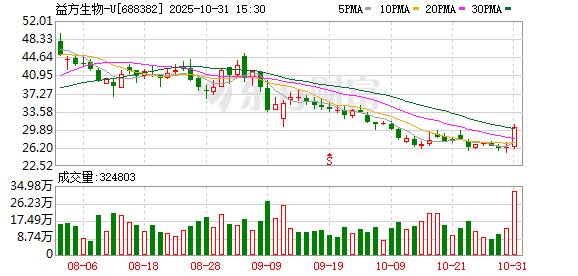
Core Viewpoint - Yifang Bio's stock price has shown significant volatility, with a year-to-date increase of 112.18%, but a recent decline over the past 60 days of 34.68% [1][2] Group 1: Stock Performance - As of November 5, Yifang Bio's stock price was 28.22 CNY per share, with a market capitalization of 16.32 billion CNY [1] - The stock experienced a 2.05% decline during the trading session on November 5, with a trading volume of 1.02 billion CNY and a turnover rate of 0.85% [1] - The stock has been on the "龙虎榜" (a trading list for stocks with significant trading activity) four times this year, with the most recent appearance on October 31, where it recorded a net buy of -39.28 million CNY [1] Group 2: Financial Performance - For the period from January to September 2025, Yifang Bio reported a revenue of 30.89 million CNY, representing a year-on-year growth of 61.27% [2] - The company recorded a net profit attributable to shareholders of -181 million CNY, which is a 40.59% increase compared to the previous year [2] Group 3: Shareholder Information - As of September 30, 2025, Yifang Bio had 12,400 shareholders, an increase of 26.17% from the previous period [2] - The largest shareholder is Hong Kong Central Clearing Limited, holding 16.22 million shares, an increase of 8.16 million shares from the previous period [2] - New entrants among the top ten shareholders include Ping An Medical Health Mixed A and Yongying Medical Innovation Selected Mixed A [2]
大药的诞生,才是医药的未来:医药行业2026年年度策略
Haitong Securities· 2025-11-05 02:03
Core Insights - The pharmaceutical industry is positioned as a perennial growth sector due to aging populations, urbanization, and changing disease profiles, with a strong recovery expected in 2025 after a downturn from 2022 to 2024, driven by both innovative drugs and medical devices [2][3] - Demand and supply dynamics will remain central to the pharmaceutical industry's research, with innovation cycles and policy adjustments influencing demand growth [2][3] - The supply side is characterized by limited supply and high entry barriers, with increasing participation of Chinese companies in international competition, leading to the emergence of world-class enterprises in the pharmaceutical sector [3][4] Industry Overview - The pharmaceutical industry is expected to see significant growth in 2025, driven by a resurgence in demand for innovative drugs and a recovery in domestic medical device needs, alongside strong external demand [2] - The demand for pharmaceuticals typically fluctuates with innovation and policy cycles, with a notable increase in overseas business development (BD) opportunities anticipated in 2025 [2][5] - The Chinese pharmaceutical sector is increasingly recognized globally, with local companies making strides in various niche markets [3][4] Investment Opportunities - Opportunities in innovative drugs are highlighted, particularly in oncology, metabolic diseases, and autoimmune diseases, with a focus on next-generation therapies and precision medicine [5][29] - The report emphasizes the importance of understanding the supply-demand structure and industry upgrades when conducting detailed research on specific segments within the pharmaceutical industry [4][5] - The report identifies key players and segments for investment, including CXO services, medical devices, and consumer healthcare, with specific companies recommended for increased holdings [6][5] Market Dynamics - The report outlines the competitive landscape among top global pharmaceutical companies, noting significant changes in rankings due to the performance of key products [11][19] - Chinese companies are becoming a major source of projects for multinational corporations (MNCs), with increasing transaction volumes and values in recent years [19][21] - The report discusses the strategic focus of MNCs on acquiring innovative assets and technologies to strengthen their market positions, particularly in oncology and metabolic disease sectors [12][18] Future Trends - The report anticipates breakthroughs in various therapeutic areas, including oncology, metabolic diseases, and autoimmune diseases, with a focus on innovative treatment modalities such as TCE and in vivo CAR-T [29][30] - The small nucleic acid field is expected to accelerate, with significant advancements anticipated in 2026 across multiple indications [29][30] - The report highlights the importance of collaboration and co-development models as a means for Chinese companies to enhance their global competitiveness [25][28]
创新药概念股走低,科创创新药ETF跌超3%
Mei Ri Jing Ji Xin Wen· 2025-11-04 05:58
Group 1 - The core viewpoint of the articles indicates a decline in innovative drug concept stocks, with companies like BaiLi Tianheng, AiLiSi, and BoRui Pharmaceutical dropping over 4%, while BeiGene-U, TeBao Bio, and YiFang Bio-U fell over 3% [1][2] - The ChiNext innovative drug ETF has also seen a decline, dropping more than 3% [1] - Despite the stock declines, the biotechnology sector in China is experiencing positive developments, with 35 research projects from multiple innovative drug companies selected for oral presentations at the ESMO 2025 conference, setting a new record [2] Group 2 - Significant collaborations are emerging in the industry, such as the partnership between Innovent Biologics and Takeda, which has a total scale of up to $11.4 billion, reflecting global market recognition of the value of Chinese innovative drugs [2]




科技承压下的资金新选择,创新药开启上涨新周期?
Ge Long Hui· 2025-11-01 09:54
Core Viewpoint - The technology sector experienced significant declines, prompting a structural shift in market funds towards the innovative drug sector, which saw notable gains on the same day [1][3]. Group 1: Market Performance - The innovative drug sector rose by 3.91% amidst a downturn in the technology sector, successfully breaking through the 20-day moving average with increased trading volume, signaling positive market sentiment [3]. - The innovative drug sector had been in a downward trend since August but began to stabilize and form a bottom pattern in October [3]. Group 2: Multiple Sclerosis (MS) Market - The global market for MS drugs is projected to reach approximately $18.5 billion in 2024, with a significant portion of sales coming from third-generation products, particularly CD20 monoclonal antibodies [6]. - CD20 monoclonal antibodies are expected to account for over 60% of the MS drug sales in 2024, with the drug Ocrelizumab projected to generate sales of 7.64 billion yuan, reflecting a year-on-year growth of 7.4% [6]. Group 3: Chemical Pharmaceutical Industry - The global chemical pharmaceutical market grew from $1,038 billion in 2019 to $1,128 billion in 2023, with expectations to reach $1,156 billion in 2024 [10]. - In China, the chemical pharmaceutical market size was 883.9 billion yuan in 2022, with a year-on-year growth of 4.4%, projected to increase to 945 billion yuan by 2024 [10]. Group 4: Innovative Drug Sector Performance - In the first half of 2025, 21 A-share innovative drug companies reported revenues of 28.69 billion yuan, a year-on-year increase of 42%, while net losses narrowed significantly [11]. - The second quarter of 2025 saw these companies achieve revenues of 15.34 billion yuan, a 39% increase year-on-year, with net losses reduced by 97% [11][12]. Group 5: Future Outlook - Continued policy support for innovative drugs is expected to enhance performance, with an increase in product launches anticipated to drive revenue growth [15]. - The active business development (BD) transactions in the innovative drug sector in the first half of 2025 are expected to bolster the apparent performance of related companies [15].


益方生物10月31日龙虎榜数据
Zheng Quan Shi Bao Wang· 2025-10-31 14:51
Group 1 - The stock of Yifang Bio (688382) closed at 30.30 yuan on October 31, with a significant increase of 15.30%, a turnover rate of 7.78%, and a trading range of 19.85%, resulting in a total transaction amount of 9.45 billion yuan [2] - The stock was listed on the daily trading list due to its closing price increase of 15% [2] - The top five trading departments accounted for a total transaction amount of 5.99 billion yuan, with a net selling amount of 39.28 million yuan [2] Group 2 - Among the top five buying departments, three were institutional special seats, with buying amounts of 56.61 million yuan, 42.92 million yuan, and 37.72 million yuan respectively, while the first major buying department was the Shanghai-Hong Kong Stock Connect with a buying amount of 116.13 million yuan [2] - The selling departments included one institutional special seat with a selling amount of 50.02 million yuan, and the first major selling department was also the Shanghai-Hong Kong Stock Connect with a selling amount of 169.41 million yuan [2] - The net inflow of main funds for the stock was 87.46 million yuan for the day [3]
数据看盘多家机构激烈博弈医药股 量化、一线游资合力抢筹大众公用
Sou Hu Cai Jing· 2025-10-31 11:40
Summary of Key Points Core Viewpoint - The trading volume of the Shanghai and Shenzhen Stock Connect reached a total of 284.26 billion, with significant activity in specific stocks and sectors, indicating a dynamic market environment [1]. Group 1: Trading Volume and Key Stocks - The total trading amount for the Shanghai Stock Connect was 139.75 billion, while the Shenzhen Stock Connect was 144.51 billion [2]. - The top traded stocks in the Shanghai Stock Connect included Industrial Fulian (28.60 billion), Huaiwu Technology (14.93 billion), and Zhaoyi Innovation (14.00 billion) [3]. - In the Shenzhen Stock Connect, the leading stocks were Zhongji Xuchuang (50.82 billion), Sunshine Power (34.72 billion), and CATL (33.95 billion) [3]. Group 2: Sector Performance - The cultural media sector saw the highest net inflow of funds, amounting to 4.53 billion, while the electronic sector experienced the largest outflow, totaling -30.56 billion [5][6]. - Other sectors with notable inflows included pharmaceutical and AI applications, while insurance and storage chips faced declines [4]. Group 3: ETF Trading Activity - The Hong Kong Innovative Drug ETF (159567) saw a remarkable trading volume increase of 226% compared to the previous trading day, reaching 33.27 billion [11]. - The top ETFs by trading volume included the Hong Kong Securities ETF (150.19 billion) and the Hong Kong Innovative Drug ETF (132.22 billion) [9][10]. Group 4: Futures Positioning - In the futures market, all major contracts (IH, IF, IC, IM) saw a reduction in both long and short positions, with the IM contract showing the largest decrease in long positions [12]. Group 5: Institutional and Retail Activity - Institutional activity was high, with notable purchases in stocks like Zexin Pharmaceutical (2.65 billion) and Shutaishen (2.29 billion), while significant sell-offs were observed in stocks like Industrial Fulian (-32.25 billion) [13][14]. - Retail investors showed strong interest in Dazhong Public Utilities, which hit the daily limit, attracting substantial buying from prominent retail funds [16].




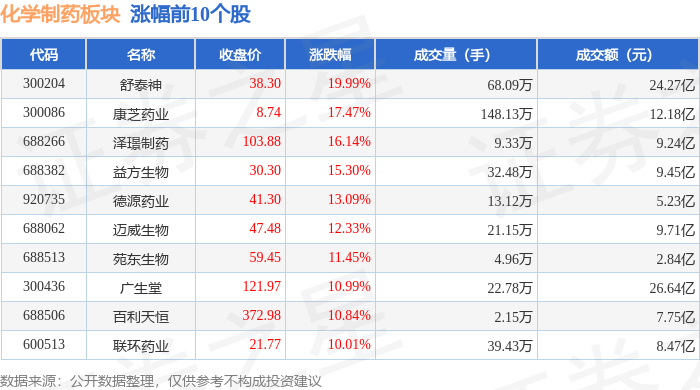
化学制药板块10月31日涨3.77%,舒泰神领涨,主力资金净流入27.85亿元
Zheng Xing Xing Ye Ri Bao· 2025-10-31 08:42
Core Insights - The chemical pharmaceutical sector experienced a significant increase of 3.77% on October 31, with Shutaishen leading the gains [1] - In contrast, the Shanghai Composite Index closed at 3954.79, down 0.81%, and the Shenzhen Component Index closed at 13378.21, down 1.14% [1] Stock Performance - Notable gainers in the chemical pharmaceutical sector included: - Shutaishen (300204) with a closing price of 38.30, up 19.99% on a trading volume of 680,900 shares [1] - Kangla Pharmaceutical (300086) closed at 8.74, up 17.47% with a trading volume of 1,481,300 shares [1] - Zema Pharmaceutical (688266) closed at 103.88, up 16.14% on a trading volume of 93,300 shares [1] - Other significant performers included Yifang Bio (688382) up 15.30%, and Deyuan Pharmaceutical (920735) up 13.09% [1] Capital Flow - The chemical pharmaceutical sector saw a net inflow of 2.785 billion yuan from institutional investors, while retail investors experienced a net outflow of 974 million yuan [2] - The main stocks with significant capital inflow included: - Shutaishen with a net inflow of 472 million yuan, accounting for 19.44% of its trading volume [3] - Lianhuan Pharmaceutical (600513) with a net inflow of 338 million yuan, representing 39.88% of its trading volume [3] - Guangshengtang (300436) with a net inflow of 303 million yuan, making up 11.37% of its trading volume [3]