
InventisBio (688382)

Search documents
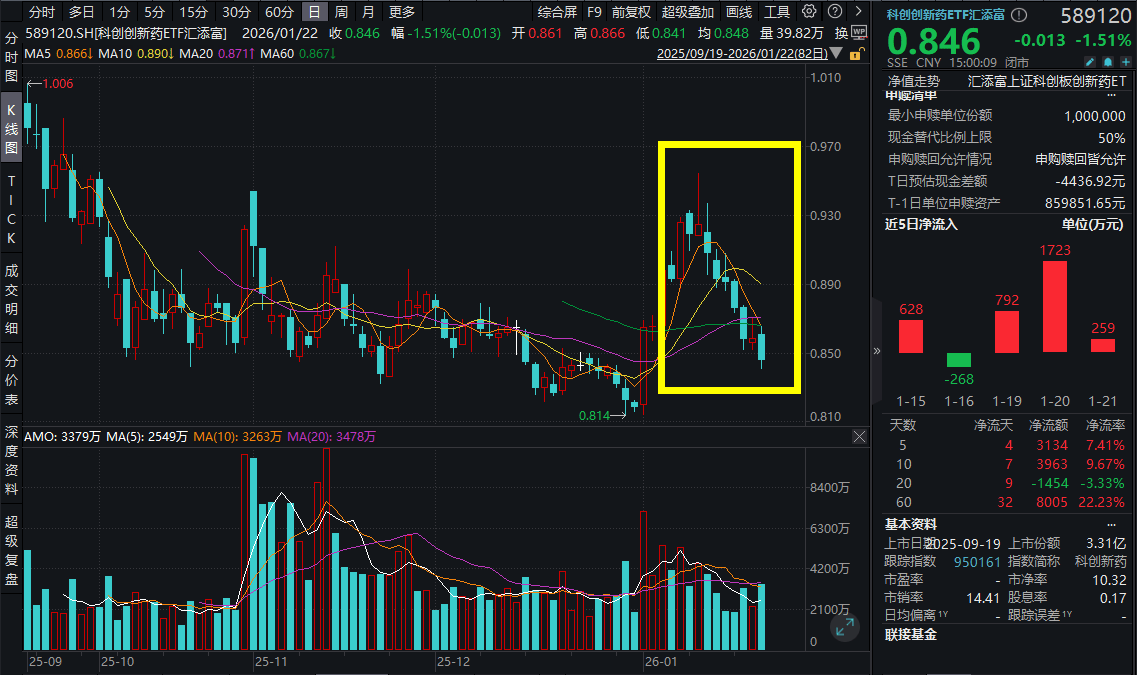
创新药继续承压,益方生物跌超6%,科创创新药ETF汇添富(589120)跌1.5%,连续3日吸金近2800万元,资金逢跌坚定增仓!什么信号?
Sou Hu Cai Jing· 2026-01-22 08:38
Core Viewpoint - The A-share market experienced fluctuations on January 22, with the Shanghai Composite Index rising by 0.14%. The innovative drug sector faced pressure, as evidenced by the decline of the Science and Technology Innovation Drug ETF Huatai (589120) by 1.51% by 15:00. However, the ETF saw a net inflow of funds totaling 27.7361 million yuan over the past three days, indicating a trend of buying on dips [1]. Group 1: Market Performance - The Science and Technology Innovation Drug ETF Huatai (589120) recorded a net inflow of 27.7361 million yuan over three days, showing a clear trend of increased buying despite market declines [1]. - By 15:00, the ETF's component stocks exhibited mixed performance, with notable gains from Kangxinuo at 1.81%, Baiaotai at 0.49%, and Haoyuan Pharmaceutical at 0.48%. Conversely, Yifang Bio fell over 6%, Rongchang Bio dropped over 4%, and Baili Tianheng decreased by over 3% [6]. Group 2: Industry Insights - According to the National Medical Insurance Administration, 76 innovative drugs are expected to be approved for market entry by the National Medical Products Administration by 2025, marking a record high and indicating a trend towards diversified innovative therapies in China [4]. - Donghai Securities predicts that the innovative drug sector is entering a new era, transitioning from a generics-dominated market (pre-2018) to a period of transformation (2018-2025) characterized by price reductions and increased R&D investments in innovative drugs. By 2026, innovative drugs are expected to dominate the pharmaceutical industry in China, supported by complementary insurance policies and a focus on the pace of new drug launches and competitive dynamics [5].




医保执行价腰斩超半,KRAS G12C抑制剂市场开启“贴身肉搏战”
3 6 Ke· 2026-01-22 07:37
Core Insights - The introduction of new pricing for lung cancer drugs, particularly the KRAS G12C inhibitors, has significantly reduced costs for patients, with prices dropping by nearly 70% for some medications [2][4][7] - The 2025 medical insurance directory includes 50 innovative drugs, with nearly half being cancer treatments, highlighting a focus on unmet clinical needs [2] - The competitive landscape for KRAS G12C inhibitors is intensifying, with companies now competing on clinical efficacy and commercial execution rather than just pricing [5][7][8] Pricing and Market Impact - The price of Fluorouracil has decreased from approximately 24,900 yuan to 5,790.4 yuan per box, resulting in a 68.87% reduction [7] - Patients previously faced annual treatment costs of 223,200 yuan, which can now be reduced to approximately 20,845.44 yuan after insurance reimbursement, saving over 200,000 yuan annually [4] - The entry of these drugs into the insurance system is expected to reshape market dynamics and increase competition among pharmaceutical companies [4][8] Competitive Landscape - The KRAS G12C inhibitors market is characterized by three main products: Fluorouracil, Goresir, and Gexoriser, all approved for similar indications, creating a "three-legged" competitive structure [6] - The market for KRAS G12C inhibitors is not overly saturated, with the mutation occurring in about 14% of non-small cell lung cancer cases, and approximately 4.3% in the Chinese population [6] - Companies are focusing on differentiating their products through clinical evidence and effective management of side effects to establish a preferred choice among doctors and patients [7][8] Future Directions - Companies are exploring combination therapies and expanding indications beyond non-small cell lung cancer to other cancers like colorectal and pancreatic cancer, which may significantly increase market potential [13] - The focus on overcoming drug resistance and enhancing efficacy through partnerships and global market strategies is seen as essential for long-term success [13] - The competitive focus is shifting towards who can provide better clinical outcomes and safety profiles, indicating a new phase in the market dynamics for KRAS G12C inhibitors [7][8]
益方生物股价跌5.01%,天治基金旗下1只基金重仓,持有2.28万股浮亏损失3.14万元
Xin Lang Cai Jing· 2026-01-22 05:32
Group 1 - Yifang Biotechnology's stock price fell by 5.01% on January 22, closing at 26.15 CNY per share, with a trading volume of 266 million CNY and a turnover rate of 2.38%, resulting in a total market capitalization of 15.124 billion CNY [1] - The stock has experienced a continuous decline over three days, with a cumulative drop of 8.66% during this period [1] - Yifang Biotechnology, established on January 11, 2013, and listed on July 25, 2022, focuses on the research, production, and sales of innovative drugs, with its main revenue derived entirely from technology licensing and cooperation [1] Group 2 - Tianzhi Fund holds a significant position in Yifang Biotechnology through its Tianzhi New Consumption Mixed Fund (350008), which has maintained a holding of 22,800 shares, accounting for 4.49% of the fund's net value, ranking as the ninth largest holding [2] - The fund has incurred a floating loss of approximately 31,400 CNY today, with a total floating loss of 59,400 CNY during the three-day decline [2] - Tianzhi New Consumption Mixed Fund was established on August 4, 2011, with a current scale of 19.07 million CNY, achieving a year-to-date return of 11.21% and a one-year return of 8.1% [2]
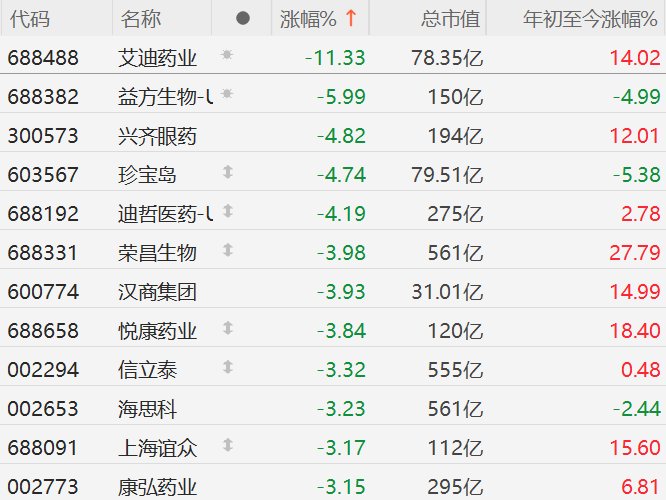
A股创新药概念股普跌,艾迪药业跌超11%
Ge Long Hui A P P· 2026-01-22 05:31
Group 1 - The A-share market saw a significant decline in innovative drug concept stocks, with notable drops including Aidi Pharmaceutical down over 11% and Yifang Bio down over 5% [1] - Other companies such as Xingqi Pharmaceutical, Zhenbaodao, and Dize Pharmaceutical experienced declines of over 4%, while Rongchang Bio, Hanshang Group, Yuekang Pharmaceutical, Xinlitai, Haishike, Shanghai Yizhong, and Kanghong Pharmaceutical fell by over 3% [1] Group 2 - Aidi Pharmaceutical (688488) reported a decline of 11.33%, with a total market value of 7.835 billion and a year-to-date increase of 14.02% [2] - Yifang Bio (688382) decreased by 5.99%, with a market capitalization of 15 billion and a year-to-date decline of 4.99% [2] - Xingqi Pharmaceutical (300573) fell by 4.82%, with a market value of 19.4 billion and a year-to-date increase of 12.01% [2] - Zhenbaodao (603567) dropped by 4.74%, with a market capitalization of 7.951 billion and a year-to-date decline of 5.38% [2] - Dize Pharmaceutical (688192) decreased by 4.19%, with a market value of 27.5 billion and a year-to-date increase of 2.78% [2] - Rongchang Bio (688331) fell by 3.98%, with a market capitalization of 56.1 billion and a year-to-date increase of 27.79% [2] - Hanshang Group (600774) decreased by 3.93%, with a market value of 3.101 billion and a year-to-date increase of 14.99% [2] - Yuekang Pharmaceutical (688658) dropped by 3.84%, with a market capitalization of 12 billion and a year-to-date increase of 18.40% [2] - Xinlitai (002294) fell by 3.32%, with a market value of 55.5 billion and a year-to-date increase of 0.48% [2] - Haishike (002653) decreased by 3.23%, with a market capitalization of 56.1 billion and a year-to-date decline of 2.44% [2] - Shanghai Yizhong (688091) dropped by 3.17%, with a market value of 11.2 billion and a year-to-date increase of 15.60% [2] - Kanghong Pharmaceutical (002773) fell by 3.15%, with a market capitalization of 29.5 billion and a year-to-date increase of 6.81% [2]



益方生物股价跌5.01%,中欧基金旗下1只基金位居十大流通股东,持有814.77万股浮亏损失1124.38万元
Xin Lang Cai Jing· 2026-01-22 05:31
Core Viewpoint - Yifang Biotechnology's stock has experienced a decline of 5.01% on January 22, with a total market value of 15.124 billion yuan and a cumulative drop of 8.66% over three consecutive days [1] Group 1: Company Overview - Yifang Biotechnology (Shanghai) Co., Ltd. was established on January 11, 2013, and went public on July 25, 2022 [1] - The company's main business involves the research, production, and sales of innovative drugs, with 100% of its revenue derived from technology licensing and cooperation [1] Group 2: Shareholder Information - Among the top ten circulating shareholders, a fund under China Europe Fund, the China Europe Medical Health Mixed A (003095), reduced its holdings by 944,700 shares, now holding 8.1477 million shares, which is 1.95% of the circulating shares [2] - The estimated floating loss for the fund today is approximately 11.2438 million yuan, with a total floating loss of 21.2655 million yuan over the three-day decline [2] Group 3: Fund Performance - The China Europe Medical Health Mixed A (003095) fund has a total asset size of 13.843 billion yuan, with a year-to-date return of 4.64% and a one-year return of 21.99% [2] - The fund manager, Ge Lan, has a tenure of 10 years and 362 days, with the best return during this period being 106.94% [3] Group 4: Fund Holdings - The China Europe National Index 2000 Enhanced A (018663) fund holds 10,000 shares of Yifang Biotechnology, unchanged from the previous period, representing 0.29% of the fund's net value [4] - The estimated floating loss for this fund today is about 13,800 yuan, with a total floating loss of 26,100 yuan over the three-day decline [4] Group 5: Additional Fund Manager Information - The fund manager for China Europe National Index 2000 Enhanced A (018663), Qian Yating, has a tenure of 4 years and 82 days, with the best return during this period being 85.19% [5]
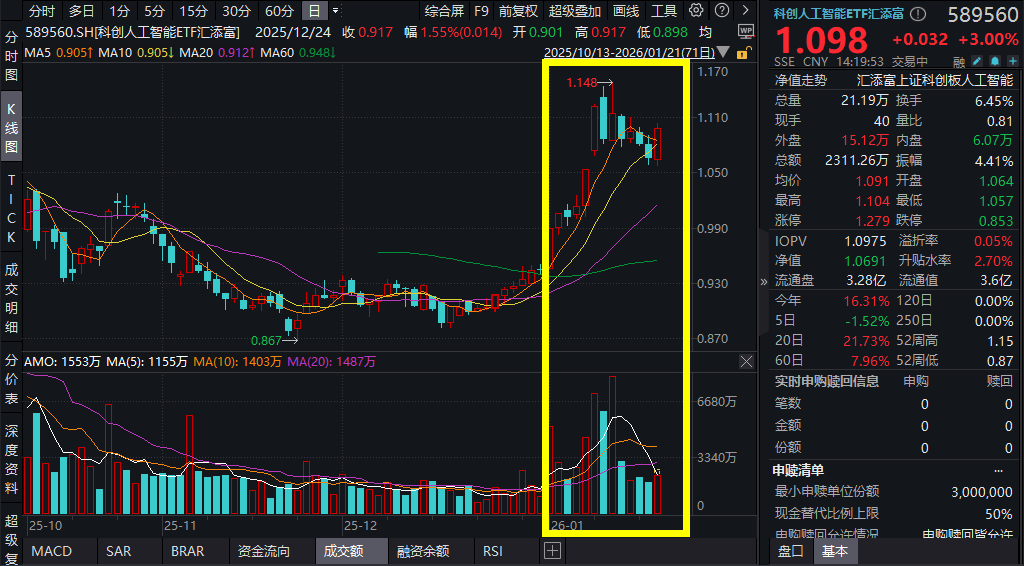
DeepSeek新模型曝光!AI主线强势回归!澜起科技领涨超10%,科创人工智能ETF汇添富(589560)涨超3%,AI应用成开年主线,后续催化怎么看?
Sou Hu Cai Jing· 2026-01-21 06:54
Group 1: AI Model Developments - DeepSeek's new model "MODEL1" is reported to be an efficient inference model with lower memory usage, suitable for edge devices and cost-sensitive scenarios, and optimized for long sequence tasks [1] - DeepSeek is expected to launch its next-generation flagship AI model, DeepSeek V4, during the Lunar New Year in mid-February, which is anticipated to significantly enhance code capabilities and potentially surpass leading products like GPT and Claude [1][2] Group 2: AI Industry Growth in China - China's intelligent computing power has reached 1590 EFLOPS, with a rapid emergence of high-quality industry data sets, positioning domestic large models to lead the global open-source ecosystem [3] - By 2025, the number of AI companies in China is projected to exceed 6000, with the core industry scale expected to surpass 1.2 trillion RMB [3] Group 3: AI Sector Investment Insights - The AI industry can be divided into three main segments: foundational layer (hardware computing power), technical layer (large models and algorithm frameworks), and application layer (vertical solutions across industries) [4] - The technical layer is expected to see significant demand and policy support, particularly in semiconductor fields, driven by capital expenditure from the foundational layer and domestic substitution strategies [5] Group 4: Market Performance and Trends - The AI application sector has become a primary focus for investment at the start of 2026, with a year-to-date increase of 19%, leading the A-share market [7] - The CES 2026 event provided insights into the future direction of AI applications, with hardware increasingly penetrating daily life through various forms, including smart glasses and wearable devices [7]


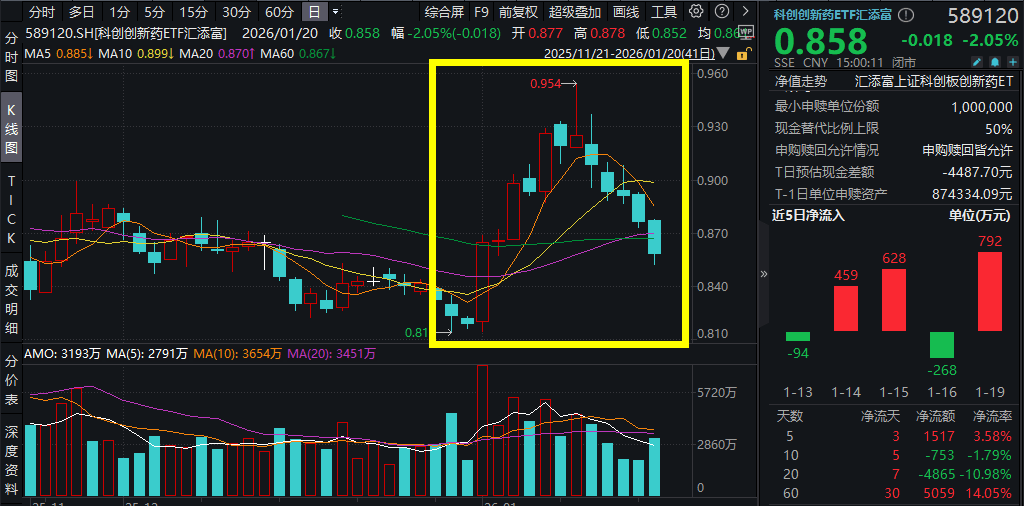
创新药板块承压,益方生物等跌超3%,科创创新药ETF汇添富(589120)跌超2%,资金逆势涌入!"全球创新药春晚"JPM召开,中国创新药闪耀全球
Sou Hu Cai Jing· 2026-01-20 11:33
Core Viewpoint - The A-share market is experiencing fluctuations, particularly affecting the innovative drug sector, with the ETF Huatai Innovation Drug (589120) declining by 2.05% and facing a five-day losing streak, despite attracting over 7.9 million yuan in funds [1][3]. Group 1: Market Performance - The Huatai Innovation Drug ETF (589120) has seen a decline in its constituent stocks, with major players like I-Mab and Junshi Biosciences dropping over 3%, and others like BeiGene and Zai Lab falling more than 2% [3]. - The top ten constituent stocks of the ETF show a negative trend, with BeiGene-U down by 2.38% and Junshi Biosciences-U down by 3.42%, indicating a general downturn in the sector [3]. Group 2: Long-term Outlook - Despite the short-term market pressure, the long-term outlook for the innovative drug sector remains positive, with expectations of a clear beta market driven by liquidity recovery at the beginning of the year [4]. - The JPM conference highlighted the achievements of over 20 Chinese pharmaceutical companies, with projections for significant revenue growth in innovative drugs, such as a 25% increase for Heng Rui in 2026 [4]. Group 3: Business Development (BD) Trends - The BD activities in the sector are at a peak, with 17 transactions occurring since January, totaling approximately 10.15 billion USD in upfront payments, significantly exceeding market expectations [5]. - The ongoing trend of foreign companies expanding in China and the increasing flow of funds into the innovative drug sector suggest a favorable environment for growth and investment [5]. Group 4: Investment Strategy - The innovative drug sector is recommended for increased allocation, particularly in Hong Kong stocks, as the market is currently at a relative bottom, with potential for new historical highs [5]. - The ETF focuses on leading innovative drug companies, providing a high degree of exposure to the opportunities presented by the rise of Chinese innovative drugs [5].
益方生物(688382) - 益方生物首次公开发行部分限售股上市流通公告
2026-01-16 10:47
证券代码:688382 证券简称:益方生物 公告编号:2026-003 本次股票上市类型为首发限售股份;股票认购方式为网下,上市股数为 160,715,196股。 本次股票上市流通总数为160,715,196股。 本次股票上市流通日期为2026 年 1 月 26 日。 益方生物科技(上海)股份有限公司 首次公开发行部分限售股上市流通公告 本公司董事会及全体董事保证本公告内容不存在任何虚假记载、误导性陈述 或者重大遗漏,并对其内容的真实性、准确性和完整性依法承担法律责任。 重要内容提示: 一、本次上市流通的限售股类型 根据中国证券监督管理委员会于 2022 年 4 月 1 日出具的《关于同意益方生物 科技(上海)股份有限公司首次公开发行股票注册的批复》(证监许可〔2022〕682 号),同意益方生物科技(上海)股份有限公司(以下简称"公司")首次公开发 行股票的注册申请。公司首次向社会公众公开发行人民币普通股(A 股)股票 115,000,000 股,并于 2022 年 7 月 25 日在上海证券交易所科创板上市,发行完成 后总股本为 575,000,000 股,其中有限售条件流通股 475,506,983 股 ...
益方生物(688382) - 中信证券股份有限公司关于益方生物科技(上海)股份有限公司首次公开发行部分限售股上市流通的核查意见
2026-01-16 10:46
中信证券股份有限公司 关于益方生物科技(上海)股份有限公司 首次公开发行部分限售股上市流通的核查意见 一、本次上市流通的限售股类型 根据中国证券监督管理委员会于 2022 年 4 月 1 日出具的《关于同意益方生 物科技(上海)股份有限公司首次公开发行股票注册的批复》(证监许可〔2022〕 682 号),同意益方生物科技(上海)股份有限公司(以下简称"公司")首次公 开发行股票的注册申请。公司首次向社会公众公开发行人民币普通股(A 股)股 票 115,000,000 股,并于 2022 年 7 月 25 日在上海证券交易所科创板上市,发行 完成后总股本为 575,000,000 股,其中有限售条件流通股 475,506,983 股,无限售 条件流通股 99,493,017 股。 本次上市流通的限售股为公司首次公开发行部分限售股,限售期为自公司首 次公开发行股票并在科创板上市之日起 42 个月。限售股东 5 名,对应的股份数 量为 160,715,196 股,占公司总股本的比例为 27.79%,具体内容详见公司于 2022 年 8 月 27 日披露于上海证券交易所网站(www.sse.com.cn)及指定媒体的 ...
益方生物:约1.61亿股限售股1月26日解禁
Mei Ri Jing Ji Xin Wen· 2026-01-16 10:43
Group 1 - The company Yifang Bio announced that approximately 161 million restricted shares will be unlocked and listed for circulation on January 26, 2026, accounting for 27.79% of the company's total share capital [1] Group 2 - The silver market has seen a surge of over 80% in the last 50 days, indicating a level of enthusiasm that surpasses that of gold, suggesting that the current situation may signal a peak in the precious metals bull market [1]